

On 14 September 2026 YouTube terminated another group of Belarusian state channels. CTV went down during a live talk show, and three radio channels of the state broadcaster followed: Radyo Stalica, Radio Kultura BY and the First National Channel of Belarusian Radio. State agencies listed those four.
They did not list a fifth one. The channel BELARUS-RTR | Belarus News, which belongs to the CTV group, stopped working on the same day. We had been collecting it for eight months, so there is a record of what it did before it went.
That record is the reason for this piece. The channel is not just another item on the list: it is the outlet that took over after the last removal wave, and its takeover is visible week by week.
April, and the week after
On 3 April YouTube removed BelTA, CTV and ONT, which together held more than six million subscribers. A backup CTV channel appeared at once and lasted five days.
Belarus-RTR did not need to be created, because it already existed and simply grew. In March it published about thirty videos a week. From the week of 6 April the pace rose to between fifty and seventy-three videos a week, and it stayed there until the end of summer.
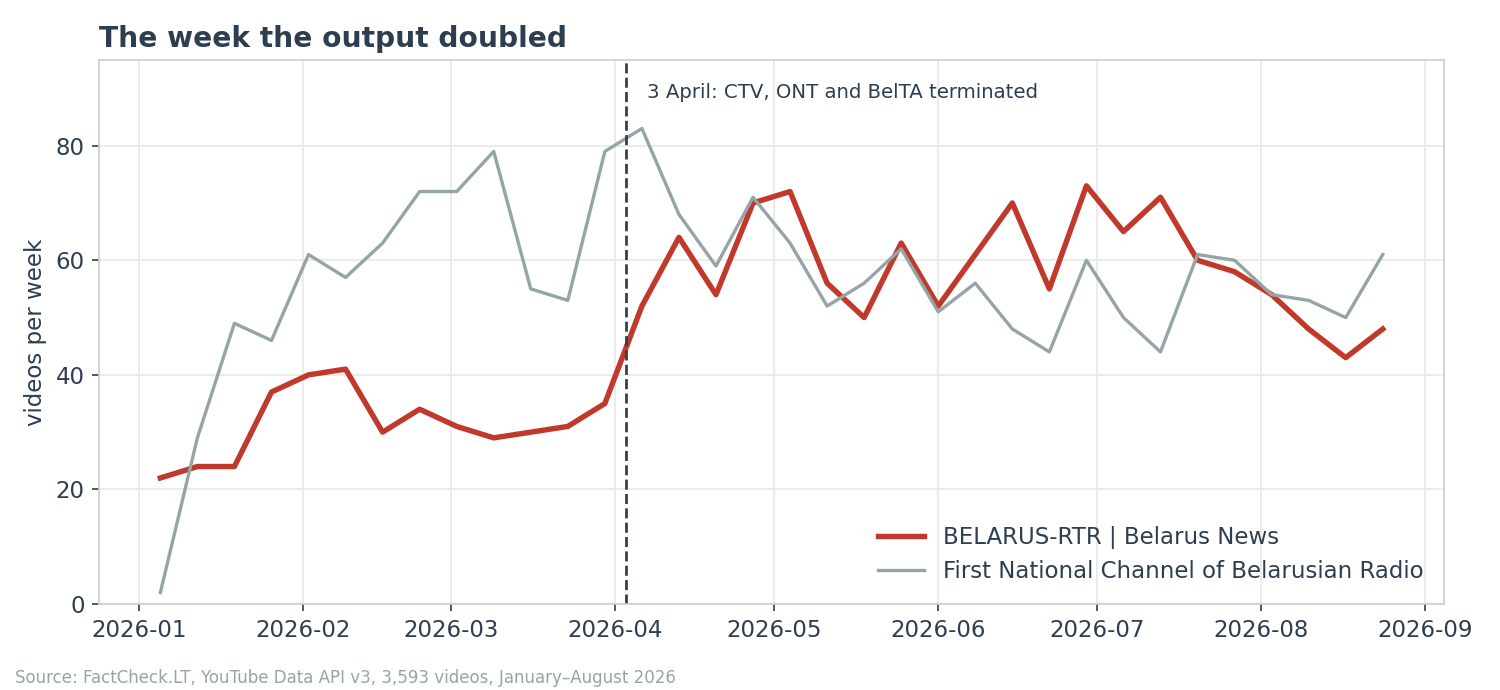
The backup channel lasted five days. The heir lasted five months.
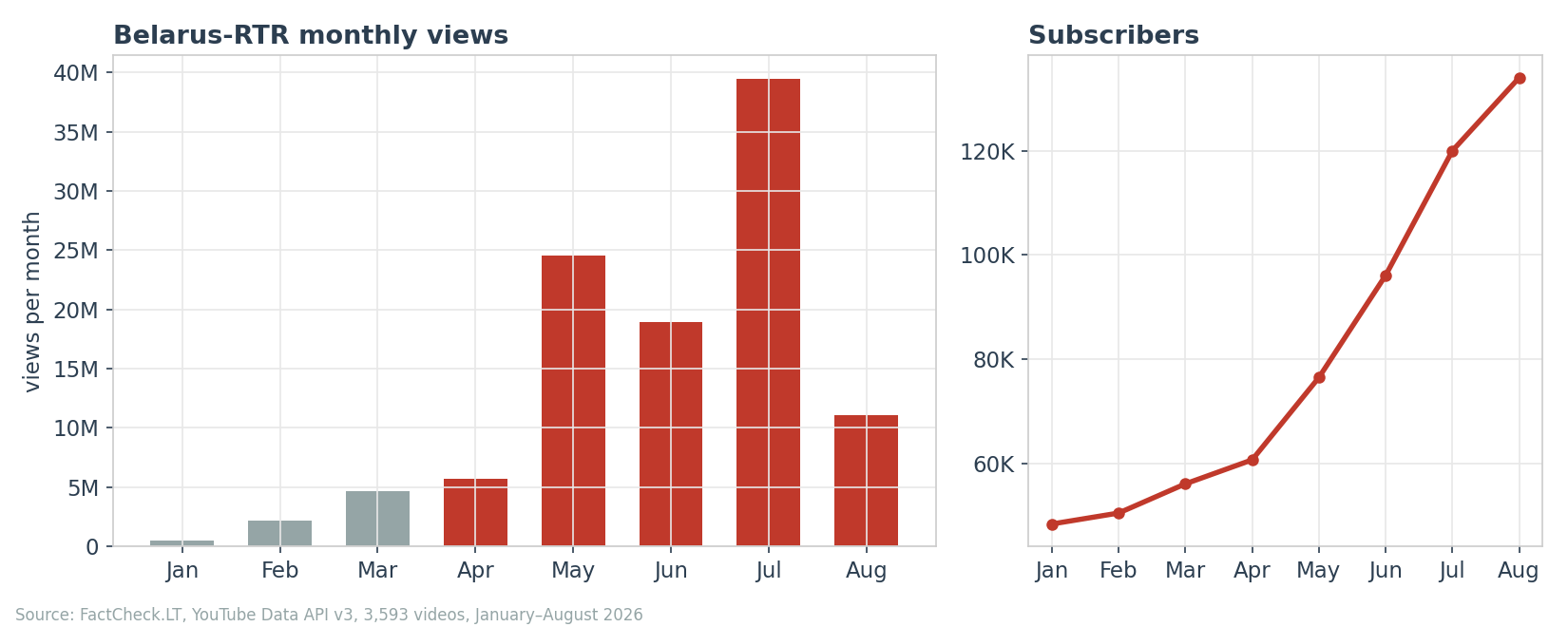
The audience followed. In January the channel collected 470,000 views, and in July it collected 39.5 million. Split the data at the April date: the first three months gave 388 videos and 7.4 million views, the next five gave 1,273 videos and 99.8 million. Subscribers went from 48,400 in January to 134,000 in August.
One more detail sits in the raw data: in the May snapshot the channel changes its name. Until April it was simply Belarus News, and from May it became BELARUS-RTR | Belarus News, with the television brand added in front.
The rule this runs into
YouTube’s help pages are direct about successors. After a channel is terminated, its owner may not use, own or create any other channel. Owners of terminated channels may not use anyone else’s channel to get around it. The ban covers new channels, bought channels, and channels where the terminated party appears often or prominently.
Circumvention is a violation in its own right, and the penalty is termination of every linked channel.
A successor channel is not a hiding place. It is a signature.
Our data describe that shape almost exactly. A channel of the same group doubled its output in the first week after the group’s main channel was terminated. It absorbed the audience, then put the broadcaster’s name on the door.
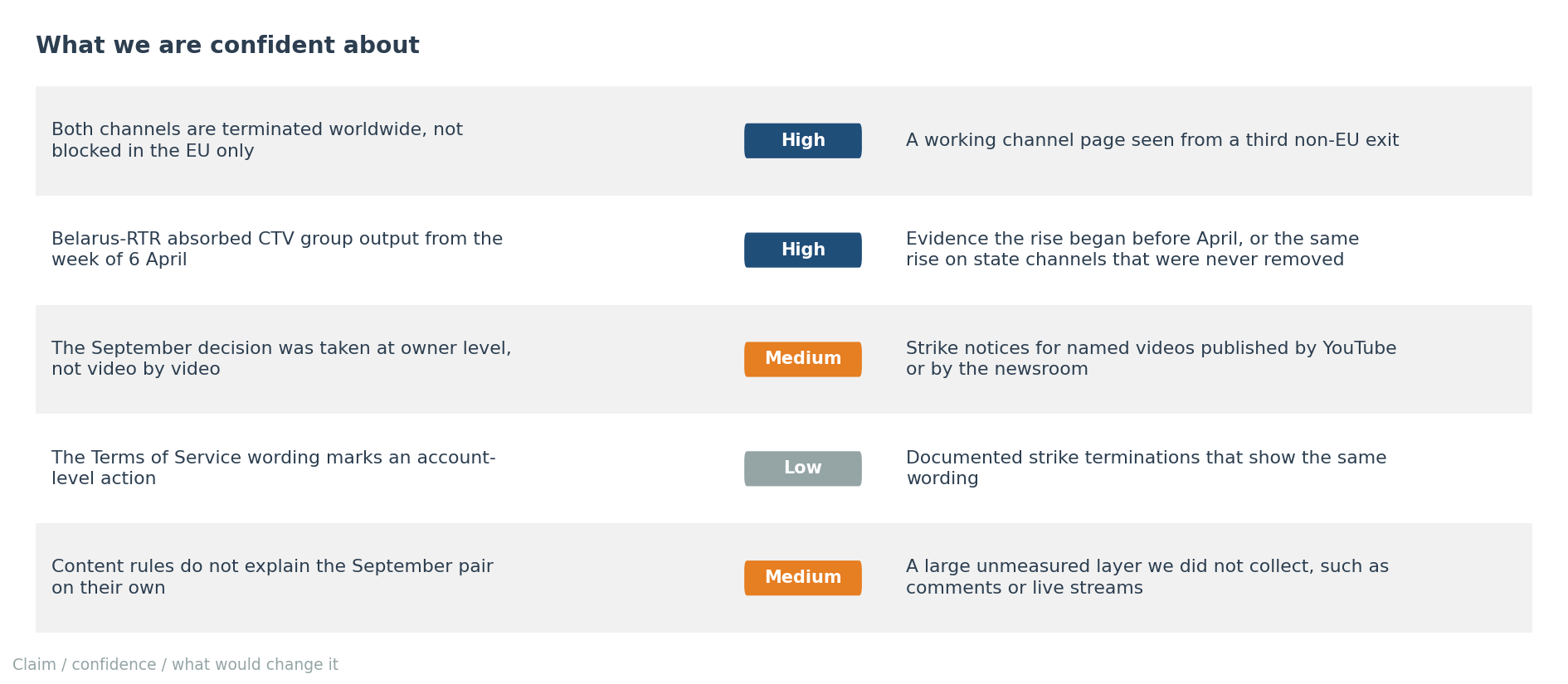
The termination notice points the same way. We checked both channels from a European exit and from a Turkish one, and both show the same line: the account was terminated for a violation of the Terms of Service. That is the wording ONT quoted in April, while terminations for accumulated strikes usually name the Community Guidelines and a specific policy instead. The mapping is not documented anywhere, so we hold this part loosely.
What the content does not explain
We classified all 3,593 videos of the two channels by title and description, and the result does not fit a content story.
The radio channel does carry a large war layer. It published 358 videos about the war around Iran, which drew 39.1% of its views. But that layer peaked in March and April. By August it was down to 23 videos a month, and monthly views had fallen from 10.35 million to 2.03 million. The topic had been fading for four months when the channel went.
Belarus-RTR is almost the opposite, with Iran content at 1.7% of views. Security-service material, the kind that carried names and personal data on CTV in the spring, is 1.3% of the corpus and half a percent of views on both channels together. Most of it is ordinary crime reporting.
One channel ran on a Middle Eastern war. The other ran on tractors. They were removed on the same day.
The two channels are very different in what they publish, and identical in who owns them.
What was actually lost
The loss is real, but it is not the loss of a political audience. Videos mentioning Lukashenko account for 80.3% of all views on the two channels, and on Belarus-RTR the figure is 90.5%, most of it from 453 short clips.
The best performing video of the year shows Lukashenko being presented with a tractor, and it has 13.8 million views. The same clip was also the radio channel’s top video in May, which tells you the material comes from one central pool.
Long-form video is a different story. Its median is 2,470 views on Belarus-RTR and 676 on the radio channel, so the programmes themselves had almost no audience here.
What to watch
By 15 November 2026. Whether the CTV group runs another YouTube channel that passes 50,000 subscribers. If a new heir appears and survives, the circumvention reading weakens.
By 31 December 2026. Whether the three radio channels return under new names. A quiet return would suggest the decision was narrower than an owner-level one.
By 31 March 2027. Whether any of the removed outlets publishes a strike notice naming specific videos. That would move the third row of the table above from Medium to Low.
Method and limits
Data come from the YouTube Data API v3, collected in monthly snapshots from January to August 2026, and each snapshot holds videos published that month. After removing duplicates we have 3,593 videos from the two channels. View, like and comment counts are snapshots taken at collection time, so newer videos are undercounted.
Categories were built with regular expressions over titles and descriptions. Descriptions on these channels are often news digests that glue unrelated stories together. Every category was therefore counted twice, with and without descriptions, and both numbers were checked before use. Shorts are separated from long-form at 180 seconds.
The corpus ends on 31 August, so it says nothing about September, and channel status was checked on 15 September from two exits. We have no correspondence between the platform and the newsrooms, and no formal statement of grounds. The mechanism described here rests on YouTube’s published rules and on measured behaviour, not on a document.
The full analysis, with the category tables and the code, is published on FactCheck.LT.