
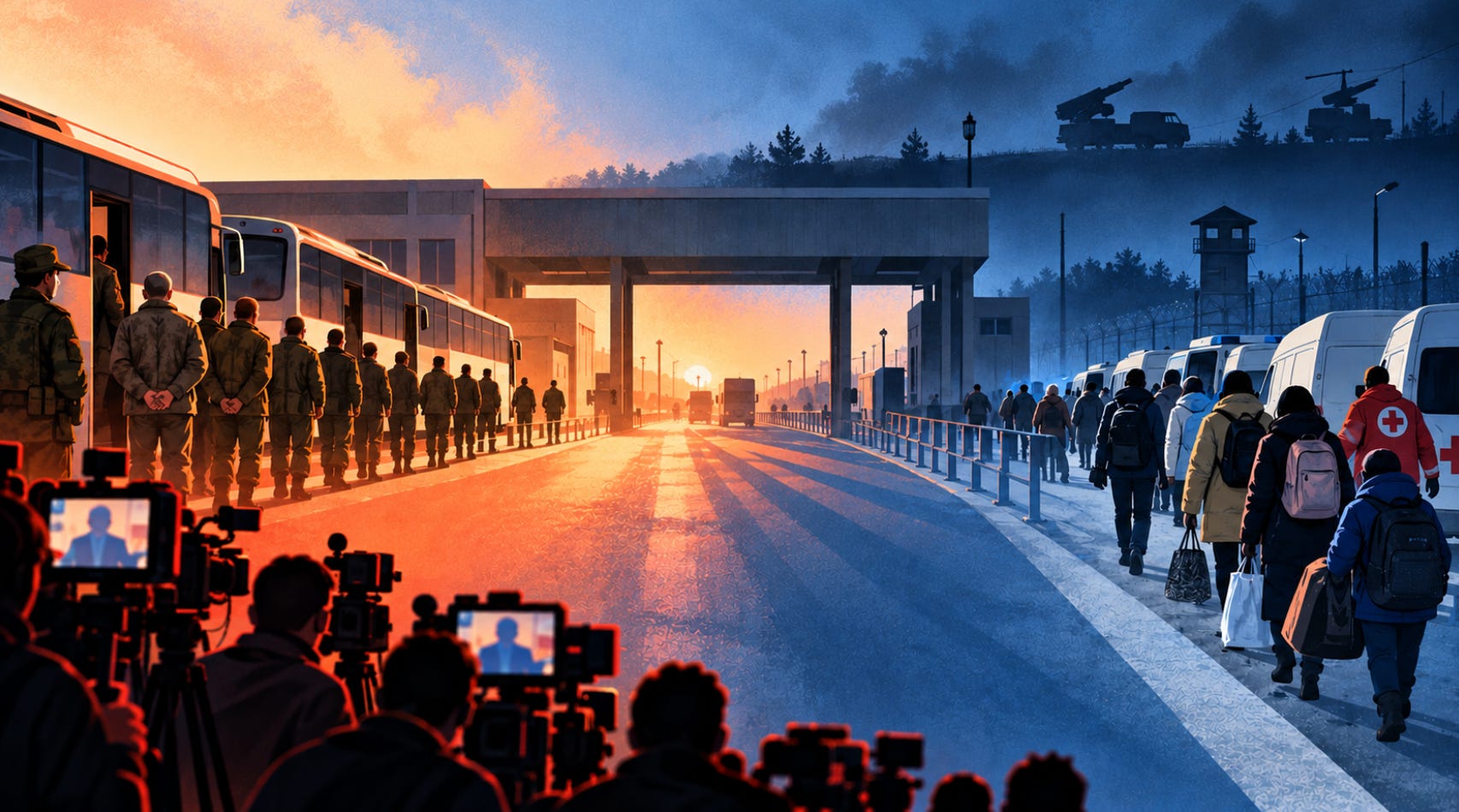
On 23 October Russia and Ukraine exchanged 270 prisoners of war each at a Belarusian border crossing. Belarusian state outlets called it a peacekeeping mission. To keep that picture, they repeat Moscow’s thanks, treat Kyiv’s silence as ingratitude, drop the Emirates’ mediation and leave out the route Ukraine uses for its civilians.
Since 2025 Belarus has become a regular venue for exchanges between Russia and Ukraine. Prisoners of war cross at Novaya Guta in the Gomel region; Ukrainian civilians from occupied territories come home through Mokrany in the Brest region. State outlets tell the first story at length, as proof that Minsk works for peace. They do not tell the second. Nor does the picture of a platform for peace make room for the fact that Russian troops entered Ukraine from Belarusian territory in February 2022. What we cannot see is how much Minsk does beyond logistics, because neither side
A platform, in its own words
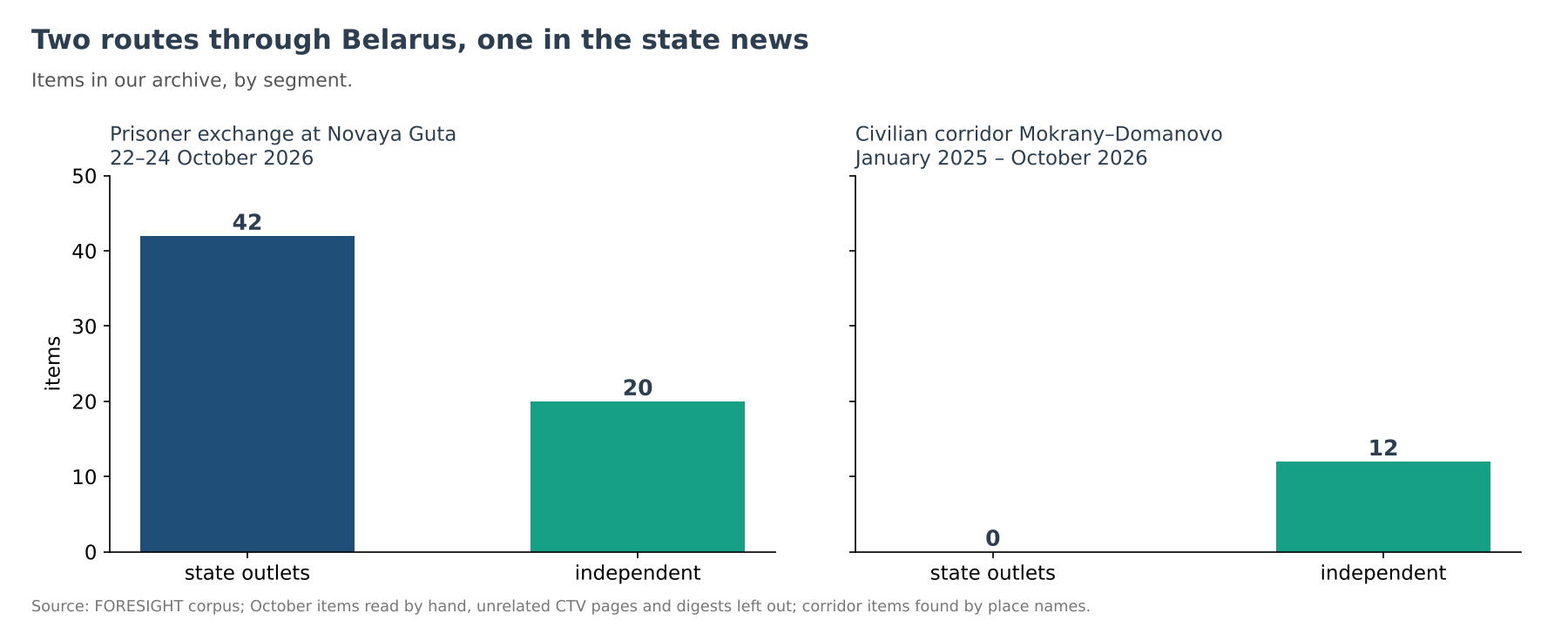
The exchange took place on 23 October, a day after the two sides swapped the bodies of dead soldiers at the same crossing. In our archive, 42 state items covered the two days. Half of them used the words of a “humanitarian platform”, a “peacekeeping mission” or thanks. BelTA wrote that Belarus, “continuing to carry out its peacekeeping mission, again served as a platform”. It listed what Minsk provided: landing at Gomel airport, buses to the crossing, hot meals and medics. The state broadcaster’s channel was shorter: “Our country shows once again that we are for peace” (Belteleradio).
State outlets tell the first story at length, as proof that Minsk works for peace.
The Russian defence ministry’s statement on the exchange ended with one more sentence: the United Arab Emirates had provided “mediation efforts of a humanitarian nature”. One state-affiliated Telegram channel repeated the statement in full. The state broadcaster’s channel quoted its opening and stopped before the Emirates. BelTA’s report did not mention them. In two days of state coverage, the only mediator named was Belarus.
A weekly review of foreign media by the presidential press pool appeared on four state channels. It put the exchange into its picture of the week: whatever the escalation on the borders, “Belarus continues to carry out its peacekeeping mission” (Pul Pervogo).
Gratitude as an argument
State outlets also report who is grateful. In May 2025 Putin called Lukashenko to thank him for the first large exchange. State commentators then made a talking point of the contrast. “Vladimir Putin called our President and thanked him for the exchange,” Vadim Gigin said, before turning to Zelensky (BelTA). “And what about Zelensky?” a guest on state television asked the same week (House of Representatives). A member of parliament told SB that there had been no words of thanks from Kyiv. Russia’s human rights commissioner, Yana Lantratova, thanked Belarus again in June 2026 (Sputnik). The argument asks the attacked country to thank the state from whose territory it was attacked. Kyiv says Russia still uses relay masts in Belarus for its drones, as we noted on 24 October.
In two days of state coverage, the only mediator named was Belarus.
Ukrainian officials describe the exchanges without crediting Minsk, which is what one would expect from the side that was invaded. When the Ukrainian ombudsman, Dmytro Lubinets, met Lantratova at the border in August, SB reported that he thanked the Russian delegation for a constructive discussion (SB). Zelensky’s statement on 23 October, as Zerkalo quoted it, listed the units of the soldiers who came home and five men thought to have died at Olenivka. It did not name the country they crossed.
The route the state does not show
The second route runs through the Mokrany crossing to Domanovo in Ukraine’s Volyn region. Since 2025 more than a thousand Ukrainians have returned home this way from occupied territories, many in ambulances provided by the Red Cross (Reform, Polish Radio). On 22 October, the day of the body exchange, eleven more crossed, Lubinets said (Reform). In February 2025 eight Ukrainian children came home through the same crossing, with Qatar as mediator (BelNovosti).
The argument asks the attacked country to thank the state from whose territory it was attacked.
Independent outlets wrote about the corridor at least a dozen times. State outlets did not write about it once. In our archive the word Mokrany appears in state media for one event: the opening of a new border guard post in April 2026 (BelTA). Reform illustrated one of its corridor stories with a frame from state television, so the state has filmed the route at least once. It has not made it a story.
A routine, not an event
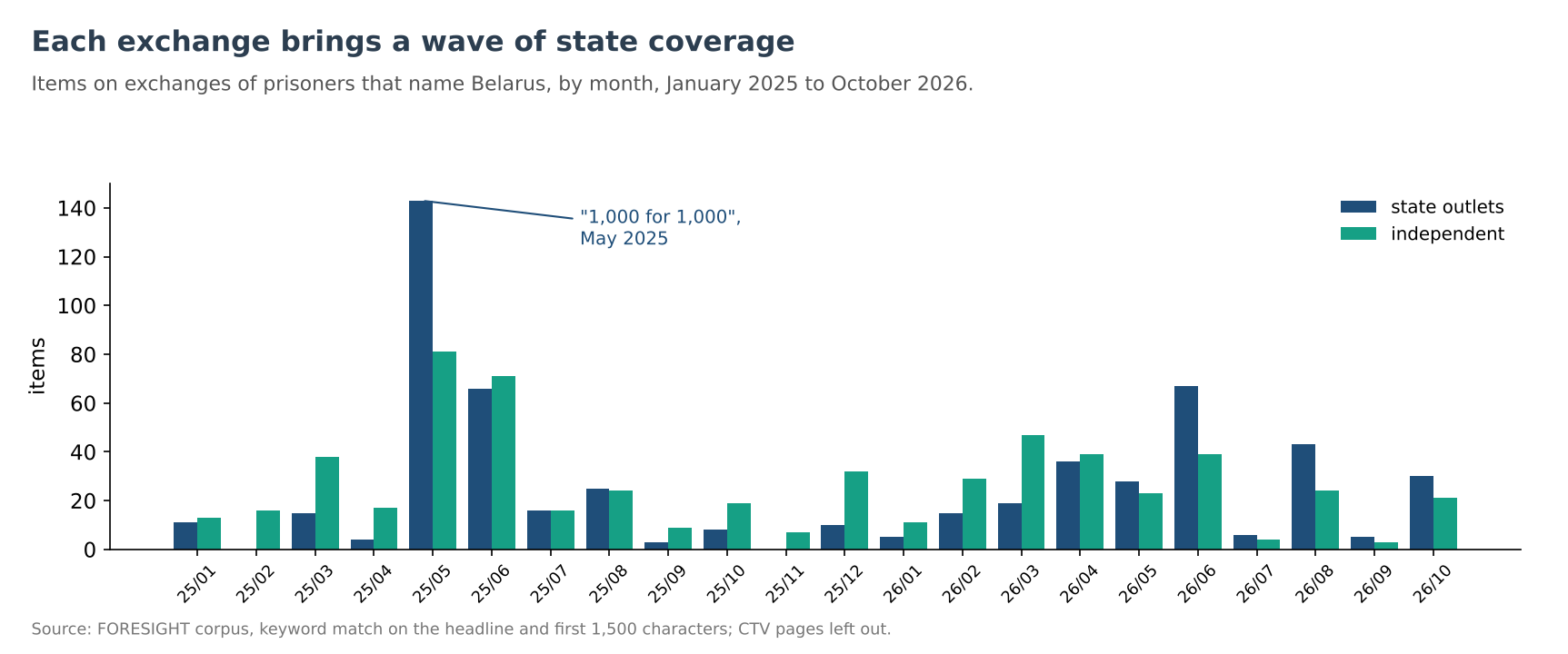
The exchanges have become regular. By the end of June 2026 eight exchanges of prisoners had passed through Belarus that year, Pozirk counted. State coverage peaked in May 2025, with 143 items during the first “1,000 for 1,000” exchange, and came back in smaller waves: 67 items in June 2026, 43 in August, 30 in October. Each wave carries the same frame.
State outlets did not write about it once.
How sure we are
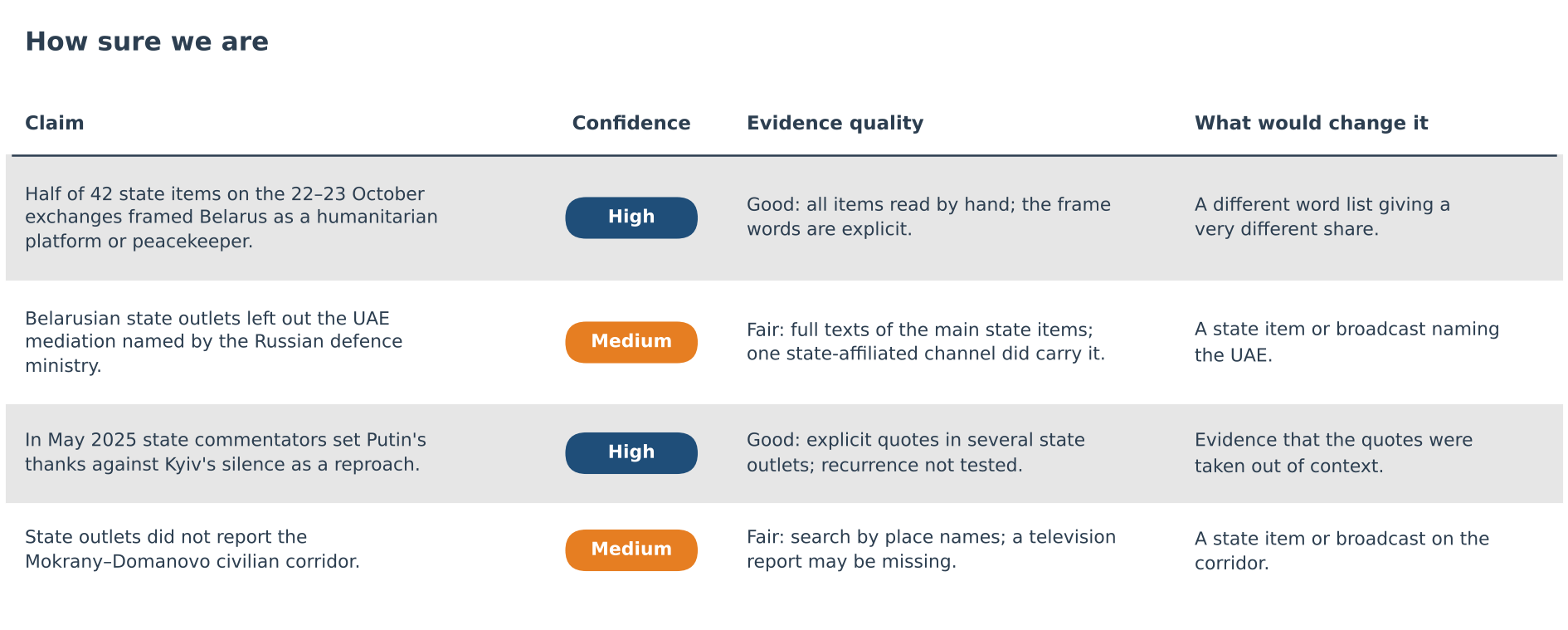
The count of state items and their frame is High. Each item is dated, and we read the October ones by hand. We left out unrelated CTV pages that matched through a block of related headlines. The use of Russian thanks and Ukrainian silence as an argument is High for May 2025, where the quotes are explicit; we did not test how often it recurs. The absence of the corridor from state media is Medium, because it rests on place names and a television report may not be in our archive.
How it fits
How it fits. State outlets present Belarus as a neutral platform for peace. To do so they repeat Moscow’s thanks, use Kyiv’s silence as a reproach, leave out the Emirates’ role and ignore the route that Ukraine uses for its civilians. Belarus’s part in the war, as the territory from which the invasion began, has no place in this picture. None of the seven theses in our working model covers this, so we record it as an observation. The simpler reading is that state editors report what Belarusian officials take part in. The prisoner exchanges involve Belarusian logistics and Russian thanks, while the civilian corridor is run by Ukraine and the Red Cross with little for Minsk to show. On that reading the silence is about news value, not about the route’s direction. The test is simple: if a Belarusian official appears at Mokrany, does the corridor reach state outlets?
What to watch
By 31 December 2026, at least one more exchange of prisoners of war between Russia and Ukraine takes place on Belarusian territory. We expect it does, with High confidence.
By 31 December 2026, a Belarusian state outlet names the United Arab Emirates or another mediator in a report on an exchange held in Belarus. We expect it does not, with Medium confidence.
By 31 December 2026, a Belarusian state outlet reports on the Mokrany–Domanovo corridor for civilians. We expect it does not, with Medium confidence.
Update, 28 October. Hours after publication, Euroradio reported that residents of Russian-occupied Oleshky in the Kherson region are to be evacuated through Belarus on 31 October. They will first be flown on a military plane to Anapa in Russia. Those who choose Ukraine will then fly with the Ukrainian delegation to Gomel and continue by land, accompanied by Dmytro Lubinets (Euroradio). According to Euroradio, the evacuation follows non-public talks between Russia and Ukraine with US participation, and a six-day ceasefire in Oleshky that began on the night of 27 October (Euroradio). It will test two of the points above: whether state outlets report a civilian operation led by Ukraine’s ombudsman, and whether they name any mediator other than Belarus.
Method and limits
We counted items in our archive from January 2025 to 27 October 2026 that mention an exchange of prisoners together with Belarus, by month and segment, and marked those that use words of a humanitarian platform, peacekeeping or thanks. For 22 to 24 October we read all items by hand and removed unrelated CTV pages, daily digests and stories on other subjects. The monthly series matches only the headline and the opening of each item and leaves out CTV, so it finds fewer October items than our reading of the full texts. We searched for words of thanks near the names of Belarus or Lukashenko in all items about exchanges since 2025, and read the matches. For the civilian corridor we searched all items for the names Mokrany and Domanovo and kept those about returns of Ukrainians; other uses of the names, such as a military range at Domanovo, were left out. Thesis tag: none (observation).