

Human Constanta’s quarterly review of “anti-extremism” for April–June 2026 is the best single description available of how the Belarusian designation machine works. Read as a measure of repression, though, its headline figures measure something narrower: the administrative throughput of four registries whose operators control both the numerator and the definition. The most useful finding in the review is not the size of any list. It is that 227 of the 297 people added to the extremist-persons register this quarter were convicted under one article, 361-4, and that almost all of them are one case.
The review is published by Human Constanta as the tenth-odd instalment of a series that has run since 2021, which is what makes it usable: the same categories are counted the same way each quarter, so the deltas mean something even when the absolute numbers do not.
What the quarterly actually counts
Four registries moved between 1 April and 1 July 2026. The Republican list of “extremist materials” took 446 new court decisions covering 654 items, reaching 10,530. The register of people “involved in extremist activity” gained 297, reaching 6,745. The register of “extremist formations” gained 31 formations and two organisations. The “terrorist” list gained 46 Belarusian citizens, reaching 714 of them inside a total of 1,458.
Three of those four numbers are counts of decisions taken by the same institutions being described. They rise when a court sits, a commission signs, or a KGB order is published. They do not rise when a person is beaten in a Mahilioŭ flat at six in the morning and released after a “preventive conversation” without paperwork, which the review documents from Nasha Niva’s 18 May reporting and which enters no register at all.
The registers rise when a commission signs. They do not rise when a man is put face-down on his own floor and released without paperwork.
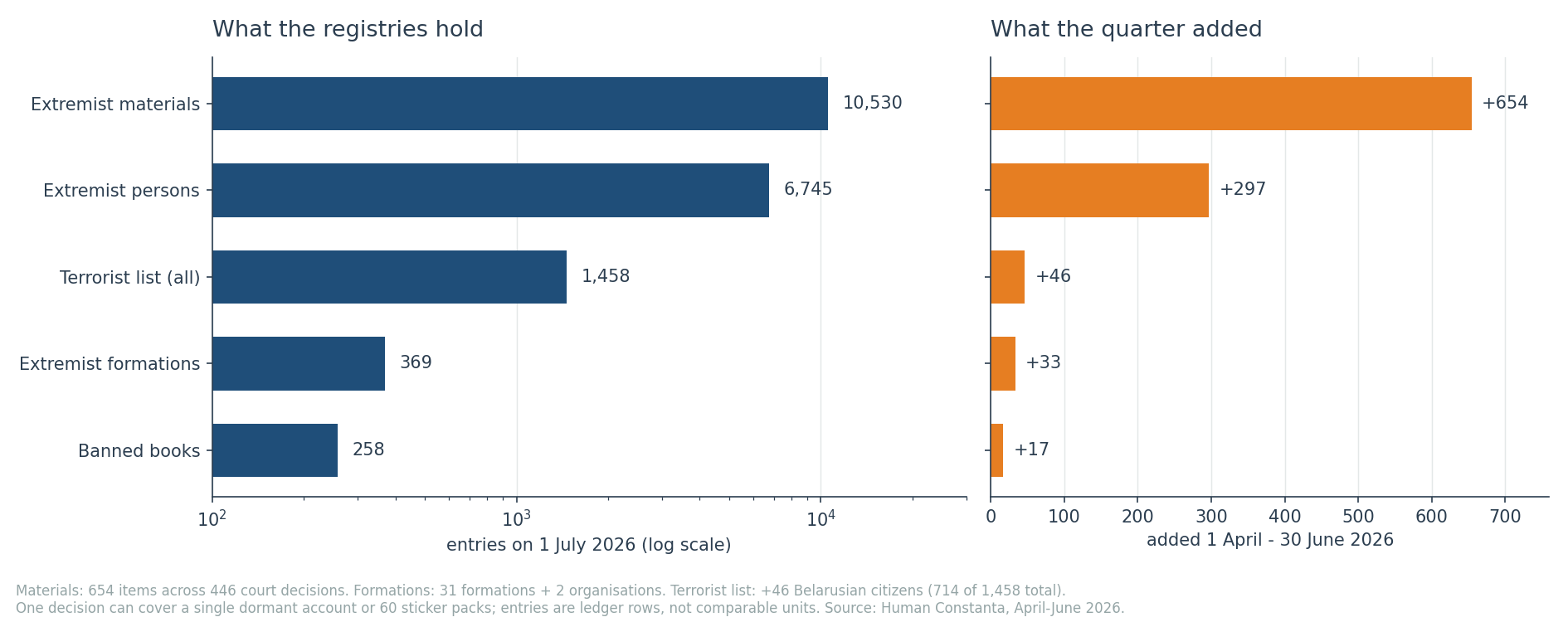
The materials list is also not an interval scale. A single decision of the Partyzanski district court in Minsk on 24 June designated 60 Telegram sticker packs containing several hundred images; the TUT.BY designation of 2021 covered roughly 700,000 articles; a dormant Instagram account last active in March 2022 counts the same as either. “10,530 materials” is a count of ledger rows.
One case, processed industrially
The composition of the 297 is where the quarter’s real signal sits. Human Constanta’s own breakdown by article: 361-4 (facilitating extremist activity) 227 people; 368 (insulting Lukashenko) 49; 130 (incitement) 38; 369 (insulting an official) 31; 361-1 and 361, 26 each; 367, 17; 369-1, 16; 342, 10; 356, 8. Those sum to 448 against a headline of 297, because most defendants carry several articles — the review does not flag the arithmetic, and a reader taking the article lines as a partition will overcount.
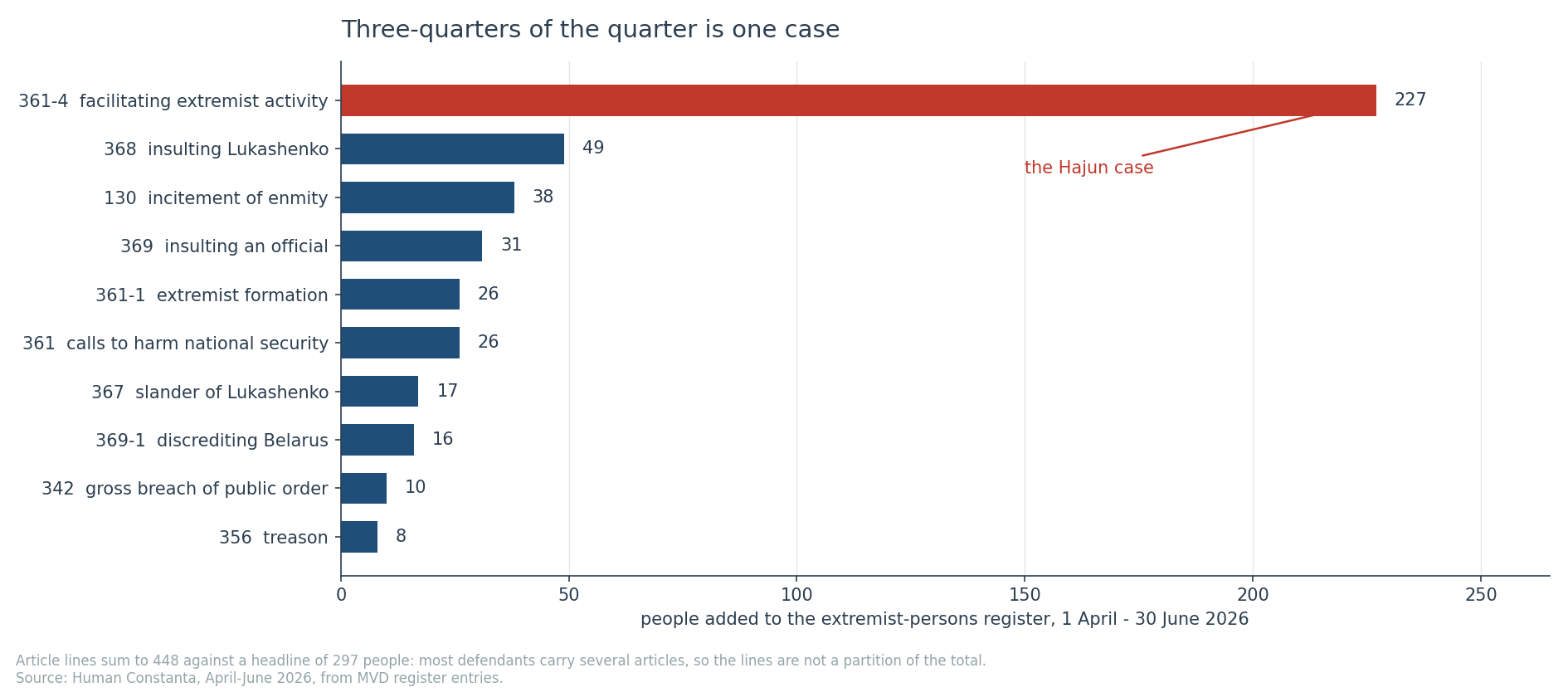
The 361-4 mass is the Hajun case: people who, years ago, sent a message to a monitoring bot tracking Russian military movements, and whose Telegram account data reached the security services in early 2025. Viasna counted at least 200 confirmed defendants by mid-June. Sentences cluster on “home chemistry” and on three years of imprisonment, and the review’s list of the sentenced reads like a payroll — a seamstress, a Mazyr refinery worker, a Baranavichy head nurse, a 75-year-old pensioner in Minsk, a 21-year-old aviation cadet.
What changed inside that case this quarter is a price. Detainees have been offered termination of prosecution in exchange for “voluntary” donations to state institutions; one man reported being asked for several thousand dollars, payable to the Republican Centre for Medical Response, over a single message to the bot. Confiscation and fines were already routine. This is the first documented instance of the charge itself being purchasable.
No exit
None of the four registries has a working removal mechanism, and this quarter three separate facts made that structural rather than incidental.
Pardoned political prisoners stay listed. Andrzej Poczobut walked out on 28 April after 1,860 days in the five-for-five exchange at the Polish border, without having asked for a pardon or admitted guilt; nobody released in these exchanges is rehabilitated, several are already defendants in new cases, and the registers keep them.
The dead get added. On 4 May the Hlusk district court designated the Facebook pages of Aleh Shabetnik, who died of COVID-19 in October 2021, and of the artist Ales Pushkin, who died in a prison hospital in July 2023. On 7 April the KGB listed Mikita Kryvtsou — found dead in a Minsk wood in August 2020 — among sixteen people “involved” in the Belarusian National Coalition, a structure founded in November 2025.
A man dead for five years was entered as a participant in a body that did not exist while he was alive.
And the categories keep widening. On 6 April the KGB designated 22 online communities where relatives of prisoners exchanged information about parcels and visiting rules — ten Telegram chats, nine on Viber, three VKontakte groups, the largest with around 1,800 members. Colony administrations then made inmates phone home and order their families out. The same quarter’s list additions include regional news TikToks from Pinsk and Luninets, a traffic-police channel in Pastavy that now consists entirely of spam, and — through the Leninski district court in Mahilioŭ — Soviet-nostalgia communities that deny the legitimacy of the USSR’s dissolution. Content with actual neo-Nazi character was about 3.5% of additions.
A university becomes a payment offence
On 14 April the Supreme Court designated the European Humanities University an “extremist organisation”, the first time an entire university has been given that status. On 5 May the Vitsebsk regional prosecutor’s office set out the consequences: paying tuition is financing extremist activity under article 361-2, up to five years; continuing to study or teach is participation under 361-1, up to six; a subscription to EHU’s web resources is itself actionable.
By 11 June Viasna knew of more than 60 searches. Graduates back to 2019 are being asked to provide their diplomas. One case decision cited by the review reaches payments made “no later than 30 April 2016”, a decade before the designation existed. Students abroad are told through their parents that the family will be detained unless they withdraw within ten days; at least 100 have withdrawn. Residence-permit cards have been damaged deliberately.
A tuition transfer made in 2016 is now evidence in a case opened in 2026.
This is the sharpest extraterritorial move of the quarter and it lands in Vilnius. It also connects to the domestic education track running in parallel: education ministry decree No. 77, in force 15 April, strips gifted-youth benefits and stipends from anyone with an “extremist” record or with conduct “damaging state or public interests”; a draft Council of Ministers resolution published for consultation on 22 May would build a register of private tutors, explicitly to bar those with such convictions regardless of expungement.
A register you can query
The registers themselves are published as unwieldy documents on the websites of the interior and information ministries. Since late 2025 an activist project, ekstremisty.xyz, has been downloading those documents nightly and rendering them as searchable tables of people, organisations and materials, with a statistics page that breaks entries down by article and by age of the listed person and accepts a date range. Search runs in the browser after the full set is downloaded, so the site never learns what name was typed, which matters for a register whose main everyday use is a Belarusian checking whether they are on it.
For anyone reading the quarterlies, this changes what can be verified. The claim that 227 of the 297 new entries carry article 361-4 is reproducible against the register with a 1 April to 30 June filter; so are the age distribution behind phrases like “sentences against elderly people”, the count of first-time versus repeat designations, and the platform split of new materials that the review asserts without numbers.
The interesting question about the register stopped being how large it is.
What the site cannot supply is the layer the review is actually built from: sentences, hearing dates, the article a person was charged under before conviction, and everything that never reaches a register at all. The registers hold outcomes of a specific administrative act. Court practice lives in Viasna’s case cards, in reporting by Nasha Niva, Flagshtok and Radio Svaboda, and in what relatives are willing to say.
Where the review is thin
Three gaps matter for anyone reusing the numbers.
Administrative cases under article 19.11 of the Administrative Code — subscriptions, likes, reposts, a screenshot in a phone — are the largest category of anti-extremism enforcement, and the review gives no figure for the quarter at all, only the observation that previous periods reached several hundred to a thousand and that visibility has fallen. The single biggest number in the system is absent from the tally.
Re-designations are counted with new ones. The Belarusian Association of Journalists was designated an “extremist formation” in February 2023 and appears again this quarter; the Belarusian Council of Culture was first listed in June 2022 and is listed again. Growth rates that mix first-time and repeat entries overstate expansion.
The largest enforcement category in the system carries no number for this quarter.
The platform claim — that the authorities concentrated on Threads, TikTok and Facebook accounts — is asserted rather than counted, though it is the most novel thing in the quarter and the underlying decisions are enumerable from the ministry’s own file. A platform breakdown of the 654 items would be a stronger finding than the running total.
Source concentration is the third issue. Where the review leaves the registers and describes enforcement, it leans on a narrow set of feeds: Viasna for case detail, then Nasha Niva, Flagshtok, Radio Svaboda, dissidentby and MAYDAY. Several passages carry no attribution at all beyond “it became known”, with neither date nor outlet. That is defensible under the conditions the review describes in its own preamble, and it still means the enforcement narrative rests on a handful of newsrooms whose own coverage is shaped by who has relatives abroad willing to talk.
Watch items
By the next quarterly (covering July–September 2026, expected October): whether additions to the persons register break away from 297, which has now held for two consecutive quarters, and whether the 361-4 share falls below 60% as the Hajun cohort is worked through. A fall would indicate exhaustion of the case rather than a policy change.
By 31 December 2026: whether any entry is removed from any of the four registries by an act other than a court appeal — a single documented removal would falsify the one-directional reading above.
Whether the tutor register is adopted as a Council of Ministers resolution, and whether its final text keeps the clause that ignores expungement of conviction.
Whether a conviction under 361-2 for EHU tuition is handed down, and in which region. Two of the quarter’s more inventive designations — the dead activists’ accounts, the Soviet-nostalgia groups — came out of Mahilioŭ region courts, as did all three foreign-media designations tracked in this series in July 2025 and after.
Method and limits
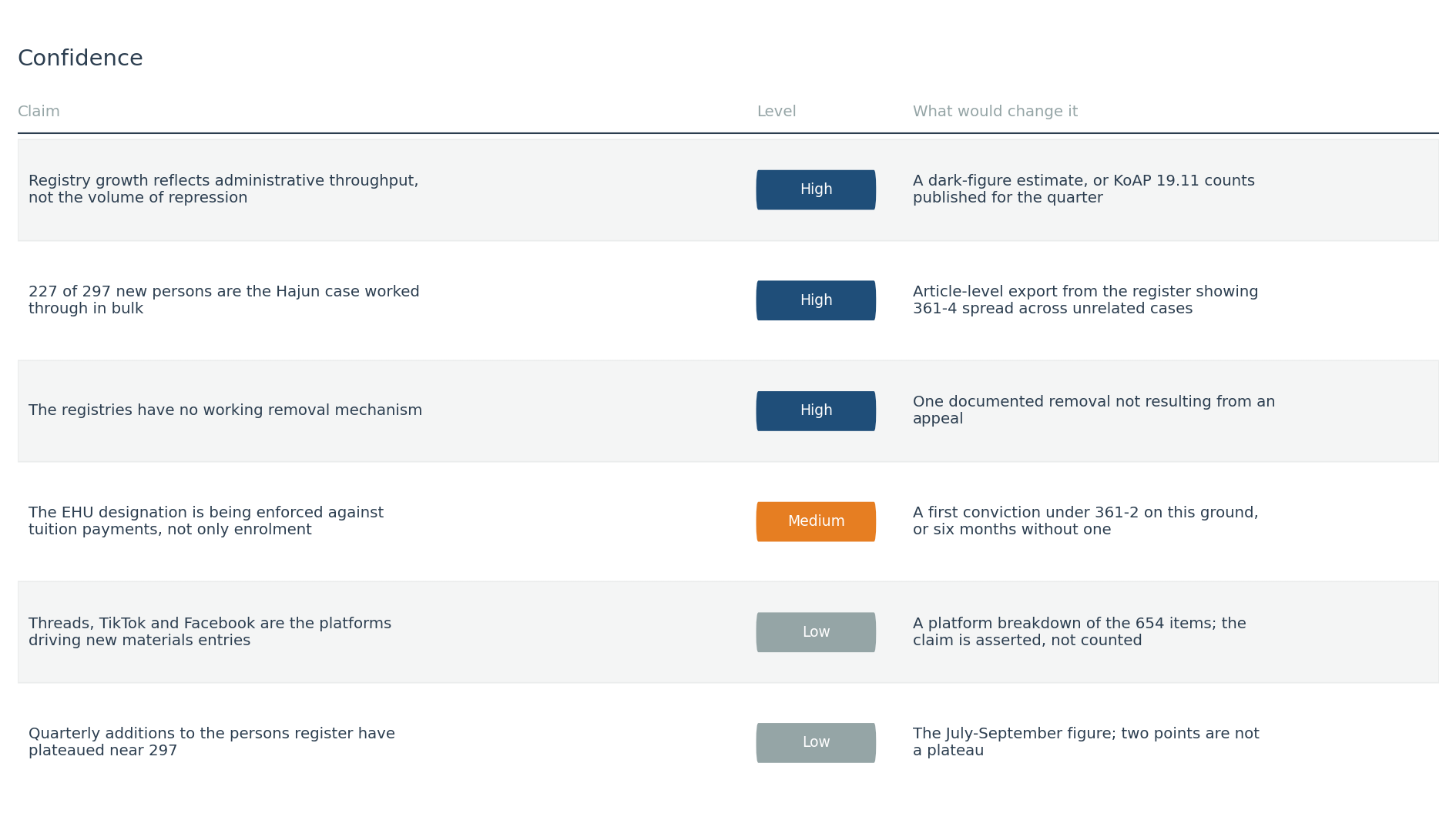
This brief is a critical read of a secondary source. The figures above are Human Constanta’s unless attributed otherwise; no independent count of the Ministry of Information list was run for this piece, and the arithmetic note on the 448-against-297 article breakdown is a reading of the review’s own table rather than a recount of the register. The ekstremisty.xyz mirror described above renders its tables in the browser, so the numbers there were not machine-read for this piece either; a recount against it is the next step and would settle three of the six rows in the confidence table.
Cross-reference: Viasna’s six-year report of 9 August 2026 records at least 8,670 people convicted in politically motivated cases since 2020, against 6,745 currently on the extremist-persons register, which is a rough consistency check rather than a match — the register began in March 2022 and its inclusion rule is the entry into force of a sentence under specified articles.
Two items in the review fall outside its stated window without being marked: the genocide-investigation figures from Andrei Shved date to October and December 2025, and the section reproduces state-media assertions about the Gecevičius case (40,000 killed in the October 1941 raid, 6,000 proven) without independent sourcing. Both are quoted here only as descriptions of official claims.
The review uses gender-inclusive underscore forms throughout, which is a stylistic choice with a practical consequence: the forms break standard tokenisation, so anyone building a corpus from these quarterlies should normalise before indexing.