

The European Council on Foreign Relations published In the Bear’s Paw this month, a policy brief by Vasil Navumau arguing that Belarus has moved from being Russia’s rear-operating base to its forward-operating base, and that Europeans should answer with something other than another sanctions package. Among the concrete things it asks for: working-level diplomatic contacts kept alive in Minsk, third-party intermediaries, technical formats such as hotlines to relay information about military movements, and an OSCE-style risk-reduction partnership modelled on the Vienna Document.
The brief also quotes Belarus’s deputy foreign minister Igor Sekreta, from a June roundtable on the militarisation of Europe, to show how Minsk’s rhetoric now tracks Moscow’s. He is cited on NATO exercises and on the EU promoting a militarist agenda. Both lines are real, and the roundtable was convened on the OSCE platform by Russia’s permanent mission, which makes the alignment point stronger than the brief makes it.
The same appearance contained something else. In the state agency’s own rendering, Sekreta proposed as an urgent measure “restoring military-to-military communication channels”, asked for a return to transparency mechanisms and contacts at any acceptable level including tactical interaction in border areas, and invited EU and NATO states to negotiations on a Eurasian charter, due to open in September 2026 alongside the UN General Assembly.
That is the recommendation and its counterparty statement, two months apart, and the brief carries the first without the second.
The instrument the paper asks Europeans to invent was publicly offered by the ministry it quotes, in the speech it quotes.
Nothing here says the offer is sincere. Minsk has proposed border-area military contacts before while the balloons and the tunnels continued, and a charter that would bar foreign military infrastructure threatening a neighbour’s core interests reads oddly from a state hosting Oreshnik. But a paper whose central practical proposal is a communication channel has to say whether the channel has already been offered and on what terms, because that is the difference between a proposal and a decision about an offer on the table.
What the exchange lever has actually produced
The brief’s other main instrument is conditional engagement: concessions traded against verifiable steps, with prisoner releases as the model case. It cites the December 2025 episode, 123 people released as Washington lifted potash sanctions, and recommends that the US widen the opening by “easing restrictions on Belarusian potash exports”.
That lever was spent five months before publication. On 19 March 2026 John Coale announced the removal of the remaining potash sanctions covering Belaruskali, the Belarusian Potash Company and Agrorozkvit, plus relief for two banks and the finance ministry, against 250 prisoners released, the largest single release since 2020. A recommendation to do the thing that has already been done in full is not a small editorial slip in a paper whose argument is that Europe should learn from Washington’s transactionalism.
The results of the model case are measurable, and they do not point where the brief points.
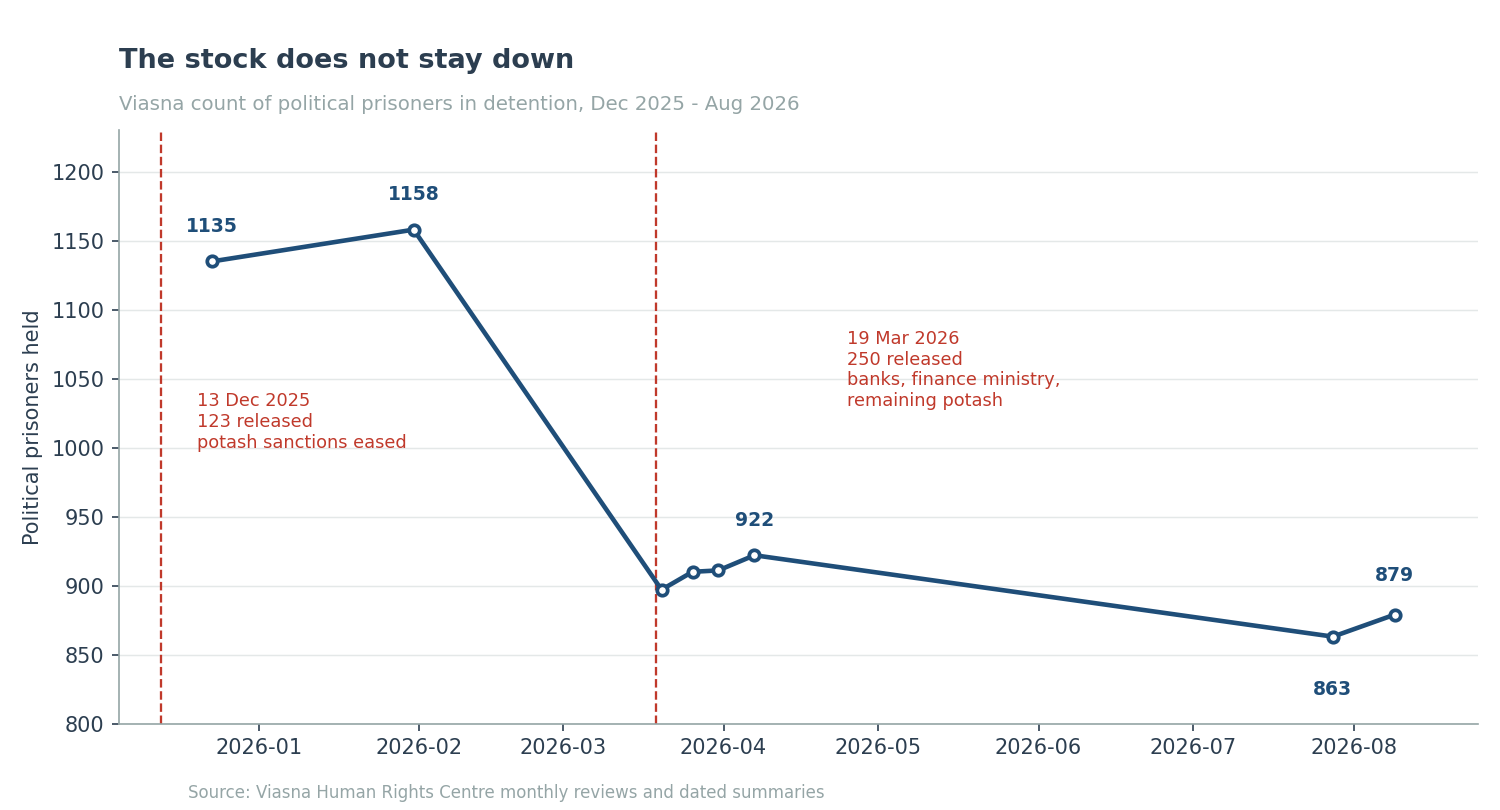
Viasna counted 1,135 political prisoners on 23 December 2025, ten days after the potash deal, and 1,158 at the end of January. The March release moved the number below a thousand for the first time in four years, to 911 at the end of March. It was 922 by 7 April, 863 on 28 July, and 879 on 9 August. The curve stopped falling in April and turned back up in the second half of the summer.
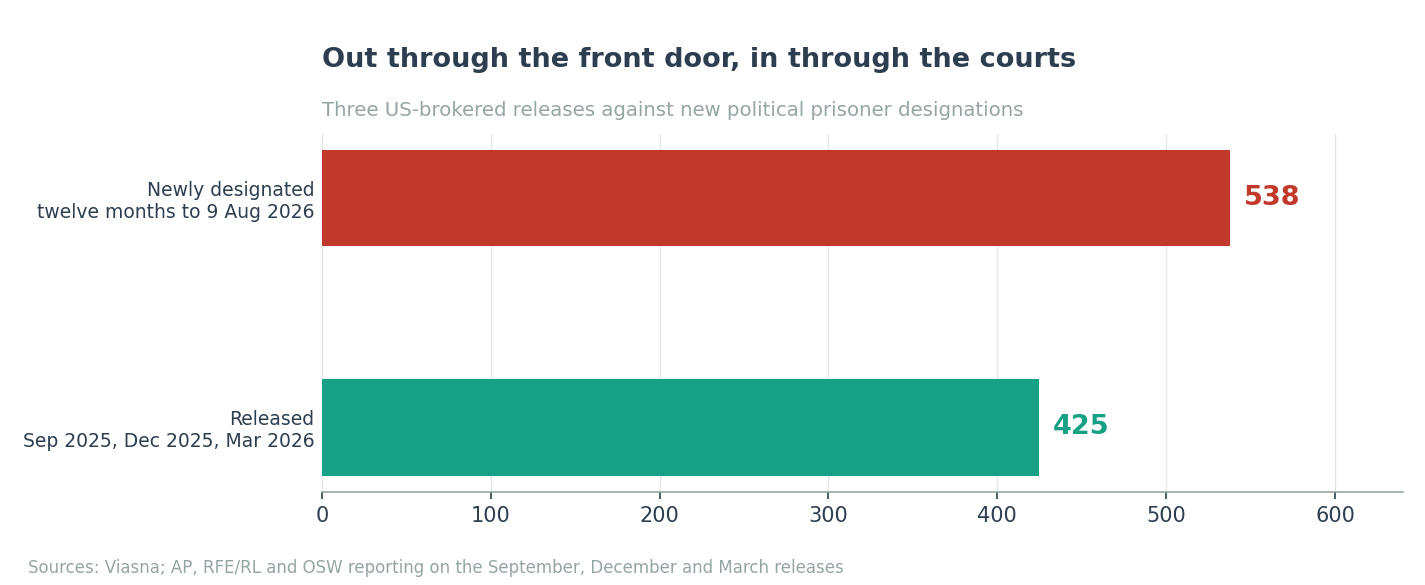
Across the twelve months to 9 August, three US-brokered releases moved 425 people out. In the same window the human rights community recognised 538 new political prisoners. The exchange works: people do come home. What it does not do is reduce the stock, because the stock is refilled by a court system that the exchanges never touch, and the brief’s proposed European version of the same mechanism inherits that arithmetic unchanged.
Four hundred and twenty-five out, five hundred and thirty-eight in, and the register still holds 879 names.
Four datings
A paper arguing that a threshold was crossed has to be right about when things happened. Four checks:
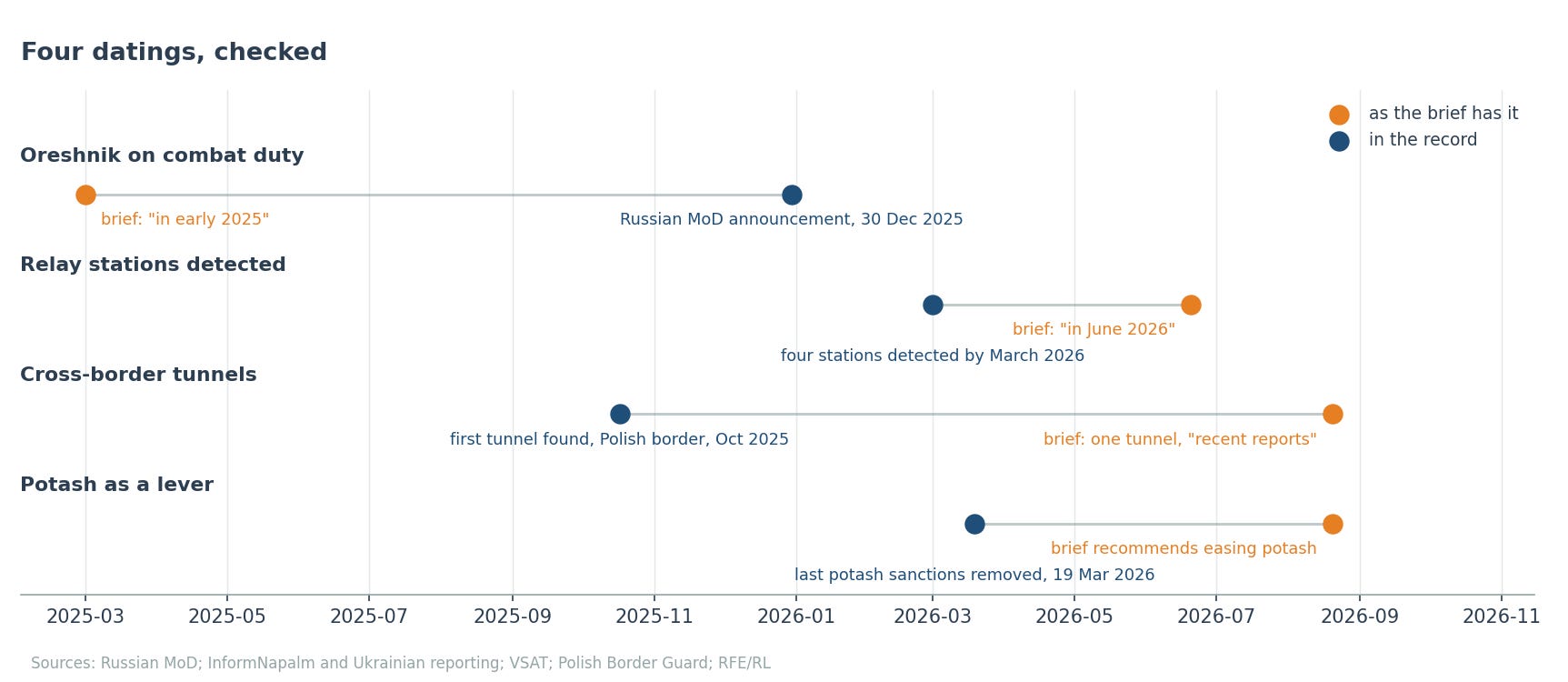
The text says Russia moved Oreshnik to a site around 60km south of Minsk in early 2025. The Russian defence ministry announced the unit on combat duty on 30 December 2025, and Lukashenko had said on 17 December that the system had arrived the day before. The brief’s own map carries the December 2025 date. Text and graphic contradict each other by about a year, and the graphic is right.
The signal relay stations are dated to a June 2026 discovery by Ukrainian intelligence. The stations were public from January 2026, four of them were identified by March, and Kyiv sanctioned Lukashenko over them on 18 February. June is when Zelensky issued the ultimatum, which is a different event and a better one for the brief’s argument about residual agency.
The tunnel appears as a single recent discovery aimed at moving migrants. Lithuania’s border service reported three tunnels in the two weeks either side of 26 July and twelve underground crossing attempts so far in 2026, with the first such tunnels found on the Polish section in 2025. A phenomenon a year old and running at a dozen attempts reads differently from one novel passage.
None of this touches the brief’s conclusion that Belarus is more militarily embedded in Russian planning than it was in 2022. It touches the claim to have identified when the shift happened, which is the part a policy audience will act on.
What holds
The strongest section is the one on exile. Treating forced migration as a governance instrument rather than an aftershock, and asking whether European legal regimes accidentally complete the regime’s work, is the right frame, and it matches what the passport track has looked like from inside. The observation that Russia has not used real coercion against Minsk, no trade war, no blockade, no propaganda campaign against Lukashenko, sets a bar that most Belarus commentary skips. The warning about funding volatility after the US cuts is specific and correct. The paper is also honest that a democratic transformation is not on the table, which is more than several better-known documents manage.
A brief that names the coercion Russia has not yet used is more useful than one that assumes it already has.
Watch items
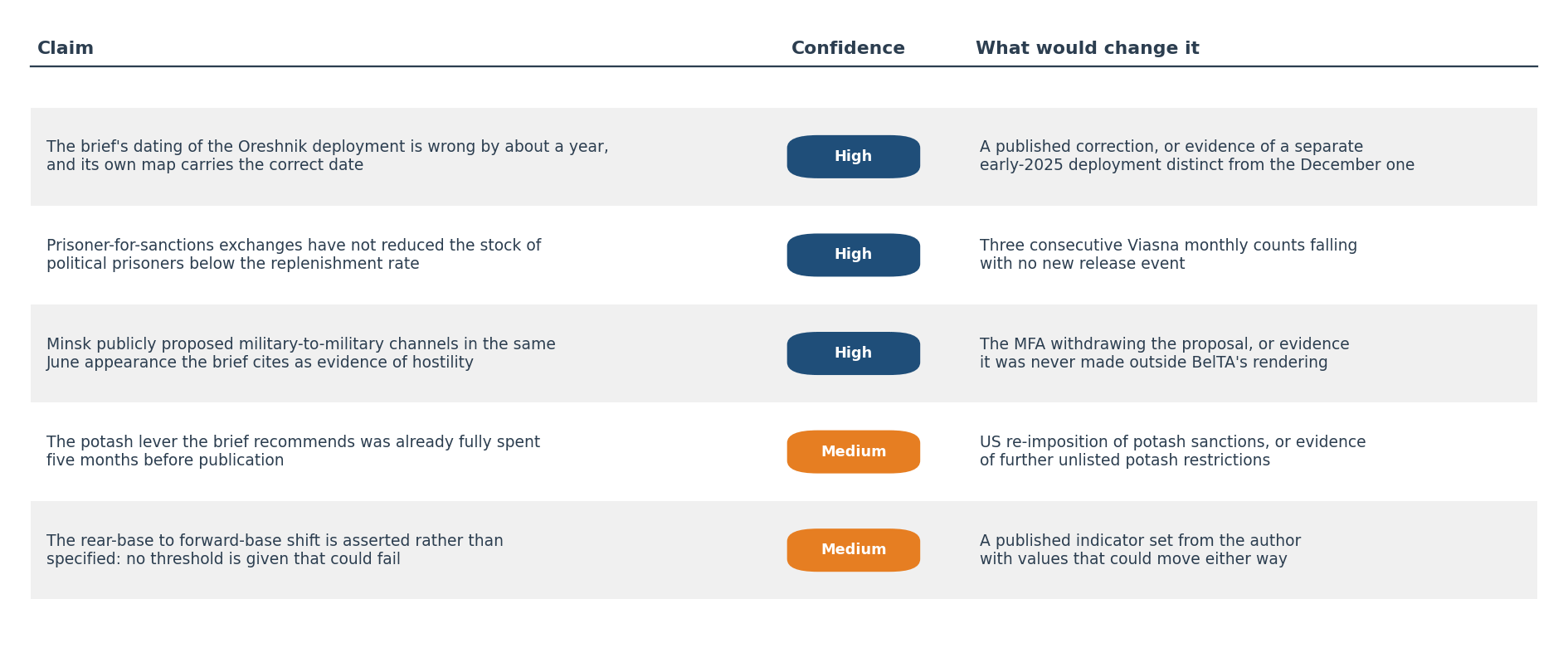
By 30 September 2026, Viasna’s monthly count stays above 850 in the absence of a new release event. By 31 December 2026, no EU member state opens a declared military-to-military or border-deconfliction channel with Minsk of the kind the brief recommends. At the September UN General Assembly session, no EU or NATO member joins negotiations on the Eurasian charter, and Minsk names the refusal as evidence of European militarism. If the first two fail, the exchange arithmetic in this piece is wrong and the channel recommendation is more live than it looks.
Method and limits: this piece reads one document against dated public sources. Prisoner figures are Viasna’s published counts on the dates given and are lower bounds by the organisation’s own statement. Release totals cover the September 2025, December 2025 and March 2026 tranches only and exclude individual pardons. The Sekreta proposal is known through the Belarusian foreign ministry’s press service as carried by BelTA, not from a transcript, and the wording of any offer made in Vienna may differ. The brief was read as published in PDF; the web version may carry links the PDF does not.