
Militarised schooling in Belarus is not a story anyone is hiding. The state announces the programme, other outlets relay it, and across two and a half years the descriptive vocabulary runs almost entirely through state channels while the judgement runs through everyone else. Almost no document does both. When you separate what is being announced from what is being said about it, one component turns out to be growing and the rest have plateaued: the ten-day residential field camps.
One announcement, six relays, one verdict
On 13 August the deputy education minister, Alexander Kadlubai, told a pre-term seminar that the tenth-grade subject “pre-conscription and medical training” has been rewritten. Boys get a ten-hour course in operating unmanned aerial vehicles; girls get an expanded practical medical block with elements of tactical medicine. The theory has given way to skills needed in real conditions, he said. The seminar section on pre-conscription training was held on the premises of military unit 5448, an MVD internal troops brigade in Minsk, and Kadlubai described cooperation with that unit as one of the best examples in the country, to be scaled across Belarus.
BelTA published it. Zviazda and SB carried it in Belarusian and Russian. Charter97, Reform and Zerkalo carried it, Zerkalo noting the course is no longer an elective. Gazetaby carried the same paragraphs under a headline about preparing young Belarusians for war. UNIAN in Kyiv carried the same paragraphs the next day and closed with a two-word verdict on what the country is becoming.
Nothing in the factual content changes across those six steps. The ministry’s own wording survives intact into outlets that treat it as evidence of a war footing. Of the twelve documents our filter caught in that window, exactly one carried any evaluative vocabulary at all, and it was the Ukrainian one.
The ministry’s own wording survives intact into the outlets that treat it as evidence of a war footing.
Two vocabularies, two populations
Treat the descriptive words as one set and the judgement words as another, and the segments separate almost completely. State-aligned sources produced 5,836 documents describing the programme and 44 judging it. Independent, exile and foreign sources produced 1,148 describing and 103 judging. Documents doing both are rare in both populations: five on the state side, forty-two on the other.
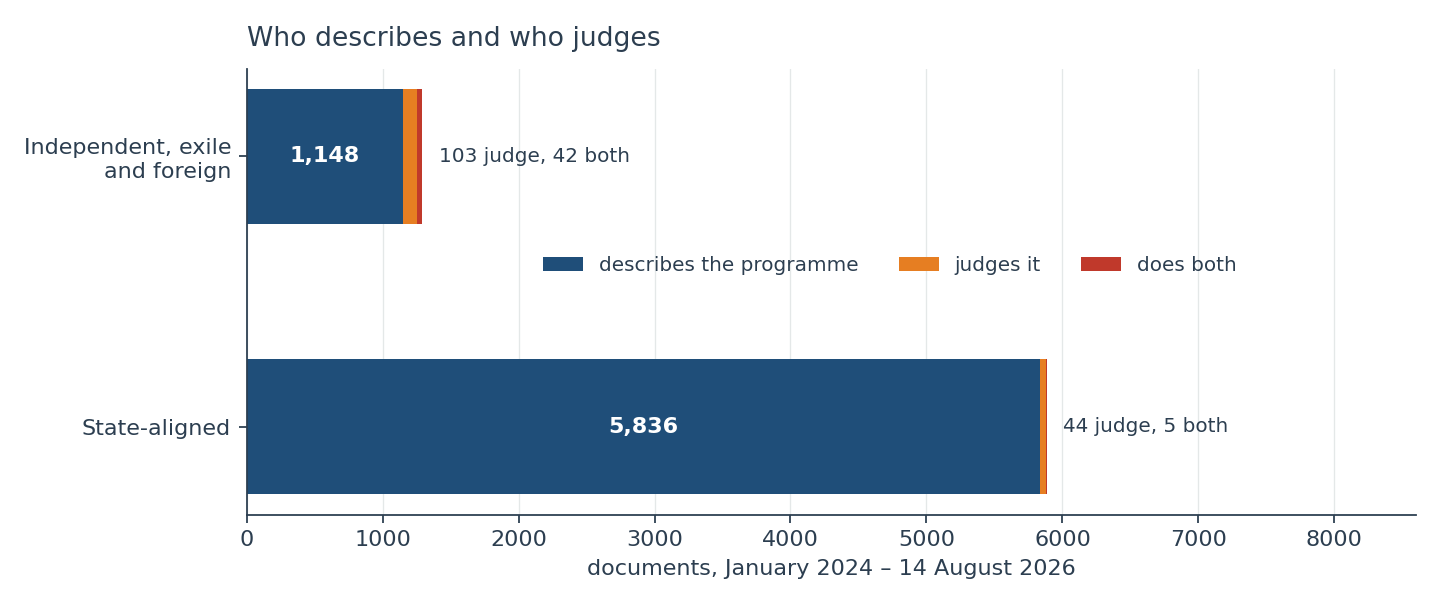
This is why education looks like the one domestic theme where the segments do not diverge in volume. They are not covering the same thing at similar intensity. One side is running a publicity operation and the other is reading its output.
The state segment’s forty-four judging documents are worth a note. At least some of them point the word outward: in May 2024 two pro-government Telegram channels ran the same text using “militarisation of education” to describe Poland, where the education minister had signed off on military classes in four thousand schools, and offered that as the real case as against the alleged one at home. We have not coded all forty-four, so how general that inversion is remains open.
What is actually expanding
Broken into components, the programme vocabulary shows one line moving and the others flat.
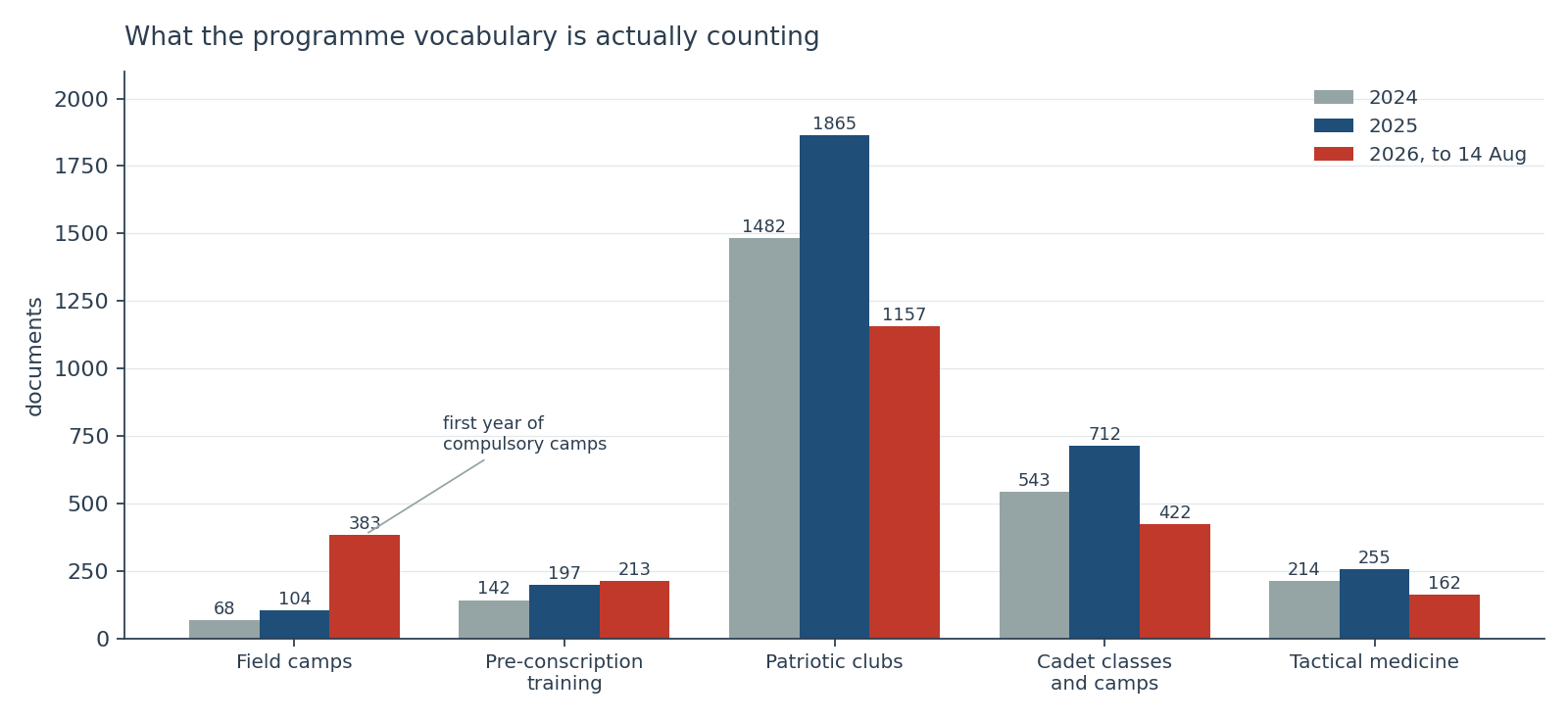
Field camps ran at 68 documents in 2024, 104 in 2025, and 383 in the first seven and a half months of 2026. Annualised, that is roughly six times last year. Pre-conscription training rises more modestly, 142 to 197 to 213 so far. Patriotic clubs, cadet classes and tactical medicine are all flat once the partial year is annualised: clubs land near 1,850 against 1,865 last year, cadet formats near 675 against 712, tactical medicine near 259 against 255.
The camps are also the component the state is pushing hardest on its own. Counting only state-aligned sources, field camps go 59, 71, 280.
That matches what changed on the ground. The ten-day camps became compulsory for tenth-graders this year and ran for the first time on the bases of military units and health facilities rather than in schools, which Kadlubai singled out as the superior format because it maximises practical skills and builds cohesion. Pavel Tsyareshkovich, Tsikhanouskaya’s adviser on science and education, told the New Belarus conference on 9 August that from 2026 the camps run round the clock. The two accounts describe the same change and disagree only on what to call it.
Clubs and cadet classes have plateaued. The component that takes sixteen-year-olds out of school and onto a military base for ten days is the one that multiplied.
The other half of the ledger
While the programme expanded, the teaching corps shrank on the state’s own numbers. Belstat reports 98,100 teachers in general secondary education for 2025/26 against 102,300 a year earlier, a loss of 4,200 in a single year with enrolment steady at about 1.1 million. Preschool lost too: 3,653 institutions against 3,721, and 321,000 children against 338,300.
Tsyareshkovich put the loss at 13,000 teachers over five years and called it 8% of the corps. Read against the whole pedagogical workforce, including preschool and vocational staff, 8% is close to arithmetically right. Read against school teachers alone it would be nearer 12%. His figure holds; the denominator he used is the wide one.
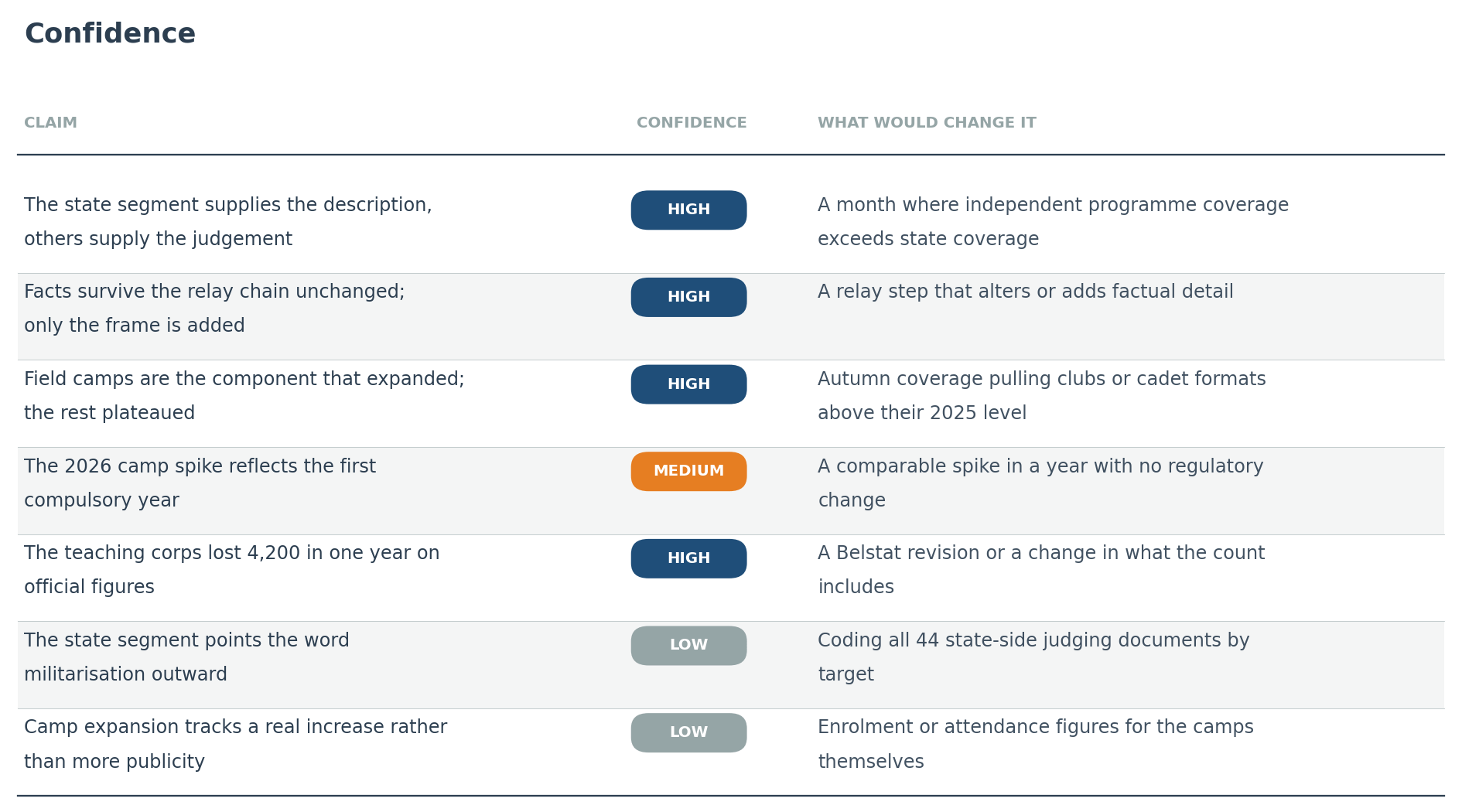
Confidence
Watch items
By 1 September 2026: whether the UAV course appears in the published tenth-grade curriculum documents, and whether the exemption grounds for pre-conscription training remain medical only.
By 31 October 2026: whether unit 5448’s arrangement is replicated by name in other regions, which is the test of “scaling across Belarus”.
By 31 December 2026: whether field-camp coverage holds above the 2025 level once the summer season ends, or whether the 2026 spike is the one-off of a first compulsory year.
At the Belstat education release for 2026/27: whether the teacher count falls below 95,000.
Method and limits
Corpus query over Belarusian state, independent, exile, Telegram and foreign segments, January 2024 to 14 August 2026, one row per URL, with chunked long-form sources exempted from deduplication. Programme and evaluation vocabularies are matched as phrases with bounded adjacency, never as words co-occurring anywhere in a document.
The 2026 column is seven and a half months. Annualised comparisons above are marked as such, and the raw counts are shown so the arithmetic can be checked. Figures attributed to Kadlubai and Tsyareshkovich are their own public statements. Belstat figures are from its education press release and the corresponding release a year earlier.