

Three separate claims surfaced in the Belarusian information space between June and early August. Each one moves Belarus up a rung: from a country hosting a Russian weapon to a country making it, deploying alongside it, and commanding it. Belarusian components in the Oreshnik. A new air-assault brigade forming in Homiel region, forty kilometres from Ukraine. Control of Russian tactical nuclear weapons and the Oreshnik passing to the Belarusian General Staff in the event of aggression.
The state segment carried none of the three. Not as denial, not as rebuttal, not as boast. Twenty-four documents on the ladder come from Belarusian independent media, two from Russian state agencies, two from foreign democratic outlets, and one from Belarusian state media — and that one leads on an air-defence regiment rather than the brigade.
This is not disinterest in the weapon. The state segment has produced 4,978 documents about the Oreshnik. It is a boundary around a specific category of claim, and it holds across three unrelated stories in nine weeks.
The pattern
What links the three claims is not subject matter but grammar. Each attributes an action to Belarus rather than a location to Russia. “A Russian missile is deployed in Belarus” is a sentence the state segment produces in volume. “Belarus builds part of that missile,” “Belarus is forming a unit to sit beside it,” and “Belarus would command it” are sentences it does not produce at all.
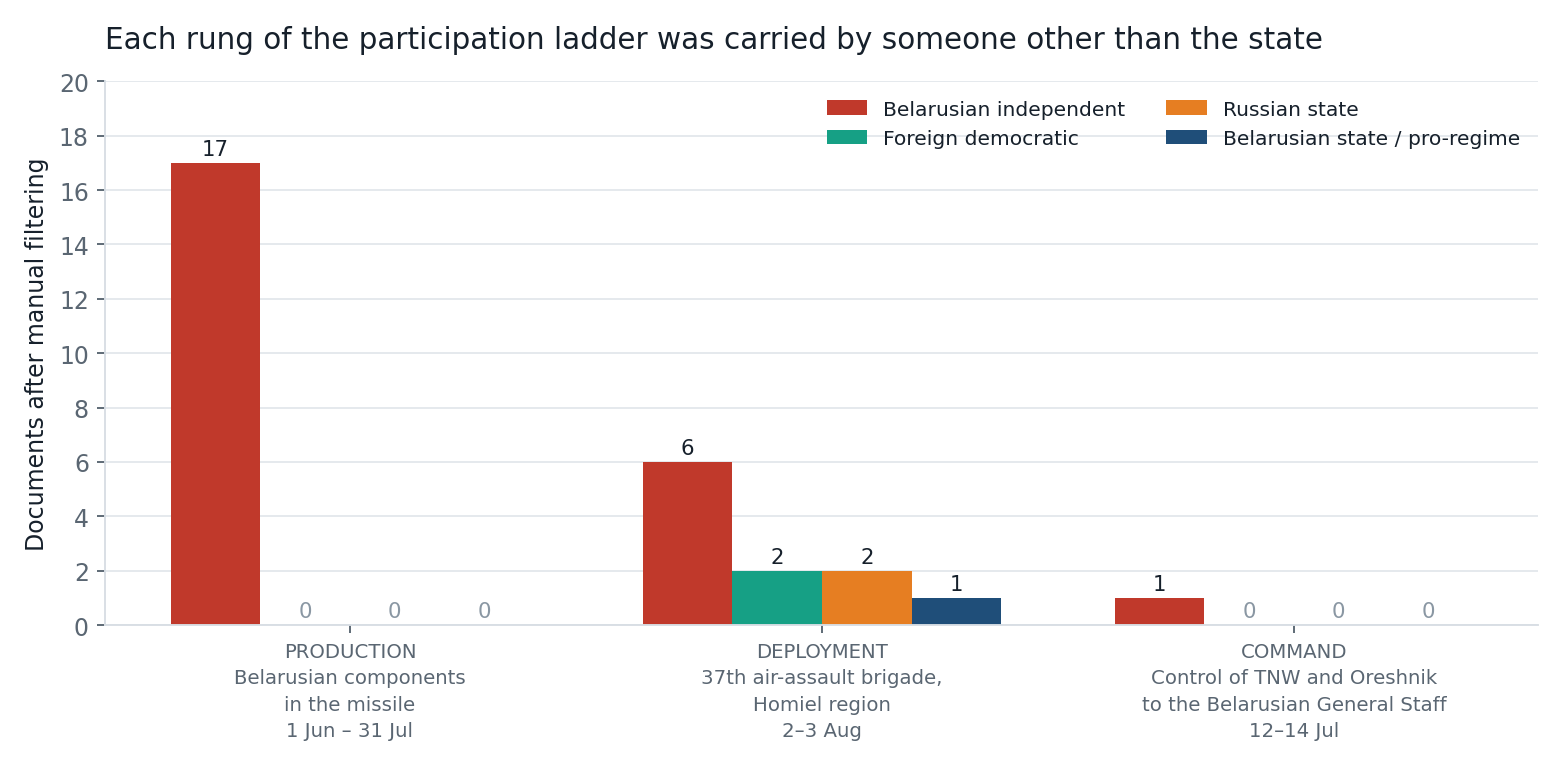
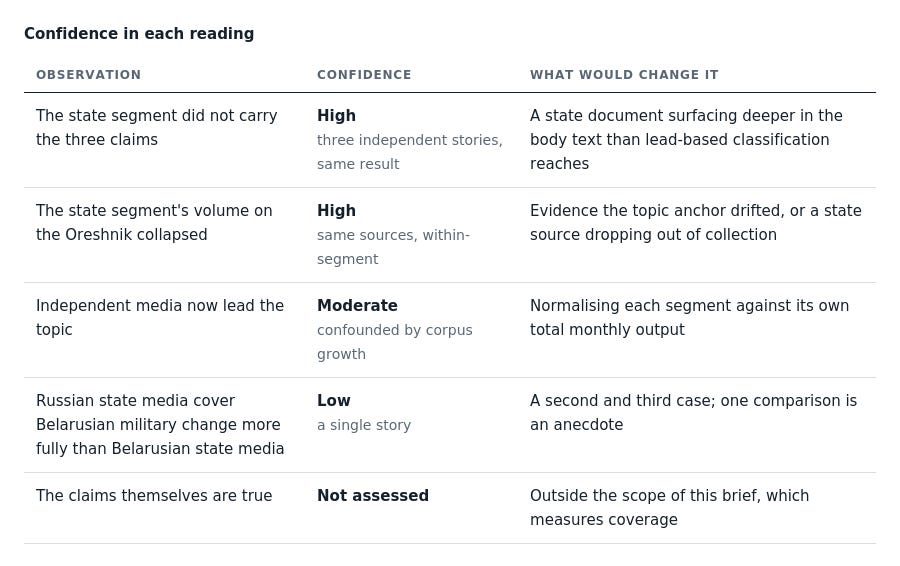
Registering this as a formal FORESIGHT typology entry should wait for a second documented case — one trigger period is a candidate pattern, not an established one. What can be stated now is the distribution.
Production. On 29 July, Ukraine’s sanctions commissioner put roughly a hundred Belarusian-made parts in an Oreshnik, out of more than a thousand, manufactured between 2023 and 2025 at Integral and Transistor in Minsk. Seventeen documents in the corpus carry the components story across the two-month window, all of them Belarusian independent. Seven of the seventeen landed on 29 July alone — exile newsrooms working the same wire within hours, not a coordinated release. The state segment produced nothing in the window, including on 24 July, when Integral caught fire and Minsk residents heard the explosion.
Deployment. On 2 August the commander of the special operations forces told the army’s own television channel that the 37th separate air-assault brigade is being formed in Homiel region: battalion in place, officers recruited, exercises in Kazakhstan and China this month, the 147th anti-aircraft regiment transferred to SOF subordination. Eleven documents followed in a day and a half.
Command. In mid-July a colonel appearing as a regular studio expert on a BelTA programme said that in the event of aggression, control of Russian nuclear assets in Belarus would pass to the Belarusian General Staff. One document in the corpus reports that sentence. State coverage of the same appearance exists and runs on deterrence — what would happen to an aggressor — without the command claim in it.
The topic the state walked away from
Pull the missile back to its arrival and the shape changes. In November 2024 the Oreshnik was overwhelmingly a state topic: 589 state documents against 209 independent. December 2024, 787 against 260. Through 2025 the state segment averaged 265 documents a month against 77, peaking at 1,074 in December 2025.
January 2026 is the first month the independent segment writes more about the missile than the state does, and it stays ahead every month after. Across May, June and July the state segment produced 79 documents on the Oreshnik. Independent media produced 681.
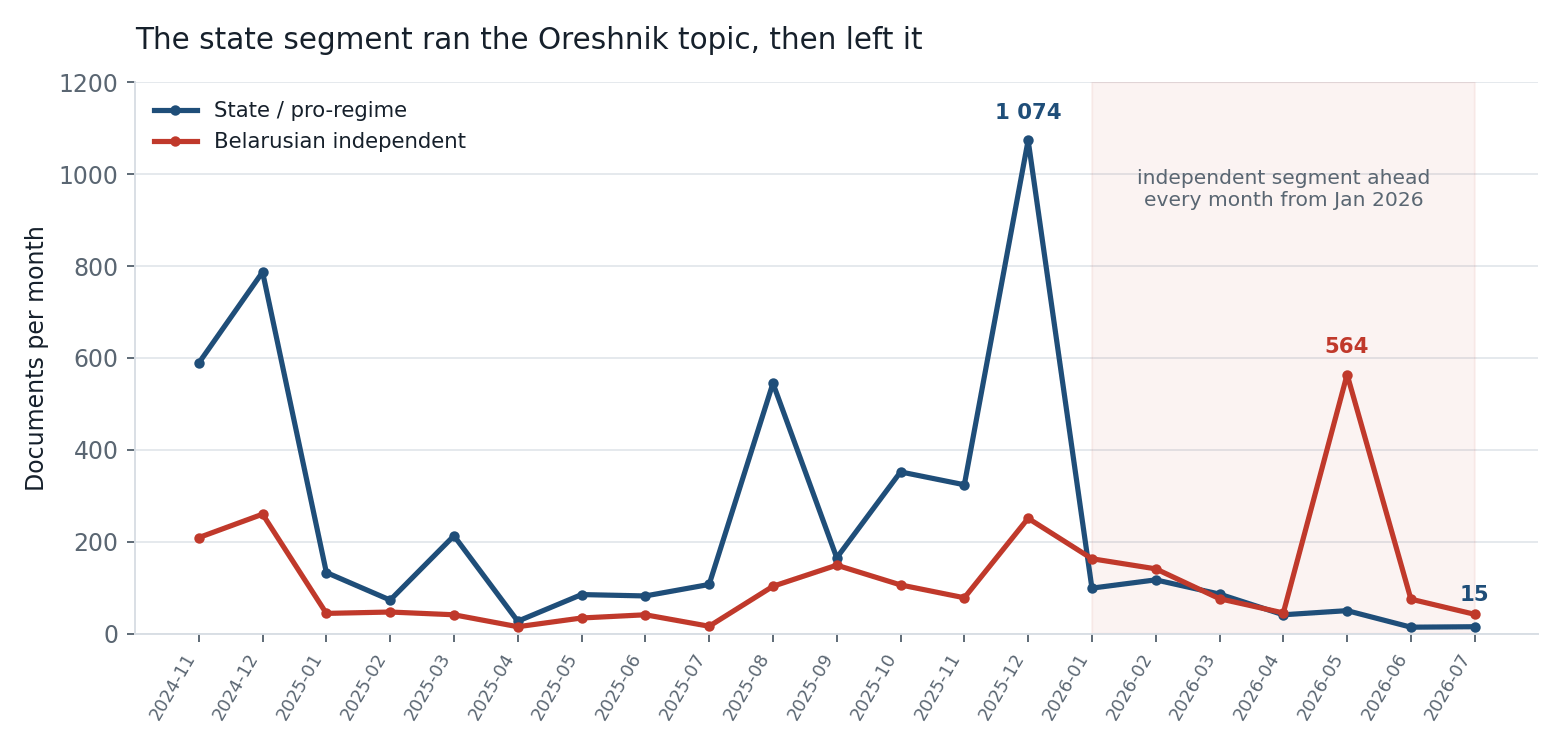
Two things constrain how far this can be pushed. The corpus grew unevenly over twenty months, adding more independent and foreign sources than state ones, so the ratio between the two lines is not a clean measurement across the whole series. The within-segment fall is cleaner — BelTA, SB and CTV were in the corpus throughout and are in it now, and 1,074 documents in December against fifteen in July is those same outlets changing behaviour. And the independent spike in May 2026, 564 documents against 75 the following month, has not been traced to an event; until it is checked for contamination, nothing rests on it.
What the state segment does say
Across its 4,978 Oreshnik documents the vocabulary is consistent and narrow. Security and defence terms appear 1,905 times, production 1,204, combat duty and deployment 1,085, deterrence 742, sovereignty 559. Components and parts: 215, which is 4.3 per cent and a generous count, since it includes every use of the word regardless of context.
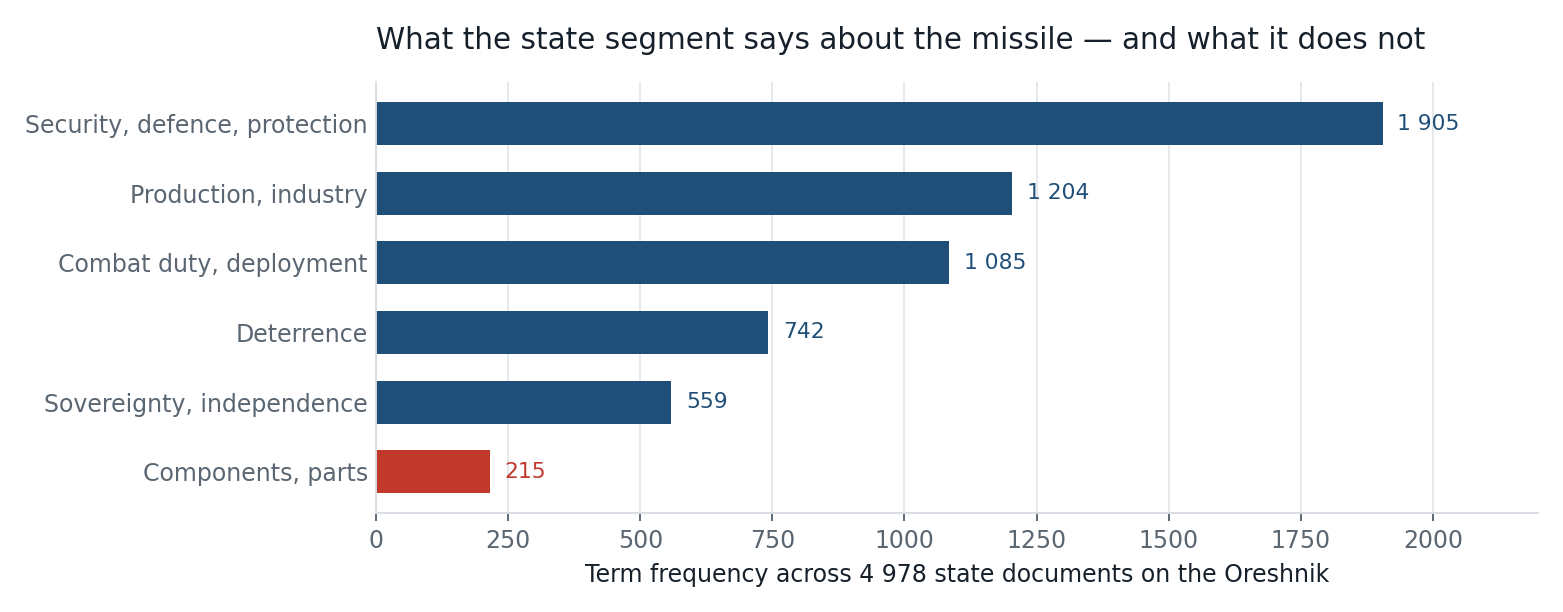
Production ranks second — but in this segment production means the Belarusian defence industry and Union State manufacturing in general, not Belarusian parts inside a Russian missile. The distinction is the whole finding: the state segment is fluent about industry and silent about this particular supply chain.
Who distributed the brigade
The brigade announcement is the cleanest case in the set, because the source was unambiguously the state. A serving colonel said it on military television. What happened next did not follow.
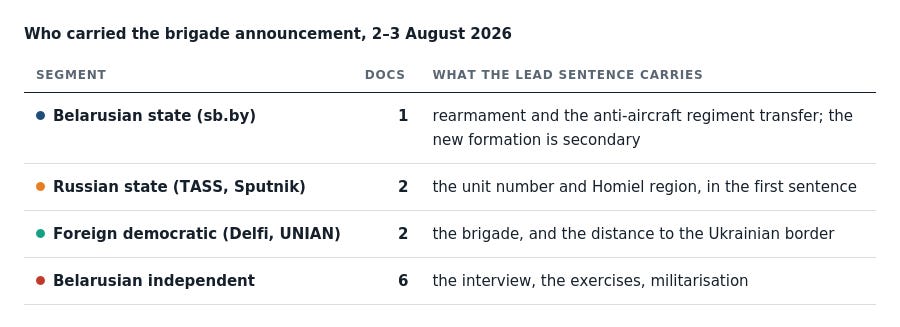
BelTA, the flagship state agency, did not cover it in the window. For anyone monitoring Belarusian military change through Belarusian state sources, the implication is uncomfortable: on this story the Russian state wire was the fuller source on Belarus.
Confidence
Watch items
The commander said the brigade’s formation completes this year. If BelTA reports the completion, the silence was about timing and nothing structural follows. If Sputnik and TASS report it and BelTA does not, the boundary is real and worth naming.
A state-side denial of the components claim would be the first state document on that rung, and would say more about the boundary than continued silence does.
If the command claim is repeated by a serving officer rather than a studio commentator, it moves from commentary to signal and should be treated as a separate event.
Method and limits
Corpus of 73 sources, web and Telegram, segment labels assigned at source level in advance, queries reproducible against PostgreSQL. The topic anchor matters here: aryeshnik is also the Russian word for a hazel bush, and the unanchored term returns 11,501 documents against 8,208 anchored to the weapon — roughly 29 per cent of any raw count on this term is shrubbery.
Three of the four SQL predicates in this run leaked, in three different ways, and the numbers above come from manual review of the item-level exports rather than from clean queries. The components predicate keyed on a surname shared by a regional chief architect and an athletics memorial, and returned a sports tournament and a patriarch’s visit as state-segment hits. The brigade predicate returned 138 documents, 119 of them one outlet’s general feed — weather, a stolen beehive, a tennis dress — which turned out to be page furniture landing inside the document text at scrape time rather than a loose predicate. The command predicate searched on the speaker and found him as a talking head: 28 of 69 documents were clips from one channel on unrelated topics.
Manual filtering removes false hits; it cannot recover documents a leaking predicate never returned. Every figure here is a lower bound. Classification used lead text rather than full bodies, so a claim mentioned deep in an article may be missed. The military television channel where the brigade was announced is not in the corpus, so the originating broadcast is not counted. Known date errors affect around a third of a per cent of documents in any rolling week.
This brief describes coverage. It does not establish that Belarusian components are in the missile, that the brigade is where it is said to be, or that any transfer of command authority exists.