

National Statistical Committee of the Republic of Belarus reported on 16 October that GDP grew by 2.0 percent in January to September. Its first estimates follow the same format every month: the size of the economy in rubles first, then the change in constant prices. From February to April, when that change was negative, all 14 state headlines on the releases in our collection gave only the ruble figure. From May, when it turned positive, all 33 led with the growth rate. Independent outlets headlined the rate every month. What we cannot see is who in the state newsrooms makes that choice.
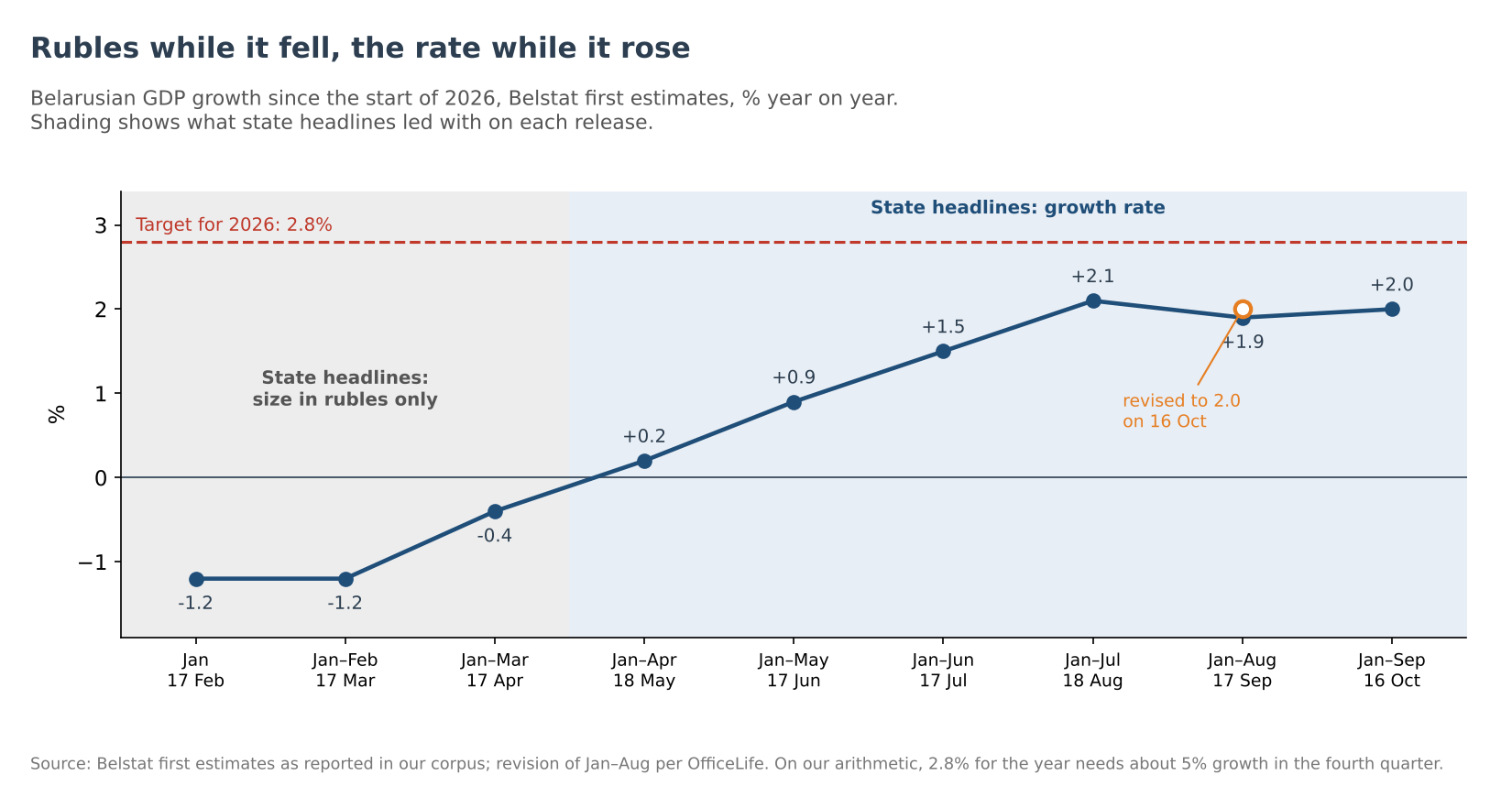
Rubles while it fell
In January GDP fell by 1.2 percent. BelTA’s headline said the economy “amounted to 23.3 billion rubles”, and SB and BelTA’s Telegram channel used the same form. Pozirk wrote that GDP “fell by 1.2 percent”, and Nasha Niva that it “began to fall”. The same split ran through the two-month and first-quarter releases. For the first quarter, minus 0.4 percent, BelTA’s headline was “68.2 billion rubles”. Where state posts gave the change at all, it came lower down as an index below 100.
The Economy Ministry’s channel went further. On the day of the first-quarter release it wrote that the economy had “moved closer to the target growth path”.
From February to April, when that change was negative, all 14 state headlines on the releases in our collection gave only the ruble figure.
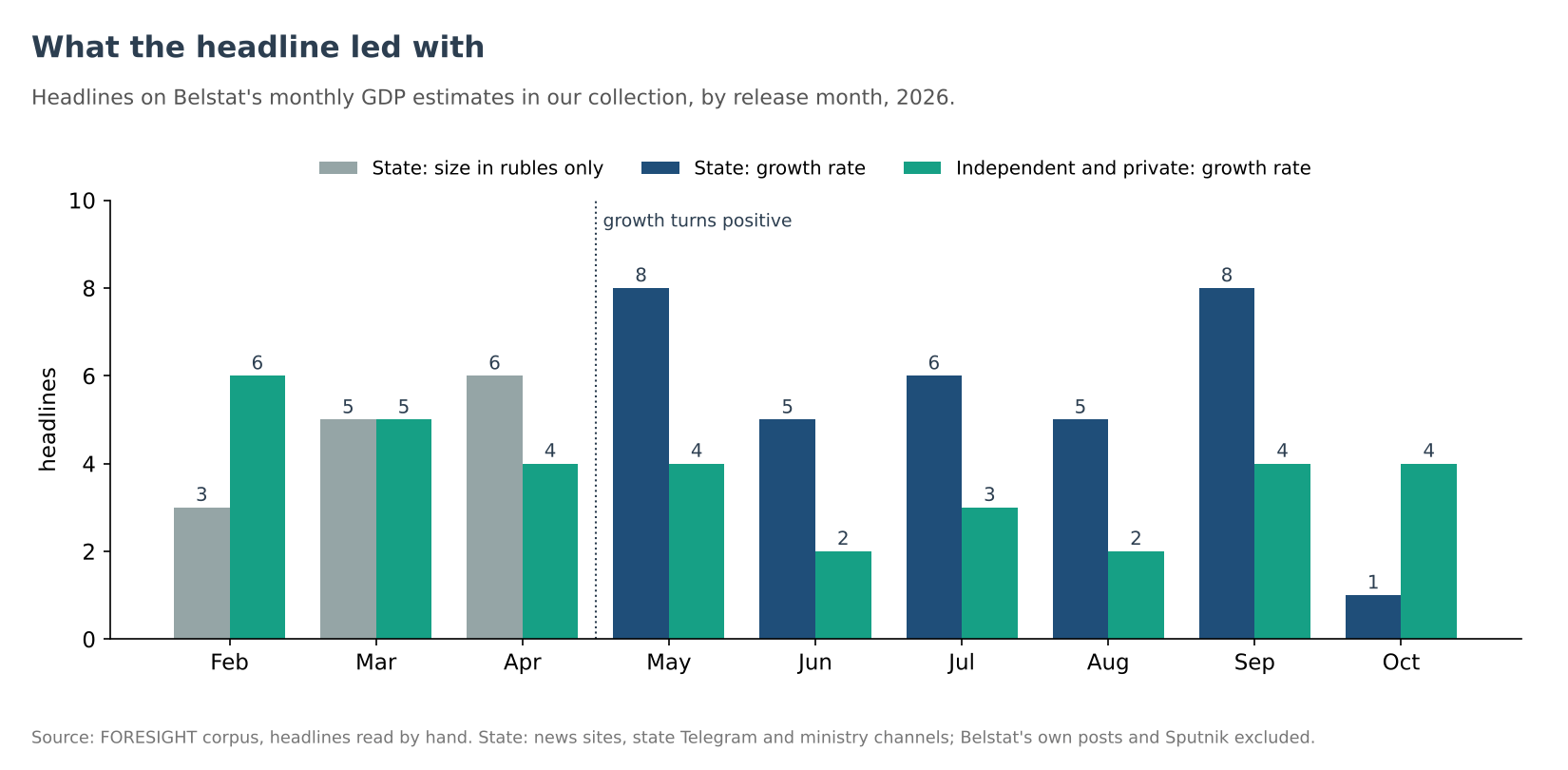
The rate while it rose
On 18 May growth reached 0.2 percent, and the rate appeared in every state headline: BelTA’s “grew by 0.2 percent”, followed by SB, STV, ONT and Zarya. In June the ministry’s channel announced that the economy had “sped up”. In September BelTA carried a Eurasian Development Bank finding that growth in January to July “accelerated”.
The rate stayed in the headline when it fell. In August the eight-month figure dropped from 2.1 to 1.9 percent, and BelTA wrote that GDP “grew by 1.9 percent”. Two days later the state site Belarus News rounded it to “almost 2 percent”.
An acceleration that was a revision
On 16 October several independent and business outlets reported that growth had sped up again, from 1.9 to 2.0 percent. Reform was one of them. But Belstat had recalculated the eight-month figure to 2.0 percent, so September did not change the total, as OfficeLife noted in its own text. BelTA’s headline said only that GDP grew by 2 percent.
The rate stayed in the headline when it fell.
The target in the corner
The year’s forecast, approved by Lukashenko, is 2.8 percent. State outlets rarely put that figure next to GDP this year. The clearest cases came on 1 September. The National Bank’s channel wrote that growth of a little over 2 percent was “below the level set by the President’s decree”, and NEWS.BY wrote that “by the annual plan we need to reach 2.8 percent”. In October BelTA reported that the Eurasian Fund for Stabilization and Development raised its forecast to 2.0 percent; the IMF’s new forecast is 1.9 percent, Nasha Niva reported.
On our estimate, reaching 2.8 percent for the year would take growth of about 5 percent in the fourth quarter. Cumulative growth has not passed 2.1 percent at any point this year, and the National Bank put the strongest quarter, the second, at 3 percent.
Nine months of 2.0 percent now leave the year’s target of 2.8 percent resting on the last quarter.
How sure we are
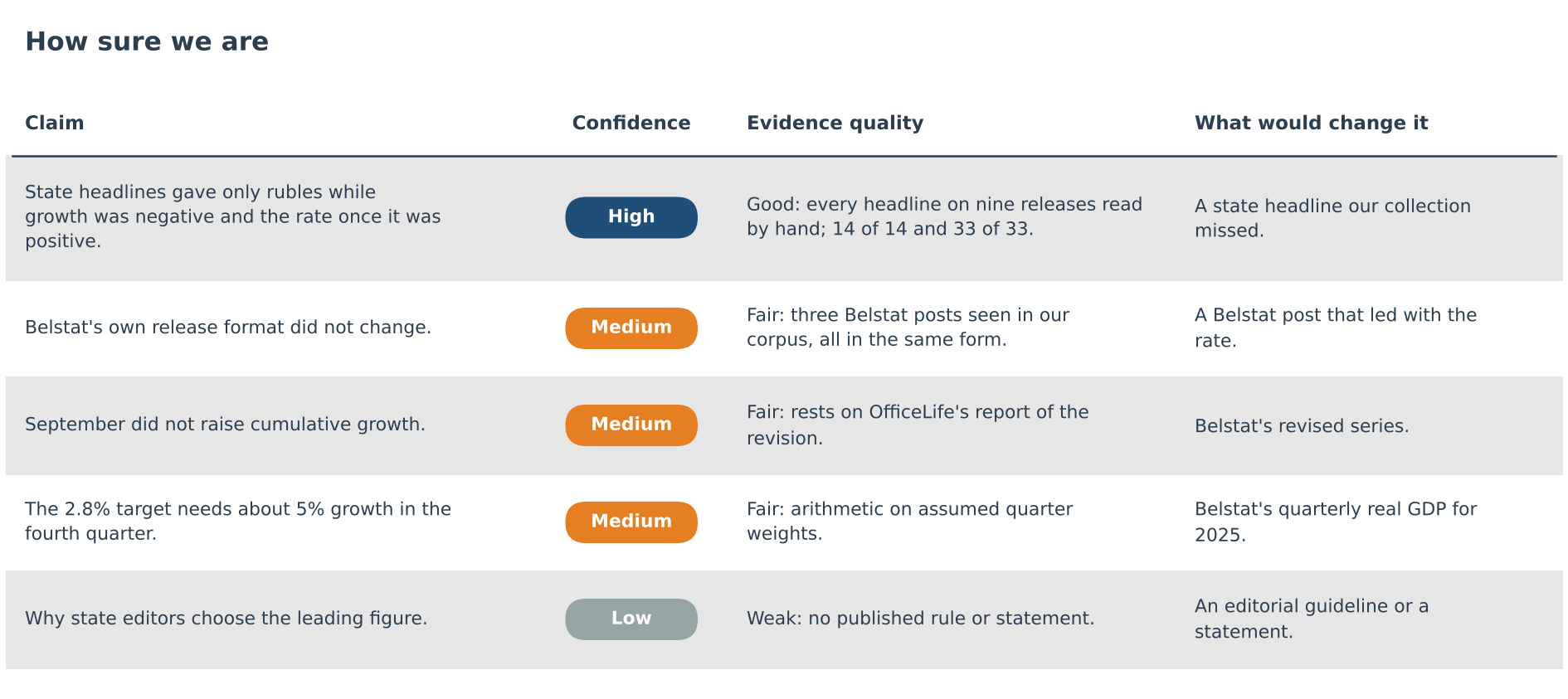
The headline pattern is High: every state headline on the nine releases was read, and the split by sign has no exception. The weakest row is the reason for it, since nothing published says how editors choose the leading figure.
Independent outlets headlined the rate every month.
How it fits
How it fits. State outlets headlined the ruble figure while growth was negative and the growth rate once it was positive. Belstat’s own format did not change. This fits T4, incidents come with a media plan, including silence: the fall was reported, but never in a headline. A simpler reading is that state editors follow the first number that sounds good, without any plan. If growth turns negative again and state headlines return to rubles, the pattern is a rule; if they headline the fall, it was habit.
What to watch
Belstat’s first estimate for January to October, due in mid-November, shows growth of 2.2 percent or less. We expect this, with Medium confidence.
Belstat’s first estimate for the whole of 2026 shows growth below 2.8 percent. We expect this, with High confidence.
By 31 March 2027, a BelTA headline on a GDP release gives only the ruble figure. We expect no such headline unless growth turns negative, with Medium confidence.
Method and limits
We collected every headline in our corpus from February to October 2026 that names Belarusian GDP for a period of the year. We kept the reports of Belstat’s nine monthly first estimates and read each headline by hand. Belstat’s own posts are not counted among the state headlines. State outlets here are state news sites, state Telegram channels and ministry channels; the Russian agency Sputnik followed the same pattern and is counted apart. The fourth-quarter estimate assumes the quarter is 27 to 29 percent of annual output in real terms; it is arithmetic, not a forecast. Thesis tag: T4.