
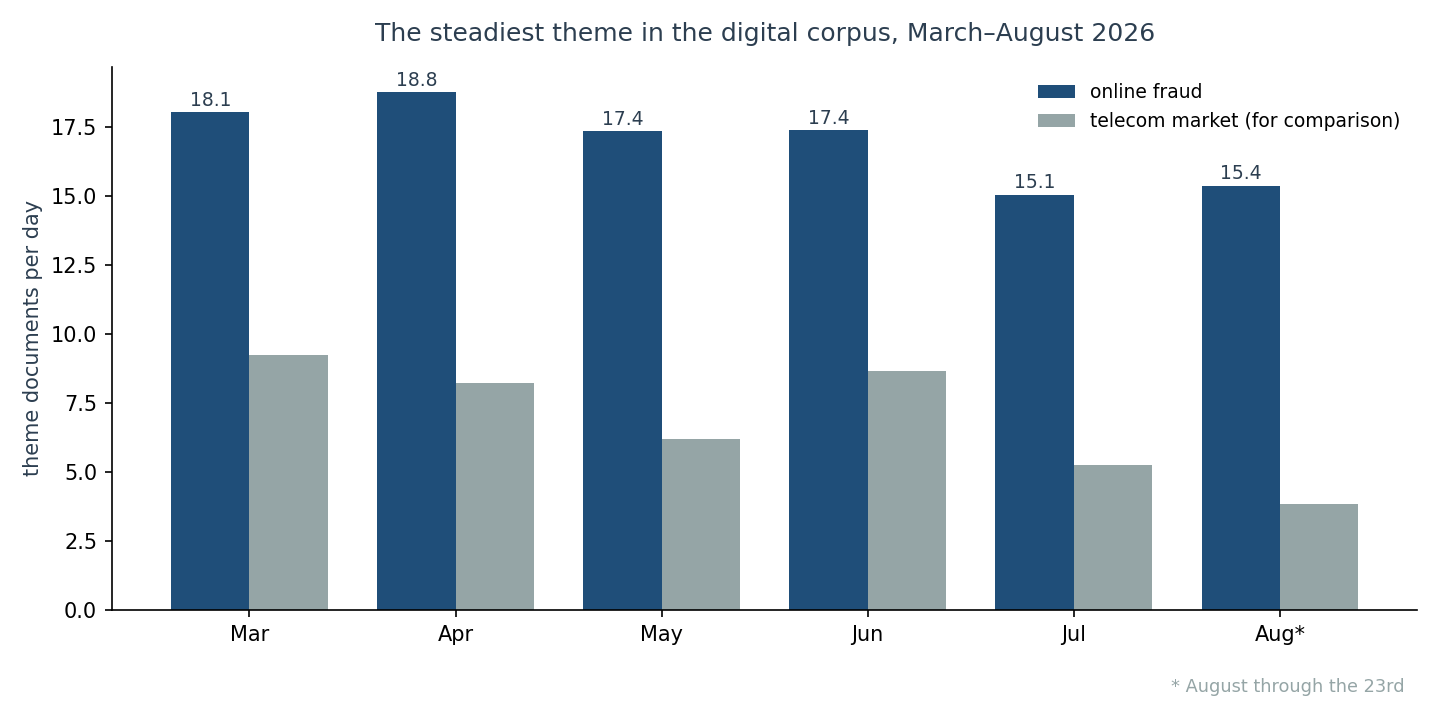
On 9 August BelTA reported that the police had received about 200 reports of scam calls over the previous day. On 12 August the state broadcaster’s channel put the figure at about 400. These bulletins run daily, with a counter, in the manner of weather. Across our corpus the online-fraud theme held between fifteen and nineteen documents a day for six months straight, the flattest series of all thirteen digital themes we track, while coverage of the telecom market fell by more than half over the same window. The steadiest digital story the Belarusian state told this half-year was about criminals.
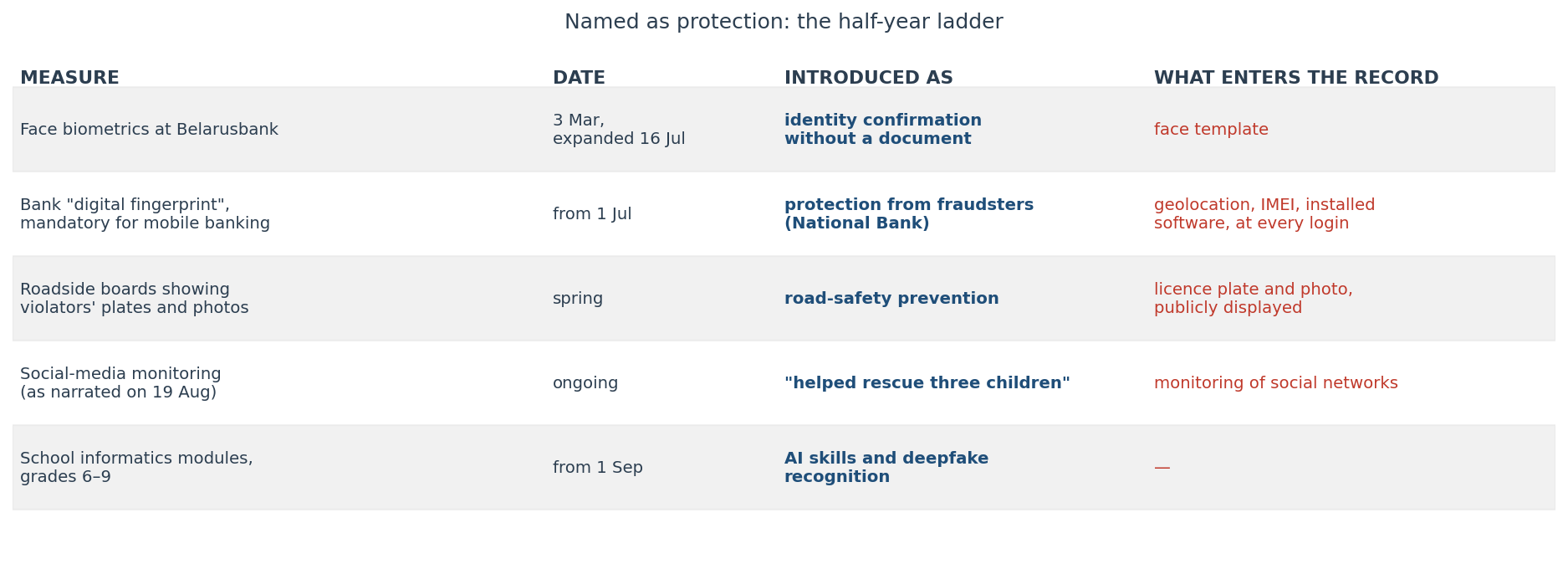
The drumbeat matters because of what arrived inside it. Each new piece of data infrastructure introduced between March and September came wrapped in a protective noun, and the noun did the work.
From 1 July, Belarusian banks are required to collect what the regulation calls a digital fingerprint of the client’s device: geolocation, IMEI, installed software, at every login to mobile banking. The National Bank’s deputy chairman Andrei Kartun explained the mechanics in May: at first login the system forms a “reference fingerprint”, and later deviations from it block the transaction. In state coverage the measure has exactly one name, protection of clients from fraudsters. Charter97 read the same document and asked who else gains access to a continuously updated geolocation record, and noted that consent survives on paper: a client who declines the collection loses remote banking. Zerkalo, in its consumer register, walked readers through what the change means at the level of the app. The state named the fraudster; the independents named the database.
The fingerprint is the largest rung on a ladder that runs the whole window. Belarusbank switched on facial biometrics in March, presented as identity confirmation without a document, and widened its geography in July. In the spring the traffic police began showing violators’ licence plates and photos on roadside boards; even the state’s own National Personal Data Protection Centre publicly questioned the legality of that display, since a plate is personal data. On 19 August three state outlets ran the same story under the same angle: social-media monitoring had helped rescue three children in Vitebsk. The monitoring itself is not news; its narration as child rescue is the register at work.
The state named the fraudster; the independents named the database.
By September the voice reaches the classroom. From 1 September, according to the state broadcaster, informatics in grades six to nine gains modules on working with AI and recognising deepfakes. Over the summer the operator Life, with the ministry’s channel amplifying, ran cyber-security lessons in children’s camps and reported seven thousand schoolchildren at its online safety classes; in mid-August the Hrodna region opened a digital-literacy week with safe messaging as its headline theme. None of these items is sinister on its face, and that is the point of reading them together: protection is the register in which the state now discusses everything that happens between a citizen and a screen, and the register does not distinguish between a phishing warning and a mandatory geolocation feed.
Consent survives on paper: a client who declines the collection loses remote banking.
Two things make this a series rather than a mood. The first is the volume floor: fraud coverage does not spike around its own news, it simply never stops, which is what distinguishes a campaign from a beat. The second is the direction of the asymmetry. In the fraud theme the state outproduces the independents roughly two to one, the reverse of nearly every other people-facing digital theme in the corpus; this is a story the state wants to own. What the drumbeat never carries is the follow-up question the measures invite: whether the fraud losses that justify each new collection are actually falling.
The steadiest digital story the Belarusian state told this half-year was about criminals.
What to watch
The school modules are the nearest checkpoint: the published grade six to nine informatics curricula, in the first week of September, either contain the AI and deepfake units or they do not; our only source so far is state television’s channel. The National Bank’s fraud-loss reporting for the second half of the year is the test the measures set for themselves: if the loss and incident series keeps rising into 2027 while the fingerprint collection stands, the stated purpose is unmet and the database remains. The daily police counter is worth logging as a series in its own right; two readings, 200 and 400 within four days of each other, already suggest it will not be a stable statistic, and whether the МВД begins publishing consolidated weekly or monthly totals in the fourth quarter will show whether the counter is measurement or rhythm. And we expect at least one further collection measure to be introduced under a protective name before the end of 2026; SIM-card rules and messenger verification are the obvious vacant spaces. If the next measure arrives named as control rather than as care, that would be the genuine surprise.
The monitoring itself is not news; its narration as child rescue is the register at work.
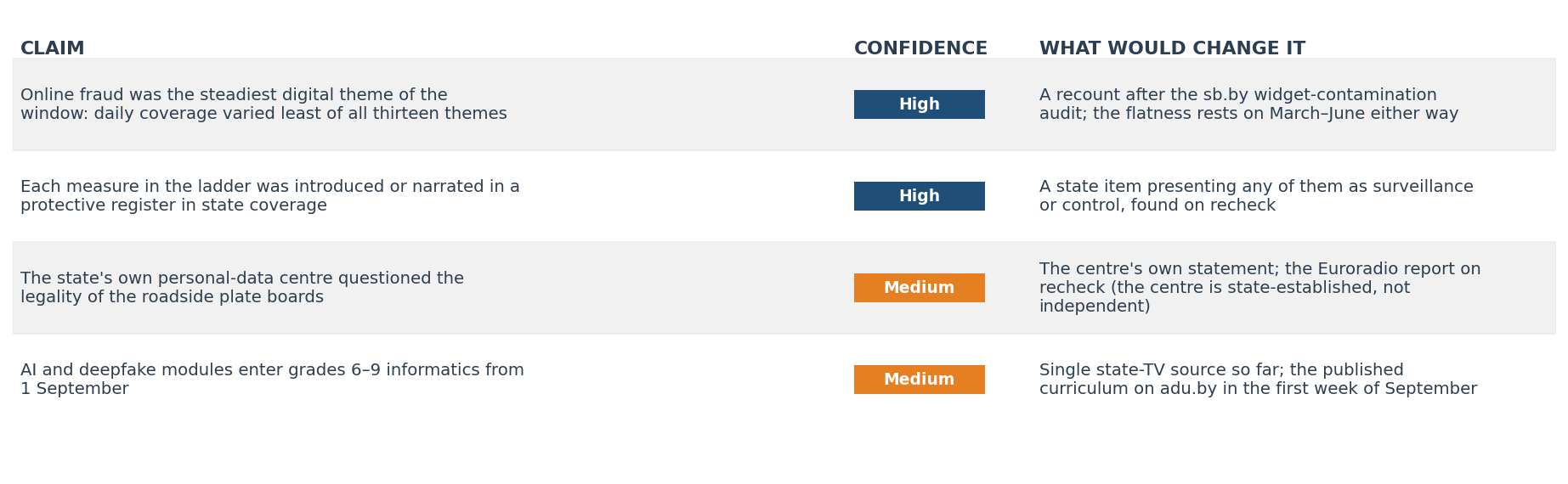
Method and limits. Built on the FORESIGHT corpus: 290,290 documents dated 1 March – 23 August 2026 within a 3.78-million-document archive of Belarusian state, independent, business and exile media. The fraud theme is selected by hybrid retrieval, semantic similarity plus a lexical anchor in the headline or lead; 66 percent of its documents carry a Belarusian marker there. Daily rates divide monthly counts by calendar days, August by 23. A known defect inflates uncertainty in the July and August counts: one major state outlet stores a site-wide news ticker inside the article text field, and the flatness claim therefore rests primarily on March–June; a corpus-wide audit is pending. The state-established status of the National Personal Data Protection Centre and the single-source school-curriculum claim are held at medium confidence, as marked. All figures are journalists’ renderings of official statements, not the underlying records.