

On 28 September a decree discharged Pavel Muraveyko, the chief of the General Staff, from military service “in connection with reaching the age limit”, and named him deputy head of Lukashenko’s Administration. He had turned 55 two days earlier. In our collection, 67 state items covered the move, and in none did his age appear near his name; they told it as Lukashenko’s own choice of an “alternative, competing point of view”. The defence minister, Viktor Khrenin, turned 55 in August and still serves. What we cannot see is why the age rule moved one general and not the other.
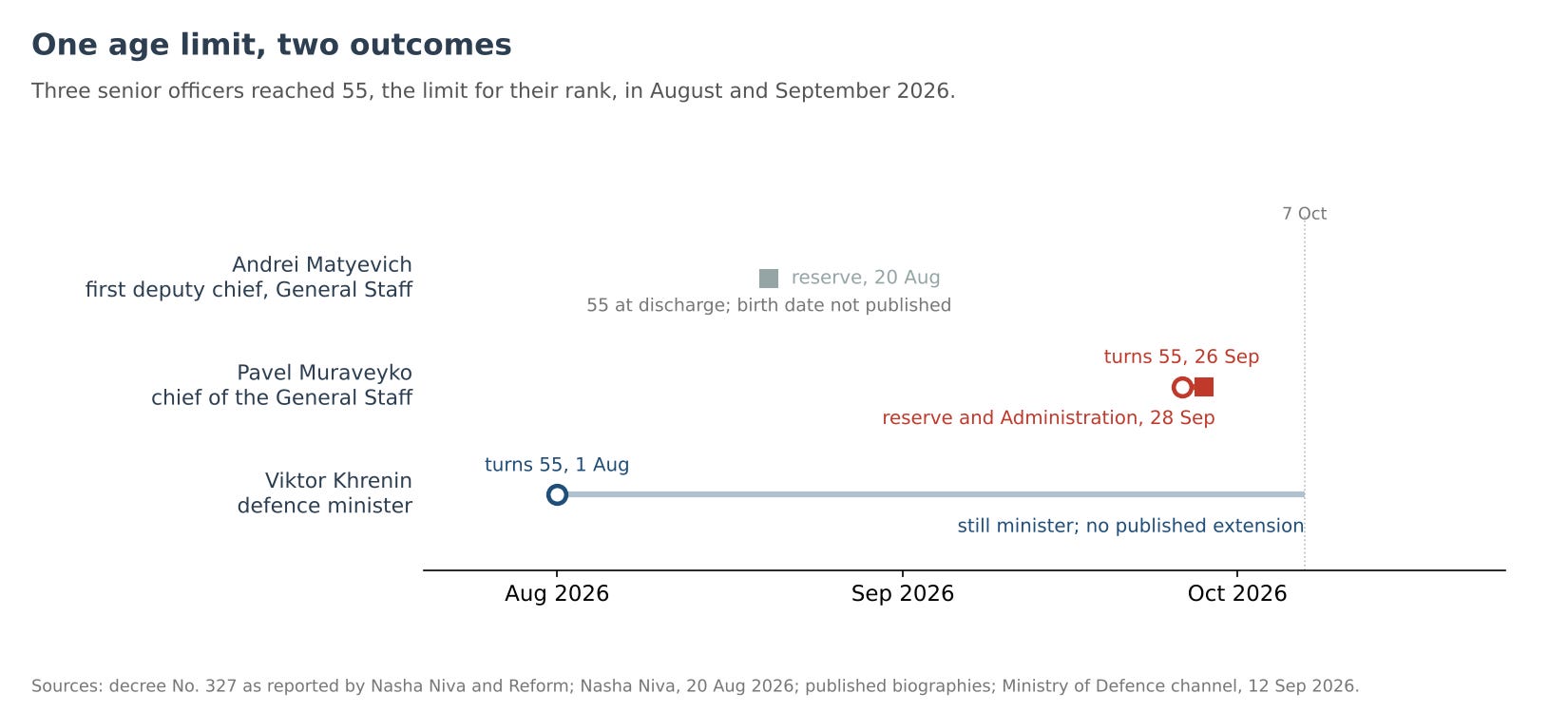
Two days after the birthday
Belarus’s law on military service sets the age limit for major generals and lieutenant generals at 55, according to the text of article 58. An officer who reaches it must leave the service. With his consent he can stay for up to five years, and then for five more, and for colonels and above the decision is Lukashenko’s.
In August and September the limit reached three senior officers. Andrei Matyevich, first deputy chief of the General Staff, was moved to the reserve on 20 August at 55. Muraveyko, born on 26 September 1971, according to his school’s alumni page, followed on 28 September. Decree No. 327 discharged him by age and kept his right to wear the uniform, and the same decree gave him the civilian post.
State media told the move as a personal choice and never mentioned his age.
Khrenin was born on 1 August 1971, according to a biography of Suvorov school graduates. He is a lieutenant general, so the same limit applies. On 12 September the ministry’s channel still signed him as minister and lieutenant general. We found no published decision that extends his service, in our corpus or on the web. The law allows one, so his case is not a breach, but it is a choice that nobody has explained.
What state media said
State outlets gave the move one reading. BelTA quoted Lukashenko: an “alternative, competing point of view” must exist at the highest level. Nobody had recommended Muraveyko, he said, and the choice partly surprised the Administration’s leadership, the Security Council and the military. NEWS.BY’s channel quoted Muraveyko himself: his task is to give the leader “a full picture and an alternative view” of what happens around the country.
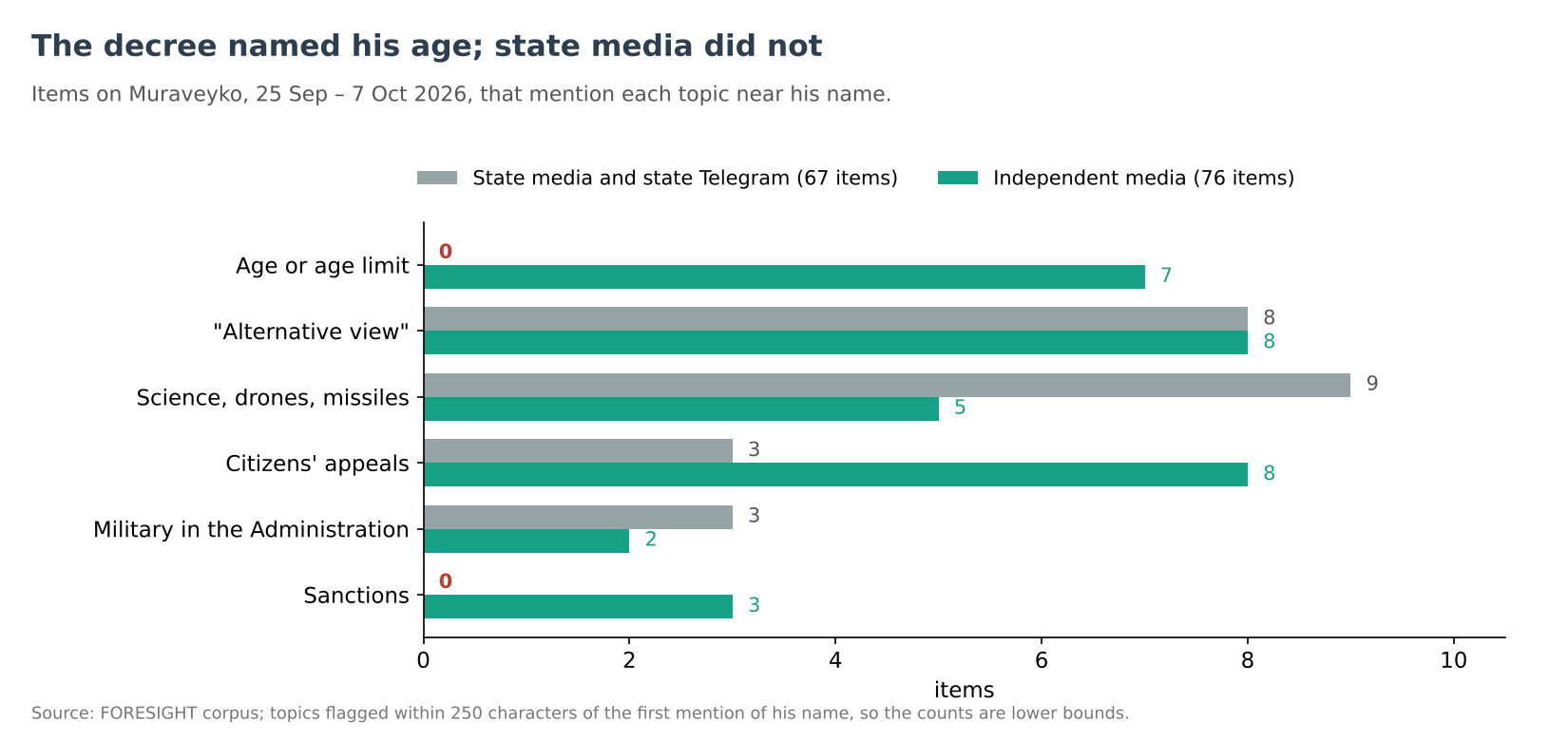
On 4 October the head of the Administration, Dmitry Krutoy, added two tasks. Muraveyko will oversee strategic projects in the defence industry and regional programmes, and he will work on citizens’ appeals. A day later Krutoy said that these appeals now also arrive through TikTok, Threads and Telegram.
We found no published decision that extends his service, in our corpus or on the web.
Independent outlets read the same decree and found the age. Seven of their 76 items mentioned it. Nasha Niva noted that he was moved “two days after he turned 55”, and Reform reported the age discharge the next morning. Pro-regime Telegram answered a third reading. On 2 October a post forwarded by Haidukevich’s channel complained that critics called the appointment “preparation for war”.
The alternative who reported on himself
His first public task in the new post came on 6 October, at a test site of the Academy of Sciences’ powder metallurgy institute. Lukashenko told scientists to “zero out” drones and gave them deadlines in 2027–2028, BelTA reported. Then he asked Muraveyko whether the work was done, adding, “You know this better than me, you have only just come from there.” “Done,” Muraveyko answered. “What there is, is done.”
STV called him “the bearer of an alternative position on military building”. On his first outing, though, the alternative view was asked about a field he had overseen until nine days earlier, and it confirmed that the work was done.
“You know this better than me, you have only just come from there.”
Sanctions came first
The sanctions did not slow his career. Switzerland listed him in December 2023 and the EU in January 2024, for his role in military-technical cooperation with Russia, according to OpenSanctions. Canada and Australia followed. He became chief of the General Staff in May 2024, four months after the EU listing, and he is not on the US or UK lists. His successor, Uladzimir Bely, is 49, Pozirk reported, and we found no sanctions listing for him.
How sure we are
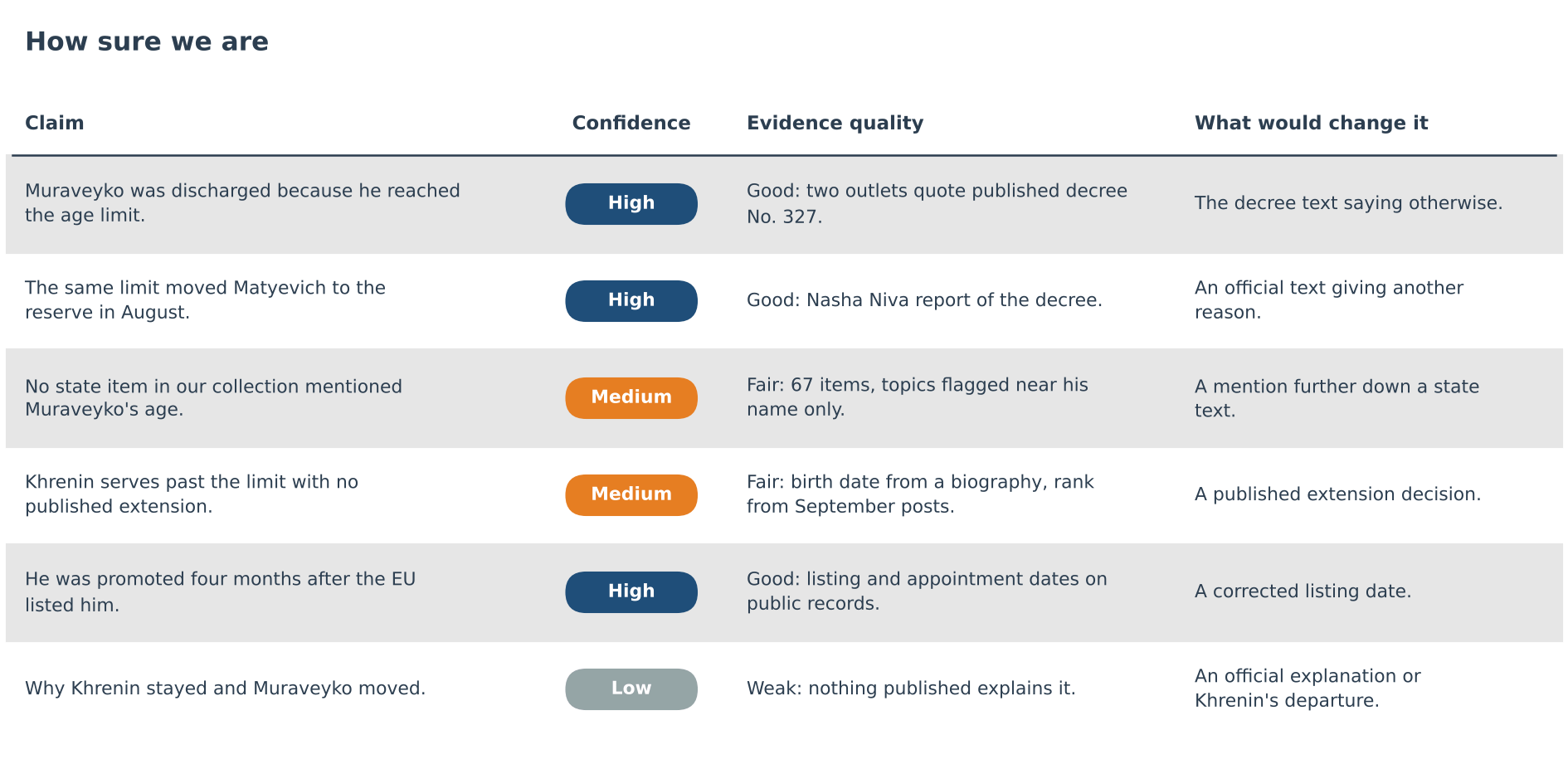
The age discharge rests on the published decree, and the dates rest on public records. The weakest row is the one that would explain the story: why Khrenin stayed. Nothing published answers it.
He became chief of the General Staff in May 2024, four months after the EU listing.
How it fits
How it fits. In two months the age limit reached three senior officers: two left the army, and the third stayed in his post. The state account of the move used Lukashenko’s words and left out the age that the decree itself named. One reading is that Lukashenko used a rule that would have ended Muraveyko’s service anyway to place a trusted general where he wanted him. The other is simpler: the move is routine retirement with a soft landing, and the “alternative view” is how it was presented. A published extension for Khrenin, or his departure, would show whether the limit is applied by rule or by choice.
What to watch
By 31 March 2027, a decision that extends Khrenin’s service is published, or he leaves the ministry. We expect neither, with Medium confidence: he stays and no decision appears.
By 31 December 2026, Muraveyko again reports on defence-industry work at an event with Lukashenko, as covered by BelTA. We expect this, with High confidence.
By 28 February 2027, the EU adds Bely to its Belarus sanctions list. We expect this, with Low confidence.
Method and limits
We searched our corpus for Muraveyko from 25 September to 7 October 2026: 169 items, of which 67 were state media and state Telegram, 76 independent and 13 pro-regime Telegram. Topics were flagged in a window of 250 characters around the first mention of his name, so a mention of age further down a text would be missed. We also searched for Khrenin from June 2026 for any extension, anniversary or age limit. Birth dates come from published biographies, and the age limits from a public copy of article 58 whose latest amendments, in force since October 2025, we have not checked against the official portal. Sanctions dates come from OpenSanctions, which records when each list added a person.