
Minsk and the exiled opposition both call Interpol politicised, and both are describing the same set of refusals. The Prosecutor General’s office publishes its own annual numbers, and read alongside the extraditions Belarus carried out in the same period they describe a mechanism that works normally for ordinary crime and jams on political cases. The jam is not the end of the story. In the same statement where he complained about Interpol, the Prosecutor General reported a thousand people a year located through Russia, and when neither channel delivers a person, the pressure lands on relatives who never left.
The complaint, twice
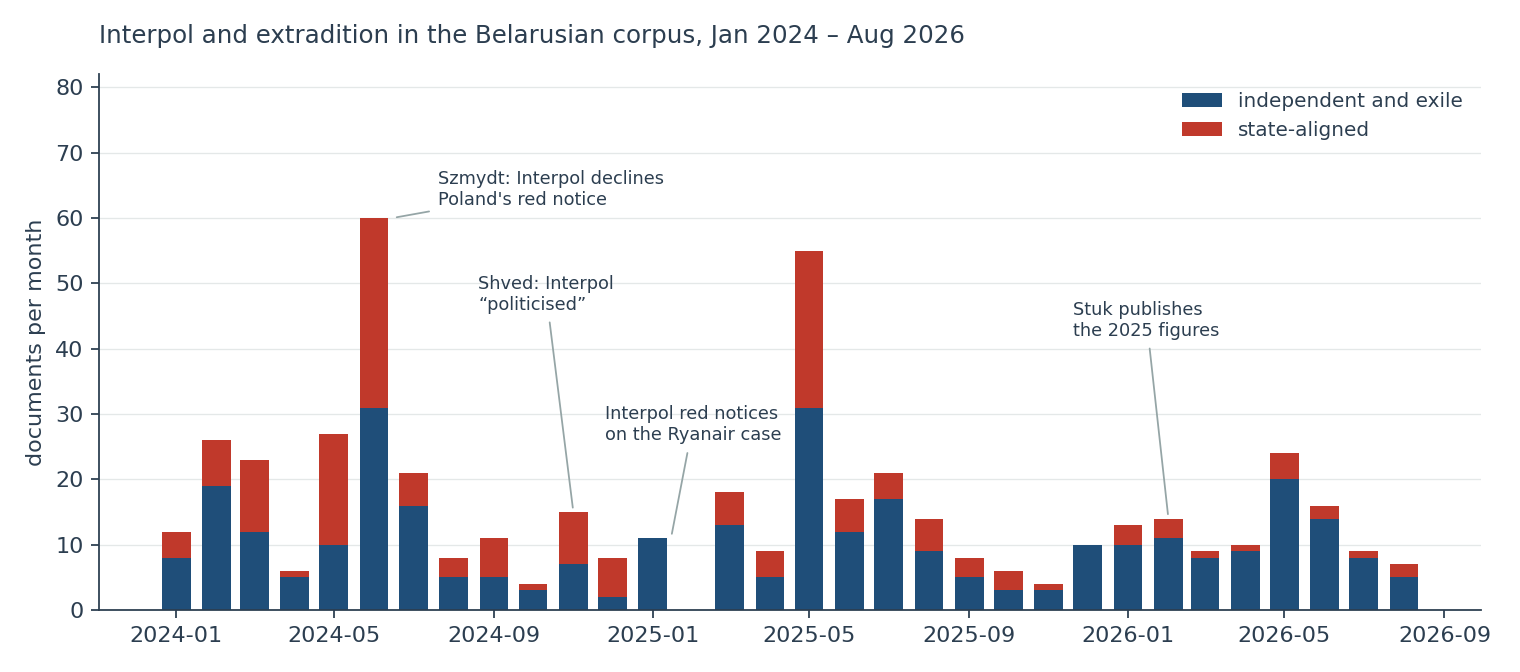
On 1 November 2024 Prosecutor General Andrei Shved said Interpol’s work was largely politicised and that the organisation was effectively blocking Belarusian wanted notices. More than half of the people Belarus was seeking, he said, were wanted under “extremist” articles or for evading military service. The statement entered the corpus that day through at least ten documents, seven state-aligned: three BelTA items, CTV, TASS, Belarus-News and the BTRC news channel on Telegram. Russia’s Prosecutor General Igor Krasnov was quoted the same day on politically biased attitudes to extradition.
Five months earlier the same outlet had run the opposite argument approvingly. Tomasz Szmydt, the Polish judge who defected to Belarus in May 2024, told BelTA on 5 June that Interpol’s refusal to circulate a red notice on him amounted to a veiled acknowledgement that the charges were political. PAP had reported the refusal the day before. Eight documents in the state-ledger subset, seven state-aligned.
The institutional act is identical in both episodes. A declined notice is evidence of the requesting state’s political motive when the request comes from Warsaw, and evidence of Interpol’s politicisation when it comes from Minsk.
The mirror case arrived on 28 January 2025, when Interpol issued red notices at Poland’s request on two Belarusians over the forced landing of the Ryanair flight in Minsk in 2021. Ten documents that day and the next, from Zerkalo, Pozirk, Nasha Niva, Reform, Euroradio, Charter97, Gazetaby, Mostmedia, BelNewsBy and Wirtualna Polska. Not one of them state-aligned. The segment that spent June 2024 explaining what an Interpol refusal proves had nothing to say about an Interpol notice.
A declined notice is evidence of the requesting state’s political motive when the request comes from Warsaw, and evidence of Interpol’s politicisation when it comes from Minsk.
The vocabulary stays inside officialdom. Across the Interpol material, “политизирован” appears in 23 state-segment documents and 22 independent ones, on a state subset roughly a quarter the size, and once in 176 pro-regime Telegram documents. It is a talking point for prosecutors, and the amplification pyramid does not carry it.
The year Minsk published
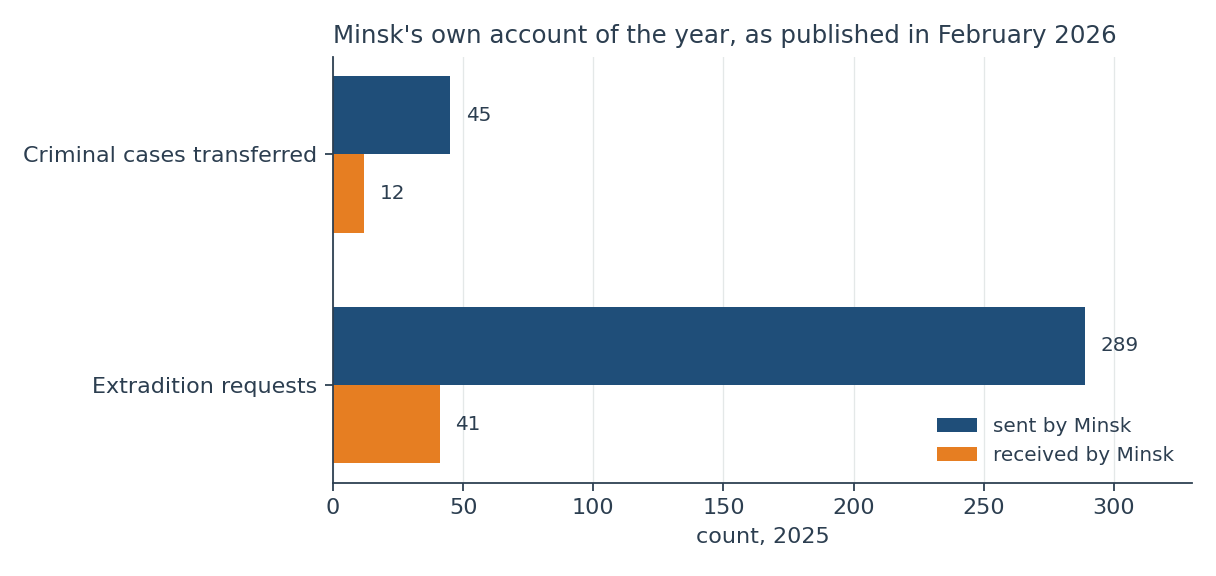
On 19 February 2026 deputy Prosecutor General Aliaksei Stuk gave the 2025 figures: 289 extradition requests sent abroad for Belarusian nationals, 41 received; 45 criminal cases handed to other jurisdictions, 12 taken in. Pozirk carried it, and the item sits in my corpus twice under two identifier schemes, one of eighteen such pairs I removed before counting.
Put Shved’s description of the caseload against Stuk’s arithmetic and the complaint answers itself. If most of what Minsk asks for rests on “extremist” charges and draft evasion, the refusals are the mechanism doing what its constitution requires. Nothing in the corpus shows Interpol stating grounds for any specific Belarusian refusal, so the inference runs through Minsk’s own account of what it asks for.
Mediazona and Zerkalo published the granular version of this in June 2024, reporting how Belarusian authorities work Interpol’s databases to pursue political emigrants. In November 2024 Valery Tsepkalo argued from the opposite direction, demanding that Belarus be made to submit its “extremist” and “terrorist” lists to the UN, Interpol, FATF, the OSCE and ICAO, on the reasoning that exposure to those bodies would discredit the lists rather than legitimise them.
If most of what Minsk asks for rests on “extremist” charges and draft evasion, the refusals are the mechanism doing what its constitution requires.
What Belarus does when it is on the receiving end
Traffic the other way moves without friction. Belarus extradited a Lithuanian citizen sought via Interpol in May 2024, handed Lithuania two more accused persons in June, and approved a Lithuanian request for a murder suspect that December. A third-country national went to Austria in April 2025, three men wanted for fraud to Tajikistan in July, and a man sought through Interpol to Turkey in May 2026. Parliament ratified an extradition treaty with Pakistan in May 2025. The interior ministry’s press service posted the Turkish handover under a hashtag for international cooperation and a line about the inevitability of punishment.
The reverse also holds where Minsk prefers it. Pozirk reported in May 2025 that a Finnish national wanted through Interpol had been sheltering in Belarus for a fifth year. In June 2024 Belarus was seeking a suspect detained in Kyrgyzstan in a transnational organised crime case, and in August 2024 state outlets announced that a Ukrainian had been placed on the international wanted list, a category that sits outside ordinary crime entirely.
Armenia is where the two tracks collide most often. Shved raised the extradition of Belarusians there in October 2024, the same month a Belarusian facing extradition received refugee status in Yerevan. Another political refugee in Armenia was reported at risk in June 2025. That September Belarus was reported to have withheld from Armenia its justification for searching for blogger Alexander Lapshin.
The channel that does deliver
The most useful sentence of 1 November 2024 was not the complaint. On the same day, in the same appearance, Shved reported that more than a thousand people wanted by Belarus are located annually on Russian territory. Pozirk rendered the same figure as more than a thousand over eighteen months. Either way the order of magnitude dwarfs the 41 extradition requests Belarus received in 2025 and sits against the 289 it sent.
The architecture around that number kept being built. In October 2024 Lukashenko approved a draft amendment to the CIS treaty on the search for persons, with negotiations to follow. In October 2025 the Belarusian and Russian prosecution services agreed to cooperate on oversight in the armed forces, and Shved presented Belarusian practice to the CIS coordination council of prosecutors general. Individual cases surface at the same rhythm: a man who had hidden in Russia sentenced in Minsk to twelve years on drug charges in November 2025, a furniture fraudster extradited from Russia to Belarus in May 2026.
The clearest instance is from April 2026, when a Russian court penalised a Russian citizen at the request of Belarusian prosecutors over a message sent to a Belarusian security officer during the 2020 protests. A six-year-old political case, prosecuted inside Russia, against a Russian national. No red notice would ever have carried that.
Personnel moved in the same period. Shved left the Prosecutor General’s office on 19 December 2025, elected chairman of the Supreme Court at the second session of the All-Belarusian People’s Assembly, which puts the man who called Interpol politicised at the head of the court system that hears in-absentia proceedings. Dzmitry Hora, previously head of the Investigative Committee and before that of the KGB’s investigative directorate, was appointed Prosecutor General on 23 December. Stuk’s February figures were published under him. In July 2026 the head of the Belarusian National Central Bureau of Interpol was dismissed, without a published reason.
The man who called Interpol politicised now heads the court system that hears in-absentia proceedings.
Where the pressure goes instead
On 6 August 2026 the Belarusian Association of Journalists described a nationwide wave of visits to parents and relatives of journalists who had left, at least fifteen cases in recent weeks, carried by Zerkalo, Pozirk, Reform and Euroradio within a day. Reports the next day said relatives of departed journalists were being asked for DNA samples. On 8 August Viasna and Dissidentby recorded relatives of released political prisoners summoned for talks, sometimes twice a week, threatened with travel bans.
The DNA practice first appears in the corpus a year earlier, on 8 August 2025, when MAYDAY TEAM reported officers in Mahiliou region collecting genetic material from relatives of activists and former political prisoners who had gone abroad. Six documents that day, then nothing until the 2026 wave.
Viasna’s six-year report the following day treats this as a counted category rather than a new development: pressure on relatives sits inside an aggregate of more than 100,000 recorded instances of persecution since 2020, alongside detentions, searches and interrogations. The report gives at least 10,016 people criminally prosecuted on political grounds, at least 8,670 convicted including in absentia, and at least 879 political prisoners held on 9 August 2026. Several outlets headlined 4,602 instead, the cumulative count of people granted political-prisoner status over six years rather than the number in detention. Viasna titled the English edition for transnational repression, so the frame this brief tests is its own.
The layers touched in the same week. On 7 August 2026 the Prosecutor General’s office asked Poland to extradite Dzmitry Salauyou, former editor of Mahiliouski Rehiyon, on two political articles. On 10 August Leanid Marozau, legal adviser to Sviatlana Tsikhanouskaya, told Euroradio that detentions on Interpol lines had become close to weekly, with charges reframed after 2024 as economic or drug offences (broadcast).
When neither channel delivers a person, the pressure lands on relatives who never left.
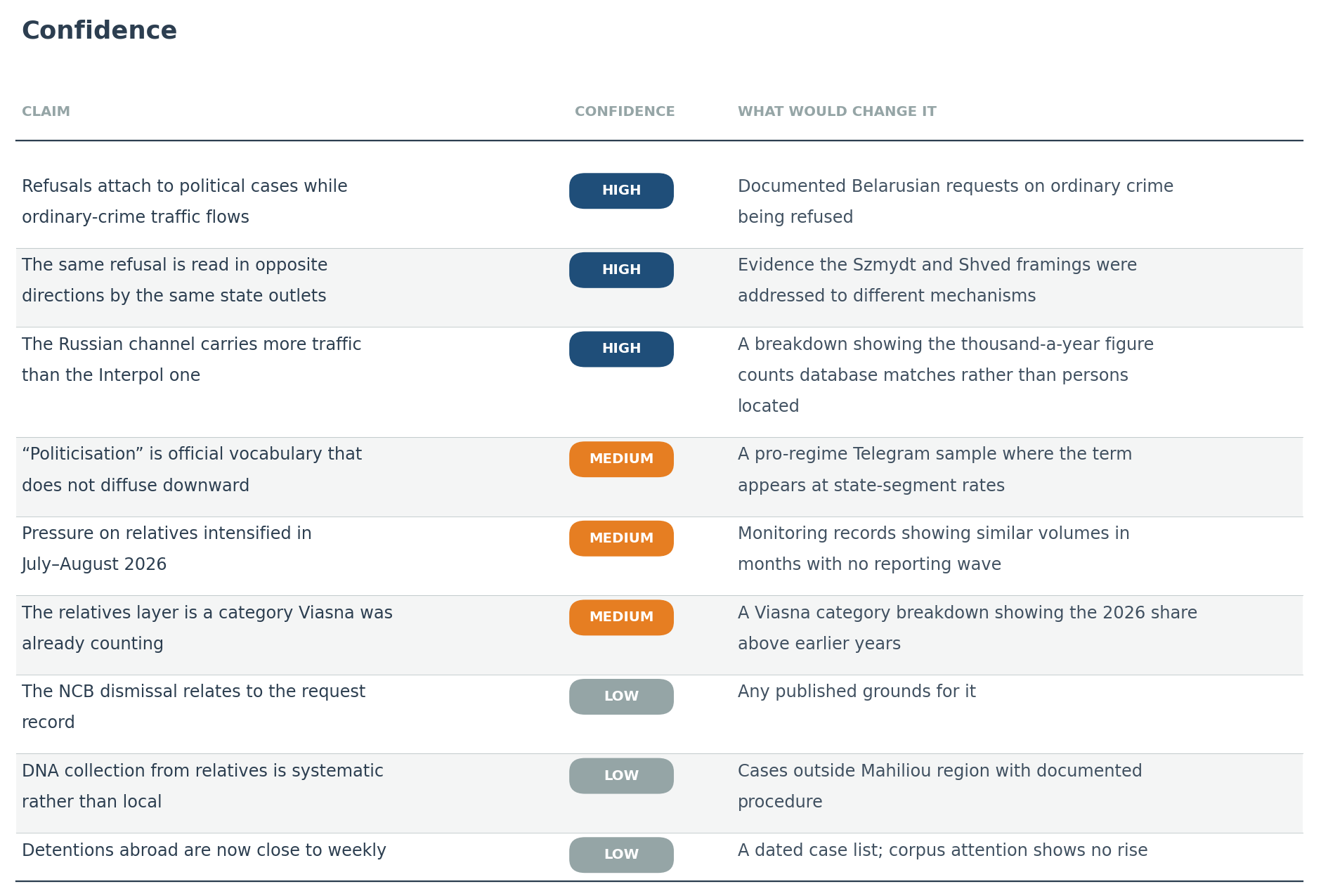
Confidence
Monthly attention in 2026 runs at 13, 14, 9, 10, 24, 16, 9 and 7 documents, at or below 2024 levels. Marozau’s frequency claim is about events; the corpus measures coverage, and coverage of routine detentions is thin. February 2025 returns zero documents, which I read as a corpus gap rather than a month without cases.
Watch items
By 30 September 2026: whether Poland responds publicly to the Salauyou request, and on what grounds.
By 31 October 2026: whether the new head of the Belarusian NCB produces any change in published request volumes.
By 31 December 2026: whether the CIS search treaty amendment approved in October 2024 is signed, and whether its text is published.
By 31 December 2026: whether the DNA practice appears in a second region with a named procedure, or stays a Mahiliou-region report.
At the February 2027 briefing: whether the outbound figure moves off the 289 level, whether the Russian location figure is given again, and whether the “extremist article” share is repeated under Hora.
Method and limits
Corpus query over Belarusian state, independent, exile, Telegram and foreign segments, January 2024 to 12 August 2026. The series counts 496 documents where an Interpol term appears in the headline or the first 400 characters, 327 in independent and exile segments and 169 state-aligned. The relatives layer was tightened by hand from 1,166 matches to 34, the DNA layer from 119 to 7, the remainder being forensic reporting on cold cases. Viasna figures come from its six-year report of 9 August 2026. The thousand-a-year Russian figure is reported in two incompatible forms by BelTA and Pozirk from the same appearance. Figures attributed to Shved, Stuk and Marozau are their own public statements, reproduced as claims.