
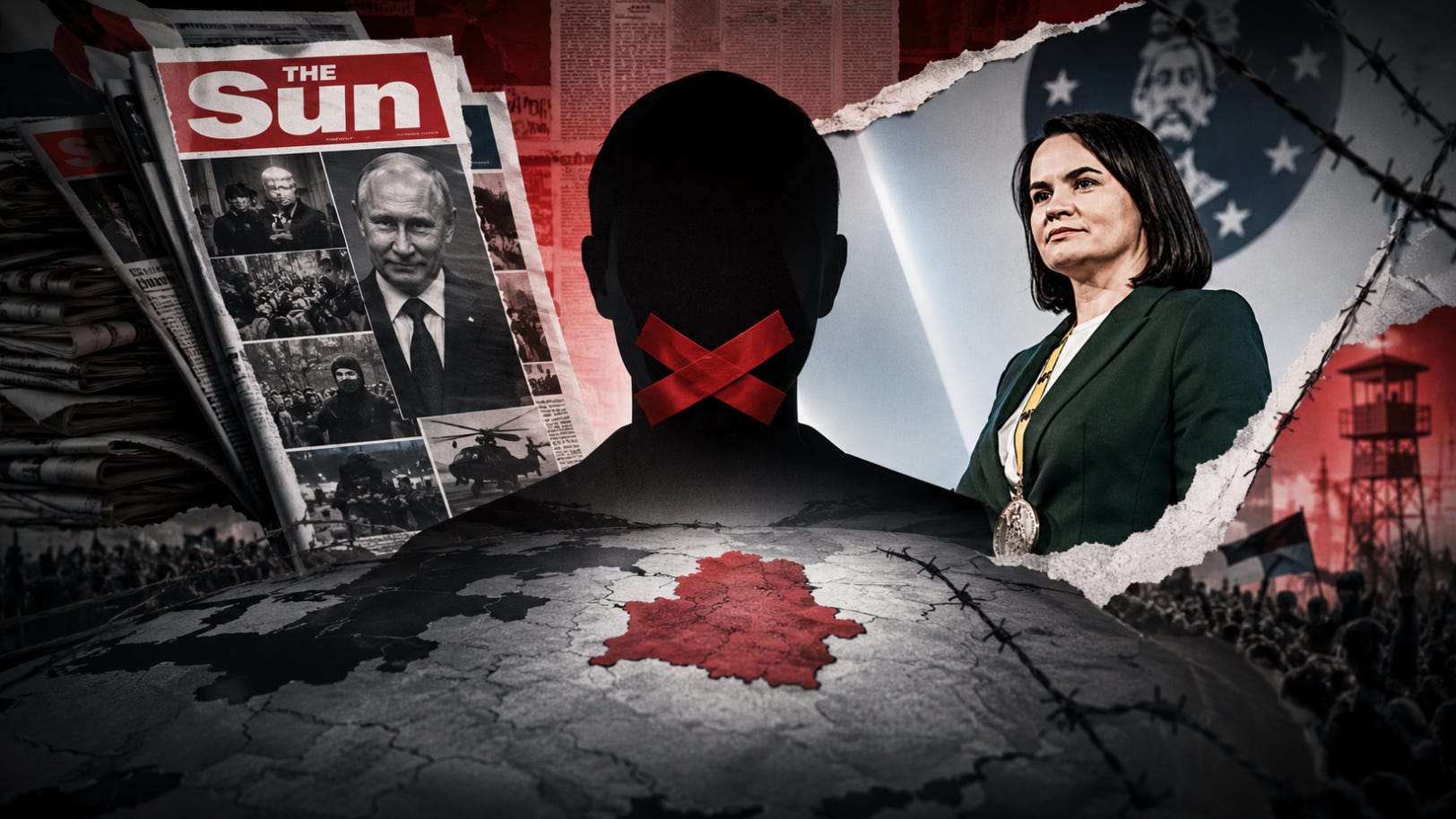
Here is a number I cannot stop thinking about. We just finished coding every article Britain’s biggest tabloid, The Sun, has published about Belarus in ten years: 123 pieces, 2016 to 2026. In eight of them, Belarusian society acts, speaks and has motives of its own. Eight articles in a decade.
Not eight sympathetic articles. Sympathy is abundant: repression is actually the single largest frame in the corpus, 25 articles about crackdowns, political prisoners and executions. But sympathy is not agency. In the tabloid’s telling, Belarusians overwhelmingly appear as objects: people things are done to, on a territory things are done through. Across the 83 articles genuinely about Belarus, the country is an instrument of someone else’s will in 54 and scenery in 18. The “someone else” needs no introduction.
The exception is what makes this a story rather than a complaint. For roughly two months, August and September 2020, the frame broke. Maryia Kalesnikava tore up her passport at the border, and The Sun wrote about a woman who out-manoeuvred her own kidnappers. Crowds filled Minsk, and The Sun wrote about a society, not a regime. Even its Lukashenko coverage of those weeks portrayed a man scrambling to react to Belarusians, rather than Belarusians existing at his pleasure. Four of the nine articles from that window grant agency. That is more than the following five years combined.
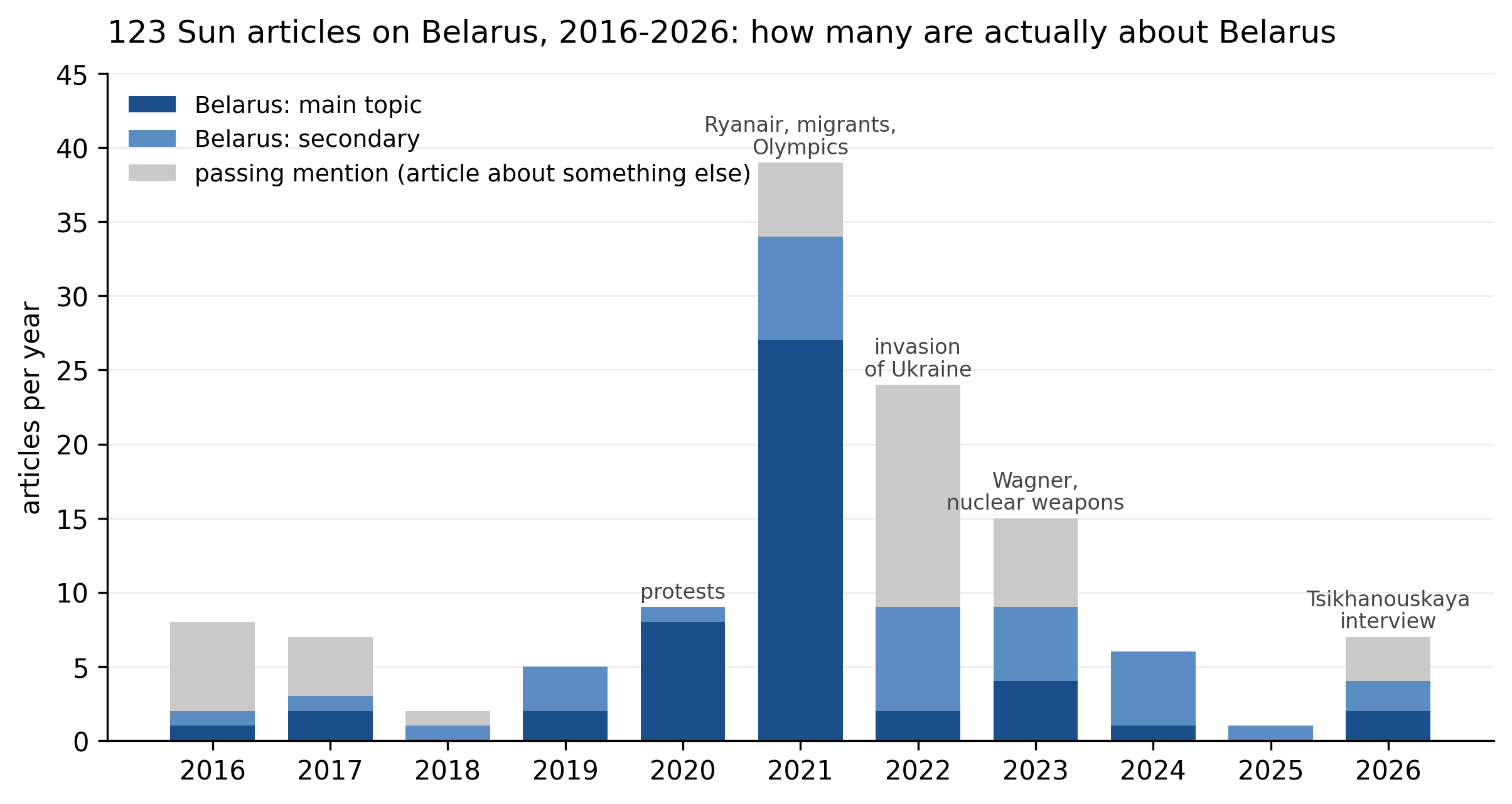
Then came 2021, the year Belarus finally got the tabloid’s full attention: 39 articles, a third of the entire decade, driven by the Ryanair hijacking, the weaponised migration crisis and the Olympics. And here is the twist the data delivers: the peak of attention was the peak of voicelessness. Of the 34 substantive articles that year, exactly two grant Belarusians agency, both about sprinter Krystsina Tsimanouskaya, the one 2021 protagonist who acted on camera, refusing to board a plane home. In 32 of 34 articles, Belarus is simply identified with Lukashenko. Raman Pratasevich appears in six articles and acts in none. Attention, it turns out, is not the same as visibility.
The pattern has held ever since. After February 2022, Belarus dissolved into war coverage as a launchpad and a nuclear parking lot. In 2025, an election year, The Sun published exactly one Belarus article, and it was about a prisoner release framed as a favour to Trump. The presidential election itself, a story featuring a dictator voting with a Pomeranian named Umka, did not clear the bar. We checked three independent ways; the silence is real.
What did the eight exceptions have in common? Not politics. The earliest is from 2016: a Minsk software engineer who built his father a prosthetic arm in a basement and posted the blueprints online for free. Then a Eurovision duo. Then Kalesnikava. Then Tsimanouskaya, twice. Then Ales Pushkin, the artist whose protest was his art, and whose death in prison The Sun covered as the story of a man who acted. Then Sviatlana Tsikhanouskaya, twice, most recently last week.
Every one of them is a named person with a deed and a legible motive. That is the entire formula. Elections do not clear the tabloid threshold; statements do not; anniversaries do not. A person who does something does.
For everyone working to keep Belarus visible in the West, that is both a constraint and an instruction. The mass-market frame will not carry abstractions, and it will flatten the country into one man’s name whenever we let it. But it demonstrably makes room for a Belarusian who acts. The window of 2020 was not opened by editors. It was opened by people.
The full study, with the corpus, codebook, charts and methodology, is out now on FactCheck.LT: A Country Without a Voice: Ten Years of Belarus in The Sun.
Numbers in this piece: 123 articles (2016-2026), 83 substantively about Belarus; agency in 11, of which 8 belong to society; 2021: 39 articles, agency in 2, Belarus-equals-Lukashenko in 32 of 34; 2025: 1 article. Methodology, reliability checks and editorial adjudications are documented in the full publication.