
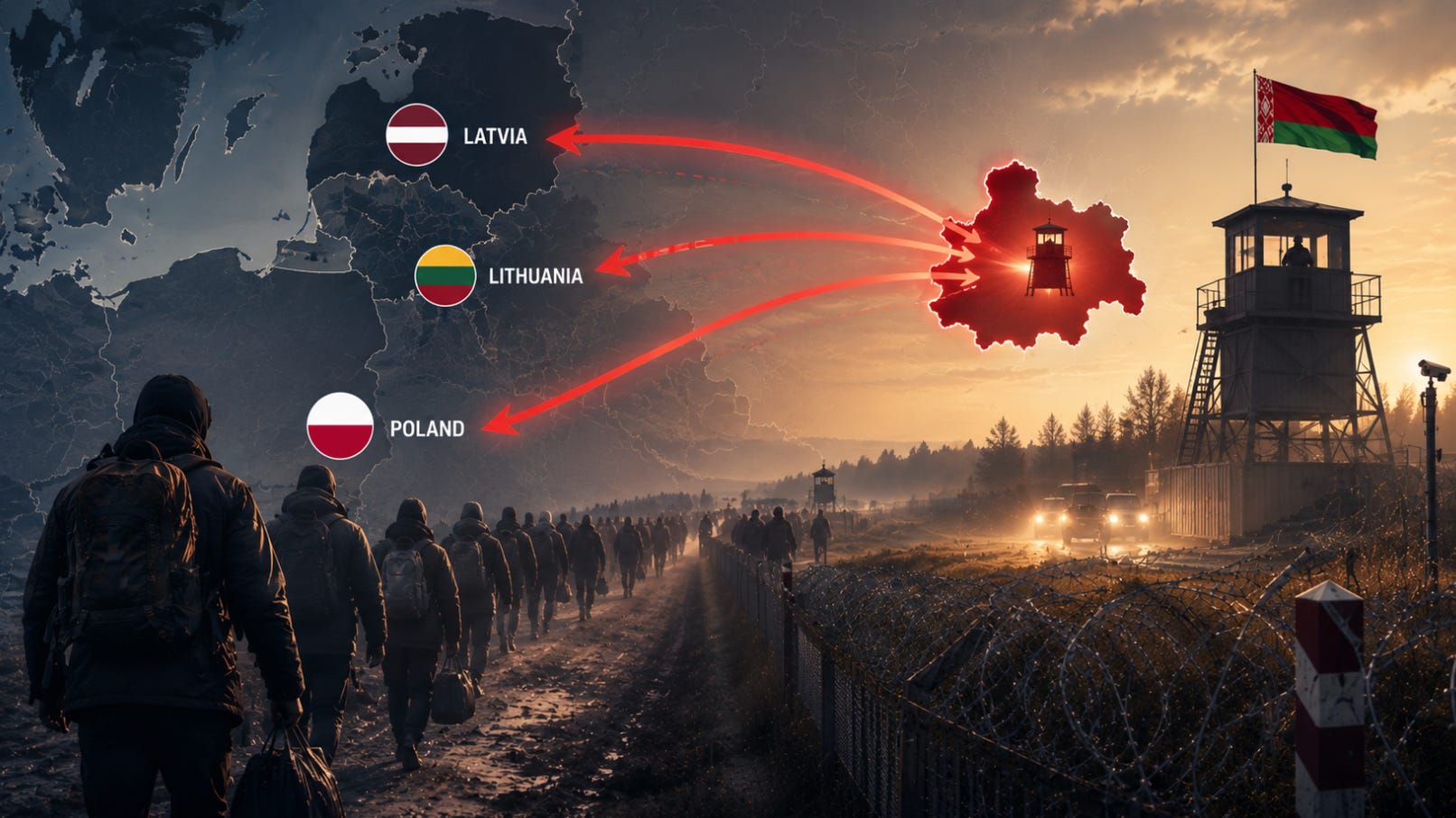
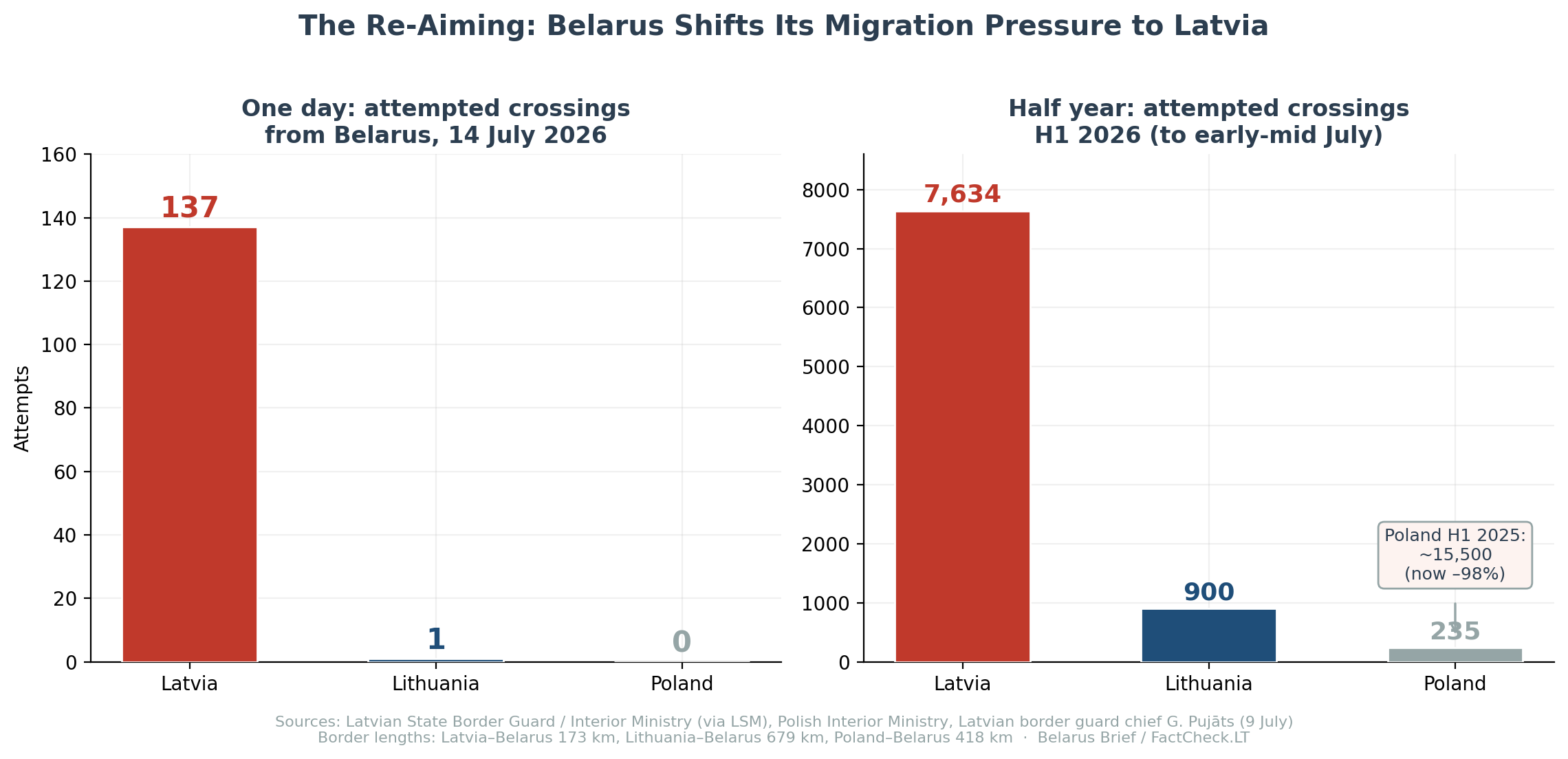
On 14 July, the three EU borders with Belarus told three different stories. Latvia recorded 137 attempted illegal crossings in a single day. Lithuania recorded one. Poland recorded zero.
This is not a fluctuation. It is the visible edge of a full re-targeting of the instrument Minsk has operated since 2021 — and the official border statistics of all three countries, read together, date the pivot almost to the week.
The displacement, in official numbers
Poland’s interior ministry reports roughly 235 attempted crossings from Belarus in the first half of 2026 — against more than 15,500 in the same period of 2025. A drop of over 98%, which Warsaw attributes to its border fortification and a claimed 100% apprehension rate. Lithuania’s count for the year stands near 900. Latvia’s, as of 9 July: 7,634 — already 800 more than in the same period last year, on a 173-kilometre border, the shortest of the three.
Whatever share of Poland’s decline is deterrence, the flow did not disappear. It moved. Latvia’s border guard chief Guntis Pujāts stated it plainly: Latvia is “currently the main destination” of the route.
The ramp: from a frozen January to a record July
The Latvian monthly series shows the pivot’s timing with unusual precision. January and February 2026: 12 attempts combined — a hard winter shut the route almost entirely. Late March: the streak begins — since then, Latvia has not logged a single day without an attempted crossing. April: 1,700. May: 2,433. June: 2,263. On 1 July, a single day brought 232 attempts — a figure unseen on any Belarus-EU border since September 2023.
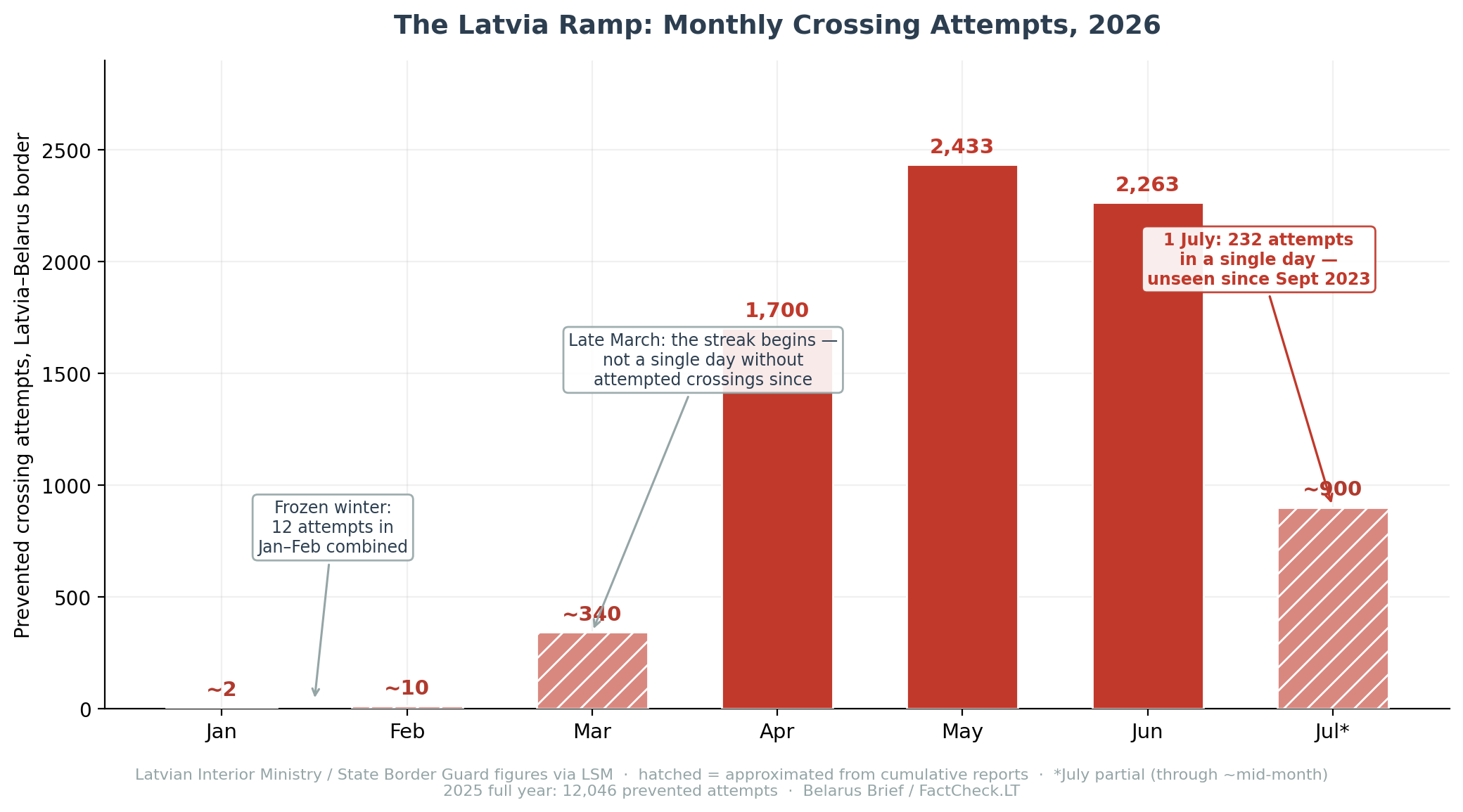
The seasonality is real — warm weather always raises the numbers. But seasonality does not explain the distribution: the same summer that lifted Latvia’s counts to records left Lithuania’s near-flat and Poland’s at zero. The routing is a choice, and Latvian authorities describe the mechanics of that choice directly: migrants arriving legally in Belarus, transported to the frontier, escorted by Belarusian security forces, equipped to breach barriers — and in some cases prevented from turning back.
Why Latvia
Three explanations circulate, and they are not mutually exclusive. Latvia’s border guard chief has named the country’s support for Ukraine among the reasons it became the primary target. The infrastructure gap is real: Latvia’s fence and surveillance build-out lags Poland’s completed fortification, making its 173 kilometres the path of least resistance. And the calendar offers a third: Latvia holds parliamentary elections on 3 October — and the 2021 playbook showed how effectively engineered migration pressure converts into domestic political stress in a campaign season.
The week the response escalated
The past week marked a qualitative shift in Riga’s counter-moves, tracked across our corpus:
The Prosecutor General’s office opened a criminal case against officials of the Belarusian border service, qualifying their conduct since summer 2021 as the “deliberate and systematic unlawful activity of a criminal organization” — the first attempt by a target state to attach individual criminal liability to the hybrid operation’s operators. The interior minister called the situation a “Minsk hybrid attack” and requested 100 border guards from neighboring states. And the pressure is already producing secondary effects: Lithuania is weighing temporary controls on its Latvian border against secondary movement — while the Lithuanian and Latvian presidents jointly rejected internal Schengen controls as “capitulation,” insisting the answer lies at the external frontier.
That last exchange is the strategic point. The instrument’s purpose was never merely to push people across a line; it is to force EU states into visibly un-European measures against each other. A criminal case against Belarusian border officials targets the operators. Internal Schengen checks would hand Minsk the outcome.
What to watch
A checkable expectation for the coming months: if the targeting logic is electoral, Latvian border pressure should hold or intensify through the October 3 campaign and slacken after — the way pressure on Poland tracked its own political calendar in earlier phases. If instead the driver is infrastructure, the completion of Latvia’s barrier build-out through 2026 should bend the curve regardless of the election. Two hypotheses, one border, a measurable difference. We will track both in Weekly Signals.
Sources and method: official figures from the Latvian State Border Guard and Interior Ministry (via LSM), the Polish Interior Ministry, and Latvian border guard chief G. Pujāts’s public statements (9 July 2026). Monthly values for January–March 2026 are approximated from cumulative official reports. Discourse context from the FORESIGHT corpus (~3,5M documents, 100+ sources), which tracked the escalation week of 13–19 July across Latvian, Lithuanian, Belarusian state, and Belarusian independent coverage. Belarus Brief / FactCheck.LT, Vilnius.