

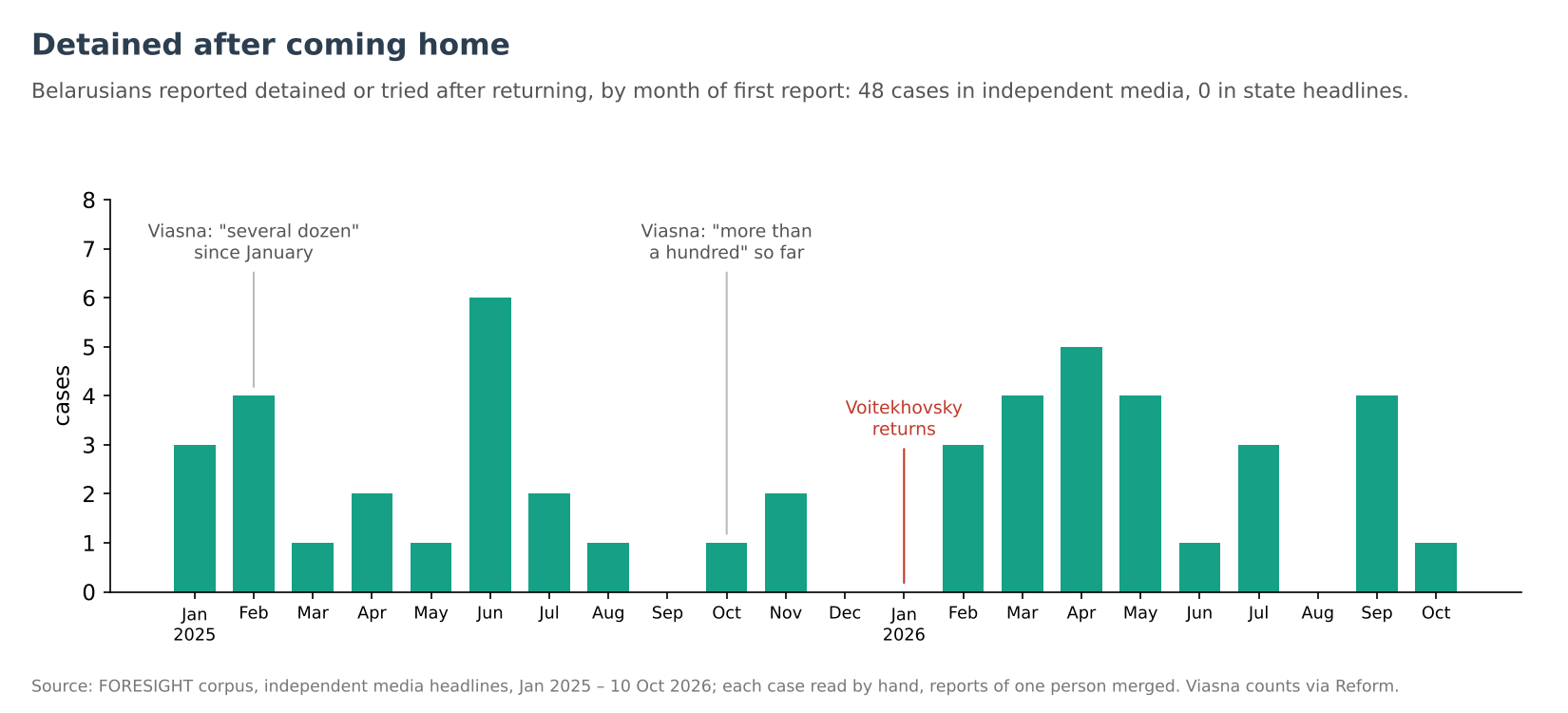
By our hand count, independent media reported 48 Belarusians who were detained or tried after coming home between January 2025 and early October 2026. Belarus’s state media tell a different story about return, through a government commission that reviews applications from people abroad. Anatoly Voitekhovsky appears in both stories. In January he was the commission’s witness in a state film; in October he received a four-year sentence. In the same 21 months our collection holds no state headline about a Belarusian prosecuted after coming home. What we cannot see is how many people come back through the commission without any case at all.
Two stories about coming home
The independent count comes from headlines alone. Most cases follow one pattern. A person who left after 2020 comes back to visit, to replace a passport or after studies abroad, and officers detain them at the border or the airport. The charges are donations, comments, “extremism” or, in two cases this year, terrorism and treason. Viasna counted “several dozen” such detentions in the first weeks of 2025 and more than a hundred by October.
In January he was the commission’s witness in a state film; in October he received a four-year sentence.
The commission belongs to the other story. In state outlets it appears as an open door, and it makes news in bursts tied to official statements. In September 2024 state media ran it with a pardon of 30 people, and in October with a decree that made the commission permanent. In February 2025 the prosecutor general said that “about 40 people” could return without any claims against them, and later that applications were coming in more actively. The independent record also shows the door failing. In August 2025 a young man who came back to Hrodna through the commission still had an open criminal case, and in November a member of the commission was himself detained.
The film
In January the state broadcaster showed “Escape Home”, a film about Vladimir Usser, a 70-year-old Belarusian who died in a shelter in Białystok after a Polish spying investigation. Its main witness was his neighbour, Voitekhovsky, a founder of a private Baranavichy newspaper in the 1990s who had left after the 2020 protests. BelTA introduced him as a man who had “returned to the Homeland with the commission’s help”. NEWS.BY quoted him on Usser: “He was forgotten. Nobody needed him”.
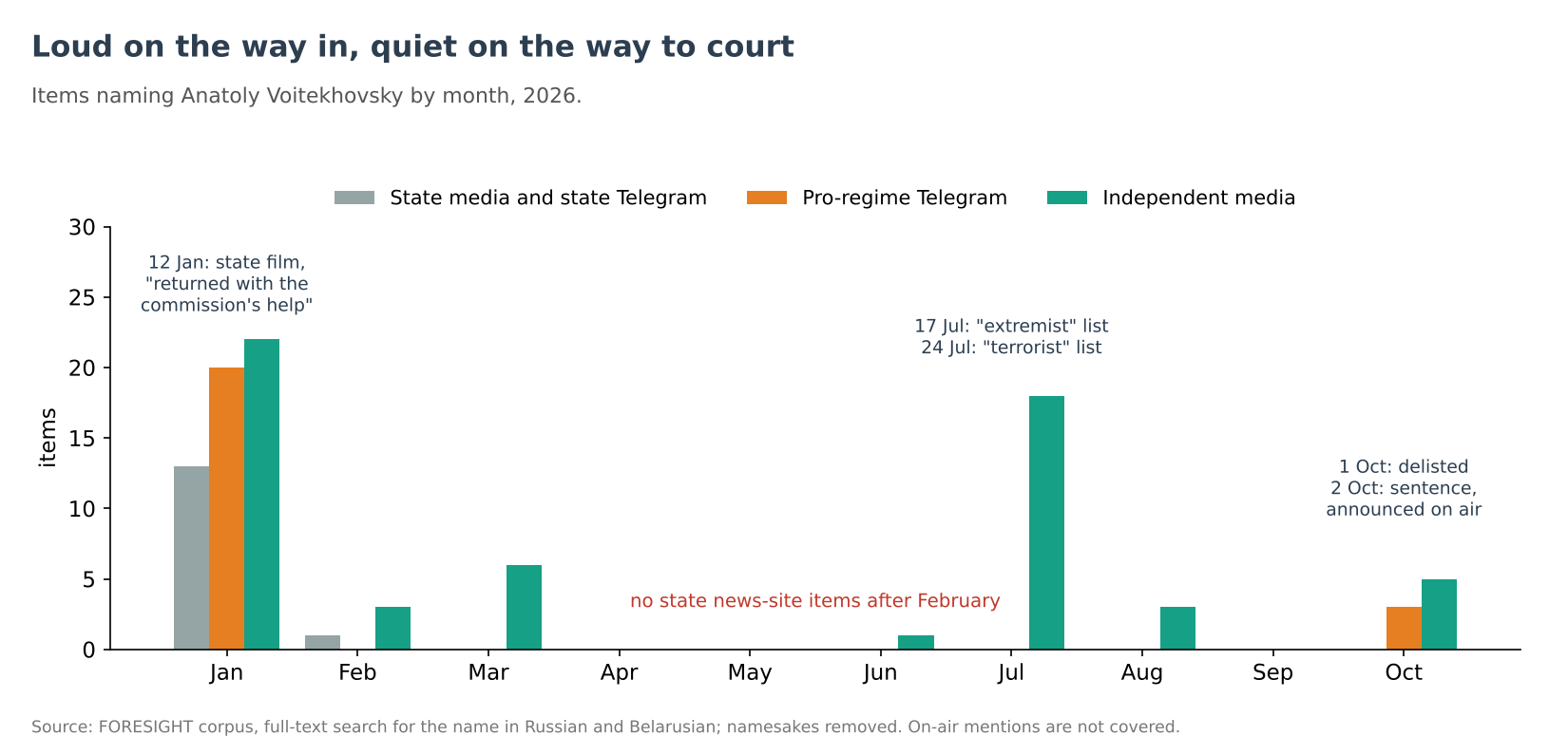
In January our collection holds 13 state items and 20 pro-regime Telegram posts that name Voitekhovsky. After February it holds none on state news sites. Usser’s daughter disputed the film’s account of how her father died.
After February it holds none on state news sites.
Listed, delisted, sentenced
Only independent media reported the next steps. On 17 July Voitekhovsky appeared in the militia’s list of “extremists”. On 24 July the KGB added him to its list of “terrorists”, which bars a person from holding a phone number or a bank card. On 1 October the KGB removed him from that list. On 2 October the state channel “First Information” announced his sentence on air: four years of restricted freedom at home, Zerkalo reported.
The same day two pro-regime channels, Belarus and the World and Yellow Leaks, explained the sentence. Voitekhovsky had been the witness who saw Polish officers beat Usser, they wrote. But he had his own record of “destructive comments” and protests. “However, he turned in time” to the commission.
“However, he turned in time” to the commission.
How sure we are
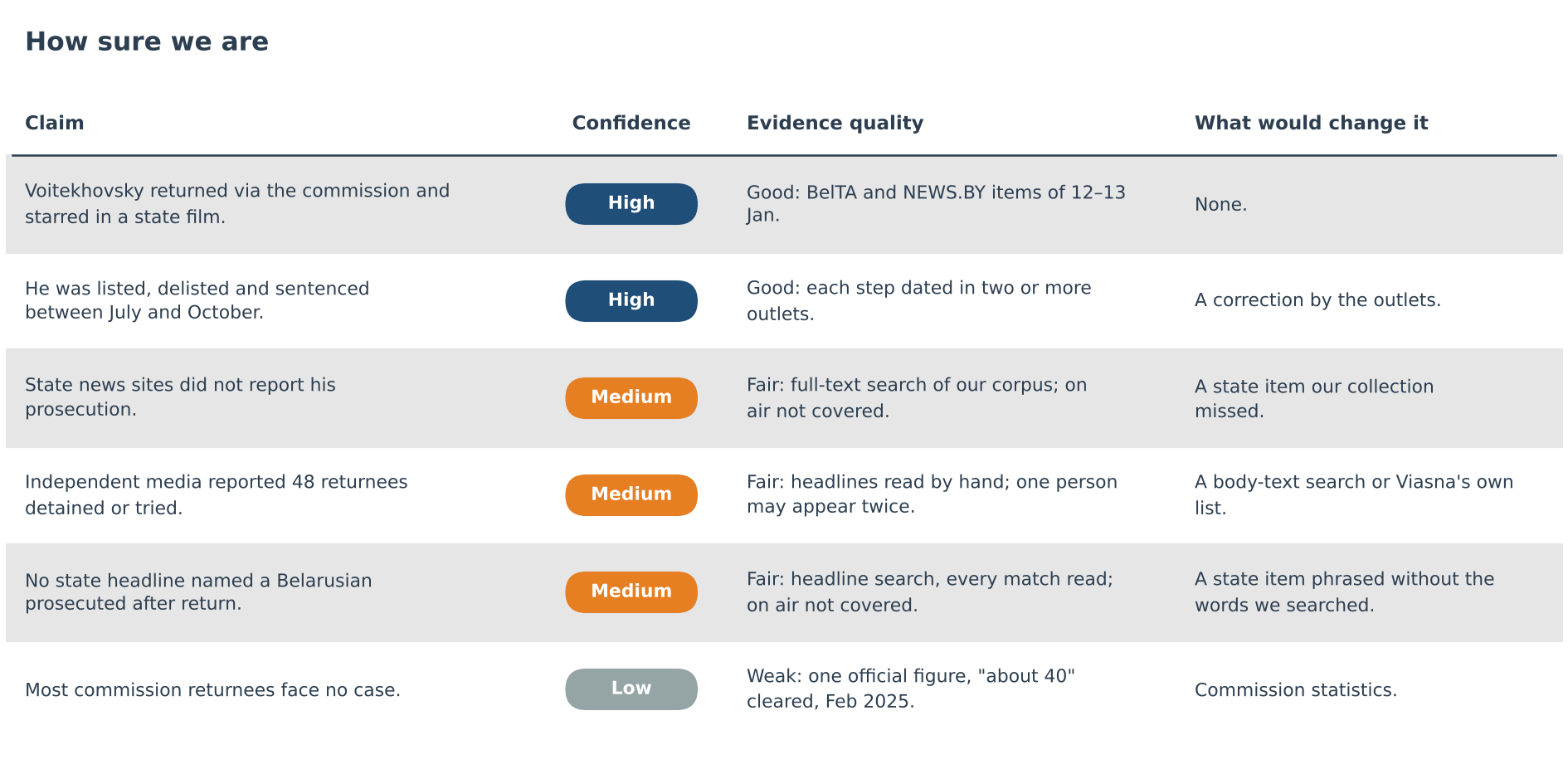
The Voitekhovsky timeline is High, since each step is dated in more than one outlet. The count of 48 is the weakest number: it rests on headlines and on cases that independent media heard about, and two reports may describe one person.
In the same 21 months our collection holds no state headline about a Belarusian prosecuted after coming home.
How it fits
How it fits. The state account of return rests on the commission. Its best-known witness then faced prosecution, and state outlets told his sentence on air as leniency instead of reporting it on news sites. This fits T7: the regime manages exile through both the door it advertises and the cases it does not. The data do not rule out a narrower reading, that most people who use the commission come home without trouble and are simply not news. If the commission published how many returnees it cleared and how many faced charges, the two stories could be set side by side.
What to watch
By 31 March 2027, the commission or a state outlet publishes how many people who returned through it later faced charges. We expect no such figure, with Medium confidence.
By 31 March 2027, independent media report at least 15 more Belarusians detained or tried after returning. We expect this, with Medium confidence.
By 31 December 2026, a state news site names another returnee who was prosecuted after appearing in state media. We expect this not to happen, with Low confidence.
Method and limits
We counted headlines in our corpus from January 2025 to 10 October 2026 that combine a return to Belarus with a detention, a charge or a sentence. We read every match by hand, removed unrelated returns such as lorries and prison transfers, and merged reports of the same person, which left 48 cases. The count misses cases that appear only in the body of a text and cases nobody reported. The Voitekhovsky search covers his name in Russian and Belarusian from 2024; other people with the same surname were removed. Our collection includes state television only where it is transcribed or written up, so on-air mentions may be missed. Thesis tag: T7.