

Belarusians sold more foreign currency than they bought for a seventh straight month, and both halves of the information space published the figure. The state segment filed it under devalutisation, a policy achievement; the independent segment filed it under households getting rid of dollars. The number is not in dispute and never was. What splits is which noun it goes under, and the corpus lets that split be measured indicator by indicator.
The same July, twice
On 23 July the National Bank told BelTA that Belarus has a stable long-term trend towards devalutisation of the economy; pravo.by carried it the next day, and Belarus-News added that the national currency’s share of broad money is rising. State media also published the underlying transaction: in July residents sold $337.5m more currency than they bought.
The same arithmetic appeared on the other side without the noun. Independent outlets reported that over seven months the population sold $1.3bn more cash currency than it bought, that Belarusians are shedding dollars en masse, and that enterprises were doing the same in July.
Nobody is hiding the figure. A household converting savings into roubles because it expects the rouble to hold is devalutisation; a household converting savings into roubles because it needs the money is distress. The transaction is identical and the corpus cannot tell them apart. Neither can the National Bank, which is why the noun does the work the data will not.
A household converting savings because it trusts the currency and one converting savings because it needs the money leave the same trace.
What each segment carries
Across two and a half years, three stress indicators separate cleanly. The state segment publishes the foreign-trade deficit at one document for every 6.7 independent ones, household net currency sales at one in 4.1, and gold and forex reserves at one in 2.9.
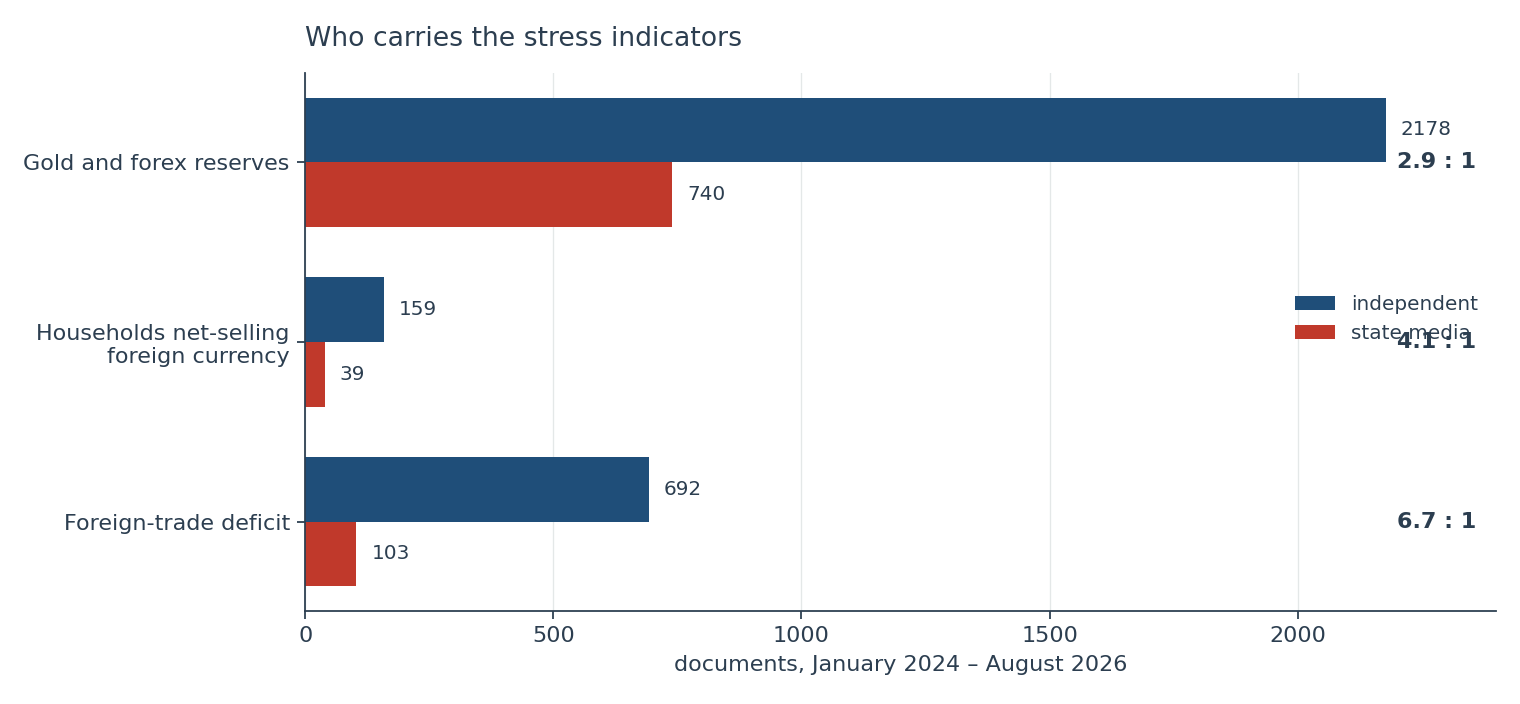
Reserves are the least suppressed because they are reportable in either direction and Minsk has a positive line available: on 24 July Pozirk noted Belarus ranks third in the Eurasian Economic Union for external debt coverage by international reserves. The trade deficit has no such line. In the recent window the only state-media document our filter flagged for it was a retrospective on how Lukashenko led the country out of the 2011 crisis, which is the deficit as history rather than as this year’s balance.
The independent segment devotes 53.4% of its economic coverage to stress indicators against 35.3% for state media. Documents carrying a headline indicator and a stress indicator together are rare everywhere: 3.7% independent, 2.9% state media. Neither segment routinely puts growth and strain in one frame.
The window the state chose
July’s headline set was strong and the state segment used all of it. GDP grew 1.5% in the first half to 149.6bn roubles; the Eurasian Development Bank said growth had accelerated; inflation for the half-year came in at 2.9%, which BelTA called a twenty-year low; the Eurasian Fund lifted its GDP forecast by a percentage point and cut its inflation forecast to 4.8%. A commentator in SB read the growth as proof the course towards the real sector was right.
Two figures from the same fortnight did not enter that set. Industrial output fell 0.7% in the first half against growth a year earlier, and the negative goods balance with countries outside the CIS approached $4.3bn. On 19 July an economist told Pozirk that the published inflation does not correspond to reality and that price growth should be expected in the second half.
The trade deficit appeared in state media once in the recent window, and it was about 2011.
Two indicators that failed
Outward capital and wear of fixed assets were meant to be in this piece. Both filters broke, in ways worth stating because they were near-misses rather than noise.
Capital outflow came back at 87 independent documents against 82 state ones, near parity, which looked like a finding until we read the matches: the recent set is about $5bn of foreign investment coming into Belarus, not money leaving it. The phrase that fires on capital flight in one register fires on investment success in another, and the filter cannot see the difference.
Wear of fixed assets returned 30 independent documents against 44 state ones, an apparent inversion. The matches are municipal: pipes, housing stock, courtyard equipment, a beet-harvester tariff. Admitted wear in the housing stock is safe for state media because it justifies a modernisation budget. The economic indicator we wanted, износ основных средств, never fired at all. Both indicators are excluded from the argument above.
Confidence
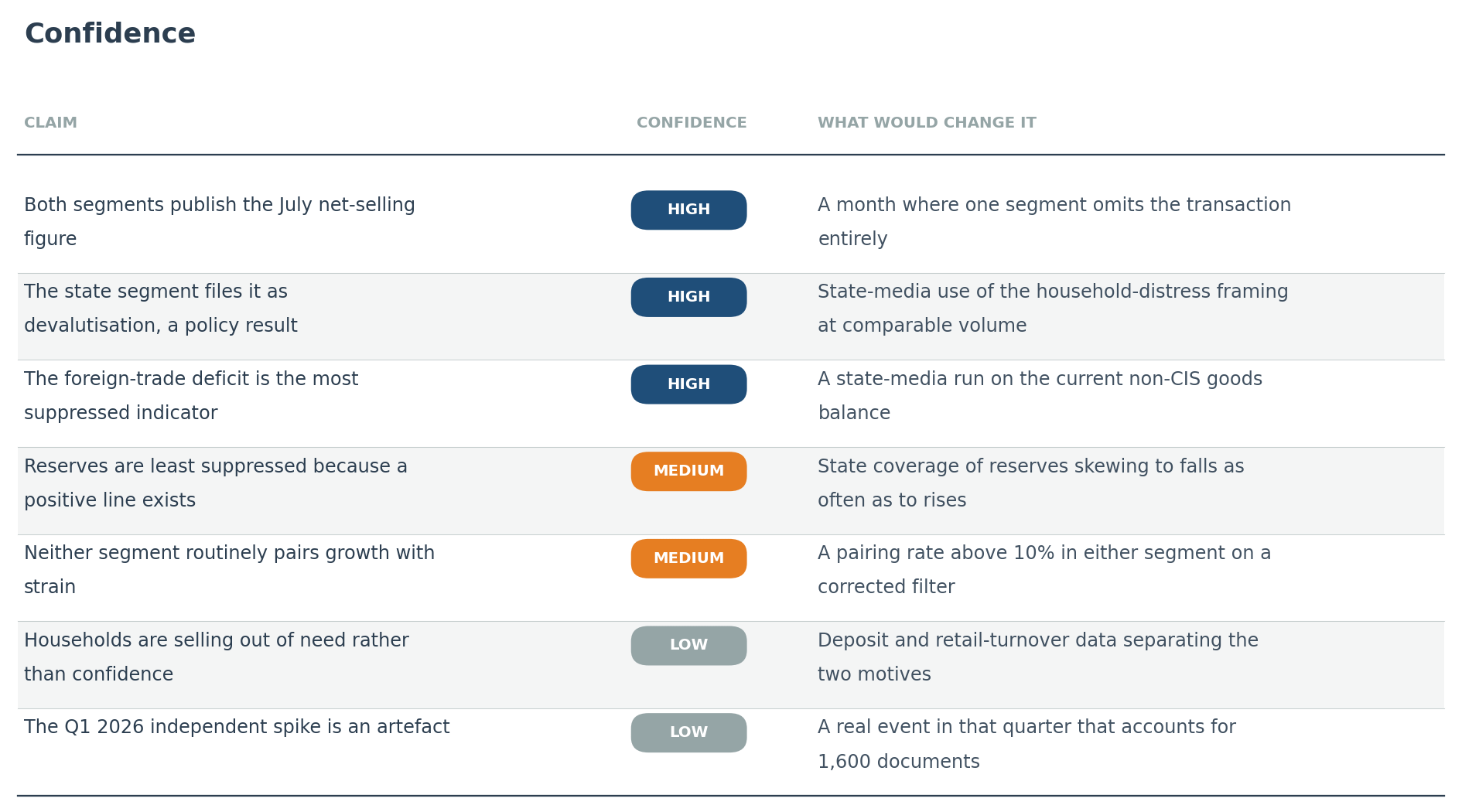
One anomaly stays open. The independent stress count for the first quarter of 2026 comes to 1,615 documents against roughly 150 in neighbouring quarters. We have not identified the cause, and until we do, no monthly or quarterly series from this run should be published. The indicator ratios above are period totals and are not affected by where inside the period the documents fall.
Watch items
By 20 August 2026: whether the National Bank repeats the devalutisation framing when the eighth consecutive month of net selling is published.
By 30 September 2026: whether state media carries the non-CIS goods balance at all once the third-quarter figure lands.
By 31 October 2026: whether industrial output stays negative while GDP stays positive, and which of the two the state segment leads with.
At the January 2027 release: whether the inflation outturn lands nearer the 2.9% half-year print or the second-half acceleration warned of in July.