

A widely shared post last week reported that the number of sole traders in Belarus fell 11.8% over the year to 1 August 2026, and that the worst-hit activity was information and communication, down 35.1%. Both figures are correct. They are also the last point of a line that has been falling for five years, and the fall is accelerating. We pulled the series from fifty of National Statistical Committee of the Republic of Belarus own monthly bulletins.
The five-year line
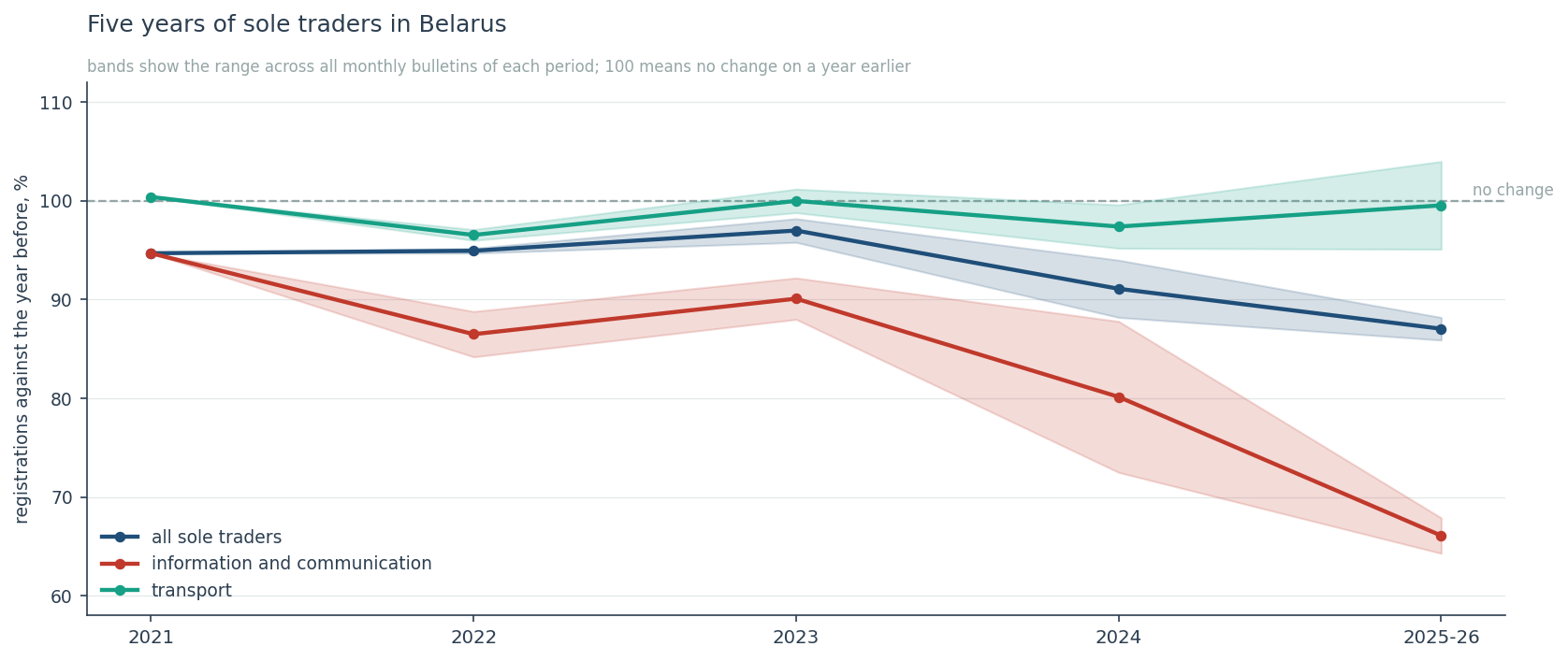
Belstat publishes a table in every monthly bulletin comparing the number of sole traders with the same date a year earlier. Read in sequence, the bulletins give a rolling picture.
In 2021 both the total and the information sector sat near 95, which is a fall of about five per cent. In 2022 the total held at 94.7 to 95.2 while information dropped to between 84.2 and 88.8. In 2023 both recovered slightly. Then the lines part. Through 2024 the information index fell from 87.8 to 72.5 inside a single year, while the total went from 94 to 88.2. In the most recent bulletins the information index reads 64.3 to 67.9, and the total 85.9 to 88.2.
So the sector has not just shrunk. It has shrunk faster than the whole every year since 2022, and the gap has widened from about ten points to more than twenty.
Not a bad year. A five-year slope that is getting steeper.
What separates the categories
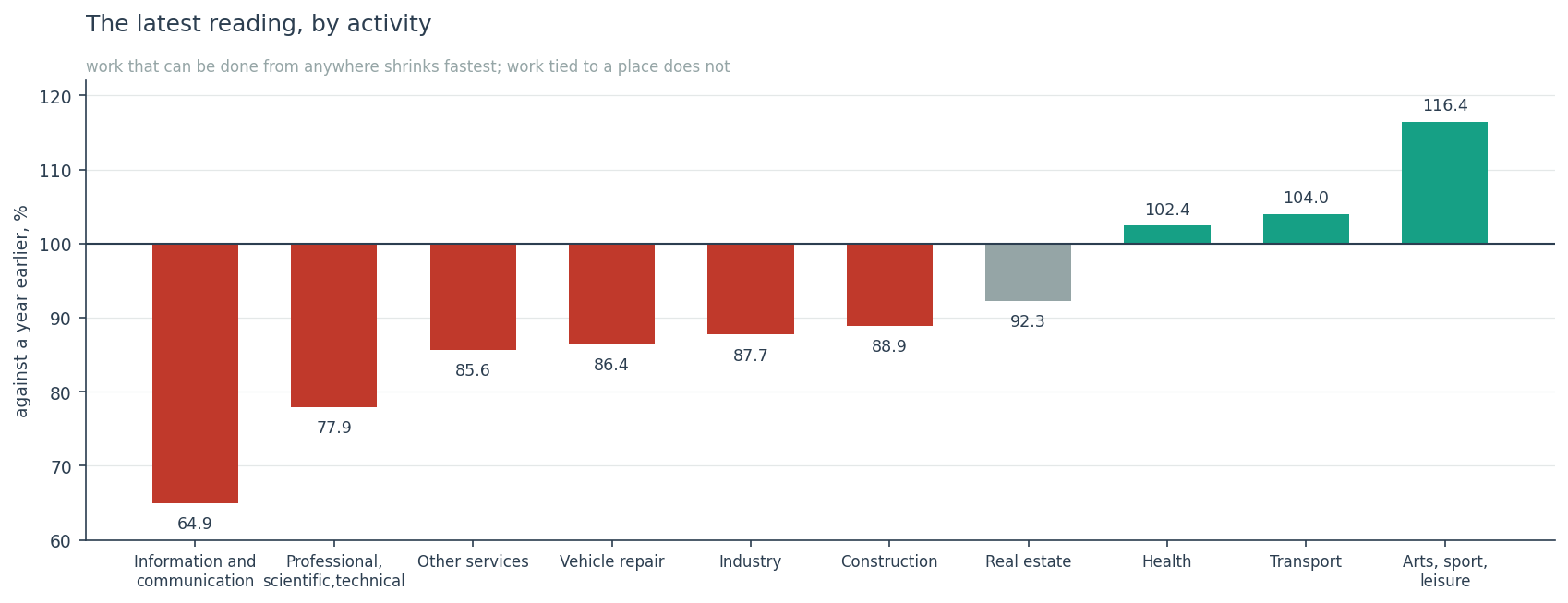
The latest reading sorts the activities cleanly, and the sorting is not about how profitable they are.
At the bottom: information and communication at 64.9, professional, scientific and technical work at 77.9, other services at 85.6. In the middle: vehicle repair, industry, construction, real estate, all between 86 and 93. At the top, growing: health at 102.4, transport at 104, and arts, sport and leisure at 116.4.
The line runs between work that can be done from anywhere and work that cannot. A programmer, a translator, a designer or a consultant can keep the same clients from Warsaw, Vilnius or Tbilisi. A minibus driver, a dentist or a gym instructor cannot.
Transport is the control case. It sat between 96 and 100 for four years and has now turned positive. Whatever is emptying the information sector is not emptying the roads.
A consultant can move. A minibus cannot.
Whatever is emptying the information sector is not emptying the roads.
What this is not
It is not a straightforward story about emigration, and we cannot make it one.
The status of a sole trader has been under legislative pressure since 2023. Many were required to re-register as legal entities or move to self-employed status, and hiring staff was barred. So part of the total fall is people changing their legal form without going anywhere, and the total index would have fallen with or without anyone leaving.
But that pressure applies to every activity equally, and the outcomes are not equal. A rule that hits all sole traders cannot explain why information and communication loses three times what transport does. Something is separating the categories, and the most obvious candidate is whether the work can be carried across a border.
We cannot prove that from this table. What the table proves is that the divergence is real, sustained and widening, which is more than the single figure showed.
A rule that hits everyone equally cannot explain unequal outcomes.
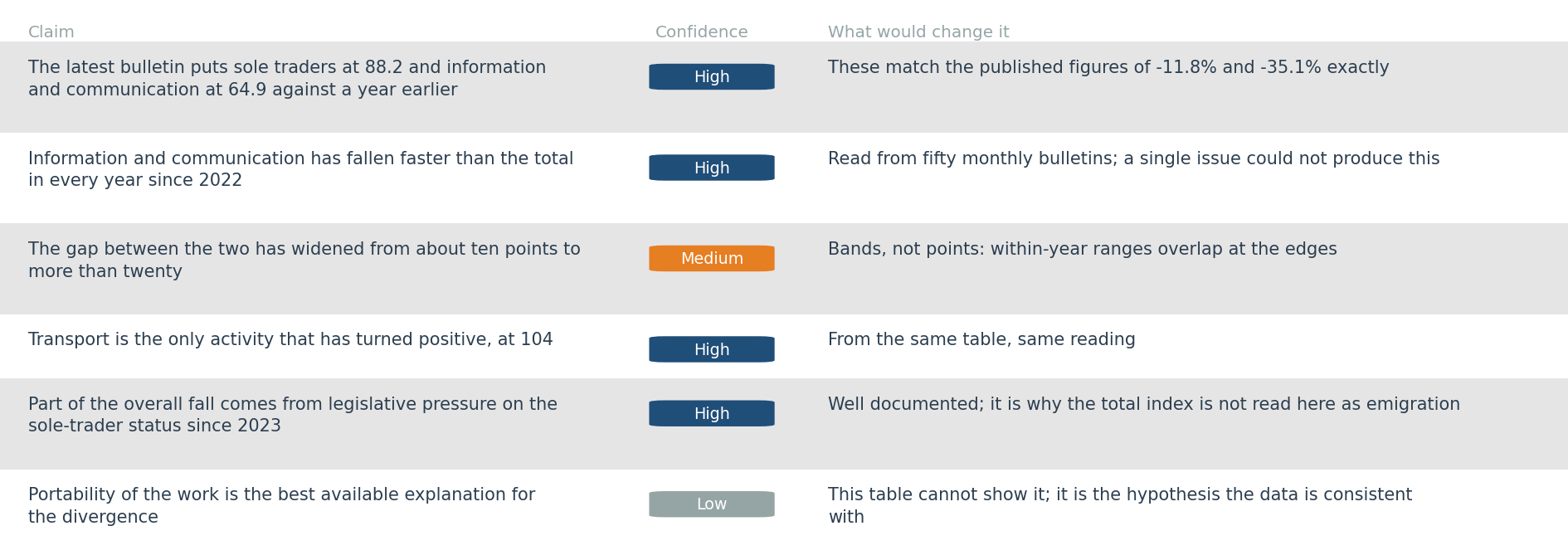
Confidence
Watch
The information index stops falling in the next quarterly readings. It has fallen in every year since 2022.
Transport stays above 100. It crossed this year for the first time in the series.
National Statistical Committee of the Republic of Belarus publishes absolute counts by activity rather than only the index, which would allow the fall to be read in people.
Any official explanation of the divergence between activities appears. So far there has been none.
Method and limits
The series comes from the table on business entities that National Statistical Committee of the Republic of Belarus prints in each monthly bulletin, pages 14 to 21 depending on the issue. Each issue carries two blocks with identical activity labels, one for legal entities and one for sole traders; we separated them by value, since the information index sits near 100 for companies and far below it for sole traders.
The figures are indices against the same date a year earlier, not counts. A reading of 64.9 means the number is about a third lower than a year before; it does not say how many people that is.
We could not date the individual bulletins. Belstat’s archive in our corpus has no publication date field, and the period labels in the extracted data are unreliable. So the chart shows the range across all bulletins of each year rather than a monthly line, and nothing here should be read as saying what happened in a particular month.
The 11.8% and 35.1% in the original post match our reading of the latest bulletin exactly, which is the main check we have on the extraction.