
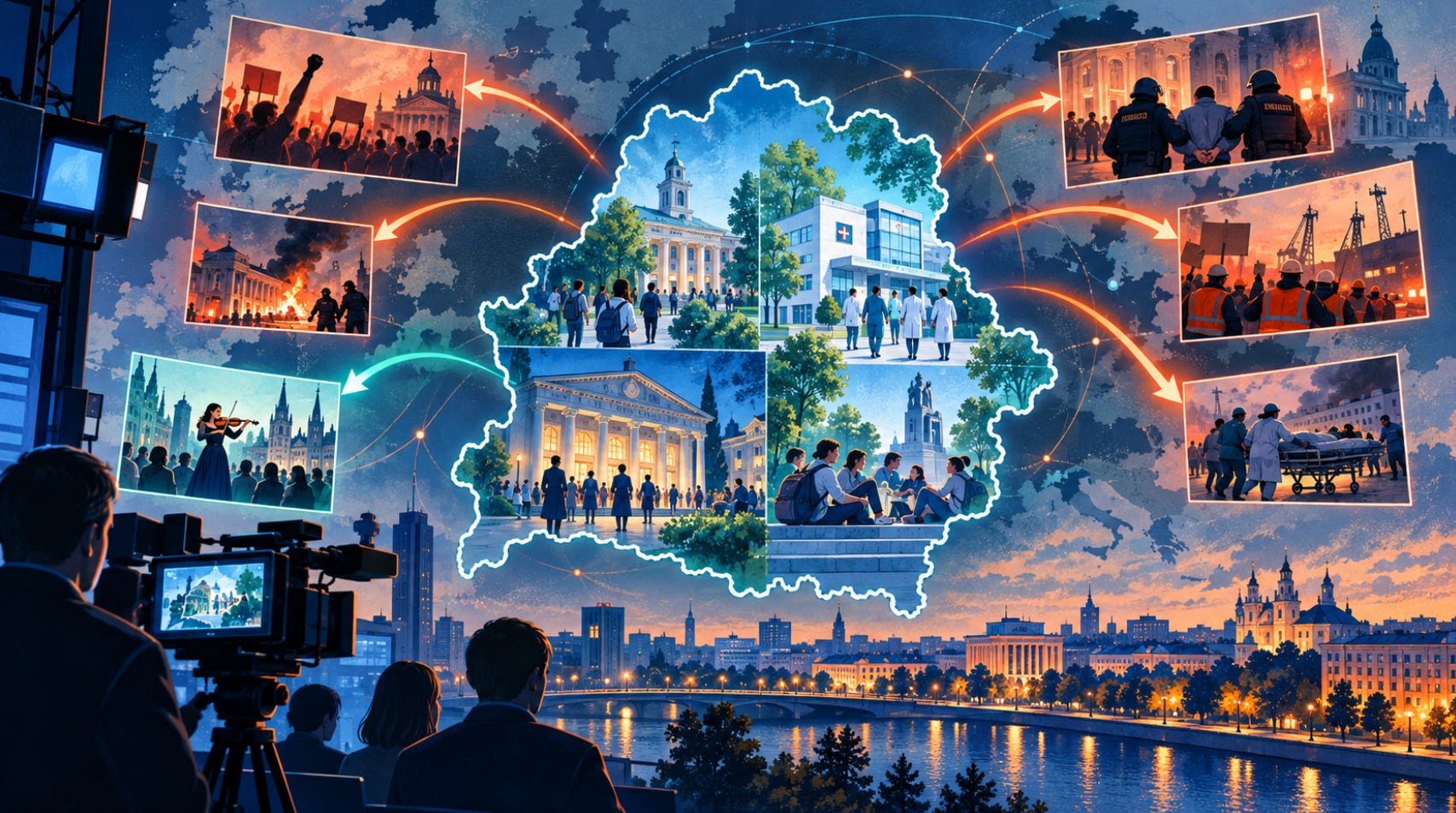
Education, youth, culture and health rarely make the news digests we use to plan our briefs, because they produce few sharp events. They still fill a large part of what Belarusians read. Since January 2025 these four fields have taken 14 per cent of everything state outlets publish, against 9 per cent for independent media. The difference is less in how much is written than in how. What we cannot see is how readers inside Belarus weigh the two pictures, since no audience data separates them.
More of it, and growing
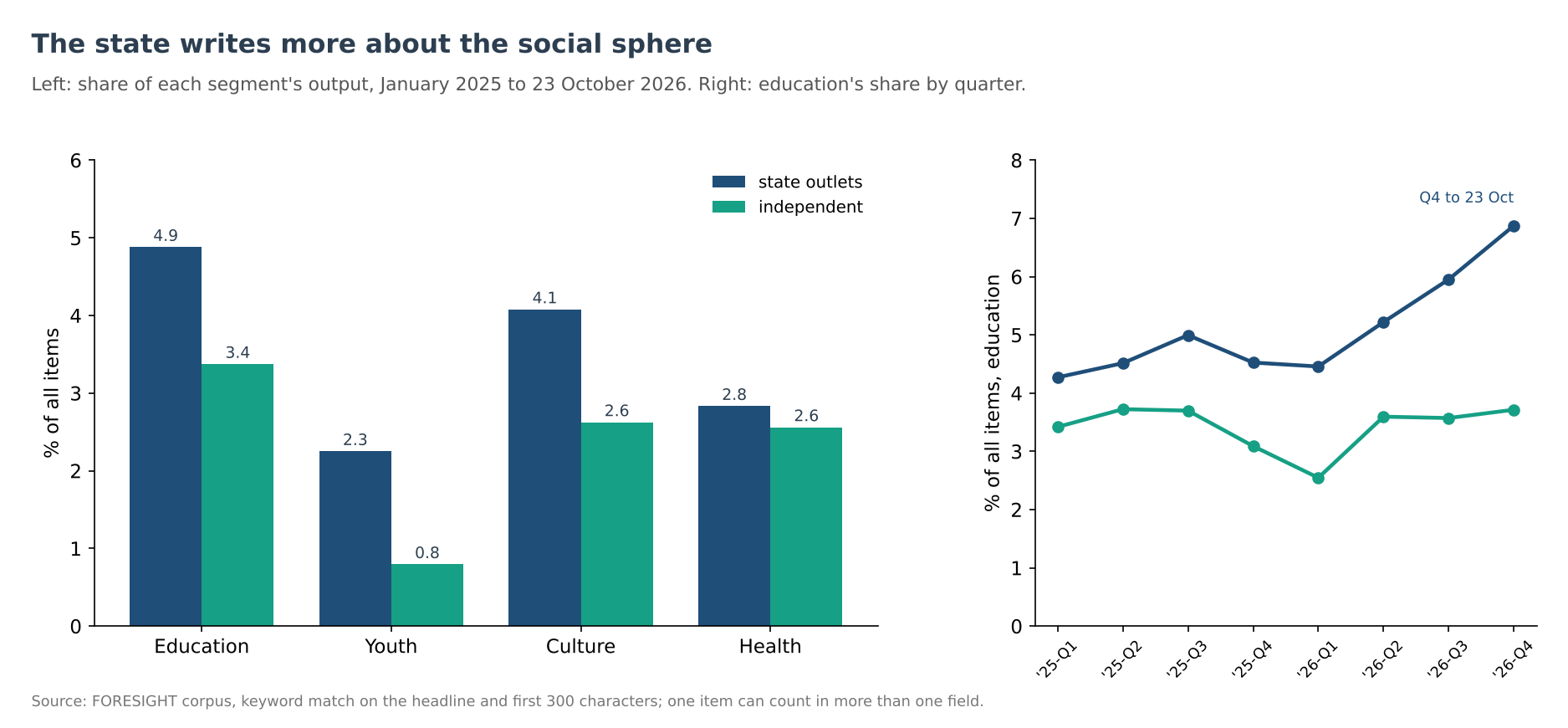
State outlets publish about four times as many items as independent ones in our archive, so the gap in absolute numbers is large. The gap in shares tells us more. Youth takes 2.3 per cent of state output and 0.8 per cent of independent output, almost three times as much. Culture takes 4.1 against 2.6 per cent, and education 4.9 against 3.4. Health is the one field where the two segments are close, at 2.8 and 2.6 per cent.
Education is also the field that is growing. Its share of state output rose from 4.3 per cent in the first quarter of 2025 to 6.0 per cent in the third quarter of 2026, and to 6.9 per cent in October so far. In independent outlets it has stayed between 2.5 and 3.7 per cent.
The difference is less in how much is written than in how.
Two vocabularies
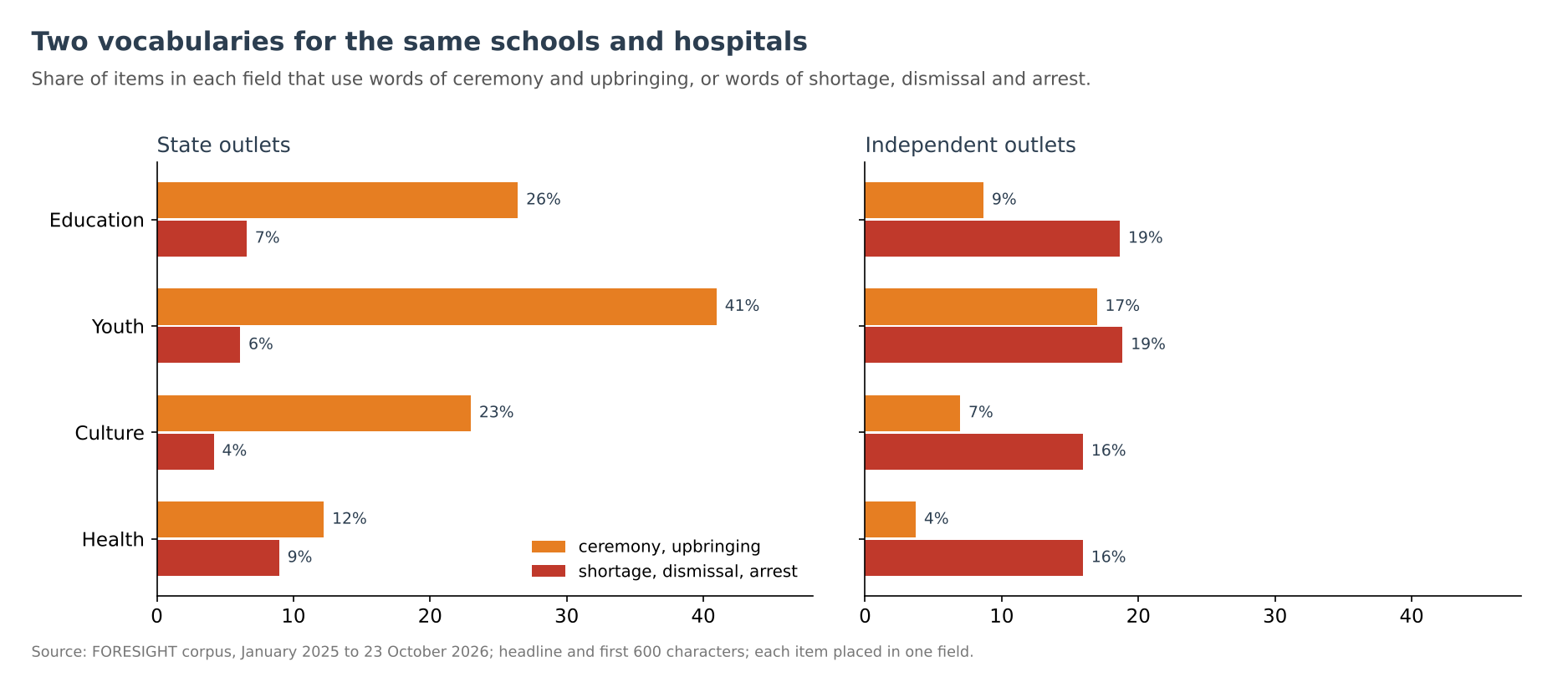
We then sorted every item in the four fields by two word lists. One holds words of ceremony and upbringing: patriotic, upbringing, forum, contest, congratulations, anniversary, the youth union BRSM. The other holds words of trouble: shortage, dismissal, arrest, sentence, closure, emigration, wages.
In state outlets ceremony words appear in 41 per cent of youth items, 26 per cent of education items and 23 per cent of culture items. Trouble words appear in 4 to 9 per cent. Independent outlets reverse the balance: trouble words in 16 to 19 per cent of items in every field, ceremony words in 4 to 17 per cent. A typical state headline on schools reads “Knowledge is valuable capital”. A typical one on youth announces the end of a festival “Youth for the Union State”.
Education is also the field that is growing.
Where the trouble happens
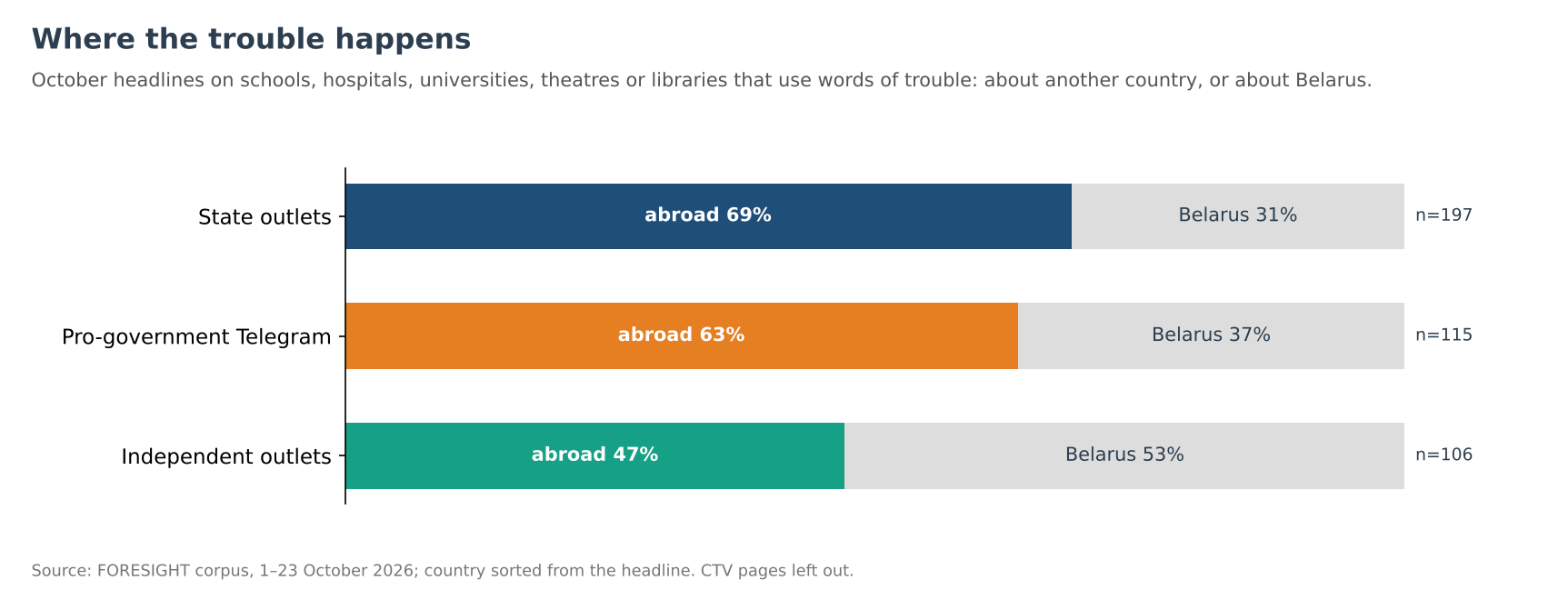
The trouble words do appear in state outlets. The question is where they point. We read the headlines of every October item about schools, hospitals, universities, theatres or libraries that used one of them. Of 197 state headlines, 135 were about another country. Of 106 independent headlines, about half were.
The state examples form a pattern. Pupils with knives in Romania and Poland, youth riots in Brussels, a teachers’ strike in Greece. When SB wrote about a shortage of medical staff, it was the WHO’s warning for the world. When it wrote about a shortage at home, it was a shortage of vitamins. The article was about skin and hair in autumn.
Trouble at home in state outlets was mostly fires, and fakes. The education ministry warned schools about a fake letter sent in the name of the Security Council, and the Gomel daily called a report about a school closure “fake again”.
When it wrote about a shortage at home, it was a shortage of vitamins.
What only one side reported
Independent outlets carried the domestic stories. On 6 October Nasha Niva reported the arrest of Alexander Karpitsky, chief doctor of the Brest regional hospital and a member of the upper house of parliament. In our archive no state item named him. In the same days independent outlets wrote that Minsk still lacks medics, and that the city’s former health chief had been jailed for eight years for bribes. They described how people were questioned in a criminal case linked to the European Humanities University in Vilnius. A young teacher left her school for Batumi, and her former deputy head still filed a police complaint over her TikTok streams.
Culture shows the same split in one week. From 15 September our archive holds 106 state items on the Minsk film festival Listapad and 8 independent ones. “Zhyvitsa” is a festival of independent Belarusian culture, held in Wrocław from 17 to 24 October. It is named in two independent items, by Nasha Niva and Charter 97, and in no state item at all. Reform.news and Budzma also announced a “festival of independent Belarusian culture” in Wrocław in October, on 4 October and 15 October, without the name in the headline.
A stage abroad
The two independent outlets that follow culture most closely add a second picture. Budzma writes almost only about culture: since January 2025 about half of its 2,921 items match our culture words. Reform.news gives culture a much smaller share of a larger output. We read every culture headline the two published from 1 September to 23 October. After removing items about Nobel prizes, oil prices and other matches that had nothing to do with Belarusian culture, 211 were left.
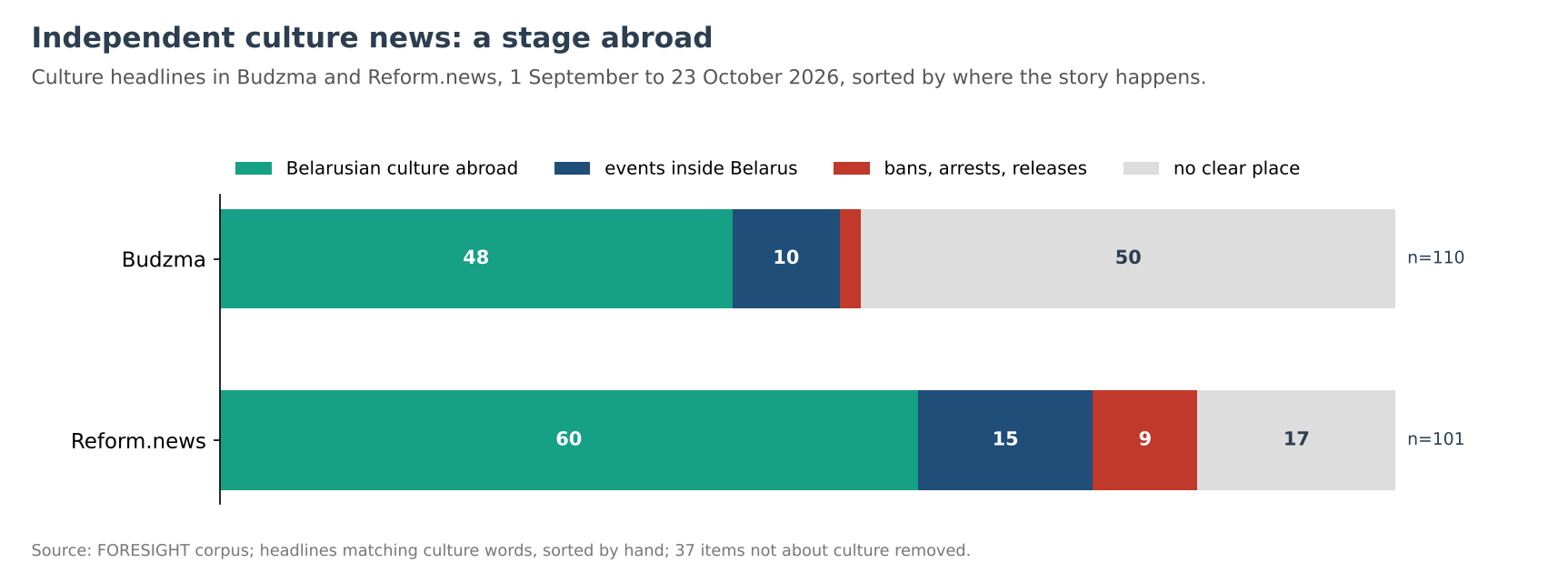
More than half, 108, were about Belarusian culture abroad. The book festival PRADMOVA opened in Wrocław, Volha Hapeyeva won the Brothers Grimm Prize in Germany, and Andrei Kutsila’s film “Letters” reached the European Film Awards shortlist. Both outlets quoted the director of a Warsaw culture house: “there is no choice: your art has to develop abroad”. Only 25 headlines were about events inside Belarus, and 11 were about banned books, arrests and released musicians. The stories from inside were often about the state. Belarusfilm is shooting a 24-part police drama. The National Art Museum opened a new hall on the site of the closed Centre for Contemporary Art. The authorities, not the church, put an end to concerts in a Brest church.
So the specialist outlets do not mainly describe culture as trouble. They describe a culture that is alive, but that lives in Warsaw, Vilnius and Wrocław. State outlets describe a culture that lives at home, mostly as ceremony. The festival counts show how rarely the two pictures meet.
More than half, 108, were about Belarusian culture abroad.
How sure we are
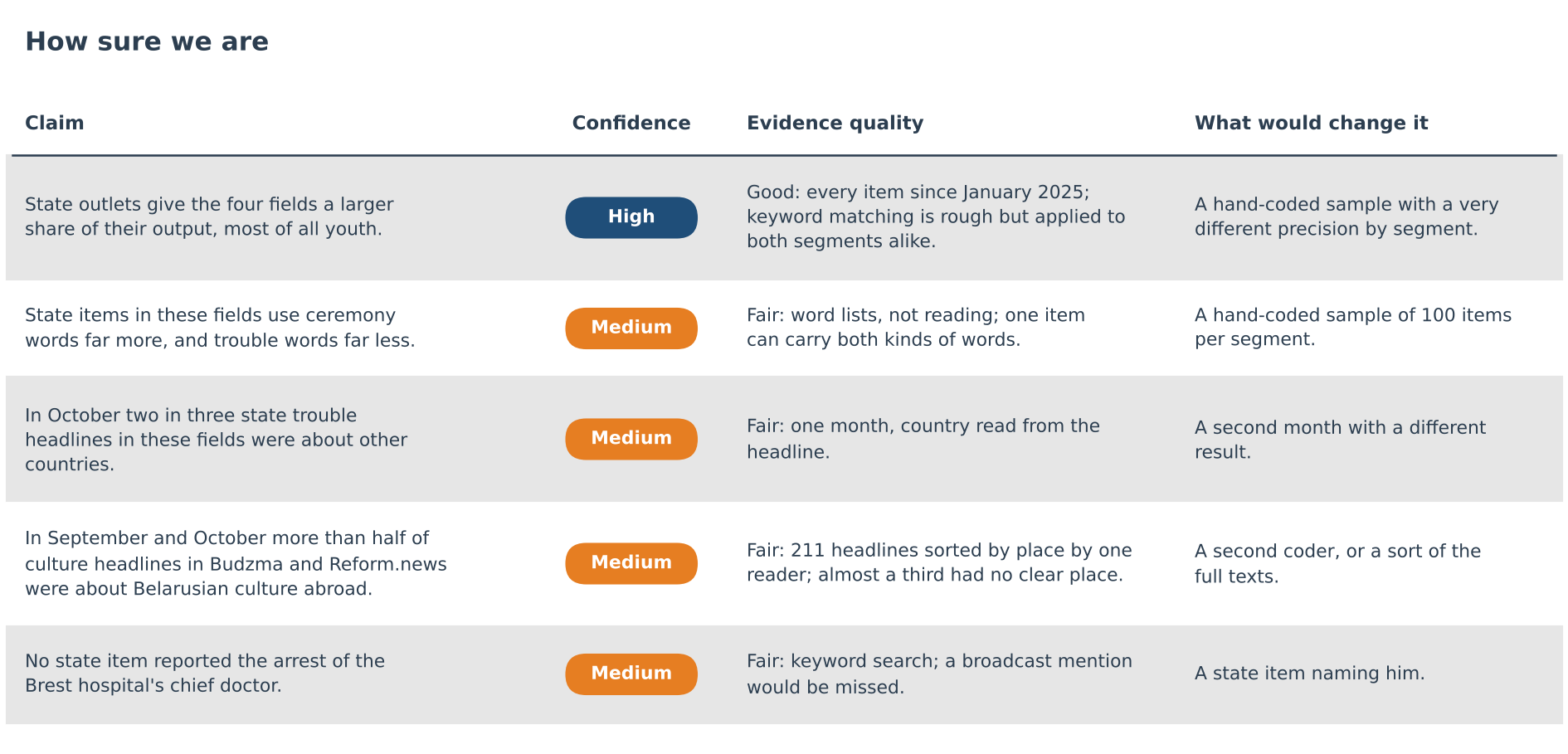
The shares are High, because they cover every item since January 2025 and the same word lists were applied to both segments. Word lists are rough: “film” also catches propaganda films, and “school” catches business schools, so the vocabulary results are Medium until a hand-coded sample checks them. The share of trouble set abroad is Medium, because it rests on one month and on countries read from headlines. The split of Reform.news and Budzma by place is Medium too: one reader sorted the headlines, and almost a third had no clear place.
How it fits
How it fits. State outlets write more about schools, youth, culture and hospitals than independent ones, mostly in a vocabulary of ceremony. They place most of the trouble they report in these fields in other countries. None of the seven theses in our working model covers this, so we record it as an observation, not as a test. It sits close to T4, the silence that comes with incidents, but here the silence is not tied to an incident; it is the normal state of four whole fields. The simpler reading is that state outlets serve readers who want school news, health advice and festival listings. On that reading, foreign stories simply fill a world news section that independent outlets run less of. A hand-coded comparison of the two world news sections would separate the readings. If state world news carries school and hospital trouble at the same rate as its other foreign news, the pattern is about the section, not the fields.
What to watch
· In the fourth quarter of 2026, education’s share of state output stays above 6 per cent while the independent share stays below 4 per cent. We expect it does, with Medium confidence.
· In November 2026, more than half of state headlines on schools, hospitals, universities, theatres and libraries that use words of trouble are about other countries. We expect it, with Medium confidence.
· By 31 December 2026, a state outlet reports the arrest or the case of Alexander Karpitsky. We expect it does not, with Medium confidence.
Method and limits
We counted items in our archive from 1 January 2025 to 23 October 2026 that match word lists for the four fields, by segment and quarter. The match used the headline and the first 300 characters, and one item can count in more than one field. For the vocabulary test we placed each item in one field, using the headline and the first 600 characters, and counted the items that contain words of ceremony or of trouble. For October we read 418 headlines from state, pro-government and independent outlets about schools, hospitals, universities, theatres or libraries that use words of trouble, and sorted them by country. CTV pages were left out because a block of related headlines caused false matches. The festival counts use full text from 15 September. For Reform.news and Budzma one of us sorted 248 culture headlines from 1 September to 23 October. The four groups were Belarusian culture abroad, events inside Belarus, bans and arrests, and no clear place; 37 items that were not about culture were removed. Independent outlets include media in exile, which write partly for readers abroad, and our state segment includes regional newspapers and Telegram channels. Thesis tag: none (observation).