
The Belarusian Yearbook is out for the first time since 2023, reviewing 2025 across twenty-two chapters in Russian and English. I wrote one of them, on the media, and that is the reason to say at the outset what this piece does: it reads the tables of contents of every edition since 2011 and counts what is in them. My own chapter is in every count here. Nothing below rests on what any chapter says.
What a contents page can be asked
An expert yearbook is an unusual object to measure. It is a map its authors draw of what a country consists of — which domains deserve a review every year, who is competent to write it, and in what language. Redraw that map fourteen times and the differences between the drawings record something the chapters themselves do not discuss.
Sixteen editions exist. The first two are scanned PDFs and are left out. The rest give 390 Russian-language chapters between 2010 and 2026, running to 777,000 words, with an English counterpart for each edition, four standing sections, and a byline on every chapter.
Contraction, and where it stopped
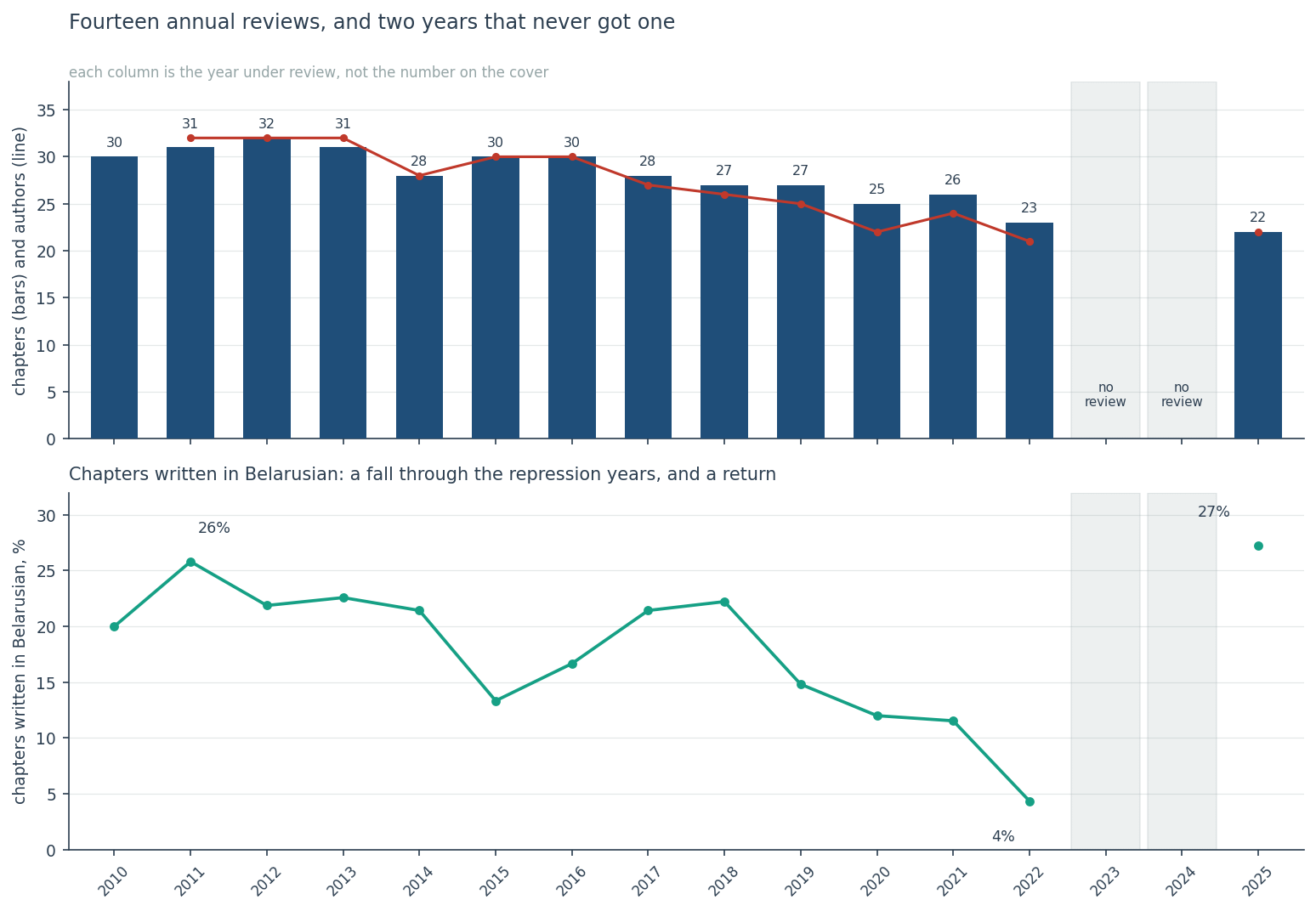
The review of 2011 ran to 31 chapters written by 32 people. The review of 2025 runs to 22 chapters by 22 people. The decline is not a single break: 28 for 2014, 27 for 2018, 25 for 2020, 23 for 2022. The floor is the reviews of 2020 and 2022, at 22 and 21 authors, and the current volume sits on that floor rather than below it.
Measured in words the picture separates. The review of 2010 holds 87,600 words, the review of 2022 holds 39,900, and this one 46,100. So the book stopped contracting between those last two, and the average chapter grew from 1,730 words to 2,100. Fewer chapters, each of them longer.
The four sections have held their proportions throughout. Society is always the largest, taking eight of twenty-two now against twelve of thirty-one in 2011. Nothing was reorganised. The book got smaller at roughly the same rate everywhere.
Which year an edition reviews is stated on its own page only from 2020 onward, and the numbering is not consistent: editions up to 2014 are named after the year they cover, editions from 2016 after the year they were published. That is why the archive appears to skip 2015 and does not. Reading the years cited inside all 390 chapters resolves the rest, and it agrees with all five editions that state their coverage year.
On that axis the run is unbroken from 2010 to 2022, and then two years are missing. Belarus in 2023 and Belarus in 2024 — the year of the parliamentary and local elections, the year of the first prisoner releases — have no annual review. The next volume after the review of 2022 is the one now out, and it reviews 2025.
One chapter in twenty-three was written in Belarusian three years ago. Six in twenty-two now.
Who came back
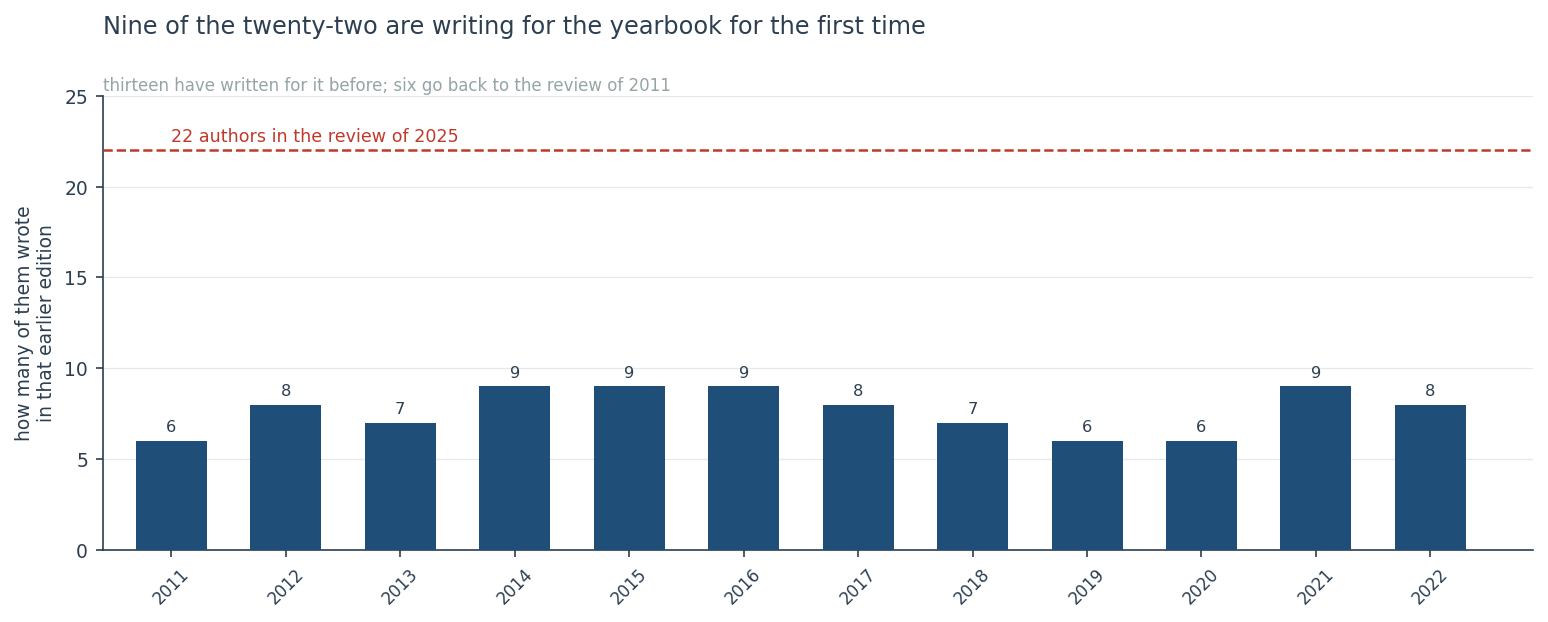
Thirteen of the twenty-two authors have written for the yearbook before. Six of them appear as far back as 2011. Nine are new to it, including Valer Karbalevich and Alaksandr Klaskoŭski, both of whom have commented on Belarus for decades without ever having a chapter here.
Nine of the twenty-two have never had a chapter here before.
Set against the last edition, eight of the current authors also wrote in 2023. So the roster was neither preserved nor replaced. A core of between a third and a half carried across every interval in the archive, including this one, and the rest turned over.
The language line
Chapters written in Belarusian made up a fifth of the review of 2010 and a quarter of the review of 2011. The share fell through the following decade to 12% and 11% in the reviews of 2020 and 2021, and then to a single chapter out of twenty-three in the review of 2022, which is 4%. It stands at 27% now, six chapters of twenty-two. The trough sits on the years of the heaviest repression and the recovery on the first edition produced wholly in exile.
Language here is read from the body of each chapter rather than from its title, using letters that exist in one orthography and not the other. An earlier pass of this measurement used titles alone and understated both ends of the curve, putting the trough at 9% and the recovery at 23%. Titles are a few words and can be set in either language; the chapter cannot.
A slot that closed
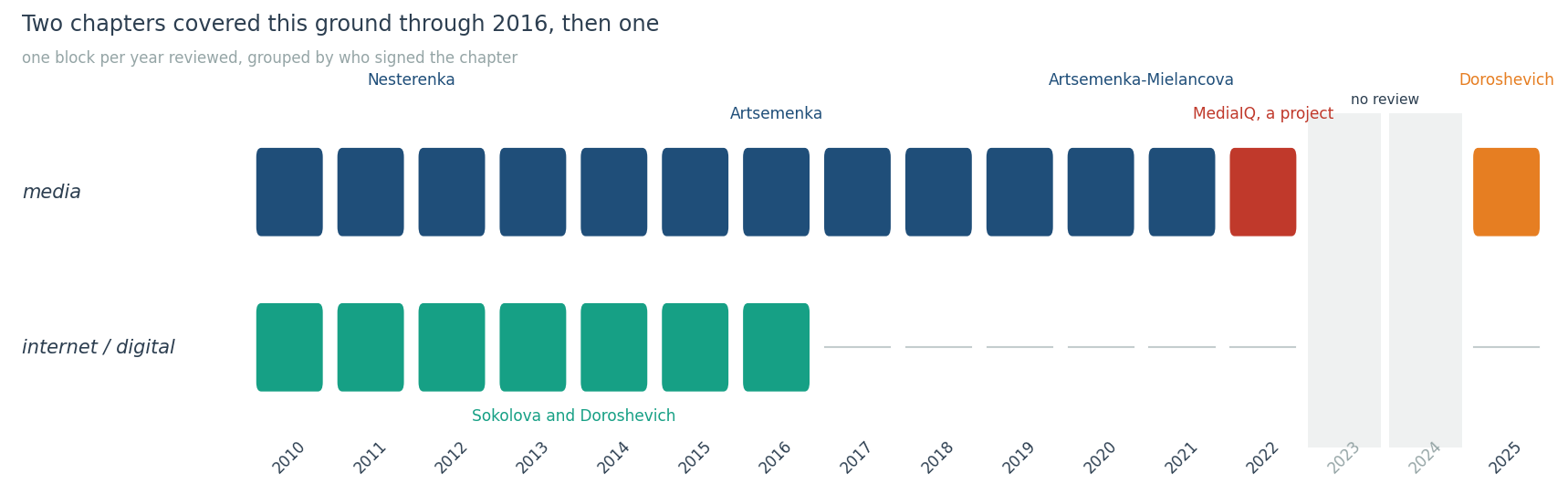
For the years 2010 through 2016 the yearbook treated this ground with two chapters. One covered the media. The other covered the internet — infrastructure, users, regulation — and from 2011 was written every time by Marina Sokolova and me. From the review of 2017 onward that second chapter stops, and no volume since has carried a separate internet or digital chapter. The subject did not leave the country in 2017. It left the yearbook’s map of what the country is made of.
The subject did not leave the country in 2017. It left the list of things worth a chapter.
One edition in fourteen carries a byline that is not a person’s name.
The remaining slot has its own line. Arkadz Nesterenka held it for two years, then Alena Artsemenka held it for nine straight, signing as Artsemenka-Mielancova from the review of 2020. For 2022 it was signed not by a person but by MediaIQ, a project. That volume contains the only two organisational bylines in the whole archive; the other belongs to a chapter on the currency market signed by the project Kosht Urada. Then two years with no review at all, and now the slot is held by a named person again — by me, the author of the chapter that closed after 2016, writing the one that stayed open. Sokolova is not in this volume.
Why a chapter would be signed by a project rather than a person is not something a contents page can settle, and it is not a question to speculate about in print while people are inside the country. What the page establishes is the fact: the practice appears in one volume out of fourteen, and in none of the thirteen others. The editors have since said publicly that the yearbook was suspended because of repression in Belarus.
Confidence
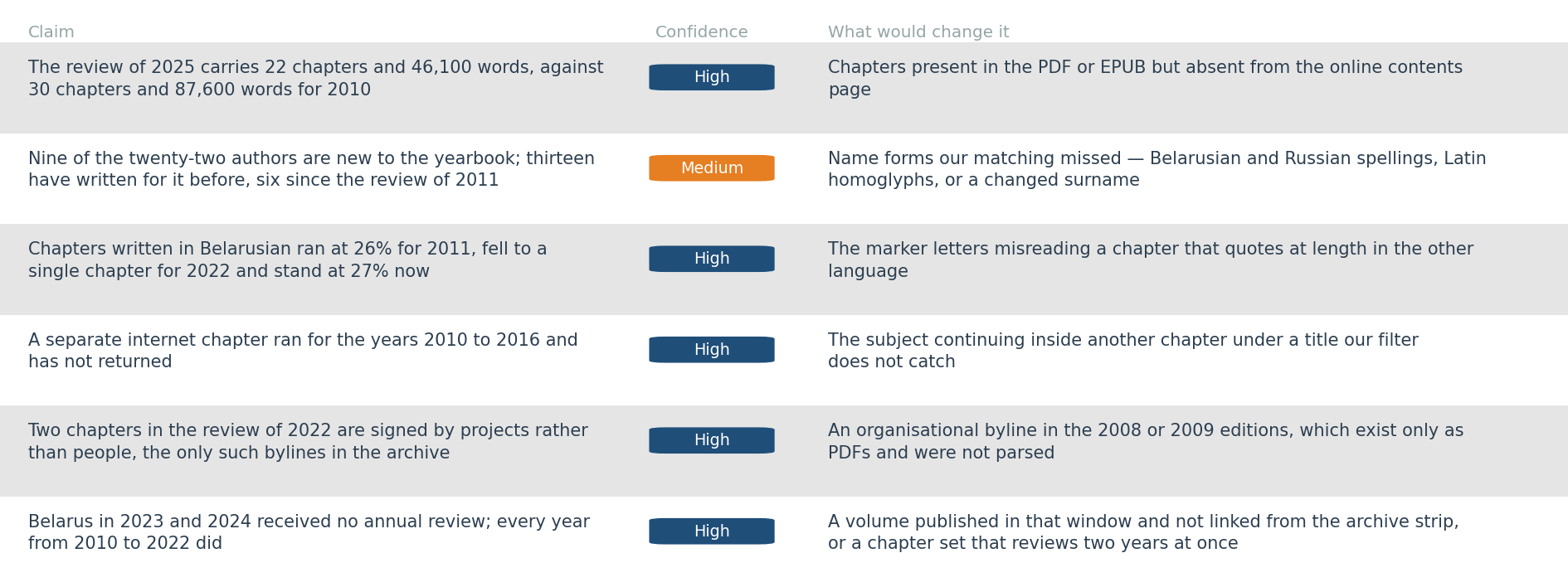
Watch
By August 2027, a review of 2026 appears. A yearbook that resumes and then runs annually is a different signal from one that resumes once.
The reviews of 2023 and 2024 stay unwritten. A retrospective volume covering the missing years would be a deliberate act of repair and would say something about the network’s ambitions.
In the next edition, the Belarusian share of titles holds above 20% rather than falling back toward the 2021 level.
In the next edition, organisational bylines return, stay at zero, or spread beyond the two seen in 2023.
A separate digital or internet chapter reappears. It has been absent for nine years and five editions.
Method and limits
The contents page of every edition from 2010 to 2026 was fetched on 22 August 2026, along with the full text of all 390 Russian chapters. The 2008 and 2009 editions exist only as PDFs and are excluded. The 2010 edition uses a different link scheme, which the first pass missed; its chapters and word counts are included here, but its bylines are not, so every count involving authors runs from 2011.
Author identity is matched on a normalised surname, folding Belarusian and Russian spellings together and correcting for Latin letters used inside Cyrillic names — the byline for Klaskoŭski contains a Latin i. An earlier version of that matching collapsed two-author bylines to one name and produced figures that were wrong; the numbers here are the corrected ones, and the difference was nine first-time authors rather than ten.
Language is assigned from the body text. Section, chapter number and byline are taken as printed. The year each volume reviews is taken from the page where stated, and otherwise from the most frequently cited year across that volume’s chapters; the five volumes that state it are all matched correctly by that method, and the winning year leads the next by between 2.4 and 4.1 times in every case.
The 390 chapters are held in our corpus as their own source, one record per chunk with its own address, dated by year of publication rather than by the year each edition reviews.