

On 22 June, the BIPART research centre published The Presidential Administration within the Belarusian Governance Structure: Functions, Personnel, and Influence — forty-six pages in Russian and English on the one Belarusian institution that combines maximum influence with minimum visibility. Anyone working on Belarusian governance should read it. It is the most complete open-source account of the Administration we have, and parts of it are simply new.
It is also a study whose narrative runs slightly ahead of its own material. Below: what it establishes, where its central claim outruns its evidence, and four things we can measure to settle the difference.
What the study establishes
Three contributions are durable.
The first is a legal genealogy. The study traces the Administration through the decrees that made it — No. 6 and No. 23 of 1994, which created a “working body”; No. 97 of 1997, which reclassified it as a “state administration body” and handed it the personnel register, ideology and the state media; No. 40 of 2017; and No. 303 of 14 August 2025. That last document matters most, because it is classified for official use, and the study reconstructs its content anyway: the Administration now handles the president’s interaction with the All-Belarusian People’s Assembly, presidential assistants may call in the security agencies and initiate disciplinary proceedings against officials, and regional inspectors are formally charged with political stability, ideological quality and oversight of civic and religious organisations. This is the clearest published account of what the 2025 reorganisation did.
The second is prosopography. Eleven heads since 1994, with tenures, prior posts, education and subsequent careers, plus a table of former Administration staff now running ministries and a typology of the recurring career loops — foreign ministry to Administration to foreign ministry, information ministry to Administration to state television. As a dataset for elite network analysis this is immediately reusable.
The third is de-mythologisation, and it is the study’s most useful move. The head of the Administration is not the “second person” in the state: he ranks seventh in the formal register, and the 2022 constitutional amendments route emergency succession to the chair of the Council of the Republic. The All-Belarusian People’s Assembly, described by a sitting deputy head of the Administration in March 2026 as “insurance against unforeseen circumstances”, is a reserve arrangement rather than a power centre. And economic policy still belongs to the government and the National Bank, who “risk losing their posts” for it. Each of these corrects an assumption that circulates freely in exile analysis.
The second ledger
The study reads its material as a single upward curve: a working body in 1994 becomes the pivot of the system by 2025. Every decree adds. But the same forty-six pages contain a second, unaggregated list.
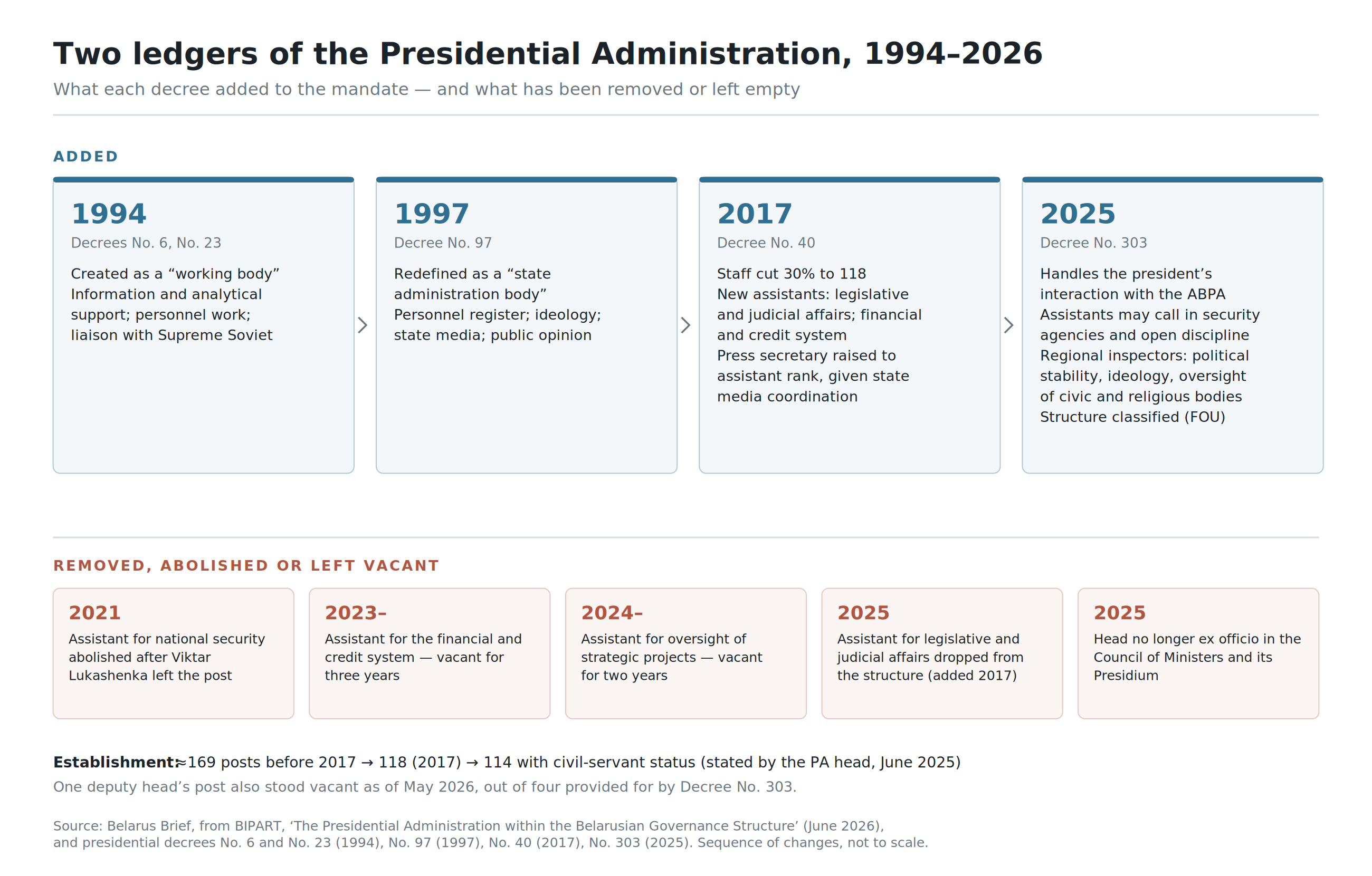
Caption: Every decree the study examines added functions to the Administration. The study also records, in passing, six removals and vacancies it does not add up.
The assistant for national security was abolished in 2021 after Viktar Lukashenka vacated it. The assistant for legislative and judicial affairs — created by the 2017 decree the study reads as an expansion of legal control — was dropped from the structure in 2025. The assistant for the financial and credit system has been vacant since 2023, the assistant for oversight of strategic projects since 2024, and one of four deputy head posts was still empty in May 2026. The 2025 decree also quietly removed the clause making the head of the Administration an ex officio member of the Council of Ministers and its Presidium. Meanwhile the establishment fell from roughly 169 posts to 118 in 2017 and to 114 with civil-servant status by June 2025.
The study’s explanation for the empty economic posts is that “the corresponding functions may have been redistributed” internally, and that under sanctions Lukashenka may prefer non-public administration of these issues. Perhaps. But that is a hypothesis stated in the conditional, and there is a competing one: an institution whose written mandate keeps widening while its staff shrinks and four senior posts stand empty for years may be losing capacity rather than gaining it — narrowing to a political-control core while economic coordination migrates to the government and security coordination to the State Secretariat of the Security Council and the family circle. The study does not test either reading. It does not have to. But it should not present only one of them as description.
Chokepoint or decision centre?
The abstract calls the Administration “the pivotal institution within Lukashenka’s system of power”. The body of the study documents something more specific and more interesting.
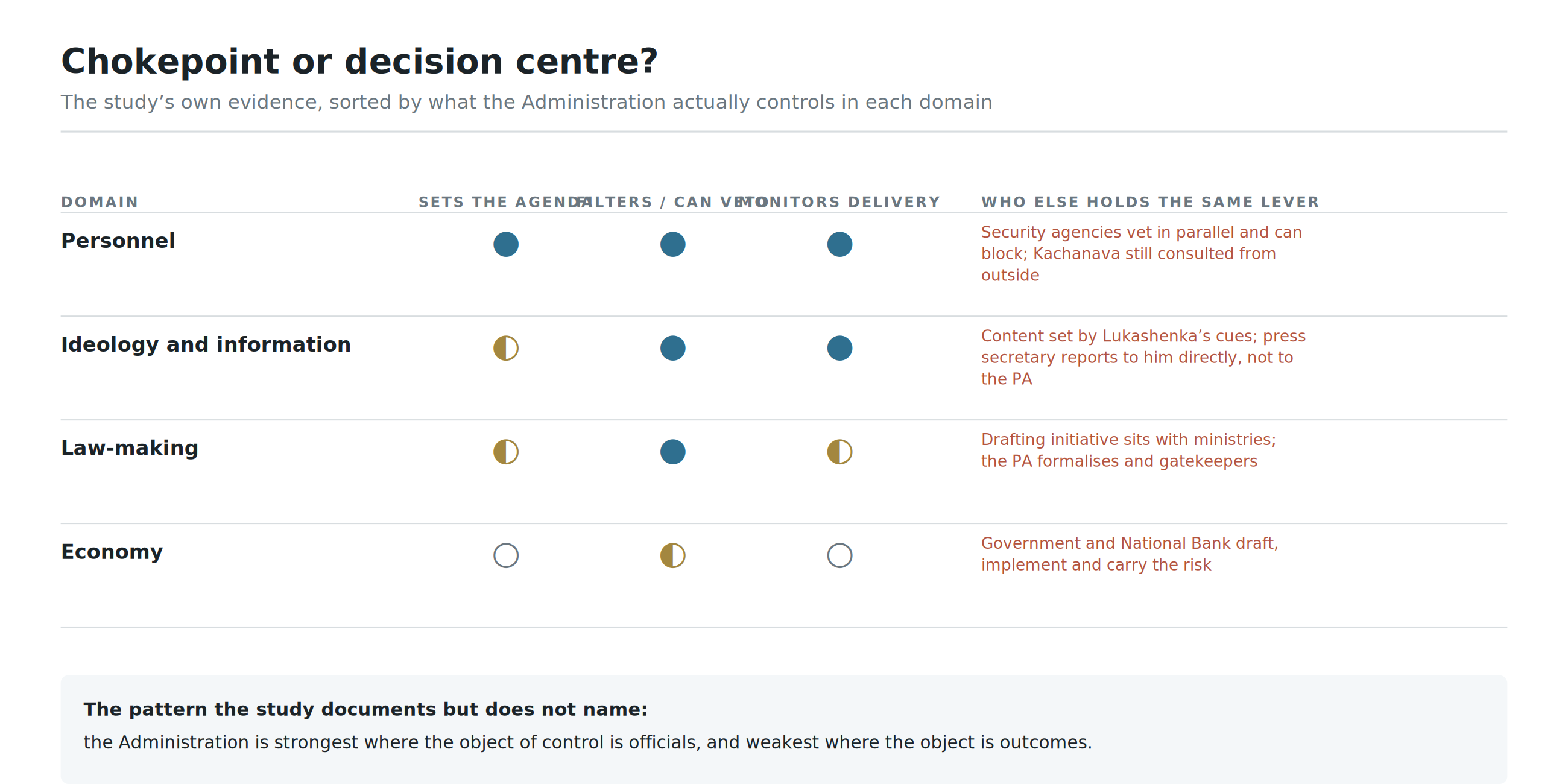
Caption: Sorted by the study’s own evidence, the Administration’s grip is a function of what is being controlled.
Where the object of control is officials, the Administration is dominant: it screens, vets, interviews and places, and every appointment on an 850-post register passes through it. Where the object of control is outcomes, it is a filter and a mediator — the study’s own formulation for the economy is that the Administration helps the government and the National Bank “promote their initiatives before Lukashenka” by framing them acceptably. Even in ideology, the study concedes that content is set by Lukashenka’s cues and that the press secretary who shapes his image reports to him directly, not through the Administration. And the closing pages say plainly that many key decisions are taken not in the Administration but in a narrower circle including the family.
That is not a pivotal institution. It is a procedural chokepoint with an unusually good seat. The distinction matters for anyone using this research operationally: sanctions design, accountability mapping and transition planning all depend on whether you are looking at where decisions are made or where they are processed.
Eleven heads, and the trouble with small numbers
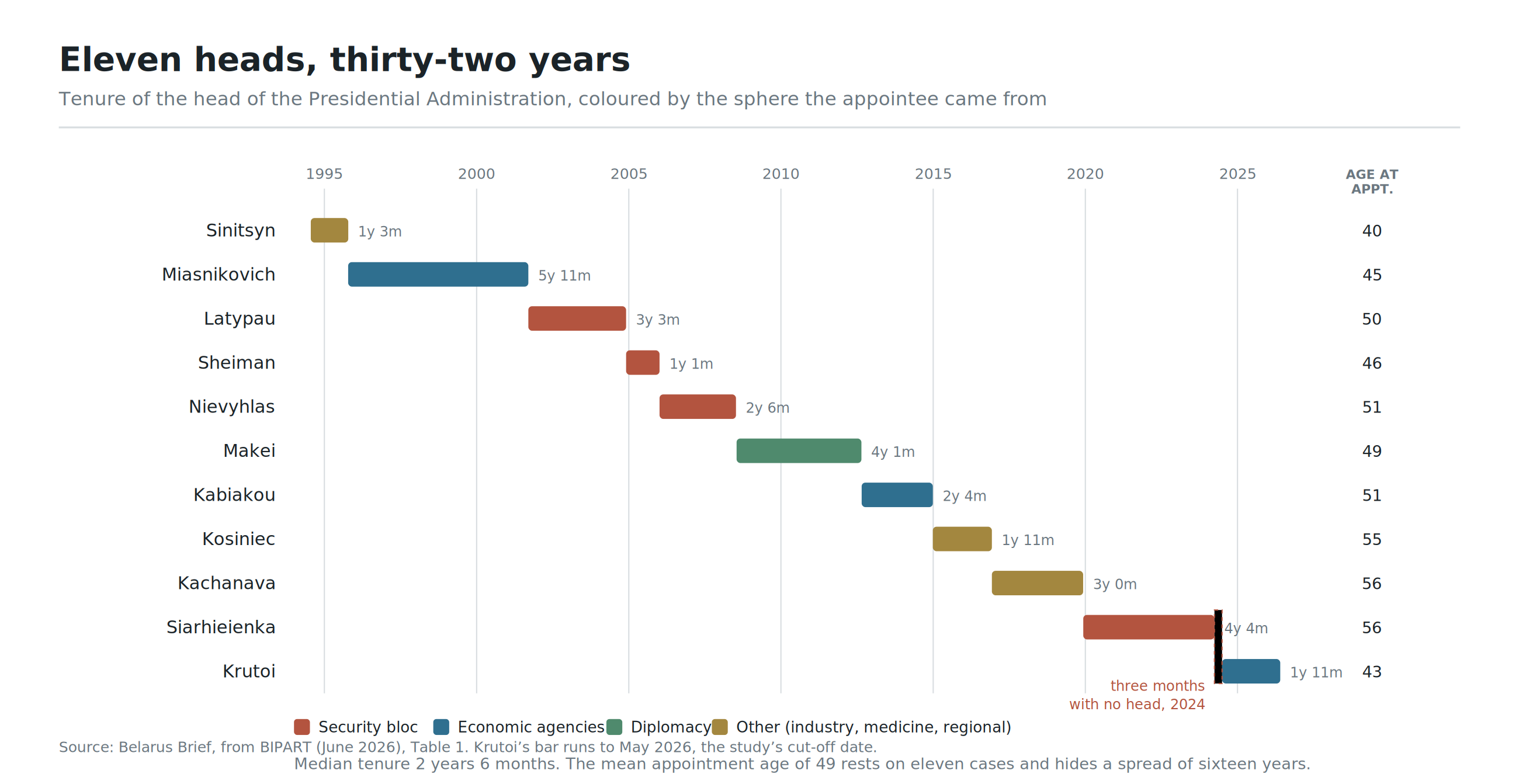
Caption: Median tenure is two years and six months. The study’s mean appointment age of 49 rests on eleven cases spanning sixteen years of age.
The biographical chapter is the study’s best data and its weakest inference. Four of eleven heads came from the security services, three from economic agencies; the study also reports that four were born in Vitsebsk region and that the average appointment age is 49. With an N of eleven and no base rates, these are descriptions of a table rather than findings about a system — as the study’s own interviewees say, when they observe that origin and profession are not decisive and that Lukashenka picks “the strongest individual he sees at any given moment”.
One detail the chapter records but does not discuss: Siarhieienka left on 29 March 2024 and Krutoi was appointed on 27 June 2024. For three months, in a system the study describes as running through the Administration, the Administration had no head. That gap is worth a paragraph.
What we would want next
The study’s method statement is one sentence: it uses open sources and expert interviews. We are not asking for the author’s name or the interviewees’ — exile research on the Belarusian nomenklatura has good reasons for both silences. But the analytical weight here is carried by quotations, and readers cannot tell how many people were interviewed, when they last had access, or whether five separate claims come from one former official. Indexed anonymous sources (”Interview 3, former ministry official, 2019–2023”) would cost nothing and change the evidentiary status of the whole document.
Two absences are more substantive. There is no comparative frame — the “administration as parallel government” pattern is well described for Russia and Kazakhstan, and Belarus would look either typical or distinctive against it. And for a study of an institution said to be growing, there is almost no behavioural data: no output volumes, no budget, no measure of how much of the Administration’s normative production is now classified. The growth is documented in the wording of decrees, not in observable action.
Four things we can measure
Our corpus covers state and regional media, the pro-government Telegram layer and official publication channels. Four indicators would discriminate between the two readings above:
Vacancy persistence. Whether the deputy head post and the two economic assistant posts are filled, tracked through personnel-day coverage. Sustained emptiness is evidence of narrowing, not redistribution.
Attribution ratio in economic coverage. How often state media put economic decisions in the mouths of Administration principals versus government and National Bank principals. Figure 2’s bottom row predicts a stable government-heavy ratio.
Transmission lag for the ideological agenda. The Administration’s monthly “Materials for Members of Information and Propaganda Groups” set a single theme — May 2026’s was tourism development. Measuring how many days pass before that theme surfaces in regional state outlets is a direct test of the claim that the Administration sets the ideological agenda rather than relaying it.
Regional inspector visibility. Public activity of the seven presidential assistants serving as regional inspectors, against that of the oblast executive committees they shadow. The 2025 decree gave the inspectors a supervisory mandate; visibility shows whether it is being exercised.
Three dated claims
To be checked here on 30 June 2027:
At least two of the three senior Administration posts vacant in May 2026 — one deputy head, assistant for the financial and credit system, assistant for oversight of strategic projects — will still be vacant.
In state-media coverage of economic policy decisions, government and National Bank principals will continue to outnumber Administration principals by at least three to one.
Dzmitry Krutoi will still be head of the Administration, taking his tenure past the eleven-head median.
If all three hold, the Administration is a stable processing centre with a shrinking establishment, not an institution accumulating power. If the first two fail, BIPART’s reading is the right one and ours is wrong.
BIPART’s study is available in Russian and English. This review draws only on the published text.