

On 16 October Belstat reported that the economy grew by 2 per cent in the first nine months of 2026. State outlets repeated the number and the sectors that led it. They left out the target it misses, the way it got there and the defence line in next year’s budget.
Belarus’s statistics office publishes a first estimate of growth every month, and state outlets report each one. The nine-month figure, 2 per cent, was reported the same way. Independent outlets used the same figure but set it next to the government’s own target of 2.8 per cent and asked why growth had stalled since July. What we cannot see is how far these first estimates are later revised, because revisions are rarely reported.
One number, two readings
In our archive, 15 state items covered the nine-month result from 16 to 27 October. Thirteen gave the 2 per cent, and seven listed the sectors that grew fastest, as the economy ministry did: transport at 104.8 per cent, trade at 104 and agriculture at 103.8 (BelTA). Two compared the result with a plan or a forecast.
Of 15 independent items, 12 made that comparison. “The Belarusian economy sped up a little. But it is still far from the authorities’ plans,” Zerkalo wrote. The analysts at macroby said September’s rise came from a statistical effect of last year’s base (Reform), and Zerkalo quoted economists who linked the slowdown to falling investment and weak exports (Zerkalo). Four independent items discussed the third quarter. No state item did.
Two compared the result with a plan or a forecast.
The target was not hidden. State outlets mentioned the 2.8 per cent several times in September and October, but in reports on forecasts by Eurasian development institutions (BelTA). Those forecasts sit below the target: the Eurasian Development Bank now expects 2.1 per cent (Reform). It appeared beside other people’s forecasts, not beside the actual result.
The path behind the number
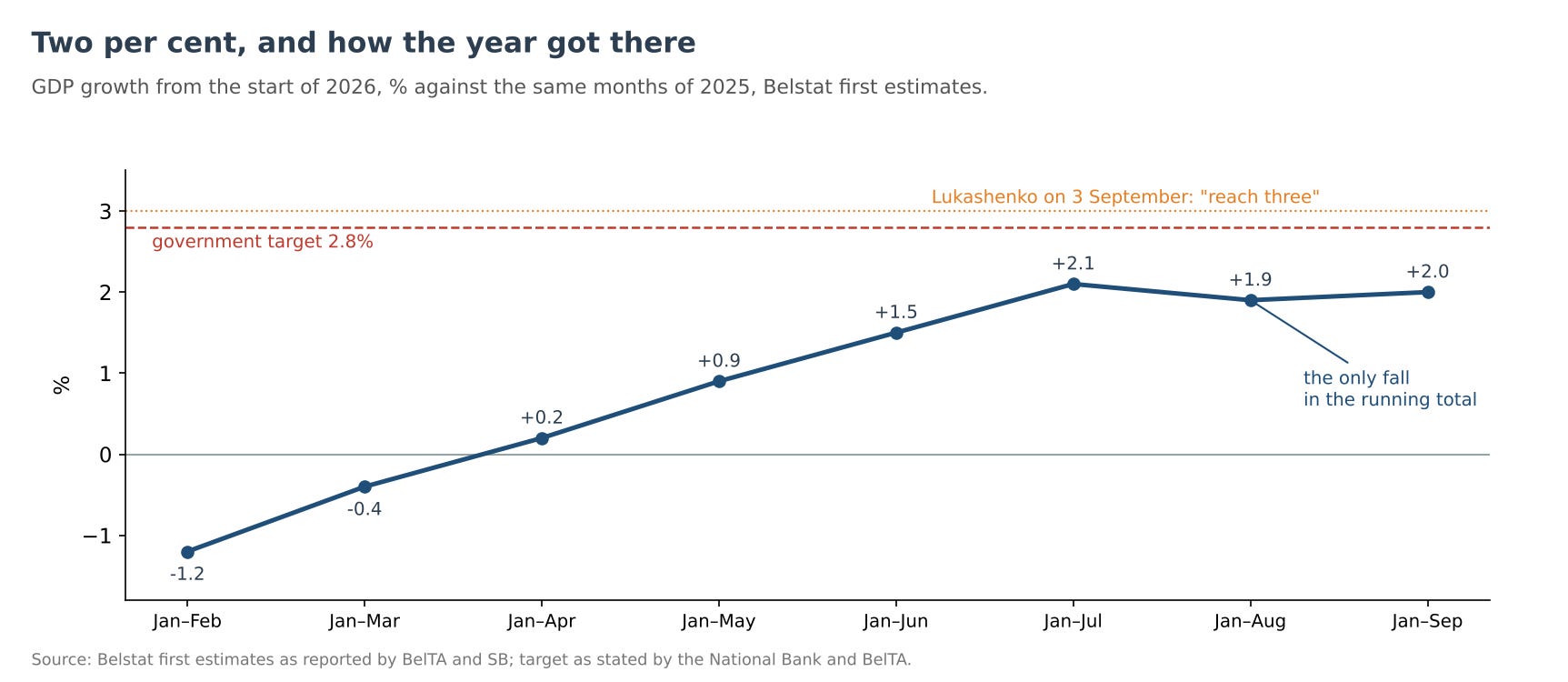
The monthly first estimates show the year’s shape. The economy shrank by 1.2 per cent in January and February (BelTA) and by 0.4 per cent in the first quarter. It returned to growth in April and reached 2.1 per cent for January to July (BelTA). Then the figure fell, to 1.9 per cent for January to August (BelTA), and rose to 2 per cent for nine months. August was the only month this year in which the running total went down. State headlines reported it as growth of 1.9 per cent.
Two weeks before the August figure came out, Lukashenko set the bar higher than the target. In Minsk he said: “We already have 2.2 per cent, we need to reach three by the end of the year” (SB). The official figure for January to July was 2.1 per cent.
August was the only month this year in which the running total went down.
The social line and the defence line
The same week, the draft budget for 2027 reached parliament. State outlets reported it through one message, repeated in 11 items. Vasily Panasyuk, who chairs the budget committee, said the budget “has a clear social orientation” and that spending on the social sphere will grow by 11 to 12 per cent (BelTA). None of the 11 mentioned defence or security spending.
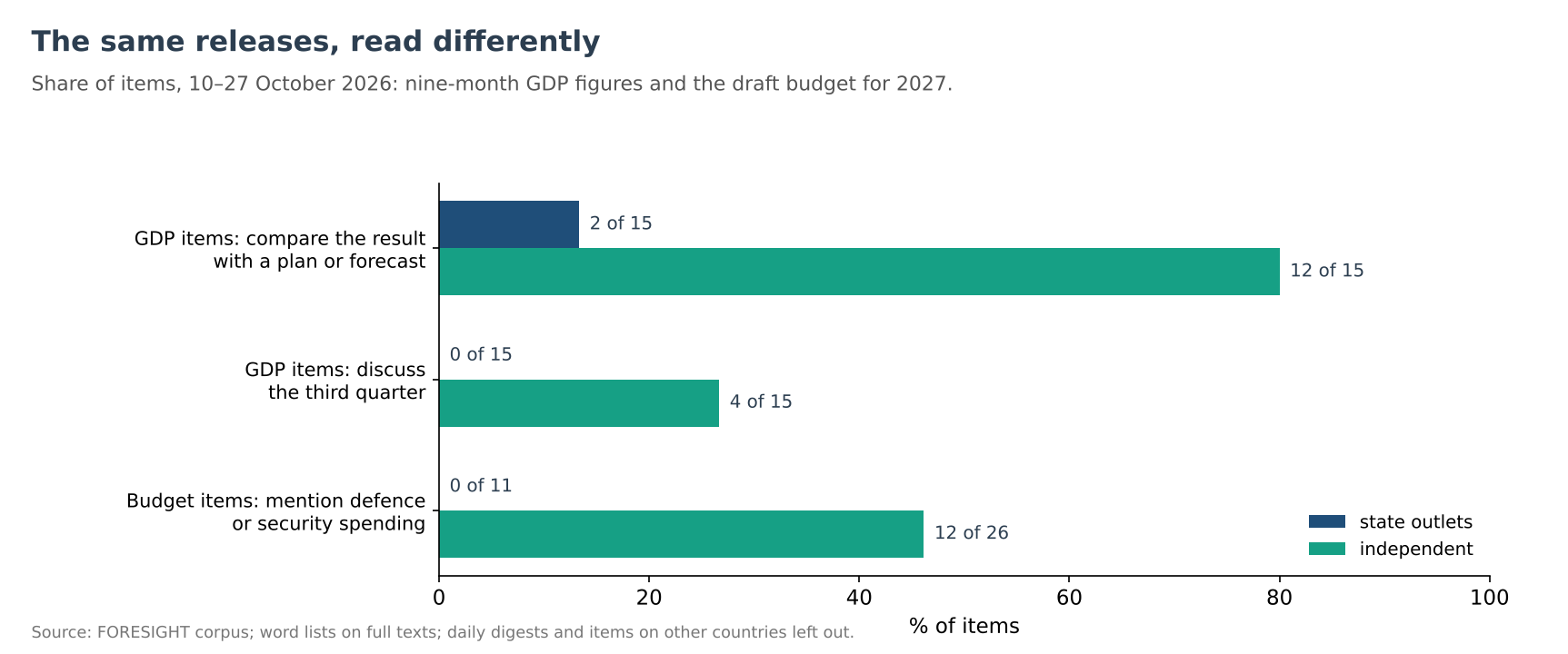
Independent outlets read the draft law. Twelve of 26 items on it discussed the defence and security lines. Euroradio compared the budget laws for 2022 and 2027: spending on national defence rose from 1.8 billion to 5.2 billion rubles, by 186 per cent. Racyja counted defence and security together at 12.66 billion rubles, about one ruble in five. A pro-government Telegram channel, quoting the draft, put the social sphere at 12 billion (Zhivet zhe Belarus). On these figures, the security lines of the republican budget are slightly larger than the social sphere that state outlets call its priority. Much social spending, however, sits in local budgets, so the comparison covers the central budget only.
None of the 11 mentioned defence or security spending.
An index the state did not report
On 19 October Polish Radio reported that Belarus had fallen three places, to 125th of 165, in the Fraser Institute’s index of economic freedom (Polish Radio). It was the only country in its region to lose ground, while all its neighbours improved (Polish Radio). Belsat followed four days later (Belsat). In our archive no Belarusian state outlet reported the ranking.
It appeared beside other people’s forecasts, not beside the actual result.
How sure we are
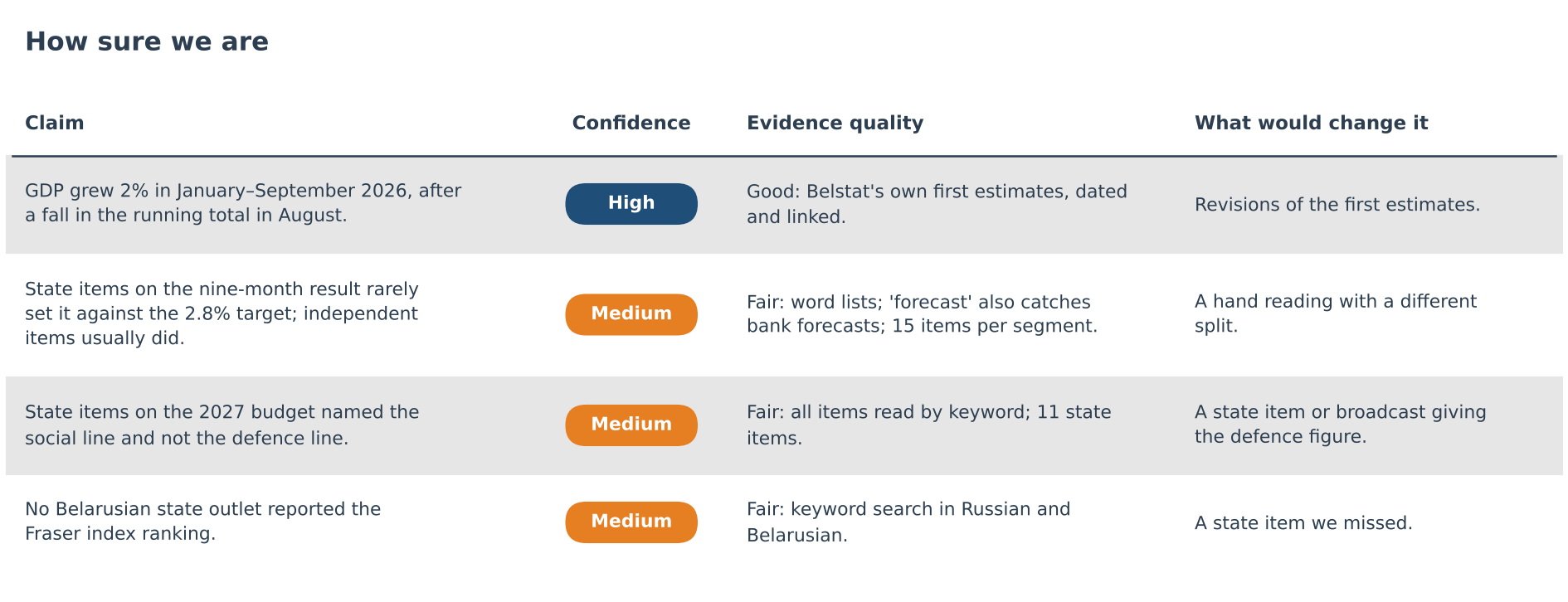
The growth figures are High: they are Belstat’s own first estimates, as reported by state outlets. The comparison of coverage is Medium, because our labels rest on word lists: “forecast” also catches forecasts by banks, and 15 items per segment is a small sample. The budget comparison is Medium: the social and security figures come from different sources, and the boundary of the “social sphere” in the central budget is not the same as total social spending.
How it fits
How it fits. State outlets report every official figure, but each one alone: the nine-month total without the target, the budget’s social line without its defence line, the bank forecasts with the target but without the result. None of the seven theses in our working model covers this, so we record it as an observation. The simpler reading is that state outlets reproduce official press releases, and the releases themselves are written this way; editors add nothing and remove nothing. On that reading, the selection happens in the ministries, not the newsrooms. A test is to compare the press releases with the published texts: if state items add context that the releases lack, the newsrooms are choosing; if they never do, they are copying.
What to watch
Belstat’s first estimate for the whole of 2026, due in January 2027, shows growth below the target of 2.8 per cent. We expect it does, with High confidence.
When parliament adopts the 2027 budget, a state outlet reports the amount for national defence. We expect it does not, with Medium confidence.
By 31 December 2026, a Belarusian state outlet reports Belarus’s place in the Fraser Institute’s index. We expect it does not, with Medium confidence.
Method and limits
We collected items in our archive from 15 to 27 October 2026 on growth in the first nine months. We marked those that give the 2 per cent figure, name leading sectors, or mention a plan or forecast, the third quarter, a slowdown, investment or exports. The monthly growth series comes from Belstat’s first estimates as reported by BelTA and SB. Belstat’s own monthly bulletins in our archive hold these figures mainly in charts that our extraction does not read reliably. For the budget we read all items from 10 to 27 October on the 2027 draft and left out items on other countries’ budgets and daily digests. Figures for defence and social spending are those reported by the outlets we cite; we did not read the draft law ourselves. Thesis tag: none (observation).