
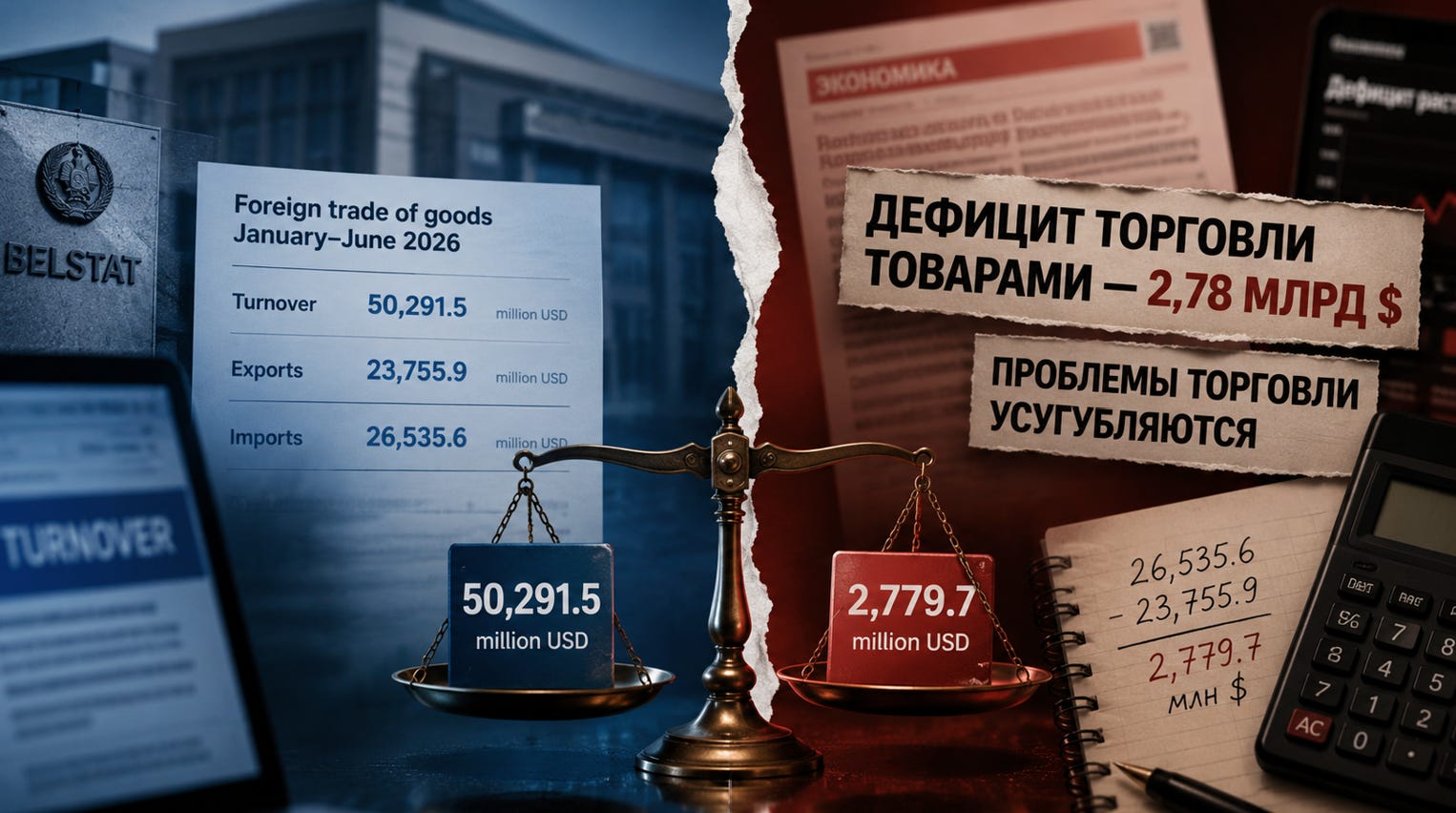
Belstat published the January–June foreign trade figures at 11:00 today. The release contains three numbers — turnover of 50,291.5 million dollars, exports of 23,755.9 million, imports of 26,535.6 million — and three year-on-year indices. It does not contain the word deficit.
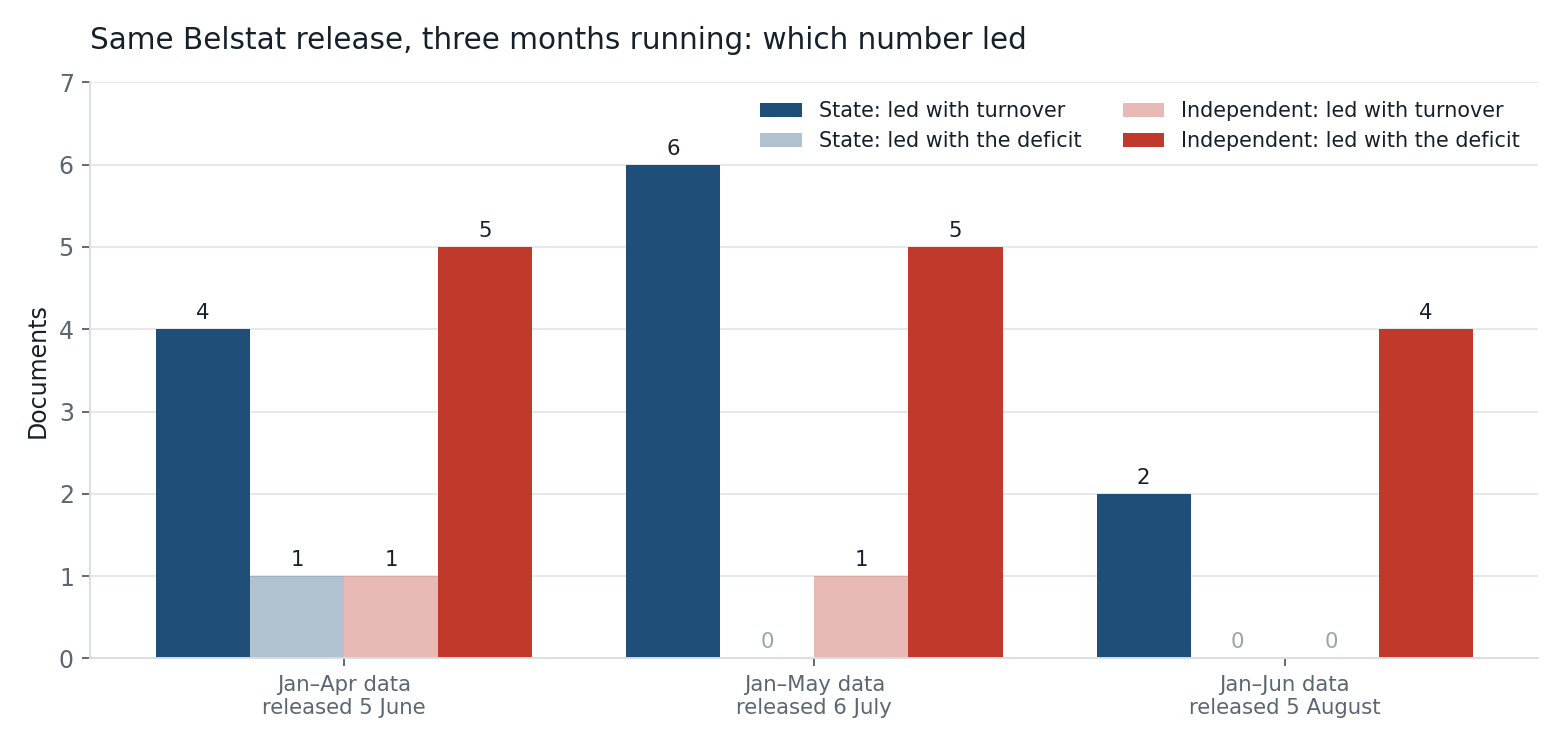
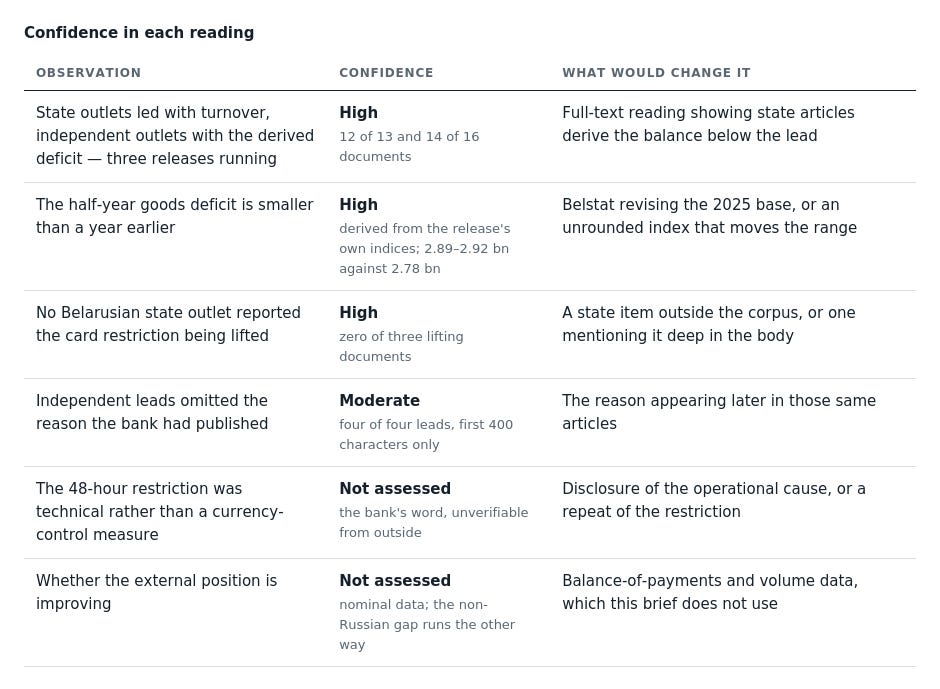
State outlets reproduced the release and led with turnover. Independent outlets performed the subtraction and led with the result: imports exceeded exports by 2,779.7 million for the half-year. Neither segment invented anything, and the split has now repeated across three consecutive monthly releases — the state segment leading on turnover in 12 of its 13 documents, independent media on the deficit in 14 of 16.
The same release supports a third statement that neither segment made. Apply the published indices to the published totals and the January–June 2025 deficit works out at roughly 2.90 billion, against 2.78 billion this year. Year on year, the goods deficit narrowed by something between 110 and 140 million dollars.
That is the pattern this brief is about, and the second half of it cuts the other way. When the country’s largest state bank restricted some card operations for 48 hours in late July, independent coverage described a bank that had closed transfers “without explanation or term”. The bank’s own notice, published the same day, gave a reason and called the measure temporary twice. It did not give a term.
The release
The mechanism is not falsification, and it is not quite selection either. Belstat’s release does not publish a balance; it publishes totals from which one can be derived. Reproducing the release and computing from it are different acts, and the two segments have settled into one each. Turnover is growing. The cumulative deficit within the year is growing too, because a running total does. Whether the external position is deteriorating is a third question, and it is the one the indices answer.
Through three releases the choice has been near-total. On 5 June, four state documents led with the January–April turnover of 32.2 billion; one, CTV, mentioned the negative balance as well. On 6 July, six state documents led with 41.2 billion for January–May, none mentioning the balance. Today, BelTA and Zviazda led with 50.29 billion for the half-year, both attributing the data to Belstat’s website. Independent outlets on the same three dates led with the deficit approaching 2 billion, then with trade problems “intensifying”, then today with the deficit at 2.78 billion and rising.
The scale behind the argument is not in dispute. The 2025 full-year negative balance in goods was 6.5 billion dollars. Independent reporting on 10 July put the increase over three years at a factor of 65 — a figure that sounds enormous mainly because the base was near zero, which is worth saying out loud rather than repeating the multiple.
What is in dispute, on this morning’s evidence, is direction. Today’s independent leads describe trade problems intensifying and the deficit rising. Both statements are accurate about the cumulative total inside 2026: the half-year gap is larger than the five-month gap, and June added over half a billion to it. Neither is accurate as a statement about the year. Exports grew 23.2 per cent against imports at 19.6 per cent, and the half-year gap is smaller than it was in the same period of 2025. These are nominal figures at current prices, so roughly a fifth of the growth on both sides is not volume; but the comparison between the two sides is like for like, and it points the other way from the headline.
The structural point sits underneath all of this and nobody leads with it: the balance is positive with Russia and negative with everywhere else. An independent count at the end of July put that non-Russian gap at about 4.3 billion — larger than the headline deficit, which means the surplus with Russia is what keeps the aggregate at 2.78. A narrowing total deficit and a widening dependence are compatible, and on these numbers both are happening. Turnover growth and deficit growth are, in that light, the same fact seen from two ends — trade is being redirected rather than reduced, and the redirection costs currency.
The 48 hours
On 29 July, Belarusbank announced a temporary restriction on currency-exchange operations for card-to-card transfers where the transfer currency differs from the account currency. The notice named a reason — technical — described the perimeter narrowly, stated that Belarusian-rouble operations and ordinary purchase, sale, payment and withdrawal were unaffected, and promised a separate notice when the restriction was lifted. It gave no end date. The restriction was lifted on 31 July. The bank’s notice of the lifting appeared on 4 August.
Seven documents in the corpus covered the introduction: four independent, three state or pro-regime. Three covered the removal: one independent, one Russian state, one domestic private. No Belarusian state outlet reported that the restriction had ended.
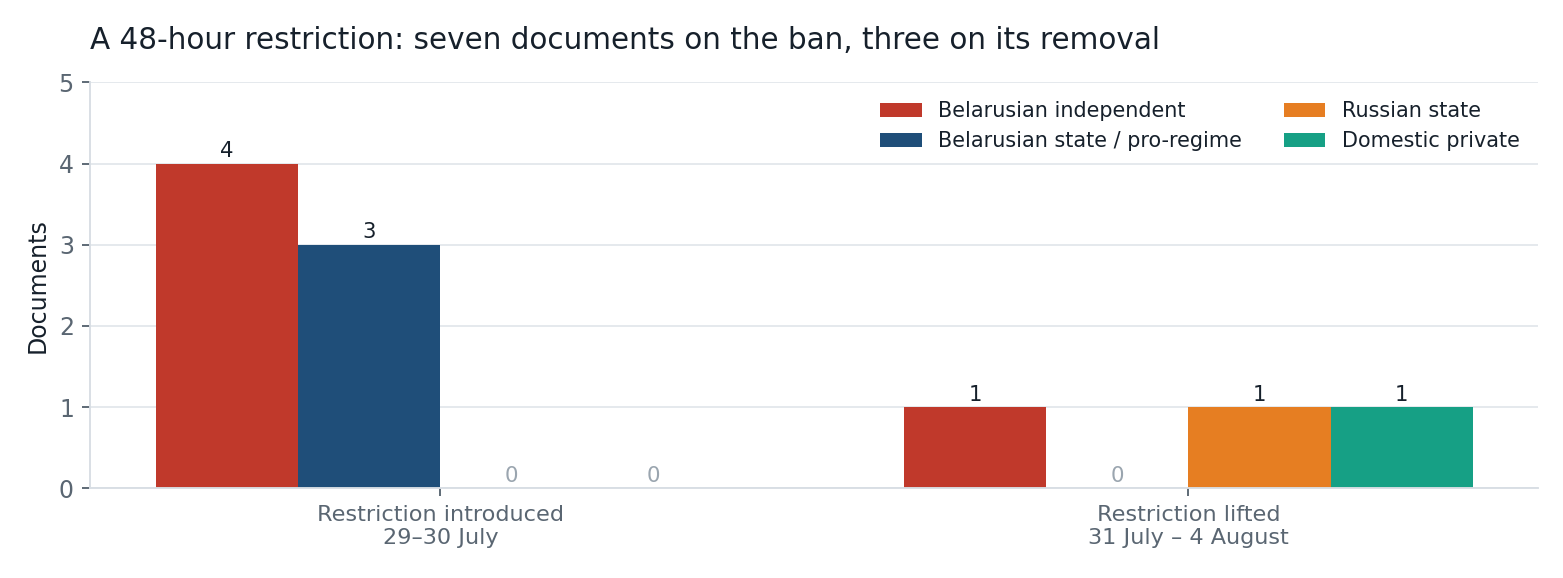
Within the introduction coverage, the reason the bank gave appears in the opening of two of the three state-segment items and in none of the four independent ones. One independent Telegram item said the bank had closed transfers “without explanation and without term”. Half of that is right. The bank had published an explanation on its own site that morning; what it withheld was the term.
This is the same mechanism as the Belstat release, running in the opposite direction. Both segments selected a true element and led with it. The state selection omitted a widening deficit. The independent selection omitted a stated reason, and — because nobody in that segment carried the correction except one outlet — left a 48-hour episode looking open-ended in the record.
I should declare an interest here. Two days ago I proposed building a brief around this restriction as evidence of tightening currency controls. The bank’s primary notices, which took four minutes to read, did not support that framing. The error was mine and it was the same error: selecting the element that fit a prior expectation.
What was actually structural
Three things in this window were durable, and all three got less attention than the 48-hour episode.
From late April, at least four banks — Belagroprombank, Belgazprombank, Alfa-Bank and MTBank — changed the settlement currency for Mastercard cards from euro to dollars. From early July, several banks introduced or raised charges on Russian-rouble operations, including a fee for accepting rouble cash and, at one bank, a commission of 20 per cent. And on 1 July a national payment service began requiring geolocation data from card users, which produced a visible public reaction.
None of these was reversed. The card restriction was, in two days.
Confidence
Watch items
The next release, of January–July data, is the test. If the state segment again leads with turnover in every item and the independent segment again leads with the cumulative balance, the pattern is established rather than observed and can be scored as a standing prediction. The sharper question is whether any outlet in either segment applies the published indices — a subtraction and a division, both available in the release itself.
Whether any Belarusian state outlet ever reports the lifting of a restriction it reported imposing. In this episode none did; a single counter-example in the next such case would change how much weight the observation carries.
Whether the settlement-currency and rouble-fee changes are followed by further measures on the rouble channel. Those, unlike the card episode, are the ones that would indicate something about the external account.
Method and limits
Corpus of 73 sources, web and Telegram, segment labels assigned at source level in advance, queries reproducible against PostgreSQL. Six topics were run with an anchor plus a required context term; homonym checks were run against anchors alone first, which is why exchange-rate reports do not appear in the deficit counts.
Documents were counted only where the anchor appears in the headline or the first 400 characters. One outlet embeds a “popular now” widget inside its stored article text, which accounted for 129 of 208 raw hits on one topic and 19 of 26 on another; without that filter the counts here would be roughly five times too high and entirely wrong. The same filter means an article that mentions the deficit only deep in the body is not counted, so every figure is a lower bound.
The classification of what an item “led with” was made on the first 400 characters, not the full text. A state article that opens on turnover may discuss the balance later; that would change how the pattern should be read, and it is not something this method can see. Treat the finding as being about lead framing specifically.
Both bank notices are public and dated on belarusbank.by. The January–June release is published on belstat.gov.by and timestamped 5 August, 11:00; the totals and indices quoted here are its own. The 2025 comparison is derived, not published: dividing this year’s totals by the published indices reproduces last year’s, and because the indices are rounded to one decimal the derived 2025 deficit sits between 2.89 and 2.92 billion. That range does not overlap this year’s 2.78, which is why the direction is stated as it is. Document timestamps are mostly unavailable — day-level dates only — so no claim is made about the order of publication within 5 August. This brief measures coverage of them, not the underlying economy: nothing here establishes what the restriction was for, or what the trade balance will do next.