

On 29 October the Belarusian Association of Journalists found the blogger Hleb Siamionau in Russia’s wanted database, with a note that the police of Gomel region are looking for him. He joined three publishers and three other media workers added in October, and more than a hundred journalists and media staff listed before them. Independent outlets report each name within a day; state outlets have not reported one. What we cannot see is the charge in most cases, and how many of the 6,000 Belarusians in the database are there for politics rather than for ordinary crime.
The month’s names
The month opened with the publishers. On 6 to 8 October independent outlets found Yaraslau Ivaniuk of Białystok, Ihar Lahvinau and Andrei Yanushkevich in the database of Russia’s Interior Ministry (Svaboda, 8 October; Euroradio, 7 October). On 12 October the media manager Aliaksandr Vasilevich appeared; earlier entries named the former tut.by journalist Adarya Hushtyn and the historian Aliaksandr Pashkevich. On 27 October the playwright Mikalai Khalezin was added (Zerkalo, 27 October), and on 29 October Siamionau (Pozirk, 29 October; BAJ).
The entries say who is looking, not why. For Siamionau the article of the Criminal Code is not given. For the publishers the independent reports name no charge either. The database records a request from a Belarusian agency and nothing more.
We searched our archive for every item since 2021 that mentions interstate search or the Russian Interior Ministry database. There are 1,156 of them. Independent outlets wrote 650. State outlets, pro-government Telegram channels and Russian state media together wrote 482. Of the state and pro-government items, 195 are crime reports: fraudsters, debtors and fugitives caught at the border. Not one of the 482 names a Belarusian journalist, publisher or blogger placed on the list.
Not one of the 482 names a Belarusian journalist, publisher or blogger placed on the list.
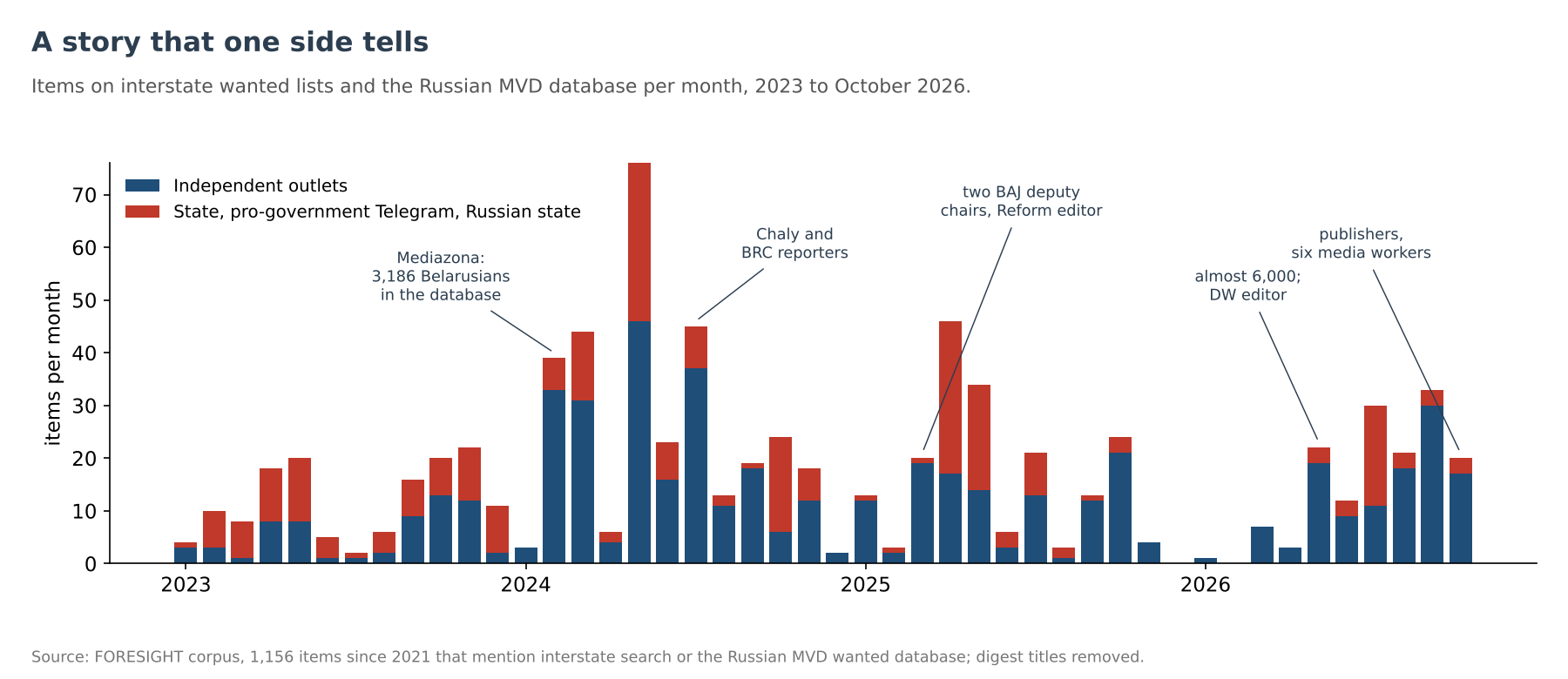
The seven people of October appear in 18 items in our archive in connection with the wanted list. All 18 are independent. State outlets know the names: they have written about Pashkevich 373 times and about Lahvinau 140 times since 2024, mostly before the entries, as historian and publisher. On the entries they are silent.
What the state does say
State outlets do talk about the mechanism, in general terms and about other people. In May 2024 the interior minister Ivan Kubrakov called cooperation with Russia “a vivid example of constructive cooperation” and listed interstate search first among its forms (BelTA, 10 May 2024). In May 2025 he reported that Russia had detained 964 people wanted by Belarus in 2024 (Pozirk, 23 May 2025). In March 2026 Pozirk reported that Russia had handed over 225 people for prosecution in 2025 (Pozirk, 16 March 2026). On 1 October the ministry said 116 people had been detained in CIS states at Belarus’s request this year (Pozirk, 1 October). None of these totals is broken down by article.
Pro-government Telegram channels add the lesson. When the list took in the analyst Siarhei Chaly and reporters of the Belarusian Investigative Center in July 2024, one channel advised exiles “to sit tight and not stick out” and not to travel to Turkey, Egypt, Georgia or Serbia (Zheltye Slivy, 31 July 2024). When Georgia expelled Leu Mikheyeu to Armenia in September 2026 and Armenian police held him, the same channel wrote: “This is the reality of all the fugitives. You can hide and change countries as much as you like, but there will be no normal quiet life” (26 September).
The instrument is admitted, the targets are not named.
State channels also report the Russian database when Russia uses it against its own critics. ONT and Sputnik Belarus carried the entries for the animator Pavel Muntyan (ONT, 26 December 2023), the rapper Oxxxymiron and the presenter Tatyana Lazareva. The instrument is admitted, the targets are not named.
How the database grew
Nobody outside the ministries publishes the political share of the database. Mediazona has counted all Belarusian citizens and natives in it at intervals, and independent outlets carried each count. In February 2024 there were 3,186 (Euroradio, 13 February 2024). In November 2024 more than 4,400 (Belnews, 28 November 2024). In April 2025 more than 4,700, with more than 1,200 added in five months (Reform, 9 April 2025). In October 2025 more than 5,000 (Reform, 9 October 2025). In May 2026 almost 6,000, with 1,118 added in six months (Pozirk, 13 May 2026). BAJ’s figure on 29 October is more than 6,000, of whom more than 100 are independent journalists and media staff.
The database adds about a thousand Belarusians a year, and the pace has not slowed.
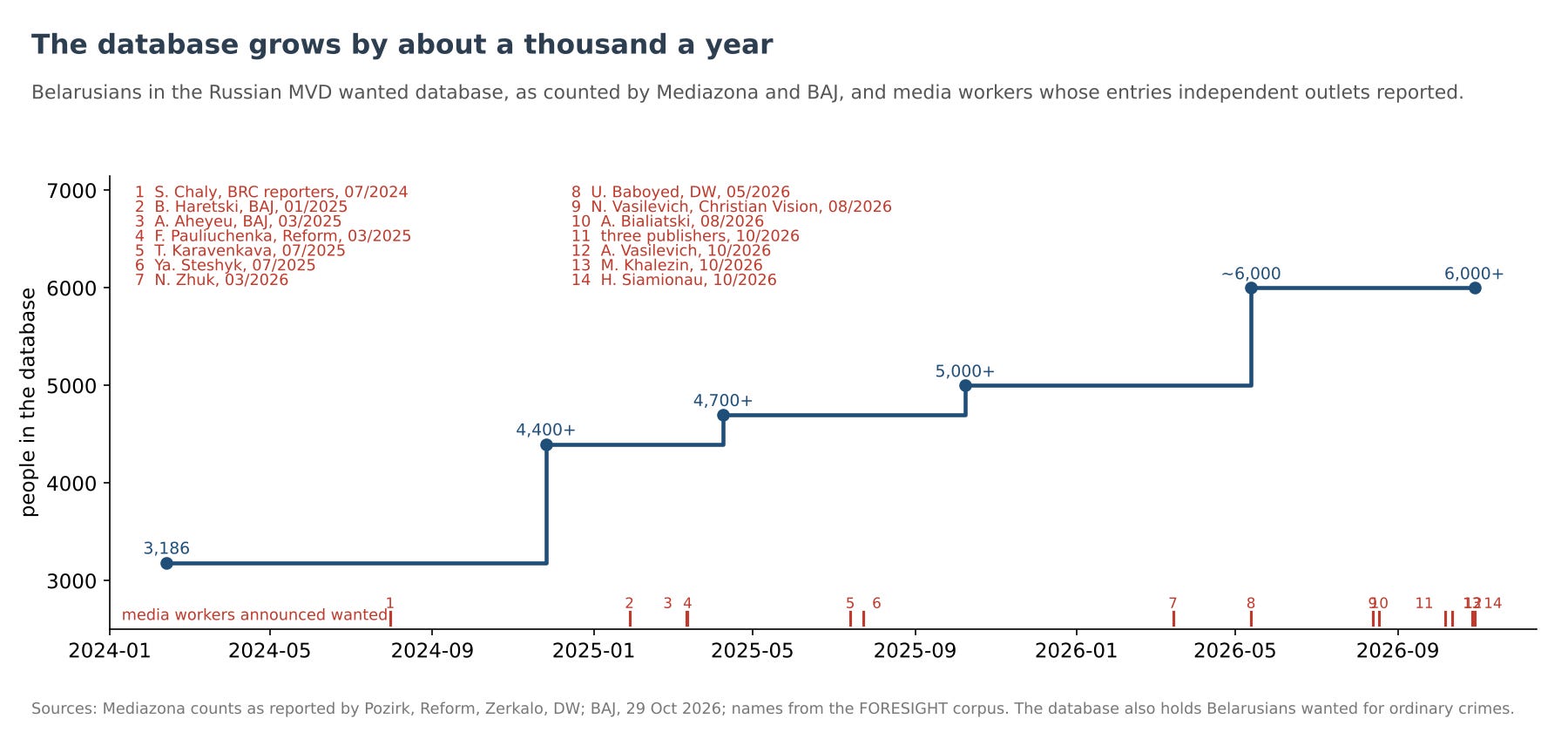
The database adds about a thousand Belarusians a year, and the pace has not slowed. The media names are a thin layer on top of it. Our archive records fourteen announcements of media workers since mid-2024. Chaly and the BRC reporters came in July 2024 (Zerkalo, 31 July 2024). The BAJ deputy chairs followed: Barys Haretski in January 2025 (Pozirk, 28 January 2025) and Aleh Aheyeu in March 2025, with the Reform editor Fiodar Pauliuchenka the next day (Euroradio, 13 March 2025). Then the journalists Tatsiana Karavenkava and Yaraslau Steshyk in July 2025, Natallia Zhuk in March 2026, and the DW editor Ulyana Baboyed in May 2026 (DW, 13 May 2026). August brought Natallia Vasilevich of Christian Vision (Christian Vision, 13 August 2026) and, in the same week, the Nobel laureate Ales Bialiatski (Zerkalo, 18 August 2026). Bialiatski learned of his entry from Zerkalo. October added seven.
Independent coverage follows these two triggers. The monthly series peaks when Mediazona publishes a count or when a known name appears, and falls to a handful of items in between. The topic has no other engine: there is no official bulletin to report.
What follows an entry
The entry is a request for arrest in any CIS state. Our archive holds the cases where it was acted on. Armenia detained Dziyana Maiseyenka in September 2024 and let her go; she had not known she was wanted (Euroradio, 2 September 2024). Yerevan airport police held the travel blogger Alexander Lapshin in September 2024, May 2025 and March 2026, each time at Belarus’s request (Mediazona, 22 September 2024; Reform, 2 May 2025; Nasha Niva, 19 March 2026). St Petersburg police detained a former KVN comic from Pinsk in October 2025, three years after a Belarusian court sentenced him for a joke about a policewoman; Russia extradited him within two weeks (Pozirk, 30 October 2025). In May 2026 Minsk tried to have Sviatlana Tsikhanouskaya detained during her visit to Armenia, according to her office (Zerkalo, 7 May 2026). In September 2026 Georgia expelled Mikheyeu to Armenia, where police detained and then released him (Pozirk, 26 September 2026).
Independent coverage follows these two triggers.
For media workers in EU states the entry has a different effect. It bars travel to much of the former Soviet space and to countries that extradite on CIS requests, and it marks a criminal case at home that relatives can be questioned about. In August BAJ reported visits to the families of journalists who had left, including the taking of DNA samples (Reform, 6 August 2026).
How sure we are
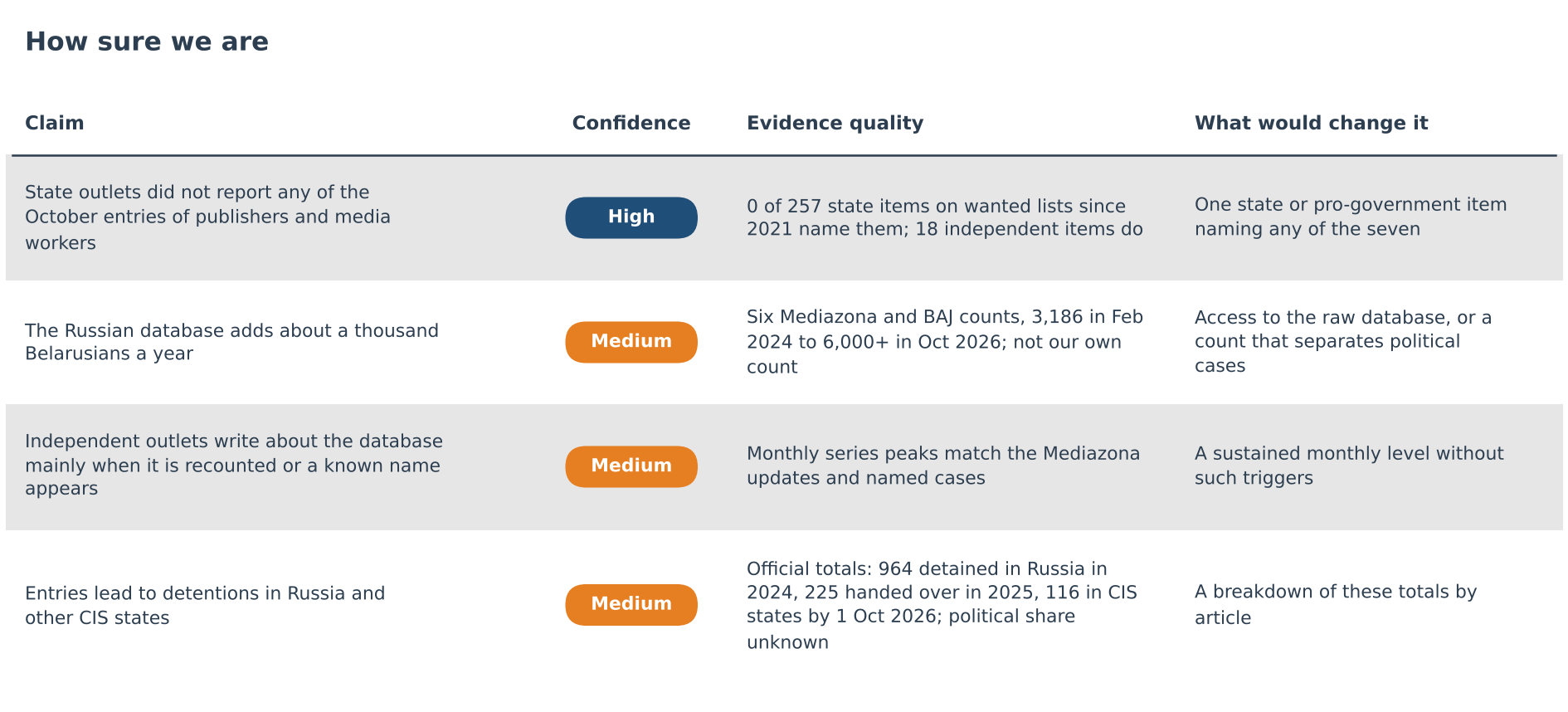
State outlets did not report any of the October entries of publishers and media workers. High. None of 257 state items on wanted lists since 2021 names them; 18 independent items do. One state or pro-government item naming any of the seven would change it.
The Russian database adds about a thousand Belarusians a year. Medium. Six counts by Mediazona and BAJ, from 3,186 in February 2024 to more than 6,000 in October 2026; not our own count. Access to the raw database, or a count that separates political cases, would change it.
Independent outlets write about the database mainly when it is recounted or a known name appears. Medium. The peaks of the monthly series match the Mediazona updates and the named cases. A sustained monthly level without such triggers would change it.
Entries lead to detentions in Russia and other CIS states. Medium. Official totals: 964 detained in Russia in 2024, 225 handed over in 2025, 116 in CIS states by 1 October 2026; the political share is unknown. A breakdown of these totals by article would change it.
How it fits
This fits T7, the half on state measures against the link between exile and home: the wanted entry is a measure that reaches people who cannot be arrested, and it is kept out of the domestic news. A simpler reading is routine. Every criminal case against an absent defendant produces an entry, and state outlets do not report entries for anyone, political or not. The 195 crime reports weaken that reading only partly: they cover arrests, not entries. The silence on the journalists is consistent with both readings; what distinguishes them is that state outlets do report Russian entries for Russian critics.
It also extends Kept in Three Ledgers (14 October) and Closing the Inbox (3 October). The Information Ministry’s register of “extremist materials” and the KGB list of “terrorists” are public and kept in Minsk. The wanted database is kept in Moscow, is searchable but not announced, and is read by Mediazona and BAJ on behalf of the people in it.
What to watch
By 30 November. The next Mediazona count. Expectation: above 6,500, since the last two half-year additions were 1,118 and about 1,000. Confidence: medium.
By 30 November. Whether any state or pro-government outlet names one of the October entries. Expectation: none. Confidence: high.
By 31 December. A further detention in Armenia, Georgia or Russia of a Belarusian on a political request, reported by independent outlets. Expectation: at least one, given five cases in our archive since September 2024. Confidence: medium.
Method and limits
The series counts items in the FORESIGHT corpus from 1 January 2021 to 1 November 2026 whose title or first 6,000 characters mention an interstate or CIS wanted list, or the Russian Interior Ministry wanted database, in Russian, Belarusian or English. We removed digest titles and left out the CTV website, whose widget repeats text across pages, and counted each URL once. Segments follow the source type: state and ministry channels, pro-government Telegram, independent and diaspora media, Russian state media. The regular expression also catches Russian entries for Russian citizens and ordinary criminal cases; we read the 482 state and pro-government items by title and snippet and coded 195 as crime reports. Database totals are Mediazona’s and BAJ’s, quoted from the outlets that carried them; we did not query the database ourselves, and the counts include people wanted for ordinary crimes. The number of media workers, more than 100, is BAJ’s. Our list of fourteen announcements is what independent outlets reported and our collector captured; the corpus has thin independent coverage for January to April 2026, so entries in those months may be missing. The charge against Siamionau is not published, and we do not infer it.
Thesis tag: T7, the half on state measures.