
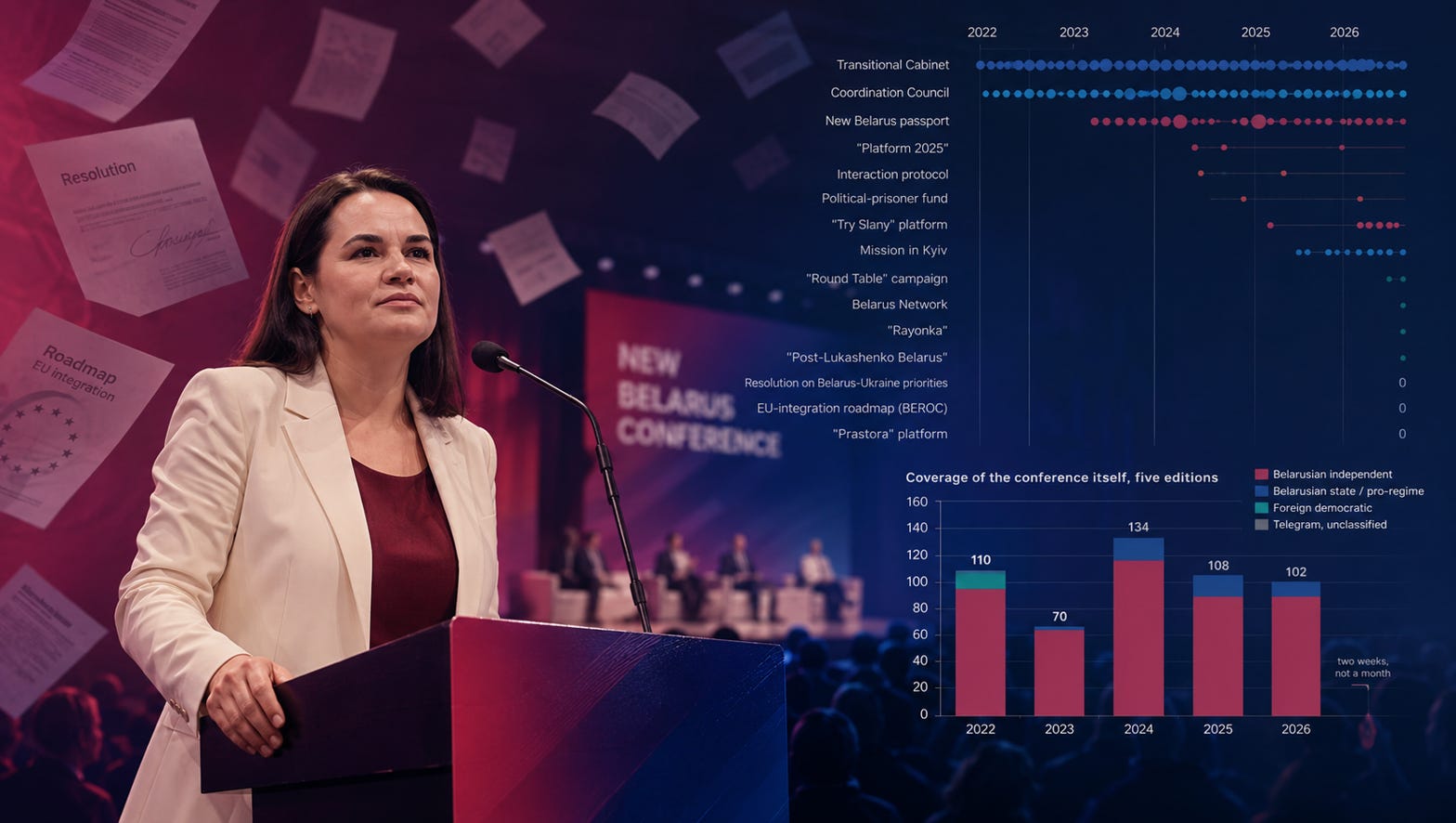
The sixth New Belarus conference closed in Warsaw on 9 August, six years and a day after the 2020 election. It adopted nine resolutions, appointed a new head of the Kyiv mission, launched one campaign and continued another, and presented a platform of draft laws, an EU-integration roadmap, a new network project, a telemedicine service and a token-based funding model.
Five conferences have done something similar before. That makes it possible to ask a question the participants cannot answer from inside: what happens to a decision after it is announced. Not whether it works — a corpus cannot see that — but whether anyone says its name again.
Fifteen named decisions from five conferences, tracked month by month:
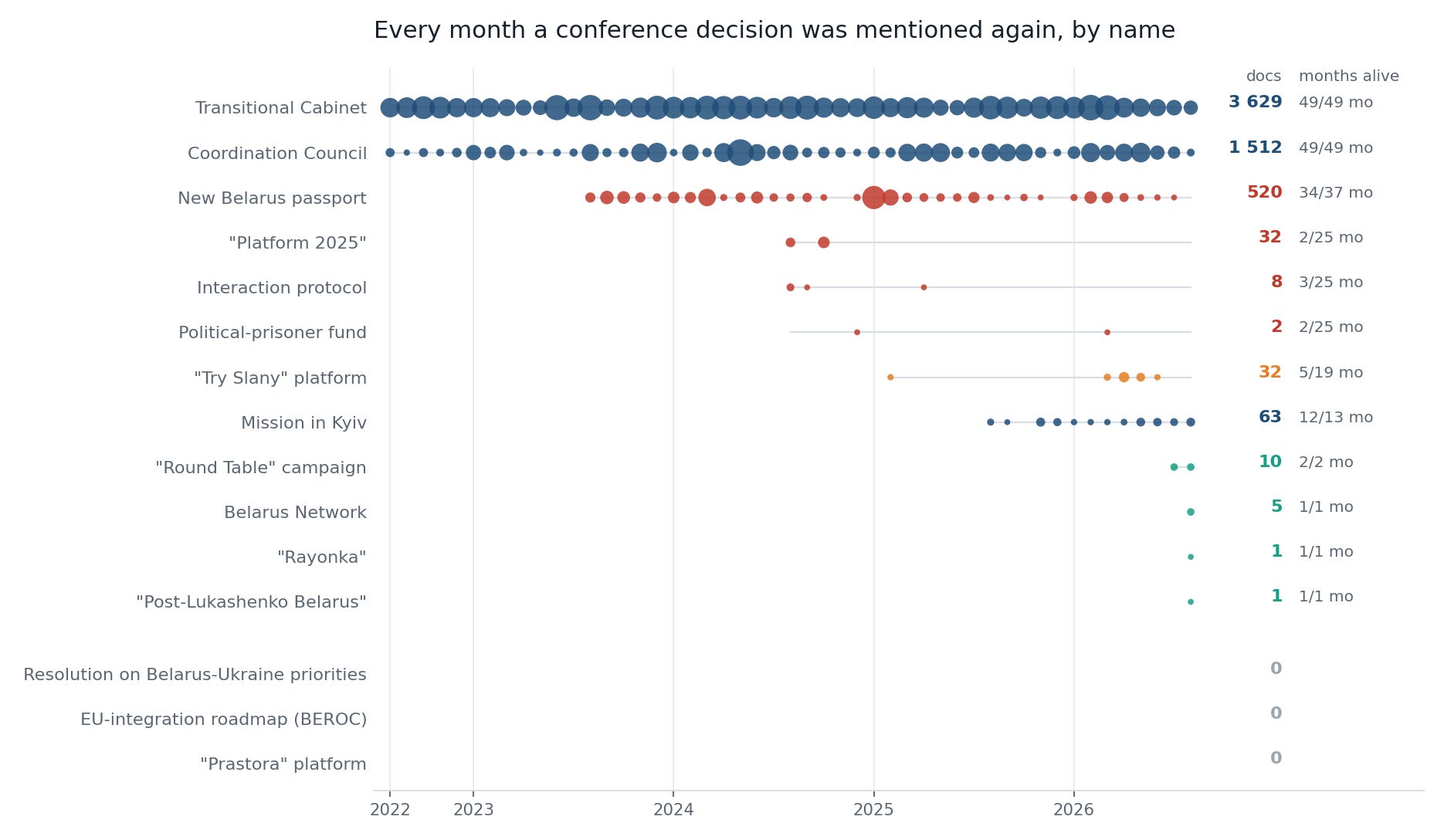
Two bodies have been mentioned in every one of the 49 months since they were created: the Transitional Cabinet with 3,629 documents, the Coordination Council with 1,512. Three documents signed at the 2024 conference have between them 42 documents in 25 months, and are silent in 22 of those months. Three of the things presented last weekend — the named resolution, the roadmap, the draft-law platform — have zero.
What the two ends look like
The Cabinet and the Council are not more popular than the documents. They are differently shaped. A body meets, appoints people, argues with itself, answers accusations and loses officials — and each of those is an event somebody writes about. In the eleven days of this August alone the Cabinet accounts for 33 documents: a deputy head meeting Ukraine’s ambassador-at-large, a representative for national revival publishing four draft laws, and its own secretary announcing he is finished.
A signed document does nothing by itself. It enters the record once, on the day of signature, and returns only if something is done to it from outside.
That is not a metaphor. “Platform 2025”, signed on 3 August 2024 by representatives of several democratic structures, has 32 documents in the corpus. Twelve are from the days of the conference. The other twenty are from 8 October 2024, when the Investigative Committee opened a criminal case against all 45 of its signatories — and most of that coverage is state and pro-regime media. After 18 October 2024 the name does not appear again.
The interaction protocol signed at the same conference has eight documents. Six are from the signing. One is from 19 August 2024, a row inside the Coordination Council over the vote on it. One is from 12 September, Tsikhanouskaya answering the question of whether she had taken too much on herself. Then nothing for 23 months.
The fund for political prisoners, announced in August 2024, has two documents. The second is from March 2026 — its own launch press conference, nineteen months later.
The case that breaks the simple version
“Try Slany” is the exception that makes the rule usable. The platform appeared in February 2025 when the New Belarus app was rebranded and split, generating two documents. Then thirteen months of silence — the pattern of a document, not a body.
It came back in March 2026, and twice over. On 10 March the Information Ministry added its projects to the register of extremist materials. Three weeks later the Coordination Council announced it would run the voting for its own elections on the platform. April and May 2026 give 24 documents: Pavel Liber’s team, DDoS attacks on the service, an audit of the vendor, an extension of the voting period.
So the variable is not whether an artefact is a body or a document. It is whether a group of people keeps acting in its name. Try Slany had a team; the protocol had signatures.
The conference does not fade
One expectation the data refused. Coverage of the conference itself has not declined across five editions: 110 documents in 2022, 70 in 2023, 134 in 2024, 108 in 2025, and 102 this year — the last from a two-week window rather than a full month, so probably an undercount.
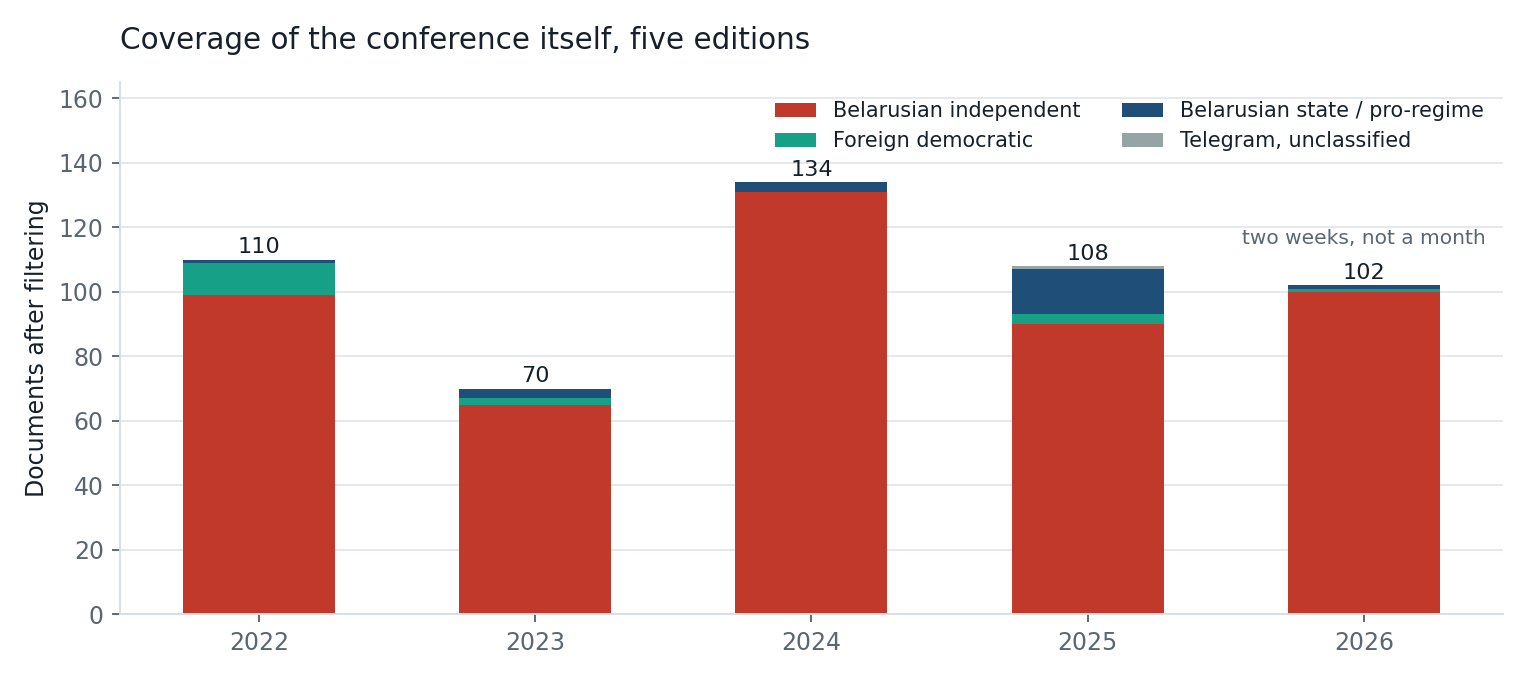
The state segment’s attention did not build either. It produced one document on the 2022 conference, three in 2023, three in 2024, fourteen in 2025 — and one this year. I read the rise to fourteen as a trend when I first saw it; the sixth edition says otherwise.
The question asked on stage
On the first panel Viktar Babaryka said that his friends inside Belarus are not interested in what happens in the democratic community, and that he sees many signals confirming it. Pavel Latushka answered that his own tell him the opposite, and that the two of them simply have different friends. Euroradio’s reportage from the two days calls this the first sparring of the conference; Babaryka, in an interview published the next day, says he was surprised it was called that and is sincerely glad they have different friends.
Both men argued from personal acquaintance, and the question is empirical. It is also the question this brief partly answers. Whether decisions reach anyone can be measured, and on the evidence above, most of the named ones did not reach far enough for their names to be repeated.
Babaryka’s own answer is the one thing presented last weekend that begins with an instrument rather than a document. Belarus Network, he says, is not an organisation but a bridge between people holding resources — time, competence, money — and people running projects, and its first component is an existing system for analysing the information field, to find out what actually concerns Belarusians and whether the field responds to what is done. He also said, on 10 August, that he is not needed by the current players in any capacity, and that the democratic forces are on the classic path of emigration: losing sight of what is needed inside the country while people inside lose sight of what is being fought for.
Whether that reading is right is not something this method can settle. What it can say is that his diagnosis and the measurement above point at the same gap.
The Kyiv mission, and a correction
The one 2026 announcement that has a body attached is the mission in Kyiv, and it is not new. It was already listed among the democratic forces’ missions in 2025, and on 5 July 2026 it was reported trying to get the New Belarus passport recognised by Ukraine. What changed on 9 August is its head: Volha Zazulinskaya, who leaves the Cabinet, replaces Sviatlana Shatsilina, elected to the Coordination Council.
I had it filed as a new structure. It is a personnel decision inside an existing one, and the distinction matters for this brief specifically: a mission with 63 documents across twelve of the last thirteen months is exactly the shape that survives, and it was already surviving before this conference.
Euroradio’s broadcast on the change is titled a resignation; the organisers’ summary describes a continuation of work on the Ukrainian track. Both are dated 10 August.
What this cannot tell you
A name going quiet is not a project stopping. The interaction protocol may be working precisely as intended and generating no news, because a functioning procedure is not a story. The fund may have been raising money throughout 2025 without a press release. The passport, whose mentions fall from 96 documents in January 2025 to one in July 2026, is still being issued as far as this corpus knows — what it cannot get is recognition, which an analyst quoted on 1 June 2026 called unlikely for Ukraine.
What the measurement does show is narrower and still worth something: how long a decision stays available to be talked about, which is the only form in which people outside the room encounter it.
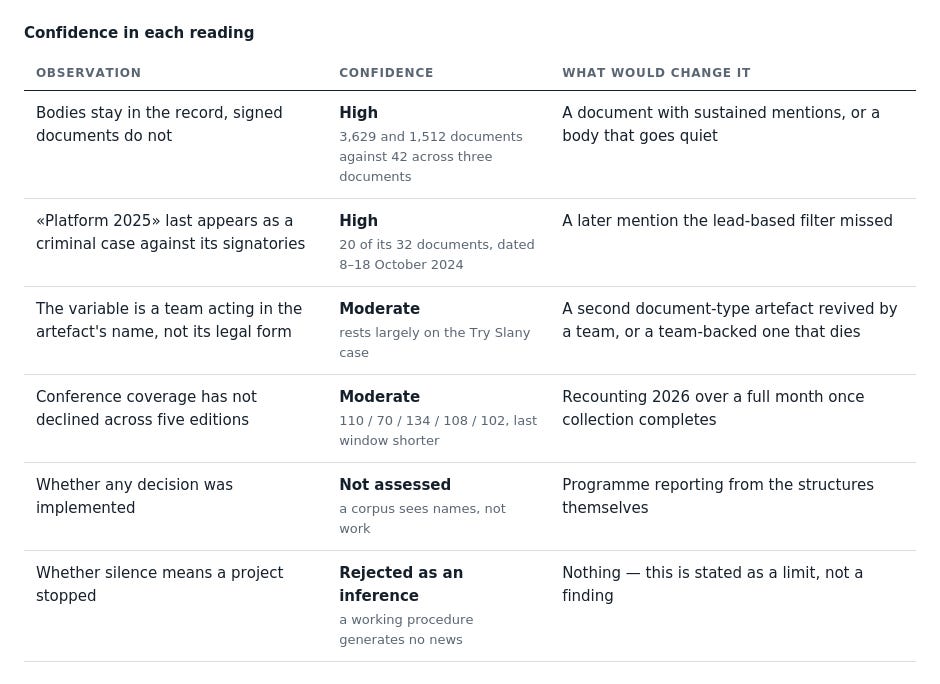
Confidence
Conclusions
Two bodies from 2022 have been mentioned in every month of their existence; three documents from 2024 are silent in 22 of their 25 months. The difference is not importance, it is whether anyone keeps acting in the artefact’s name.
The last thing that happened to «Platform 2025» was a criminal case against its 45 signatories, and most of that coverage came from state media. A signed document has no way of returning to the record on its own.
Nine resolutions were adopted this year. The one whose name was announced has no mentions at all, which makes the other eight unmeasurable until their titles are published.
The one 2026 announcement with a working structure behind it — the Kyiv mission — already existed and was already surviving; 9 August changed its head. By August 2027 it should still be producing four to six documents a month while most of last weekend’s products produce none. Same query, dated, and it will settle itself.
Method and limits
Fifteen named artefacts were tracked from their announcement to 10 August 2026, counted by month, and normalised against the monthly volume of the independent segment, which held between 14,600 and 19,500 documents a month across the period — stable enough that the normalisation changes little. August 2026 is partial, at 4,528 documents, and no share for that month should be compared with the others.
Documents count only where the artefact’s name appears in the headline or the first 400 characters. Two outlets embed a related-links widget inside the stored article text; on one artefact in a recent window, that filter removed 39 of 40 documents, which were about a man lost in a forest and a road-safety campaign. Without the filter every figure here would be several times too high.
Three artefacts were dropped or flagged as unmeasurable. “Prastora” shares its name with the ordinary Belarusian word for space, and the platform sense appears once in the whole corpus. The “Post-Lukashenko Belarus” campaign is named with an adjective that was already in general use, so its own life cannot be separated from the descriptor. The roadmap has no documents under that name at all.
Anchors were checked against homonyms before counting: without that step, “Try Slany” returns three elephant skulls found in Turkey, “Rayonka” returns a district newspaper, and the roadmap returns BelTA on Qatari mediation.
This brief measures the life of names in the information space. It does not assess whether any decision was good, whether it was implemented, or what the democratic forces have achieved.