
The Centre for New Ideas has published Anatomy of Belarusian Power, a network study of 271 members of the ruling elite by Yury Drakakhrust and Anton Radniankou. It is the first map of this size built with network methods, and it is careful about its limits. Its strongest finding is simple: the people who connect the system are often not the people at the top of the official list. The findings most likely to be quoted are weaker. The claim that the system is hard to break, and the claim that Russian influence is narrow, both lean on choices in the method that the report does not test. This brief separates the two.
How the map was drawn
The authors collected public biographies of officials from deputy minister level upward, heads of regions, security chiefs, managers of large state firms and a few people close to Lukashenko without a formal post. Lukashenko himself is left out on purpose. The study looks at ties between members of the elite and sets access to him aside.
Two people are linked if they worked in the same institution in overlapping years, or studied at the same university at the same time. Each shared year adds weight to the link. The result is 3,457 ties among 271 people. An algorithm then sorts them into groups, and three standard measures describe each person’s place: how many ties they have, how close they are to everyone else, and how often they sit on the shortest path between two other people. The last one, called betweenness, is the measure of a broker.
The people who connect the system are often not the people at the top of the official list.
The report finds a large administrative machine of about 200 people and a smaller security apparatus of 59. The security side splits in two. The army and the Interior Ministry form one closed world, while the KGB sends more of its people into civilian posts. That picture is plausible and well argued.
Where rank and position part ways
The most useful part of the study is a list of 17 “super-brokers”. They are 6% of the elite, but 63% of all shortest paths between other members run through at least one of them. The list does not match the table of ranks.
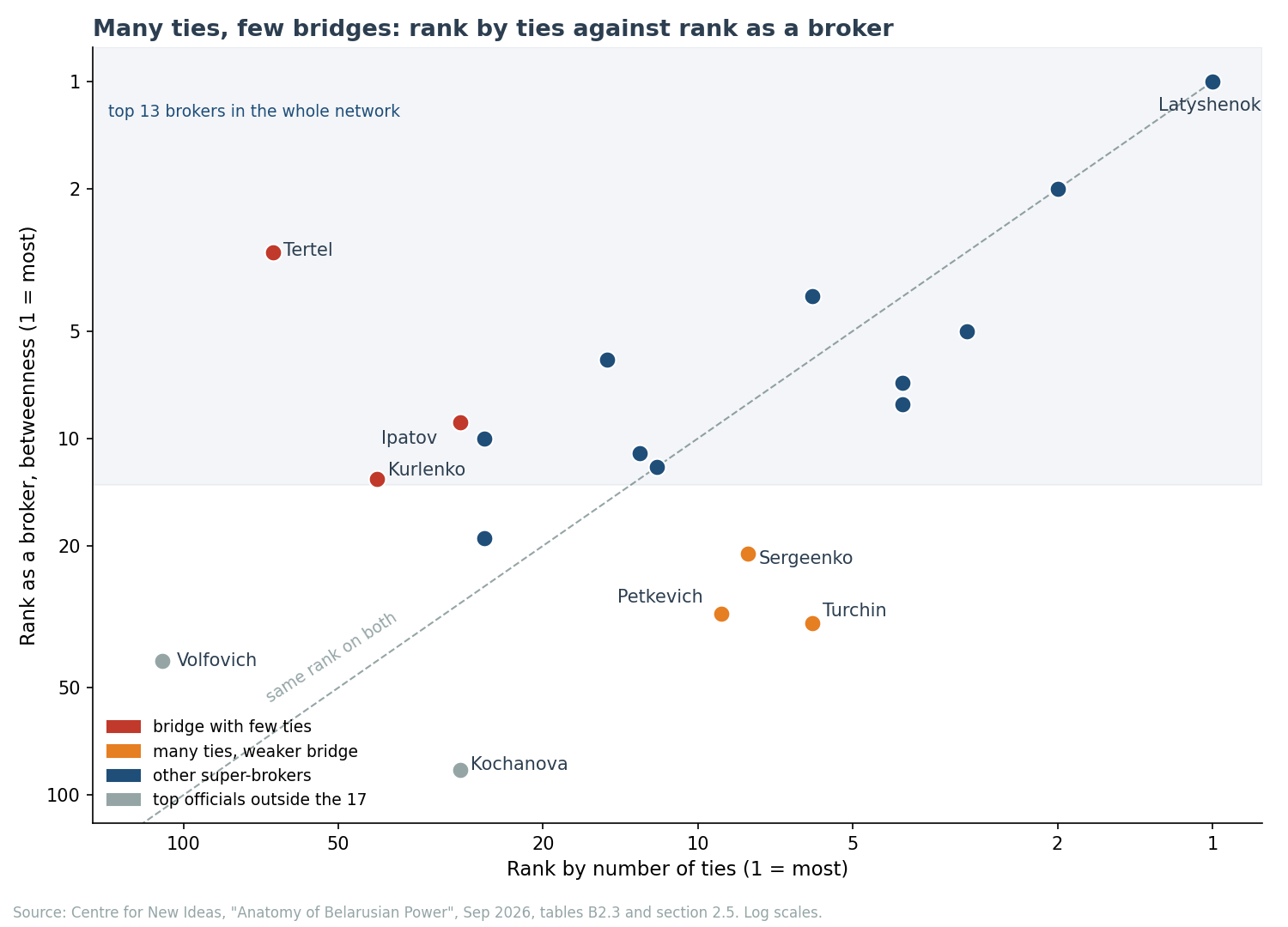
KGB chairman Ivan Tertel has only 38 ties, 67th in the network, yet he is the third-strongest broker. His few ties connect parts of the system that are otherwise apart. Prime Minister Alexander Turchin is the opposite case. He is sixth by number of ties and only 33rd as a broker, because most of his contacts already know each other. Two very senior people are missing from the list altogether. Natalya Kochanova chairs the upper house and would take over if the post of head of state fell vacant. She ranks 85th as a broker. Security Council secretary Alexander Volfovich ranks 42nd. Instead the list includes two deputy heads of the Minsk regional executive committee and a deputy foreign minister.
This does not mean Kochanova has less power than a regional deputy. The authors say so themselves. What the list shows is who has shared a career with many separate groups. For anyone planning contacts inside the system, that is a better guide than job titles.
Volfovich shows the limit from the other side. On 23 July, according to BIPART’s July–August digest, Lukashenko gave the State Secretariat of the Security Council, which Volfovich heads, oversight of KGB organisational and personnel matters. His network rank stayed where it was. His authority over the third-strongest broker grew. Supervision of this kind runs from one post to another by decision. A map of shared careers does not record it.
Sturdy partly by design
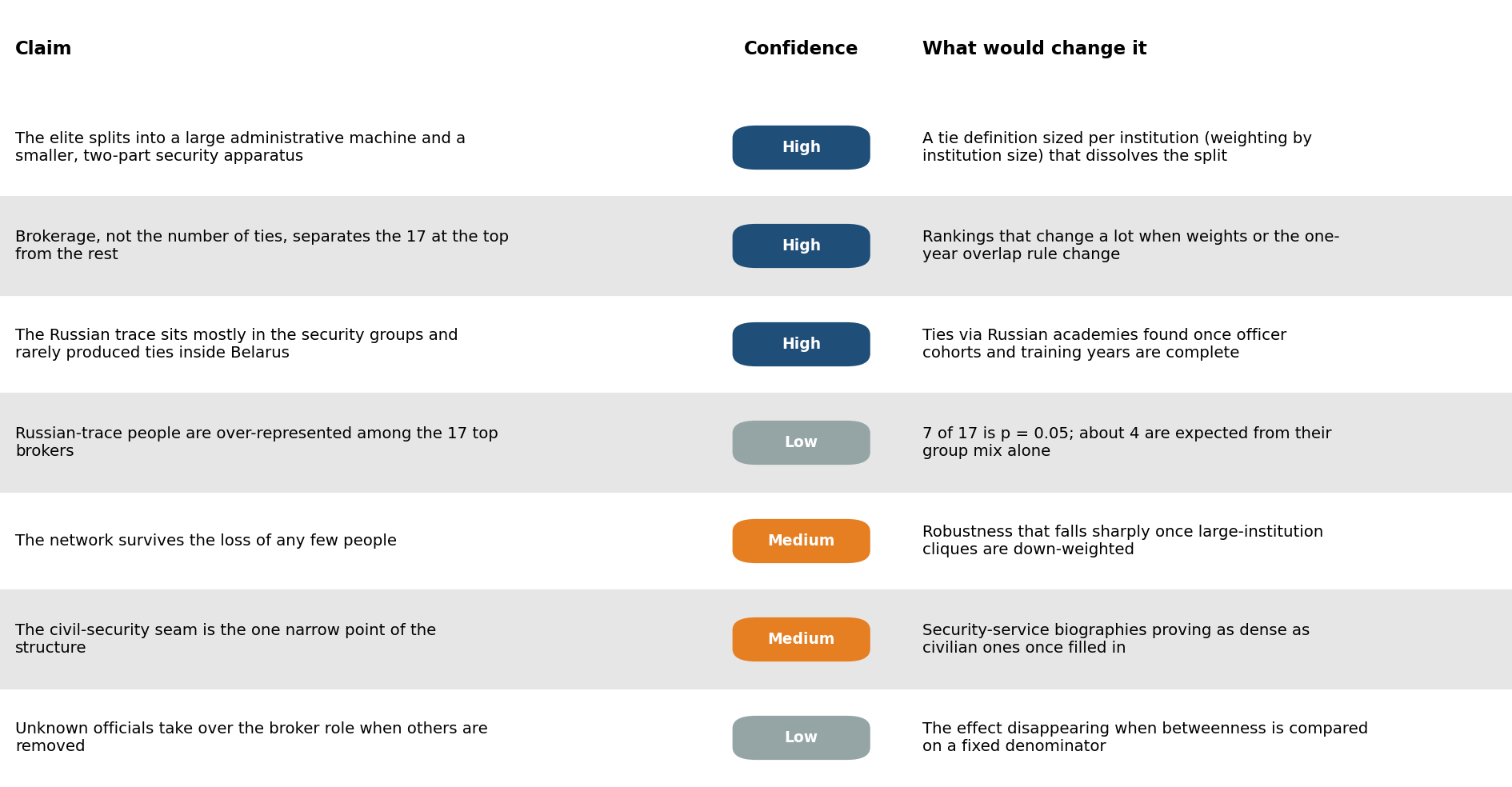
The report’s policy advice rests on one simulation. The authors remove the strongest broker, recalculate, remove the next one, and so on. The network holds together for a long time. Removing 20 people shrinks the largest connected part by only 9%. Up to a fifth of the network, it hardly matters whether people are removed in order of importance or at random. The same share stays in one piece either way. Only the paths get longer.
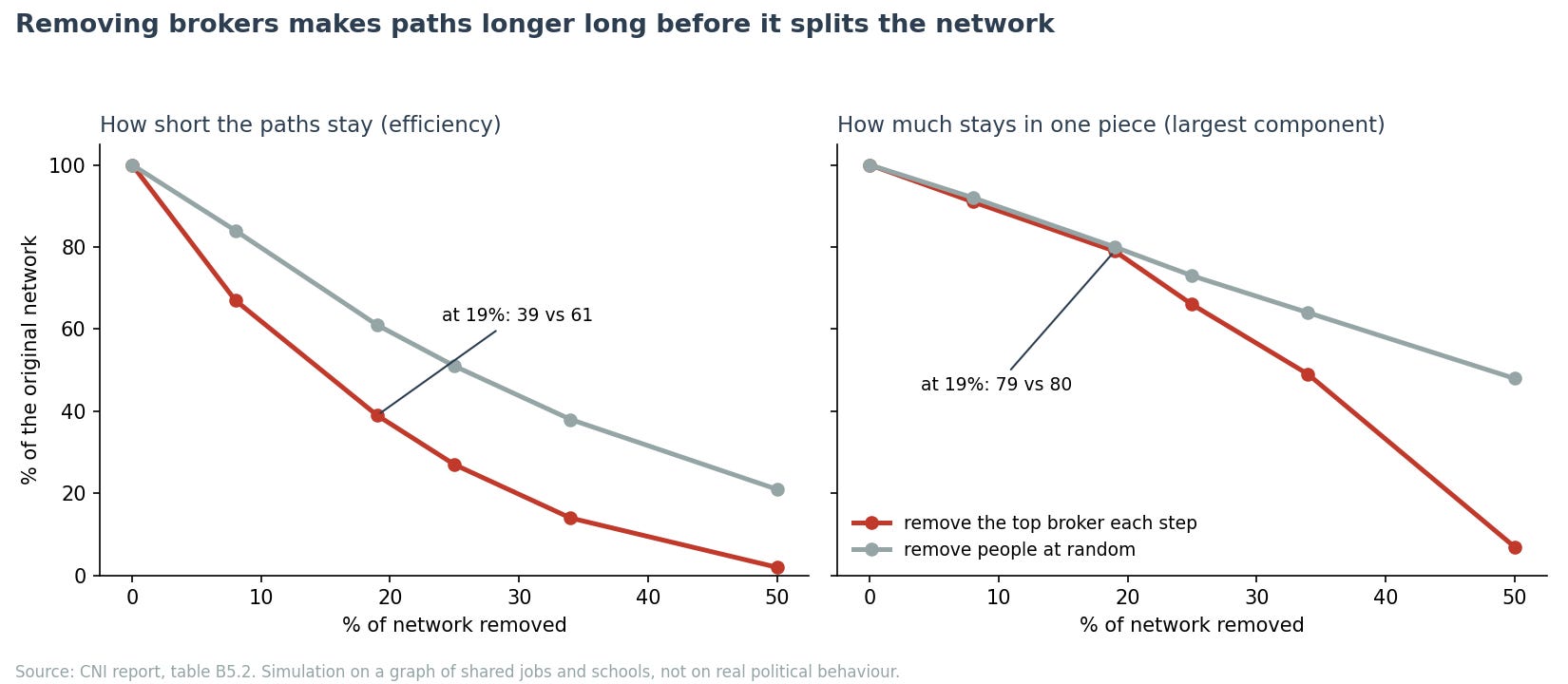
Part of this sturdiness comes from how the ties were built. When everyone who passed through one institution in the same years is linked to everyone else, each institution becomes a tight knot. The Academy of Public Administration alone produces 1,043 ties, 30% of the total. The Presidential Administration produces another 932. A tight knot has many spare paths by definition, so a network built this way will resist the removal of single people almost regardless of what happens in real politics. The authors show that removing both institutions still leaves 246 of 260 people connected. That is a good test, but it removes whole institutions and keeps the knots from all the others, such as the Belarusian State University with 278 ties.
The Academy case matters most. It runs many courses and retraining programmes for different levels of officials. Two people enrolled there in the same year may never have met. The usual fix in network research is to give ties from large institutions less weight, so that a shared ministry of 40 senior people counts for more than a shared university. The report does not try this, and we would expect the “super-broker” list to be more stable under that change than the robustness curve is.
A tight knot has many spare paths by definition, so a network built this way will resist the removal of single people.
One more result needs care. The report describes how people who were almost invisible become key brokers once others are removed. Yury Tertel, head of the state wildlife inspection, rose from 155th place to a betweenness of 0.138, higher than the original leader’s best value. But betweenness is measured as a share of paths in the network that exists at that moment. After 65 removals the network is smaller and already breaking, so the same number means something different. The idea that the broker role passes to unknown people is reasonable. This comparison does not prove it.
The Russian trace, counted again
The report counts 55 people, one in five, with a Russian trace: study in Russia, work there, or birth there. It finds that almost none of the ties between them were formed in Russia. People with a Russian past met each other at home, in Belarusian institutions. This is a clever use of the data, because each tie carries the place where it was formed.
The report then makes two further claims. The trace is twice as common at the top, 7 of the 17 brokers against 20% overall. And it is only average in the dense core of 65 people, which the authors read as proof that Russia is not built into the structure.
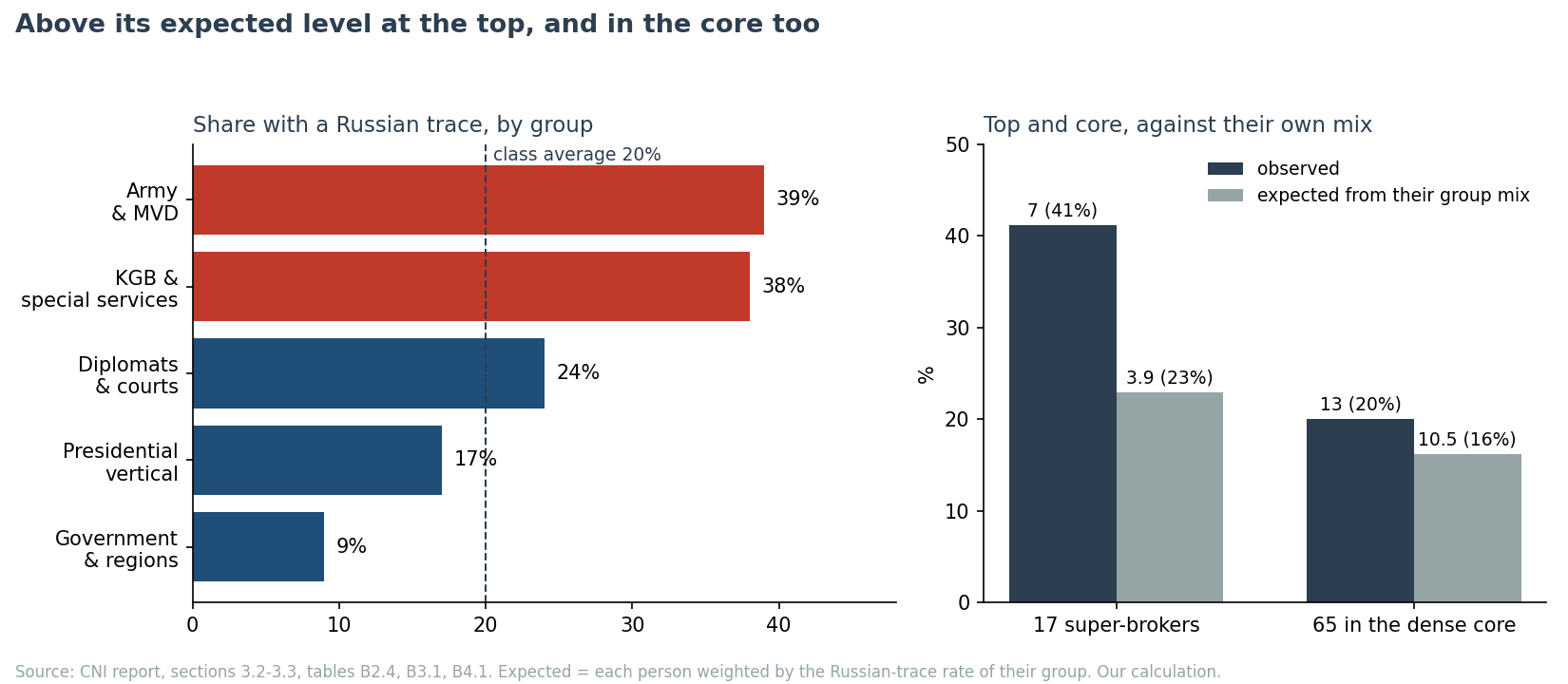
Both numbers change when they are read against group membership. The trace is common in the security groups, 38 to 39%, and rare in the government group, 9%. The 17 brokers include five people from the security groups. If each broker is given the rate of their own group, we would expect about four with a Russian trace, not seven. Seven is more than that, but with 17 people the gap is close to chance: a simple exact test gives p = 0.05. The core runs the other way from the report’s reading. It is 95% civilian, so the expected share is about 16%, and the observed 20% is above it. By the report’s own logic, the trace is slightly over-represented in the core too.
There is also a small problem of consistency. The text says the 214 ties inside the Russian-trace group formed 171 in Belarusian, 41 in Soviet and 2 in Russian institutions. The chart on the same page shows 170, 38 and 6. Other numbers differ between text and tables too. The share explained by the main factor is 71.1% in one place, 72.7% in another and 73% in a third. None of these changes the story. Together they suggest that parts of the report come from different runs of a random algorithm, and the dataset is not published to check.
The 17 brokers include five people from the security groups, and that alone explains much of the Russian share at the top.
What the graph cannot hold
The method sees shared jobs and shared schools. It cannot see ownership, contracts, family or friendship. So some findings follow from the method rather than from Belarus. Big business owners such as Nikolai Vorobei or Alexander Shakutin land at the edge of the network because their ties to the state run through ownership and contracts, which the method does not record. Lukashenko’s sons are spread across groups for a similar reason. The report says business and family “do not form their own group”, but the data could not show such a group even if it existed.
The same is true of the weak seam between civilian and security officials. The authors write that biographies of security officials are thinner, especially for training in Russian military academies. A seam that looks narrow may partly be a gap in the files. Fourteen members of the security apparatus have no ties at all outside their own group. Some of them may simply have short public biographies.
The report’s own best example of a hidden broker shows the same problem. Yury Tertel, who climbs from 155th place in the removal test, heads the State Inspection for the Protection of Flora and Fauna. The report asks readers not to confuse him with KGB chairman Ivan Tertel. The BIPART digest describes the two men as brothers. It also reports a plan this summer to change whom the inspectorate answers to, which the Security Council’s secretariat did not back. The method sees Yury Tertel’s career in the border guard. It cannot see the family.
Confidence
Watch items
The report predicts that the core survives personnel changes. If it is right, at least 15 of the 17 brokers will still hold a post inside the study’s scope on 30 June 2027.
It also predicts that departures are absorbed from inside the system. If any of the 17 leaves before 30 June 2027, the successor should come from the dense core or the second tier. A newcomer from outside the 271 would count against the claim.
The data could not show a business group even if one existed.
If CNI publishes its list of people and institutions, a recount that gives large institutions less weight should keep at least 12 of the 17 brokers. If fewer than ten survive, the list describes the Academy’s enrolment years more than it describes power.
Method and limits
This brief uses only the numbers published in the report. We did not have the underlying data and did not rebuild the network. The expected Russian-trace figures multiply each person’s group by that group’s published rate, using the group counts in tables B2.4, B3.1 and B4.1. The exact test compares 7 of 17 with 48 of the other 254 people. Our earlier reviews of CNI work, on transit monitoring and on the Telegram propaganda map, used the same approach of recounting from the authors’ own tables.