
Belstat and the trade ministry put out the half-year consumer price figure on 23 July: 2.9%, billed as a twenty-year low. The billing holds up. Belarus spent much of the last decade with inflation in double digits, and against that record the current run is a different economy.
State outlets carried it as a result. Independent outlets carried the same figure with the caveats they usually attach. Neither reaction is worth much on its own.
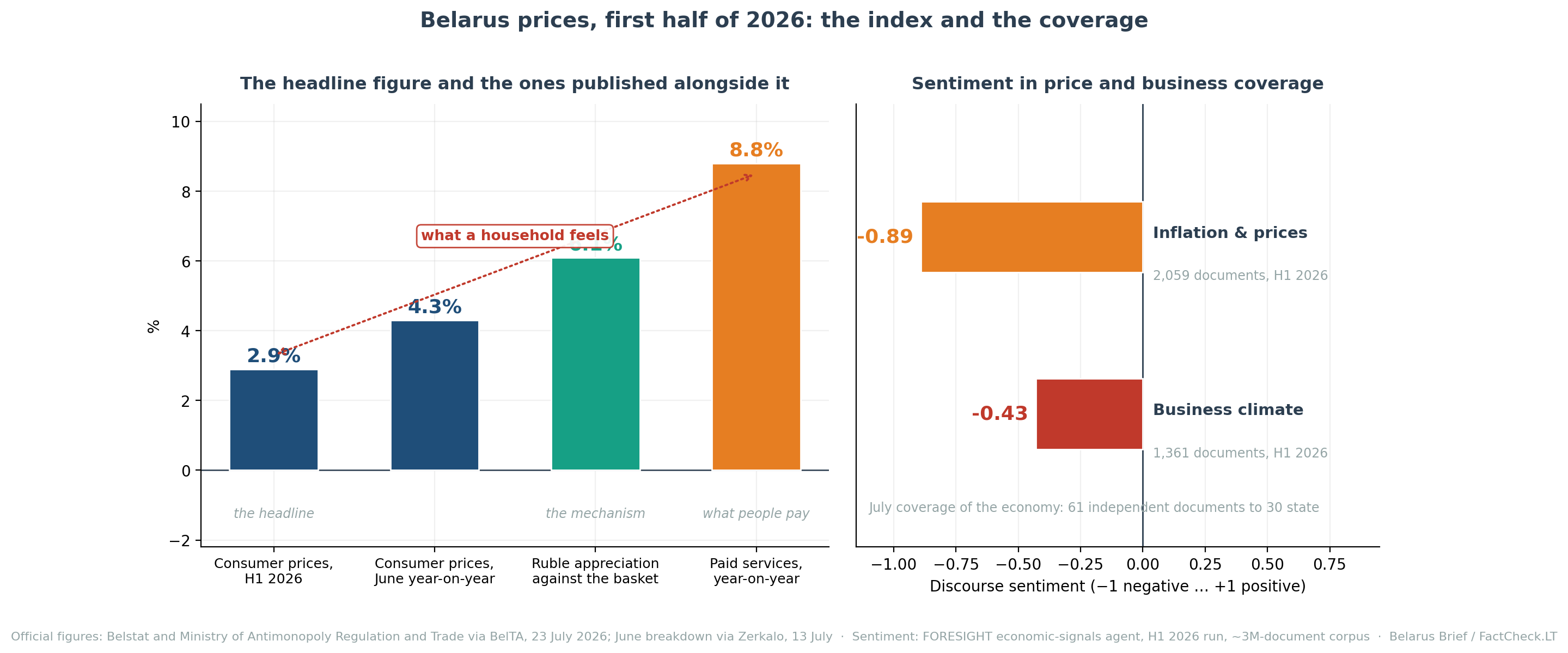
What caught our attention is that our economic-signals agent has been scoring price coverage since January and has it at −0.89, on a scale running from −1 to +1, over 2,059 documents. Of eleven economic indicators we track, only labour migration reads worse. The record print and the sourest price talk in the corpus belong to the same six months.
Part of that clears up in the same batch of July releases.
The 2.9% is a half-year figure for the basket. June alone ran at 4.3% year-on-year. Paid services, the line that covers utilities, transport and the rest of what a household can’t postpone, were up 8.8% over the year, with housing and utility tariffs raised on 1 June. For a budget that is mostly food and mostly bills, the number you live with is closer to the second one. Charter97 made this point in early July, and it doesn’t need an opposition outlet to stand up, since the breakdown is in the official release.
The mechanism behind the good print matters as well. Officials credited June’s slowdown mainly to the ruble, up 6.1% against the basket, and to seasonal fruit and vegetables. Currency appreciation genuinely does lower import prices; there’s nothing suspect about counting it. It also isn’t the kind of disinflation that comes from producing more for less, and it can go into reverse inside a quarter. macroby.org, forecasting growth of 1.5 to 2.5% for the year, treats the ruble as a temporary contributor.
Which brings up the figure nobody put in a headline. Half-year GDP came in at 1.5% against an annual plan of 2.8%. The exchange rate that flattened import prices is the same one squeezing the exporters that plan rests on.
A caveat about our own number
Since this piece leans on the sentiment score, the limits of it belong in the text rather than a footnote. Those scores are aggregates over topic-matched documents, and they inherit whatever imbalance exists in who publishes. July’s economic coverage in our corpus ran 61 independent documents to 30 state ones, so a negative aggregate is partly a fact about the source mix. Presenting −0.89 as a measurement of public mood would be misreading our own instrument.
What it does support is narrower: price coverage has held at this depth for two consecutive half-years, and it sits beside the only indicator we currently rate critical, business climate, at −0.43 on coverage up 111%, much of that about inspections and regulatory pressure on private firms.
There’s a version of this story in which the index is fabricated, and we don’t think it is. The 2.9% looks like an honest calculation of a defined basket over a defined period. It answers a narrower question than the one people are asking when they complain about prices, which is a different and much more fixable objection: cite the 8.8% services line instead of impugning the arithmetic. The stronger accusation costs credibility that the accurate one doesn’t need.
The thing to watch is the ruble. If appreciation was doing most of the work on import prices, a reversal in the second half puts the record back in play, while the services line keeps climbing whatever the currency does. Utility tariffs went up on 1 June, the next revision will land in the same corpus, and we’ll see then whether the distance between the print and the talk widens.
Sources: Belstat and the Ministry of Antimonopoly Regulation and Trade via BelTA, 23 July 2026; June breakdown and ruble appreciation via Zerkalo, 13 July; paid services and utility tariffs via Charter97, 10 July; growth forecast via macroby.org, 1 July; half-year GDP from official releases. Sentiment: FORESIGHT economic-signals agent, H1 2026 run, ~3,5M documents from 100+ sources.