

Freedom House launched Freedom on the Net 2026 on 22 October. Belarus scores 21 out of 100, one point above last year. It is the first time either of the organisation’s two Belarus scores has moved upward since the editions that covered 2020. The other score, in Freedom in the World 2026, stands at 7 out of 100 for the second year running. This brief reads the two series side by side, and then asks a plainer question: how much of what happened in Belarus in 2025 could these instruments register at all?
Two curves, one break
Freedom in the World scores a country on 25 questions, each worth 0 to 4 points. Belarus held 20 points in the 2017 edition and 21 in 2018, when the only improvement in a decade was recorded: one point for government agencies putting more information online. The score slipped to 19 in 2019 after local elections and the BelTA case against journalists, and stayed there in 2020.
The 2021 edition, covering the election year, took eight points away in one step: 19 to 11. The 2022 edition took three more, for the Ryanair landing, the NGO liquidations and the border crisis, and the score reached 8. It then held at 8 for three editions. In 2025 it lost a last point and reached 7, where it still is.
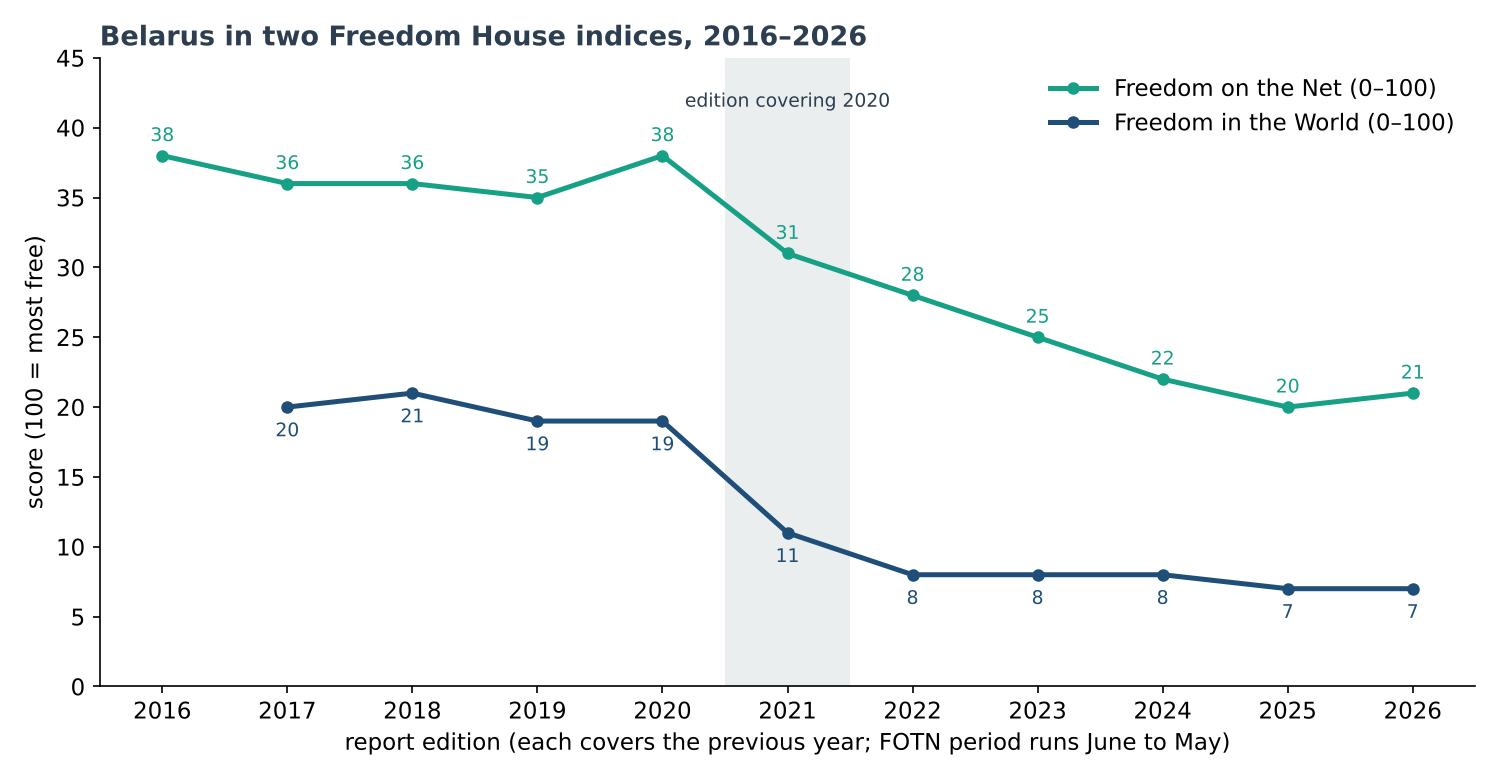
Freedom on the Net moves on a separate calendar, from June to May, and a separate questionnaire. Its Belarus curve ran between 35 and 38 from 2016 to 2020, then fell every year: 31, 28, 25, 22, 20. The 2026 edition breaks that run by one point.
The two instruments agree on the break and disagree on the floor.
Where the remaining points sit
The question-level ledger is more telling than the totals. In the 2018 edition Belarus scored zero on 7 of the 25 Freedom in the World questions. By 2021 it was 15. By 2022 it was 18. Since 2025 it is 19.
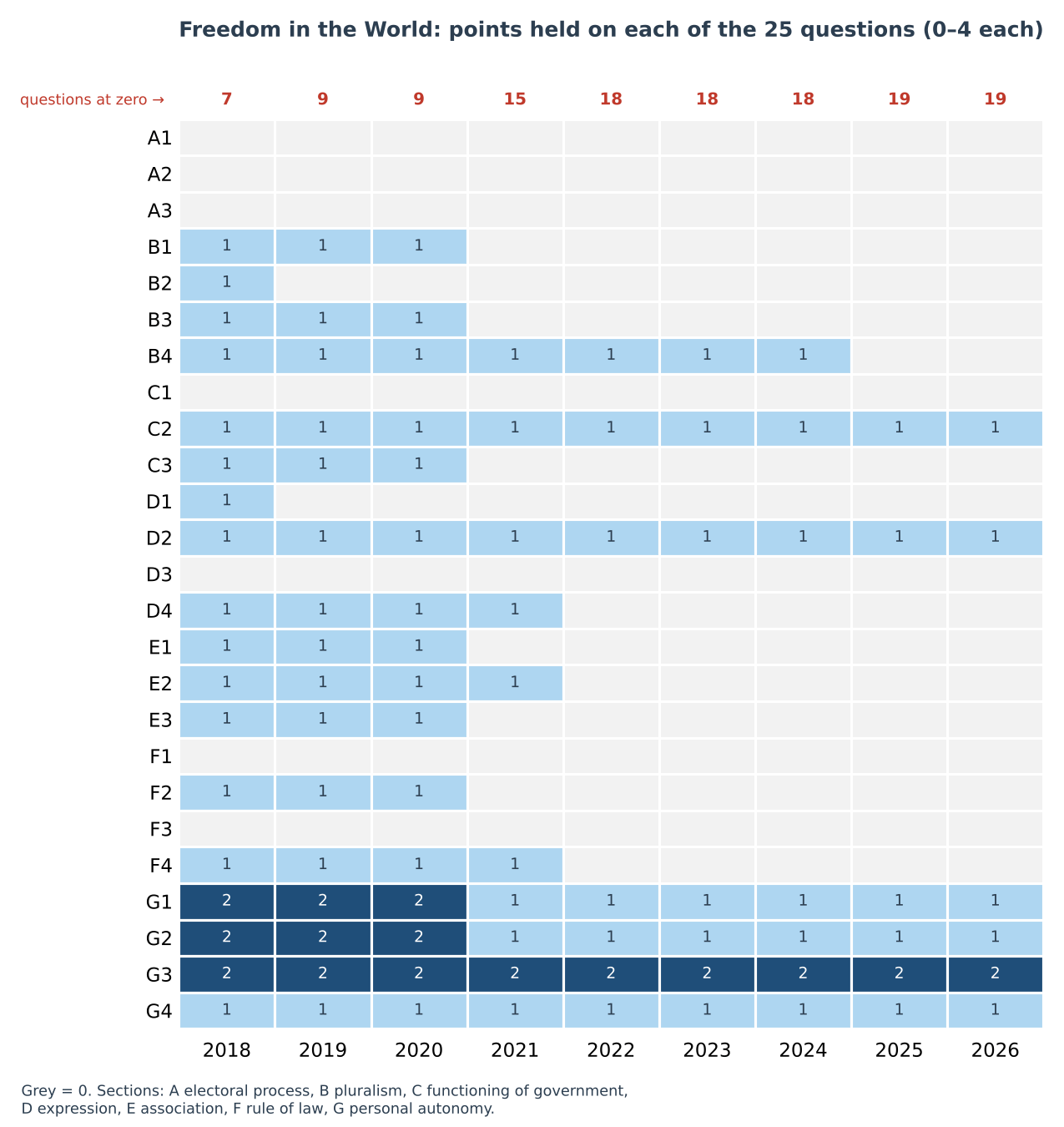
Six questions still hold points. Four of them sit in section G, personal autonomy: freedom of movement (1), property and business (1), social freedoms such as marriage and family (2), and freedom from economic exploitation (1). The other two are safeguards against corruption (1) and religious practice (1). Everything else, from elections to the judiciary to the media, has been at zero for four or more editions.
The last point to go tells something about how the floor is reached. In the 2025 edition the score for political rights of minorities and other groups (B4) fell from 1 to 0. The published reason was that restrictions “particularly since the antigovernment protests that followed the fraudulent 2020 presidential election” had left these groups without representation. The trigger was a reassessment of a situation that had existed for four years, with no single 2024 event named. That is how an index behaves near its lower bound: the remaining movement comes from re-reading conditions already in place rather than from new events.
Nineteen of twenty-five questions are at zero. The seven points left are mostly about family, property and religion.
Freedom on the Net has a wider floor because its first section, obstacles to access, measures infrastructure and price. Belarus keeps 13 of 25 points there, and that is where the 2026 improvement happened. The note under question A3 says the score rose from 3 to 4 “because the government did not order the blocking of websites outside of the .by domain, as occurred during the previous coverage period”. The previous period included the January 2025 election, when all non-.by sites were cut off. No election fell in the 2026 window, so the block was not repeated. The content section (B) stays at 5 of 35 and the user-rights section (C) at 3 of 40.
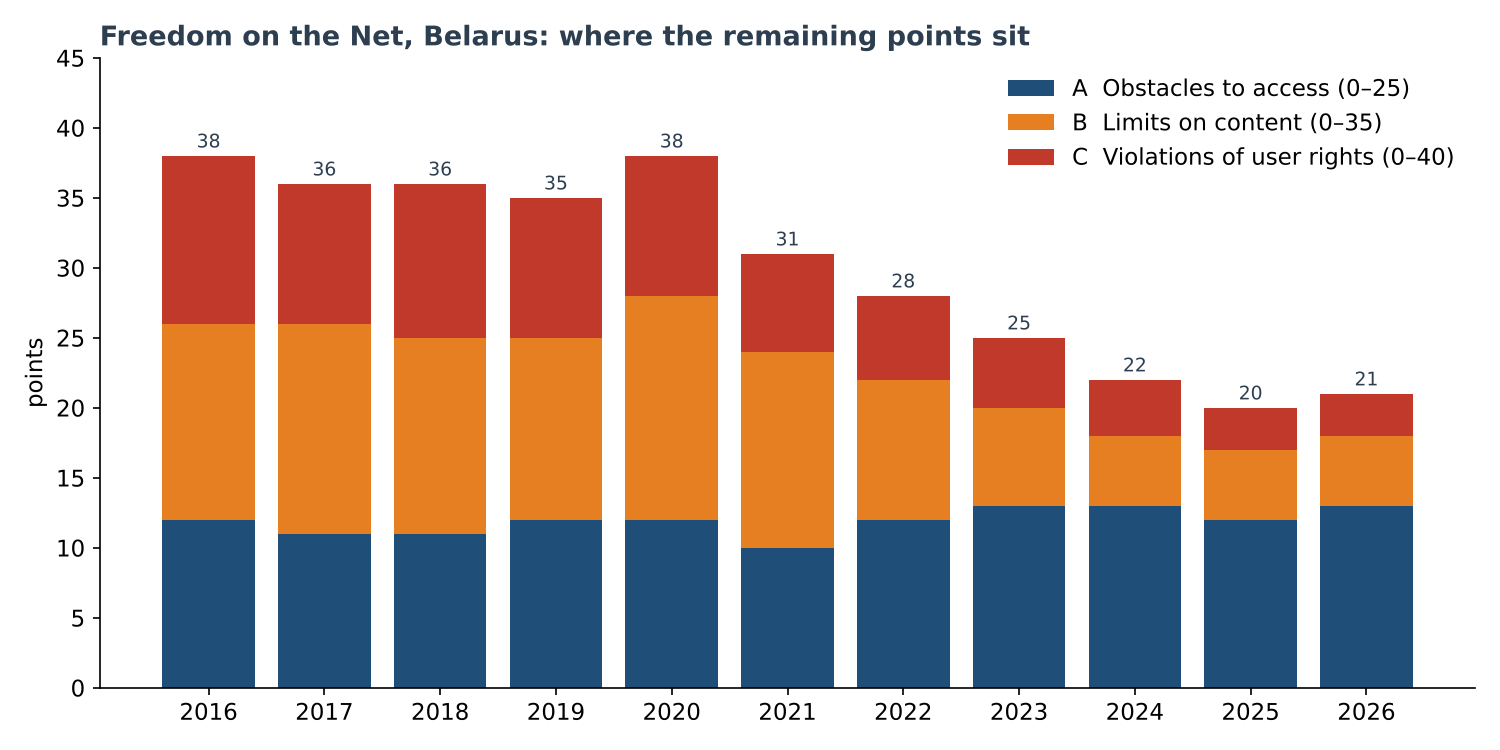
The improvement is one point for not repeating an election-day blackout in a year with no election.
What the year’s events weigh on this scale
The 2026 country report lists four key developments for 2025: the January election with its 87 percent result, the release of political prisoners after US contacts, the extremism machinery (the report cites Viasna’s count of more than 2,000 new “extremist” materials in 2025 and over 300 “extremist groups”), and a Human Constanta finding on migrant labour. None of them moved a score. The election could not: all three electoral questions were already at zero. The releases could not: the questions on due process and political prisoners were also at zero, and a score of zero has no lower neighbour to return from.
One figure in the report does not match our own ledger. Freedom House writes that “more than 130 political prisoners were freed in two releases during the year”. We tracked 52 released in September and 123 in December, which is 175 before the March 2026 tranche. The two tranches were announced with named lists, so the lower figure is a choice of definition on Freedom House’s side, for example Belarusian citizens only, or only those on Viasna’s list at the time of release. The report does not say which. We hold this at Medium until it is explained.
The instrument is also getting shorter
There is a second series in these pages, and it is about the reports themselves. The 2025 Belarus country report carries analytical text under all 25 questions. The 2026 report carries text under none of them. It consists of an overview, four bullet points and the scores, with a line stating that the report “has been abridged for Freedom in the World 2026 due to ongoing budget constraints“ and a pointer to last year’s full version. Freedom on the Net 2025 and 2026 carry the same notice. For Belarus, the last full FOTN narrative is the 2024 edition.
The score survived the cuts. The explanation of the score did not.
For a reader who uses these pages as a source, this matters more than the one-point move. The 2025 B4 justification quoted above exists because the 2025 report had room for it. If a point changes in 2027, there may be no sentence explaining why.
What to watch
Freedom in the World 2027, expected around February or March 2027: whether Belarus stays at 7 or loses one of the six remaining questions. Our expectation is 7, because none of the six (C2, D2, G1–G4) saw a documented new restriction in 2026 that Freedom House has not already coded.
Freedom on the Net 2027, expected October 2027: whether A3 holds at 4. The June 2026 to May 2027 window has no national vote, so a repeat of the .by-only block would be a new policy rather than an election measure.
Whether either 2027 Belarus report returns to full length. If the FOTN 2027 page again points to 2024 as the last full report, the gap in the narrative record will be three years.
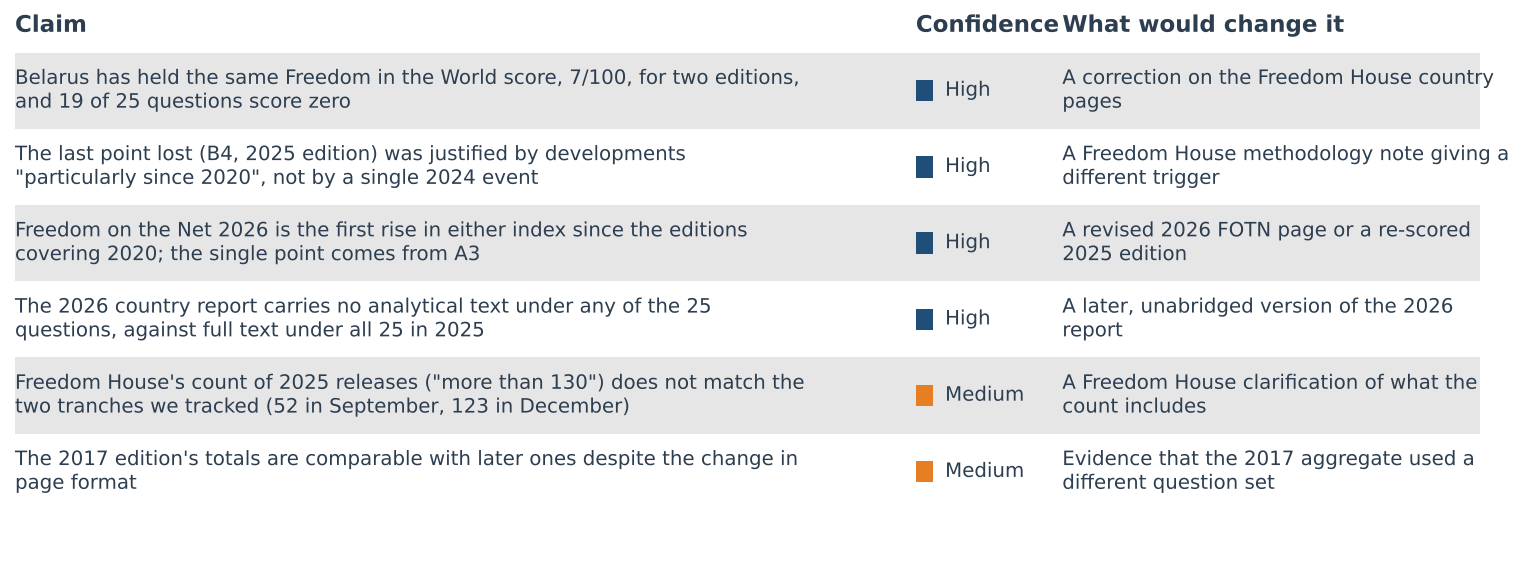
Method and limits. Scores and score-change notes are read from the Freedom House country pages for Freedom in the World 2017–2026 and Freedom on the Net 2016–2026. The 2017 Freedom in the World page uses an older format without per-question scores, so the ledger chart starts in 2018. Freedom on the Net figures for 2016–2018 are shown as the website now presents them, on the 0 = least free scale; the original print editions of those years used an inverted scale. Each edition covers the previous calendar year (Freedom in the World) or the previous June-to-May period (Freedom on the Net). The two indices are produced by different research teams with different questionnaires and should not be added or compared point for point. Counts of questions at zero were checked against the published totals for every edition.