

Belarus Brief starts a page of monthly indicators. The first one is the Narrative Divergence Index. Three months of readings show that Belarusian and Russian state media almost always tell a story the same way. They split only when the story is about Belarus itself.
Most of what we publish rests on something we can count. Some of those counts repeat every month, and a single brief cannot show how they move. From today they get their own page, called Indicators. Each indicator there has a definition, a latest value, the date of the next update and a note on its limits.
The first one is the Narrative Divergence Index, or NDI, which FactCheck.LT has calculated every month since June 2026.
How the index works
Each month we select ten significant events. For each event, a language model reads the FORESIGHT corpus and sets an axis between two opposite readings of it. Take the prisoner exchange that passed through Belarus in August. At 0 on its axis sits “Belarus as a neutral humanitarian platform with an active peacemaking role”. At 10 sits “Belarus as a technical transit corridor with no role of its own”.
Seven media environments then receive a position on that axis. They are Belarusian state media, Belarusian independent media, Russian state media, and media in Ukraine, Poland, Lithuania and Latvia. The NDI of an event is the distance between the two environments that stand furthest apart. A score of 9 means that two audiences received very different stories about the same fact.
The axis changes from event to event, and so does its direction. A 9 for one event and a 9 for another do not describe the same position. What stays comparable is the distance between environments, so the Indicators page reports gaps and never positions.
A score of 9 means that two audiences received very different stories about the same fact.
Three months of readings
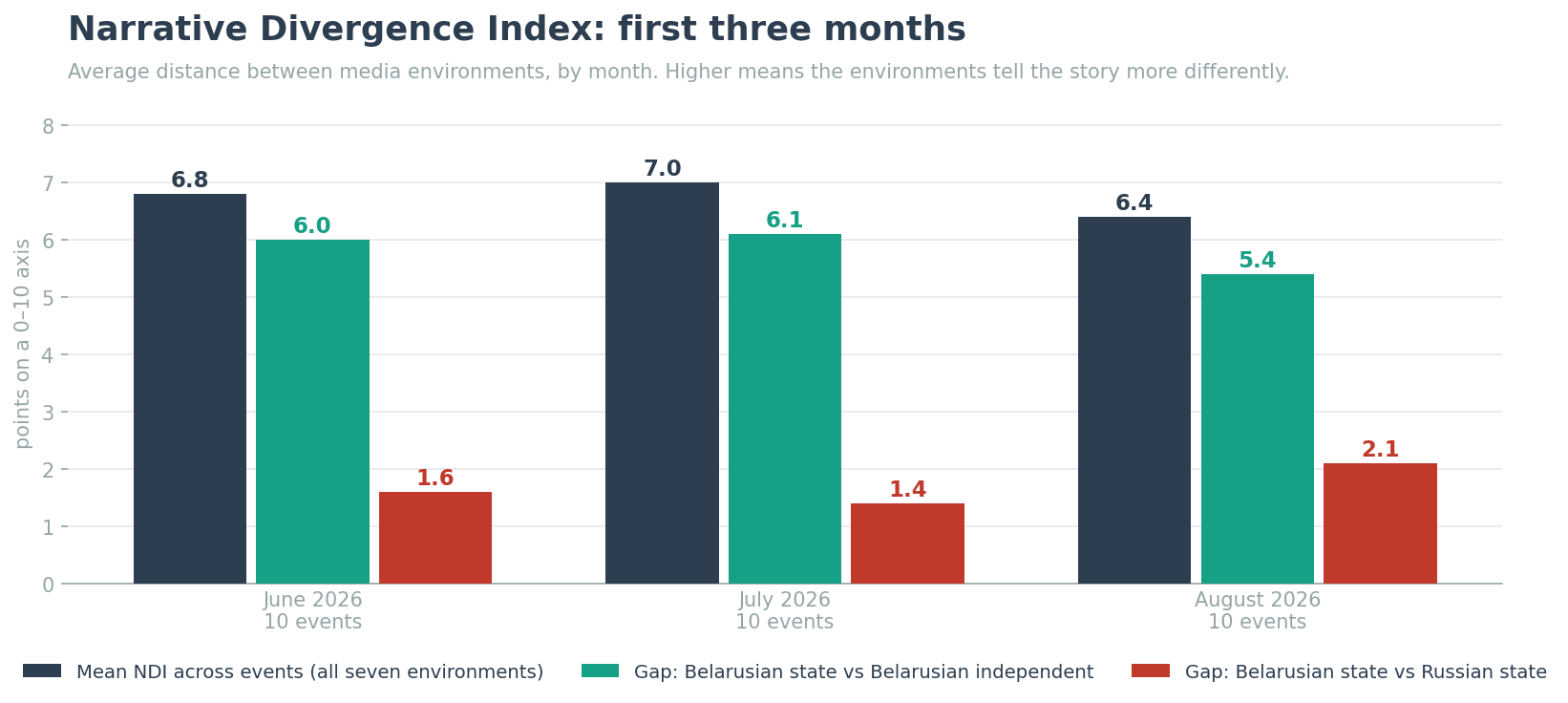
The average NDI across all events was 6.8 in June, 7.0 in July and 6.4 in August, and most of that distance comes from a single place.
Between Belarusian state media and Belarusian independent media, the average gap was 6.0, 6.1 and 5.4 points. Both sides took a position in 25 of the 30 events, and in 22 of them they stood five points or more apart. Two audiences inside one country receive different accounts of almost everything.
The gap between Minsk and Moscow is far smaller. Belarusian and Russian state media both took a position in 24 events. In 17 of those they stood within one point of each other, and in 19 within two. The monthly averages were 1.6, 1.4 and 2.1 points.
Two audiences inside one country receive different accounts of almost everything.
So the real dividing line in the Belarusian media field runs inside Belarus, which was expected. The more useful question is what happens in the few cases where Minsk and Moscow do part.
Four events where the gap opened
In four events the distance between the two state segments reached four points or more.
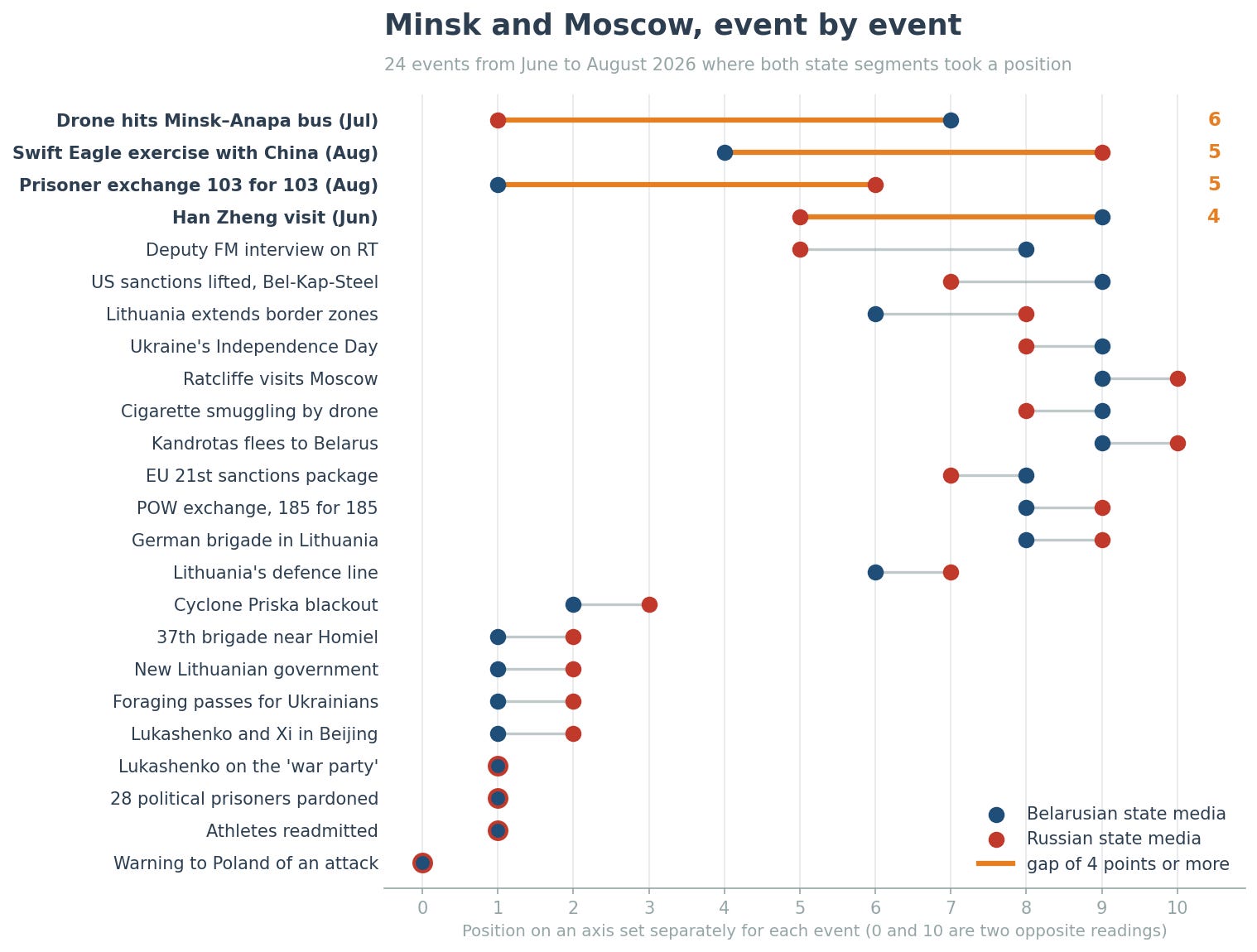
The largest gap came in July, after a drone hit a Belarusian bus travelling from Minsk to Anapa in Russia’s Bryansk region. The axis asked who was responsible. Russian state media, which called it a terrorist attack by Ukraine’s armed forces on civilians, scored 1. Belarusian state media covered it as a tragedy that required a response from the state. They did not name Ukraine as the attacker and scored 7. Minsk did not repeat Moscow’s version of an attack on its own citizens.
In August the prisoner exchange of 103 for 103 split on the question of Belarus’s role. Belarusian state media described the country as an active peacemaker and scored 1. Russian state media described a routine return of Russian soldiers, with Belarus as a place they passed through, and scored 6.
The June visit of Chinese Vice-President Han Zheng split on its weight. For Minsk it was a strategic stage of integration with concrete results, which scored 9. For Moscow, which scored 5, it was a neutral diplomatic fact inside a triangle with Russia and China, and TASS noted that the guest had met Putin before he came to Minsk.
Minsk did not repeat Moscow’s version of an attack on its own citizens.
The Swift Eagle 2026 exercise with China, also in August, split the other way. Minsk presented it as routine counter-terrorism training and scored 4. Moscow presented it as part of a Eurasian security bloc against the United States and NATO and scored 9.
What the four have in common
Each split concerns the place of Belarus. In three of them Minsk claims a larger role for itself than Moscow allows. In the fourth, Moscow gives a Belarusian exercise a heavier military meaning than Minsk wants to carry.
On stories that set Belarus against the West, the two state segments agree. EU sanctions scored 8 in Minsk and 7 in Moscow. The German brigade in Lithuania scored 8 and 9. The visit of the CIA director to Moscow scored 9 and 10. The warning Minsk sent to Poland about a planned terrorist attack scored 0 in both.
Belarusian state media therefore have some room of their own, but it is narrow. It opens when a story is about Belarus’s position between Russia, China and the war, and it stays closed on the confrontation with the West.
What the numbers cannot show
The positions come from one model run per month, and we have not yet repeated runs to measure how stable each position is. In 9 of the 30 events, at least one environment had too few documents and carries a low-data flag. Each month gives only seven to nine events in which both state segments took a position.
It opens when a story is about Belarus’s position between Russia, China and the war.
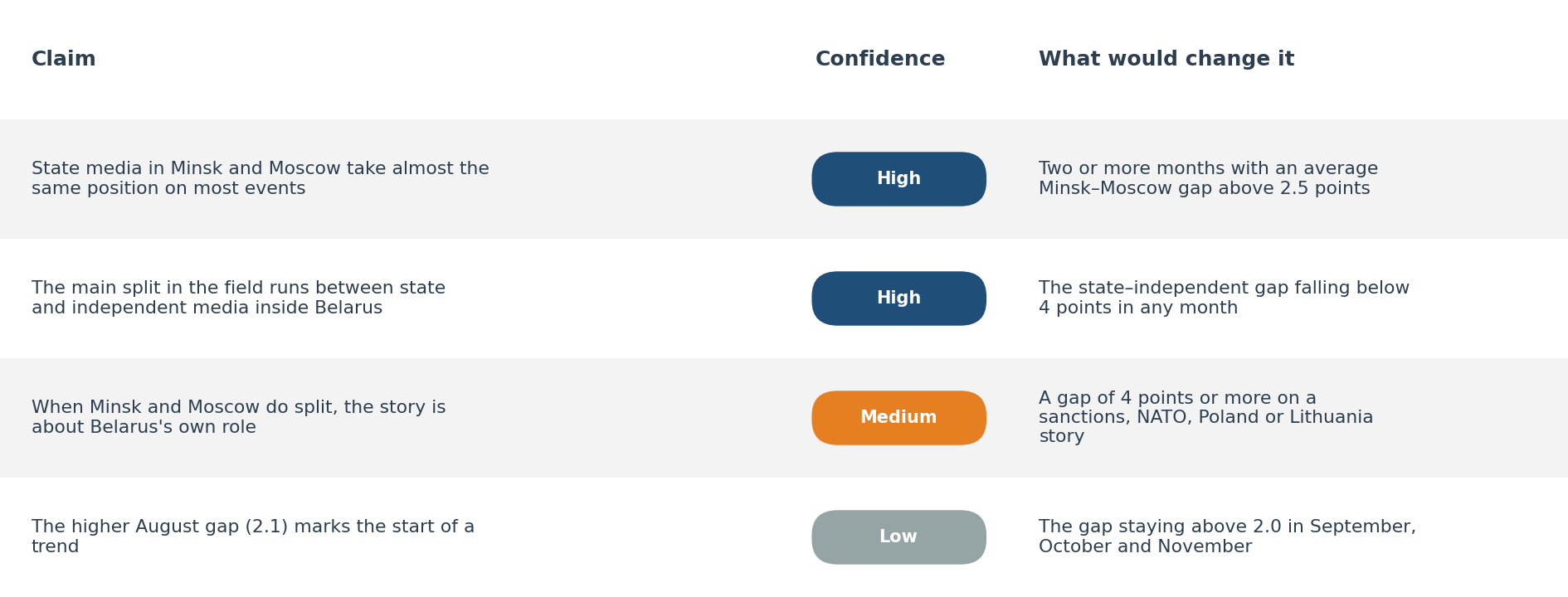
This is why we do not call the August rise a trend. Two of the four large gaps fell in August, and together they lift that month’s average from about 1.5 to 2.1. A single further month like August would still be too little evidence to say that Minsk is moving away.
The group labels also need a note. “State media” in this index means state and pro-regime outlets as classified in our monitoring, so the label covers ownership and editorial loyalty together.
What to watch
The September reading will be on the Indicators page by 20 October 2026. If the average Minsk–Moscow gap stays at or below 2.5 points, the main reading holds.
Until 31 December 2026, every gap of four points or more between Minsk and Moscow should again fall on a story about Belarus’s own role. One such gap on sanctions, NATO, Poland or Lithuania would break that reading.
The gap between Belarusian state and independent media should stay above 5.0 points in every month to December. A month below 4.0 would signal a real change in the field.
Method and limits. The Narrative Divergence Index is produced by FactCheck.LT on the FORESIGHT corpus. Ten events are selected each month. For each event a language model defines an axis between two opposite readings and places each of seven media environments on it from 0 to 10, one run per month. An event’s NDI is the distance between its two most distant environments. Gaps between two environments are absolute differences on the same axis. Readings cover 30 events from June to August 2026. “State media” groups include state and pro-regime outlets as classified in the monitoring. Nine events carry a low-data flag for at least one environment.