

In September we expected that more than 40% of the forwards made by channels on the Centre for New Ideas’ Telegram map would point outside that map. Over CNI’s own window the share is 57.7% for the five personal channels and 74.3% for the rest. Across the wider network, Lukashenko’s press pool now supplies more forwards than state television, BelTA and SB.BY together, and two channels carry most of the Russian material. What forwards cannot show is material taken from Russian sources without a link.
The test we set in September
In Branches Outside the Frame we reviewed the third wave of CNI’s mapping of Belarusian pro-regime Telegram: 33 channels, read from January 2025 to May 2026. We argued that its graph was closed to its own roster, and we set a test. More than 40% of the forwards made by those channels, we wrote, would point to channels outside the 33.
We counted every forward that those channels made in the same window. The five personal channels made 15,447 forwards, and 57.7% of them pointed outside the roster. The rest of the network made 24,894, and 74.3% pointed outside, so the test passed by a wide margin. When we ran the count again this week on a larger collection, it returned the same figures to the last forward.
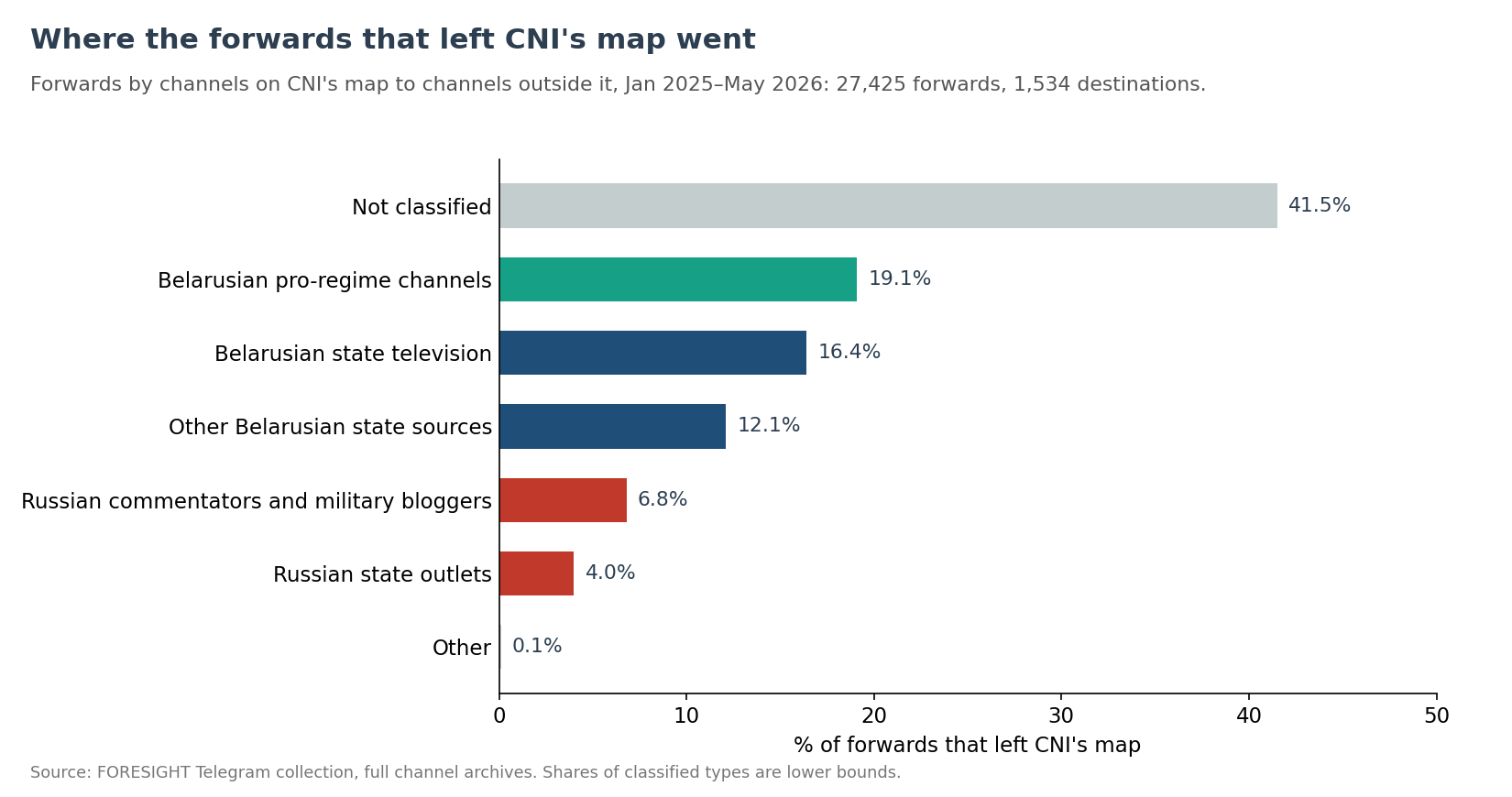
The 27,425 forwards that left the roster went to 1,534 different channels, and the top twenty of them took half. Belarusian pro-regime channels received 19.1%, state television 16.4% and other Belarusian state sources 12.1%. Russian sources received at least 10.9%, split between Russian commentators and military bloggers (6.8%) and Russian state outlets (4.0%). The remaining 41.5% went to small channels that we have not classified. Of the forwards we can classify, four in five went to Belarusian sources.
Lukashenko’s press pool now supplies more forwards than state television, BelTA and SB.BY together.
Before this count we set two thresholds for the destinations: if state television took more than half, the missing branches would be domestic. If Russian sources took more than a quarter, the second wave’s finding that the segment does not depend much on Russian channels would not hold. State television took 16.4%, and the unclassified tail cannot change that, because all four broadcasters’ channels are identified. The Russian test is still open, because for the Russian share to pass a quarter, more than a third of the unclassified tail would have to be Russian. A weighted sample of that tail will settle it.
A pool at the centre
The wider network in our collection has 68 channels: the 59 pro-regime and state channels we collect in full, plus those on CNI’s list. From August 2020 to September 2026 these channels made 433,724 forwards between them. In 2020 the network’s state supply was spread across four sources of similar weight. NEWS.BY had 9.0% of all forwards, ONT 8.0%, BelTA 7.9% and Pul Pervogo, Lukashenko’s press pool, 7.4%.
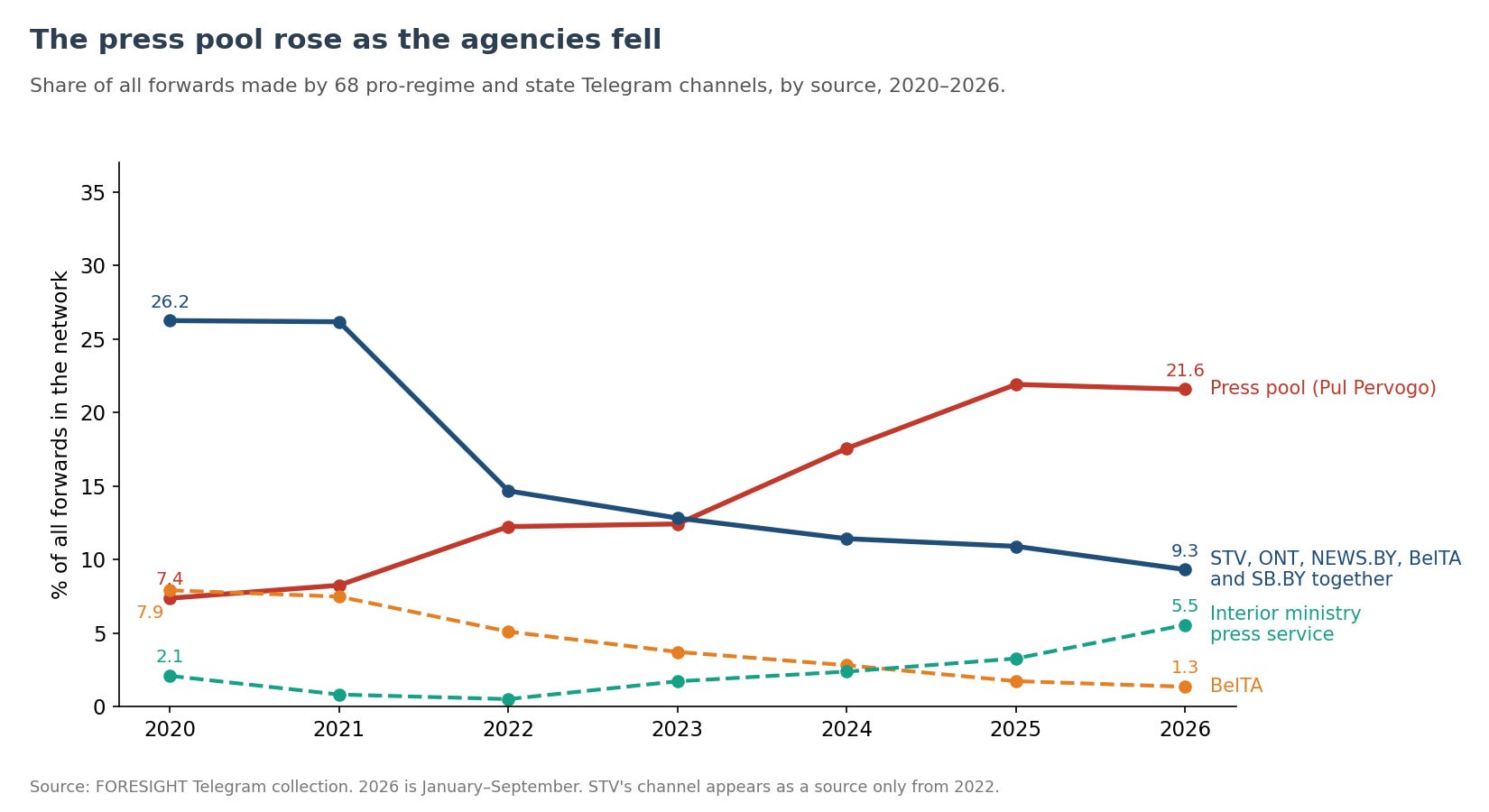
By 2026 the picture had narrowed: the press pool took 21.6% of all forwards, while NEWS.BY, ONT, BelTA, STV and SB.BY together took 9.3%. The pool’s share rose in every year but one: 7.4, 8.2, 12.2, 12.4, 17.6, 21.9 and 21.6%. BelTA’s share fell in every year, from 7.9% to 1.3%. The pool overtook the five outlets together in 2024. The interior ministry’s press service is now the second state source, at 5.5%.
For the Russian share to pass a quarter, more than a third of the unclassified tail would have to be Russian.
There are two ways to read this rise: the channels may prefer the pool, or the pool may simply post more and so offer more to forward. The network itself also changed, since channels that joined after 2022 may bring their own habits. Forwards per press-pool post, counted year by year, would separate these readings, and we have not computed them yet. The network is also smaller than it was, and its monthly post count fell from a peak of 38,531 in June 2025 to 28,101 in August 2026. Forwards fell from 85,238 in 2024 to 45,409 in the first nine months of 2026.
Two channels carry the Russian share
At network level, Russian sources take at least 11% to 16.5% of forwards each year, and the highest figure is for 2026. In 2025 and 2026 the network made 16,847 forwards from Russian sources. A personal channel called “Nikitin” made 9,002 of them, which is 42% of everything it forwarded. “Belarus and the World”, an anonymous channel with 211,772 posts since August 2020, made 3,659. Together the two account for 75% of the Russian forwards, and the ten largest senders for 96%.
BelTA’s share fell in every year, from 7.9% to 1.3%.
Without those two channels, Russian sources take at least 4.8% of the network’s forwards in 2025 and 6.2% in 2026. The typical channel takes far less, since the median channel’s Russian share was 0.6% in 2025 and 0.1% in 2026, down from 9.3% in 2020.
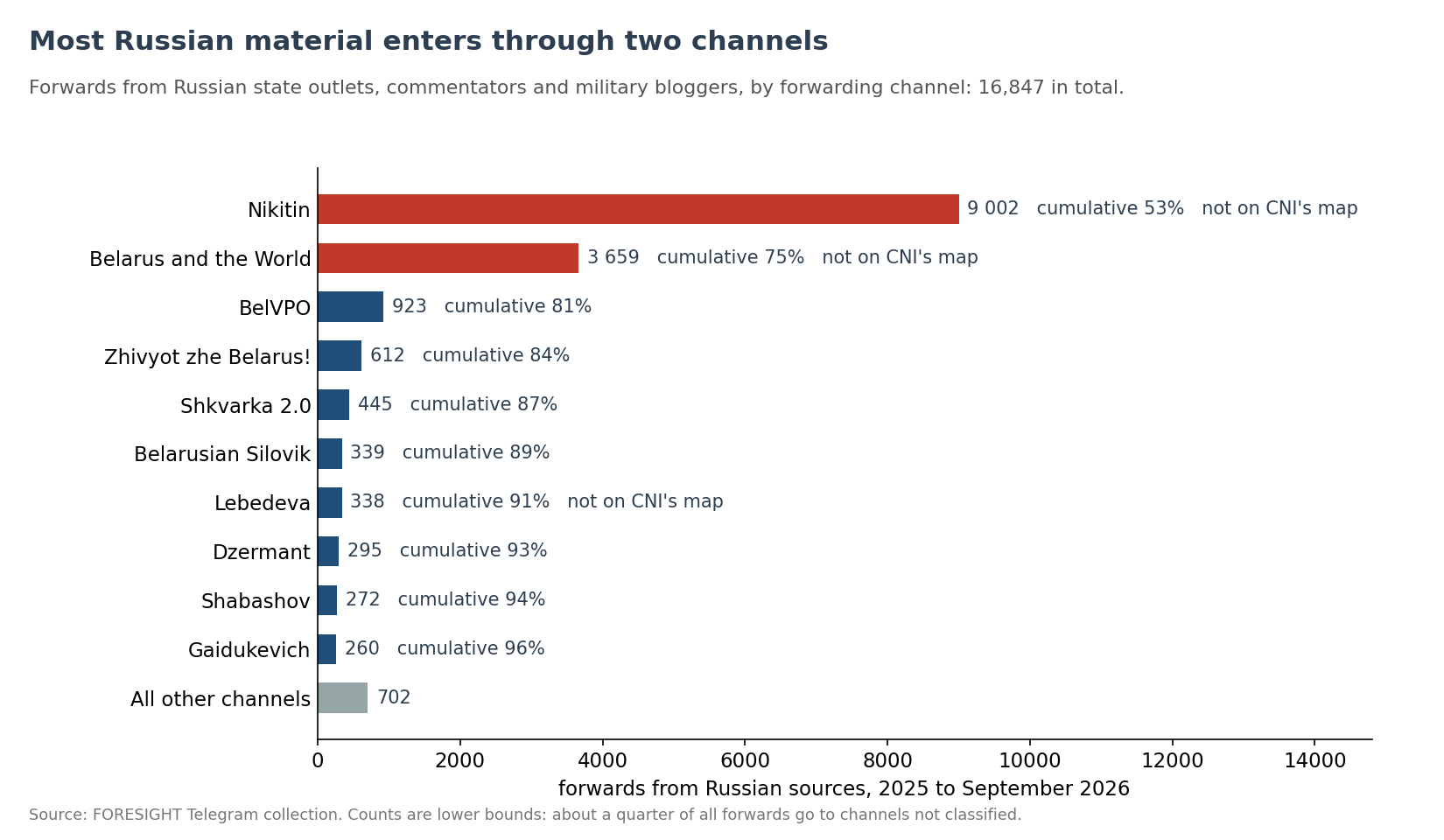
Neither channel is on CNI’s map. The second wave’s finding about Russian channels may well hold for the 33 channels it read. The two channels through which most Russian material enters the network were not among them.
How sure we are
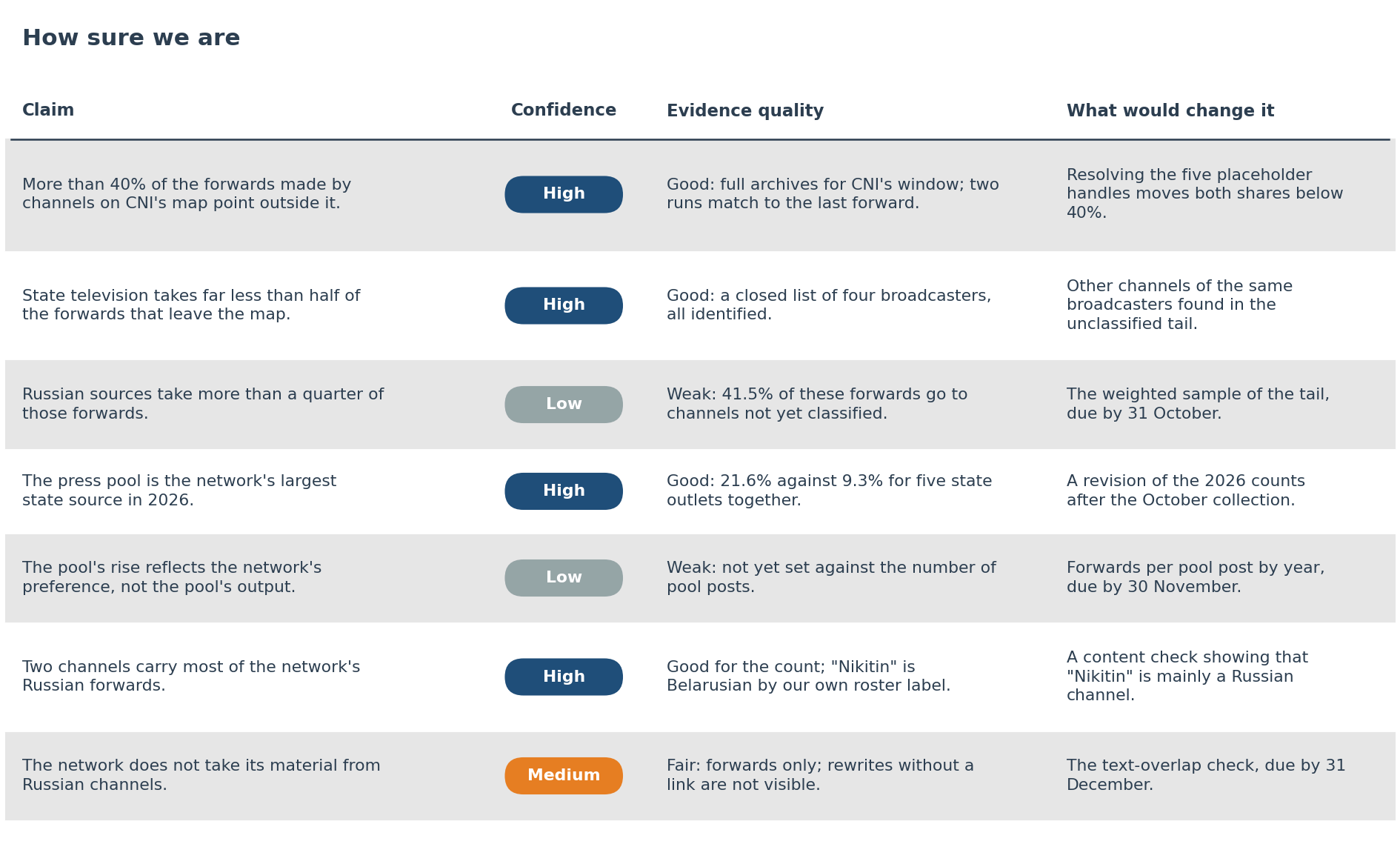
The counts behind the High rows come from the same method in both runs and match to the last forward. The open questions are what sits in the unclassified tail and what the channels copy without a forward. Both Low rows have a dated check in the list below.
The two channels through which most Russian material enters the network were not among them.
How it fits
How it fits. In 2025 and 2026 two channels carried three quarters of the network’s forwards from Russian sources, and the typical channel forwarded almost none. This fits T1: the network shares Moscow’s frame on some issues, but it does not take its material from Russian channels. The data do not rule out copying without forwarding, since a channel can rewrite a Russian text and give no link. A check of text overlap between the channels’ own posts and Russian sources would separate the two readings.
What to watch
By 31 October 2026, a weighted sample of 100 draws from the unclassified tail. We expect Russian sources to stay below a quarter of the forwards that leave CNI’s roster.
By 30 November 2026, forwards per press-pool post by year. We expect the pool’s rise to survive this test, with more forwards per pool post in 2026 than in 2021.
By 31 December 2026, a text-overlap check of one month of the network’s own posts against Russian state agency texts. If more than 10% are near-copies without a link, the forward count understates Russian supply and the T1 reading weakens.
By 15 January 2027, the press pool still takes more than 18% of the network’s forwards in the last quarter of 2026.
Method and limits
We counted forwards in the full archives of 68 Telegram channels, from August 2020 to the end of September 2026. Each post was assigned to its channel by its own address and counted once. Destinations were classified in three ways, and four channels form the state television group: STV, ONT, NEWS.BY and SB.BY. Channels we collect take the type our corpus already gives them, and 69 channels, the four broadcasters among them, were labelled by hand. About a quarter of all forwards, and 41.5% of those leaving CNI’s roster, go to channels we have not classified, so every share here is a lower bound. STV’s channel appears as a destination only from 2022, and the 2020 medians rest on 11 channels. Five small CNI channels whose addresses are still unresolved are counted as outside the roster, as in September. Only forwards are counted; quotes, rewrites and plain links are not. The channel “Nikitin” is listed in our collection as a Belarusian personal channel. Thesis tag: T1.