
A year ago Lukashenko pardoned two Catholic priests after talks with the Vatican, and believers say the two agreed to stay silent in public for a year. Four months later another priest was detained on a treason charge. State media covered the Pope all year and never named him. His sentence became known only through believers.
On 20 November 2025 Lukashenko pardoned two Catholic priests. BelTA reported that two clergymen “who committed grave crimes against the state” had been freed. The decision, it said, took into account “the intensification of contacts with the Vatican” (BelTA, 20 November 2025). Henrykh Akalatovich (Henryk Okołotowicz in Polish), a parish priest from Volozhin, was detained in November 2023. In December 2024 he was sentenced to 11 years on a treason charge (Nasha Niva, 13 January 2026). Andrzej Yukhnevich (Juchniewicz), from Shumilino, had received 13 years.
Two days later Lukashenko’s press secretary, Natalya Eismont, said the decision was taken “at the request of Pope Leo XIV”. It also took account of “the state of health of the convicts”, she said (BelTA, 22 November 2025). Archbishop Józef Staniewski, who chairs the Catholic bishops’ conference, took part in the decision, according to Eismont.
On 21 November both priests were taken to the Vatican (Zerkalo, 21 November 2025). In January Zerkalo reported that they had agreed to make no statements and to stay out of public life for a year. Believers did not know who had set that condition (Zerkalo, 13 January 2026). The year ran out on Friday.
This brief follows the same year from three sides: what happened to clergy in Belarus, what state media said about the Vatican, and what the Church itself said. The clearest case is a priest detained four months after the pardon. Anatol Parakhnevich (Parachniewicz) is the parish priest of Olkovichi in the Vileyka district.
What the year held
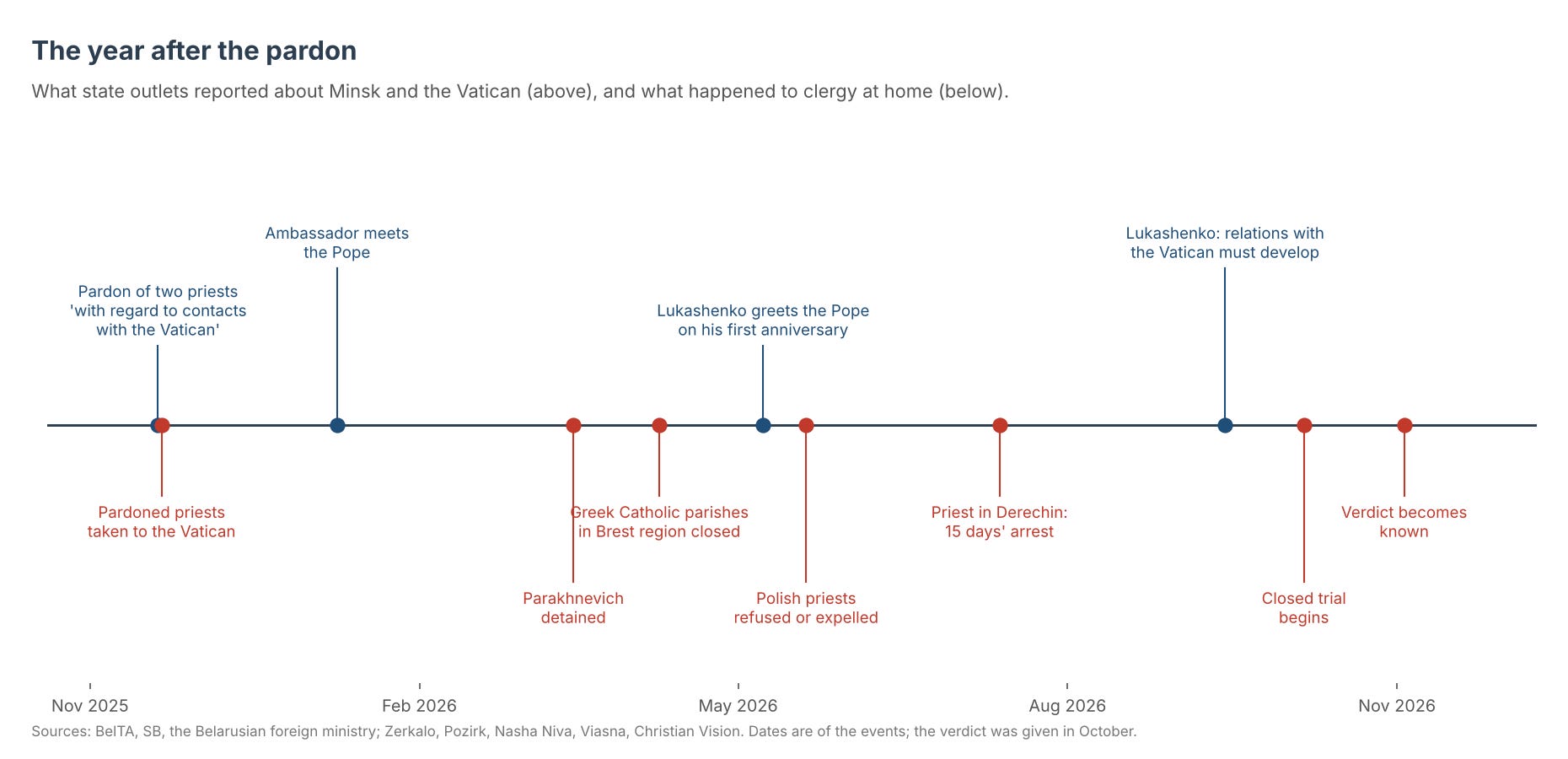
Freedom did not end Akalatovich’s case. A week after the pardon, Katolik.life reported that the authorities were trying to collect 1.7 million roubles from him, about €0.5 million, for “damage caused to the state” (Pozirk, 28 November 2025). In February his land and his car went on sale through Belyursnabzhenie, the state platform that sells seized property (Nasha Niva, 12 February 2026). In April two old icons seized from him were put up for sale too (Zerkalo, 23 April 2026). No one bought the land at three auctions (Nasha Niva, 15 May 2026), and in September it was offered for the sixth time (Christian Vision, 25 September 2026).
Inside the country, new cases began on 16 March, when Parakhnevich was detained. The rights group Viasna made the detention public on 20 March, along with those of six other Christians, two of them evangelical presbyters (Pozirk, 20 March 2026). On 9 April Katolik.life reported that all Greek Catholic parishes in the Brest region had been dissolved (Zerkalo, 9 April 2026).
In May the authorities did not renew the permits of three Polish priests to serve in Belarus (Zerkalo, 2 May 2026). By 20 May five Polish priests and a monk were being sent out of the country (Nasha Niva, 20 May 2026). In July Yury Hrytsko, a Catholic priest in Derechin in the Grodno region, was given 15 days of administrative arrest (Zerkalo, 13 July 2026).
Freedom did not end Akalatovich’s case.
The case
Parakhnevich has served in Olkovichi since 2007, and in August Viasna wrote that he has no family (Viasna, 3 August 2026). There is no one to ask about him except the bishops. In April the Norwegian group Forum 18, which reports on religious freedom, asked officials where he was held and what the charge was. The internal affairs department in Vileyka refused to give any details (Christian Vision, 12 April 2026).
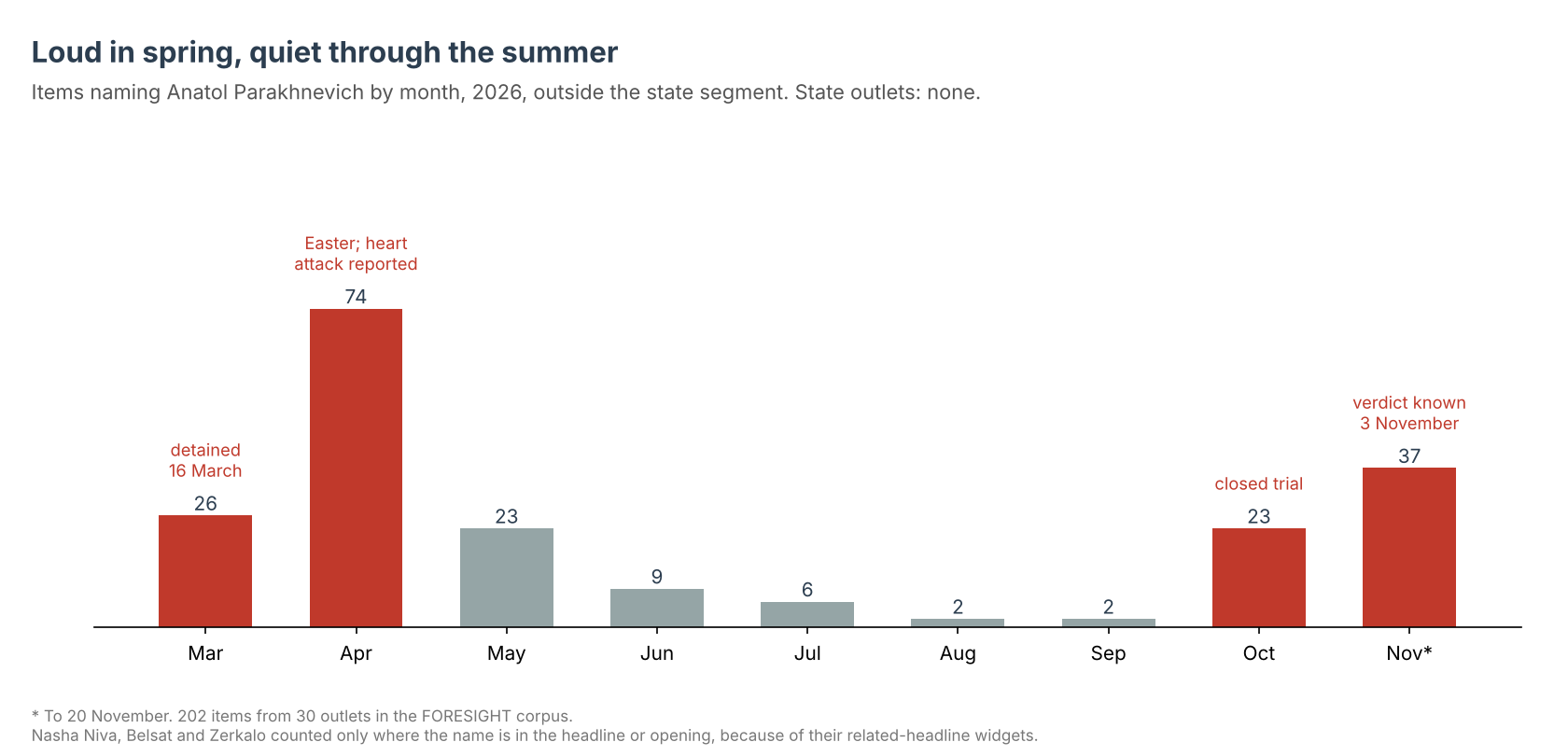
On 25 April Katolik.life reported that he had suffered a heart attack in custody and was in a serious condition (Nasha Niva, 25 April 2026). Polish Radio reported the same day that the charge was treason (Polish Radio, 25 April 2026). April brought the most coverage of the case, 74 items in the outlets we track. On 1 June Viasna recognised him as a political prisoner held under the article on treason (Pozirk, 1 June 2026). By August and September coverage had fallen to two items a month.
On 6 October Katolik.life reported that his trial had begun in Minsk behind closed doors. He had spent more than 200 days in custody (Mediazona, 6 October 2026). No news of a verdict came for four weeks. On 3 November the same site reported, from believers, that he had been sentenced to three years and a fine (Zerkalo, 3 November 2026). The sentence was passed in October, on a date no one could name. The trial had been held in the Vileyka district court, and the first reports had placed it in Minsk.
The verdict left out the treason charge: he was found guilty of “insulting the authorities and extremism” (Euroradio, 3 November 2026). He has appealed against the sentence (Christian Vision, 4 November 2026). Forum 18 put one quoted word in the headline of its report: giving information about the sentence is “forbidden” (Forum 18 in Christian Vision’s translation, 7 November 2026).
There is no one to ask about him except the bishops.
The Vatican in state media
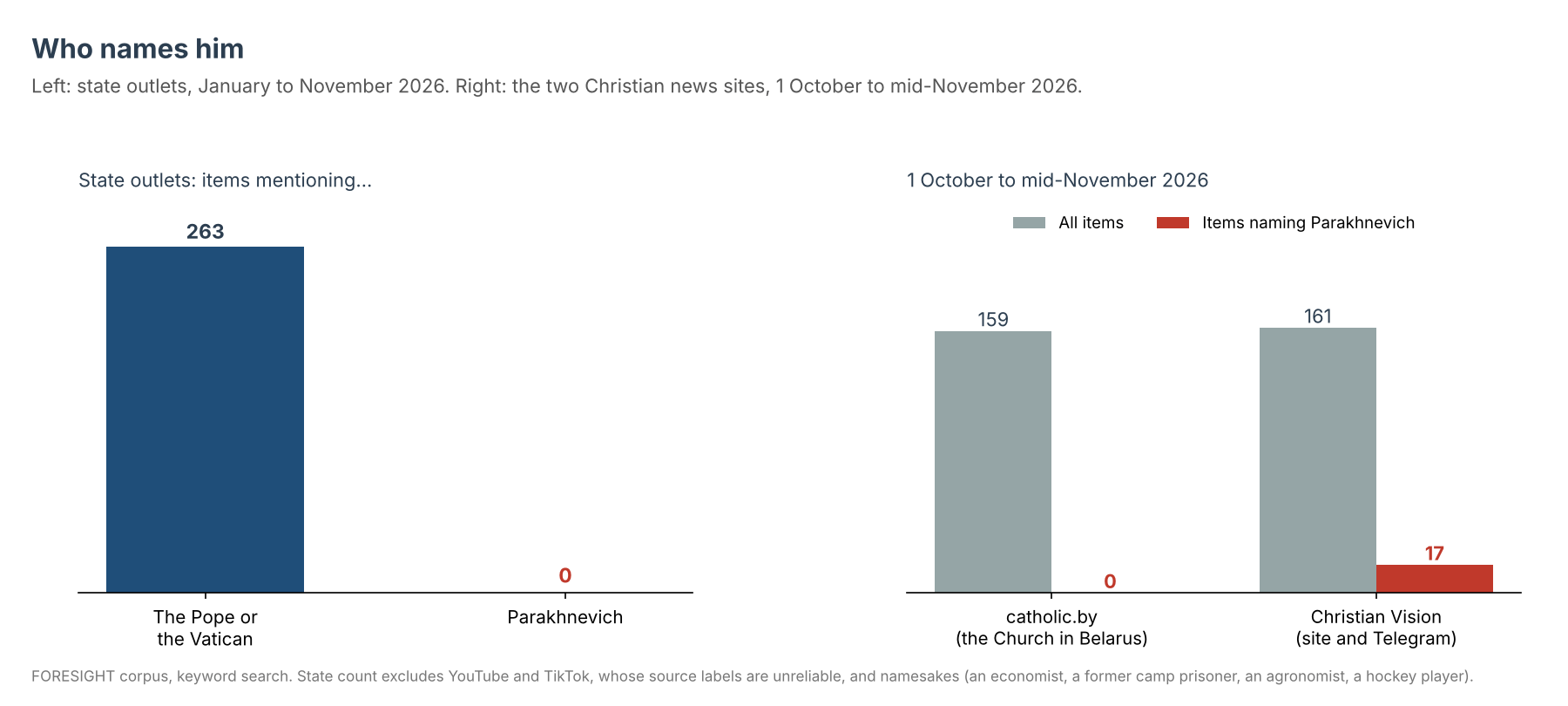
State outlets wrote about the Pope or the Vatican 263 times this year and never named Parakhnevich. His surname does appear in state outlets, but each time it belongs to someone else: an economist, a former camp prisoner, an agronomist and a hockey player.
The Vatican itself appears in two registers, and the first is diplomatic and warm. On 9 January the Belarusian ambassador, Yury Ambrazevich, met Pope Leo XIV and passed on Christmas and New Year greetings “on behalf of the Belarusian people” (BelTA, 10 January 2026). On 8 May Lukashenko congratulated the Pope on the first anniversary of his pontificate and wrote that his voice “invariably sounds as a call for peace and humanism” (BelTA, 8 May 2026). That was 13 days after the report of Parakhnevich’s heart attack. On 14 September, in a birthday greeting, Lukashenko wrote that relations between Minsk and the Vatican “must develop consistently” (BelTA, 14 September 2026).
The second register is historical and hostile. On 4 September BelTA ran a piece under the headline “Real nationocide”. In it the historian Igor Marzalyuk described how interwar Poland tried to make the people of Western Belarus Polish and Catholic. He said that the Vatican had seen Western Belarus as “missionary territory” (BelTA, 4 September 2026). On the day of the birthday greeting, the regional state outlet Grodnonews ran a video on how Poland had tried for 18 years to make Belarusians Polish (Grodnonews, 14 September 2026). The jailed priest appears in neither register.
State outlets wrote about the Pope or the Vatican 263 times this year and never named Parakhnevich.
The Church’s own voice
The Catholic Church’s portal in Belarus, catholic.by, published 159 items from 1 October to mid-November, and none of them named Parakhnevich. On 7 November it reported that 220 million Christians around the world suffer persecution and violence (catholic.by, 7 November 2026). The Church in Belarus did know of the sentence, and it confirmed this to Forum 18 (Christian Vision, 4 November 2026).
The Vatican’s own news service did report it. From 4 November Vatican News carried the sentence in at least six languages, starting with German, but not in Belarusian (Christian Vision, 8 November 2026). Christian Vision, a community of believers from several churches, named Parakhnevich in 17 items over the same weeks on its site and its Telegram channel. In October it counted at least 11 foreign Catholic outlets that had written about the persecution of Catholics in Belarus (Christian Vision, 20 October 2026).
There is an argument for silence. In August Gazetaby wrote that the Vatican “keeps silent” while it seeks the release of priests behind closed doors. It pointed to the pardon of November 2025 as the result (Gazetaby, 16 August 2026). Quiet talks freed two priests a year ago.
What we cannot see is whether the silence on Parakhnevich is a choice made to protect such talks. The bishops’ conference has published no explanation that we could find. The same silence could come from caution, from pressure or from a strategy, and from the outside the three look alike.
Quiet talks freed two priests a year ago.
How sure we are
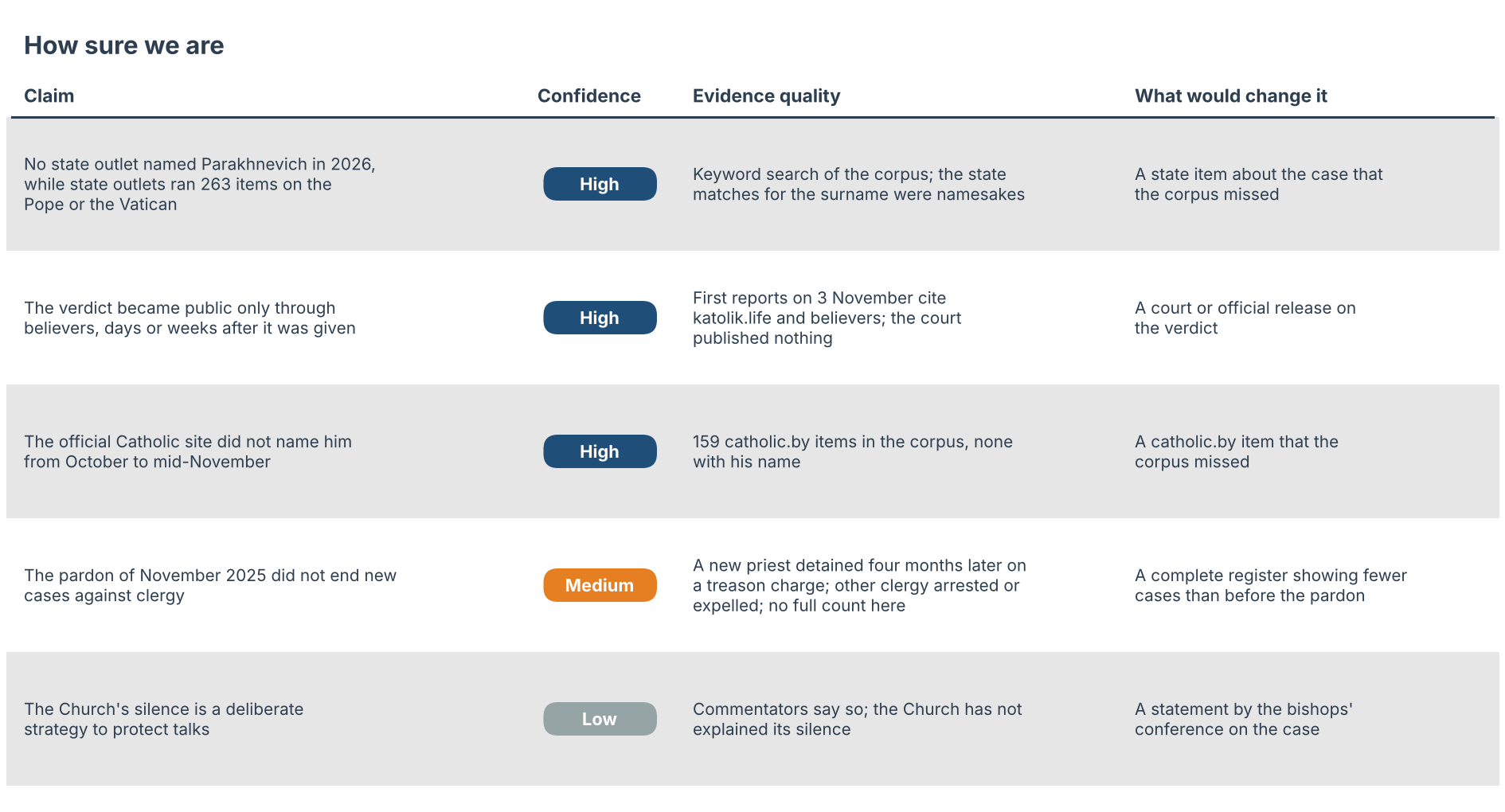
No state outlet named Parakhnevich in 2026, while state outlets ran 263 items on the Pope or the Vatican. High. Keyword search of the corpus; the state matches for the surname were namesakes. A state item about the case that the corpus missed would change it.
The verdict became public only through believers, days or weeks after it was given. High. The first reports on 3 November cite Katolik.life and believers; the court published nothing. A court or official release on the verdict would change it.
The official Catholic site did not name him from October to mid-November. High. 159 catholic.by items in the corpus, none with his name. A catholic.by item that the corpus missed would change it.
The pardon of November 2025 did not end new cases against clergy. Medium. A new priest was detained four months later on a treason charge, and other clergy were arrested or expelled; we have no full count. A complete register showing fewer cases than before the pardon would change it.
The Church’s silence is a deliberate strategy to protect talks. Low. Commentators say so; the Church has not explained its silence. A statement by the bishops’ conference on the case would change it.
How it fits
In “The Greetings Stayed” we found that catholic.by reported detained priests only in short notices, and that trials and sentences went unreported. Parakhnevich’s sentence fits that pattern. In “The Other Register” we read Christian Vision, which names the priests the portal leaves unnamed. This autumn the count was 17 items against none.
In “The Offer in the Same Speech” we found that releases bring people home without shrinking the count of political prisoners, because the courts keep adding new names. The pardon of two priests and the arrest of a third is the same pattern on a smaller scale.
Thesis tag: none (observation).
What to watch
By 31 January 2027. An appeal court upholds Parakhnevich’s sentence. Expectation: yes. Confidence: high.
By 31 March 2027. Either of the priests pardoned in 2025 speaks in public about his imprisonment. Expectation: no. Confidence: low.
By 31 March 2027. catholic.by publishes an item that names Parakhnevich. Expectation: no. Confidence: medium.
By 30 November 2027. Parakhnevich is pardoned and leaves Belarus. Expectation: no. Confidence: low.
Method and limits
The counts come from a keyword search of the FORESIGHT corpus since January 2024. We searched for the names of the priests in several spellings, for the Vatican, the Holy See and the Pope, and for words for clergy within 150 characters of a verb of arrest or sentence. Nasha Niva, Belsat and Zerkalo pages carry blocks of headlines from other stories, which our collector stores with the text. We therefore counted them only where a name appears in the headline or the opening. We left out YouTube and TikTok items labelled as state media, because those labels are unreliable. We checked every state match for the surname Parakhnevich by hand, and all of them were namesakes. One Belsat item on the heart attack carries a wrong date in our collection, and we counted it in April. The catholic.by and Christian Vision counts cover 1 October to mid-November 2026. Details of the verdict come from believers through Katolik.life, as reported by Zerkalo, Nasha Niva, Pozirk and Euroradio. The court has published nothing, and the date of the sentence is unknown. Forum 18’s findings come from its reports as published in Russian by Christian Vision.