

A Civitta Institute survey asks what Belarusians in Poland will give to exile organisations. Its case study points to audience size, the large sums follow prisoner releases, and the sample cannot measure fear of prosecution at home.
Civitta Institute has published a report on private donations among Belarusians in Poland ( Civitta report, October 2026). It rests on an online survey of 214 people in July and August 2026, six interviews and one case study. The report advises exile organisations to ask for about 50 zloty, to explain what grants do not cover and to repeat their appeals. We do not know how the people who ignored the questionnaire would have answered, and the authors themselves say that many stayed away out of fear.
Who answered
The authors planned 300 respondents and reached 214, recruited through social media groups and advertising. Sixty per cent of them, 128 people, had given to a Belarusian organisation in the past year. The report says plainly that such a sample leans toward donors. It reports donors and non-donors separately and never adds them together, which is the honest way to use it.
The lean goes further than giving. The National Bank of Poland interviewed 750 Belarusians in 2025. About 62% had a degree and 14% earned more than 10,000 zloty a month (Nasha Niva, 3 December 2025). In the Civitta sample 85% have a degree and about 22% report more than 10,000 zloty net. Half live in the Warsaw region.
The size of the whole community is uncertain too. The report counts more than 163,000 valid residence permits on 31 August 2026 and names no source. Poland’s Office for Foreigners reported over 144,000 in April 2025 (report), nearly 143,000 in February 2026 (report) and 138,000 in May 2026 (report). We could not open its August report, so the gap stays unexplained. A study that KAS Belarus published in November puts the number of Belarusians in Poland at 310,000 (KAS Belarus).
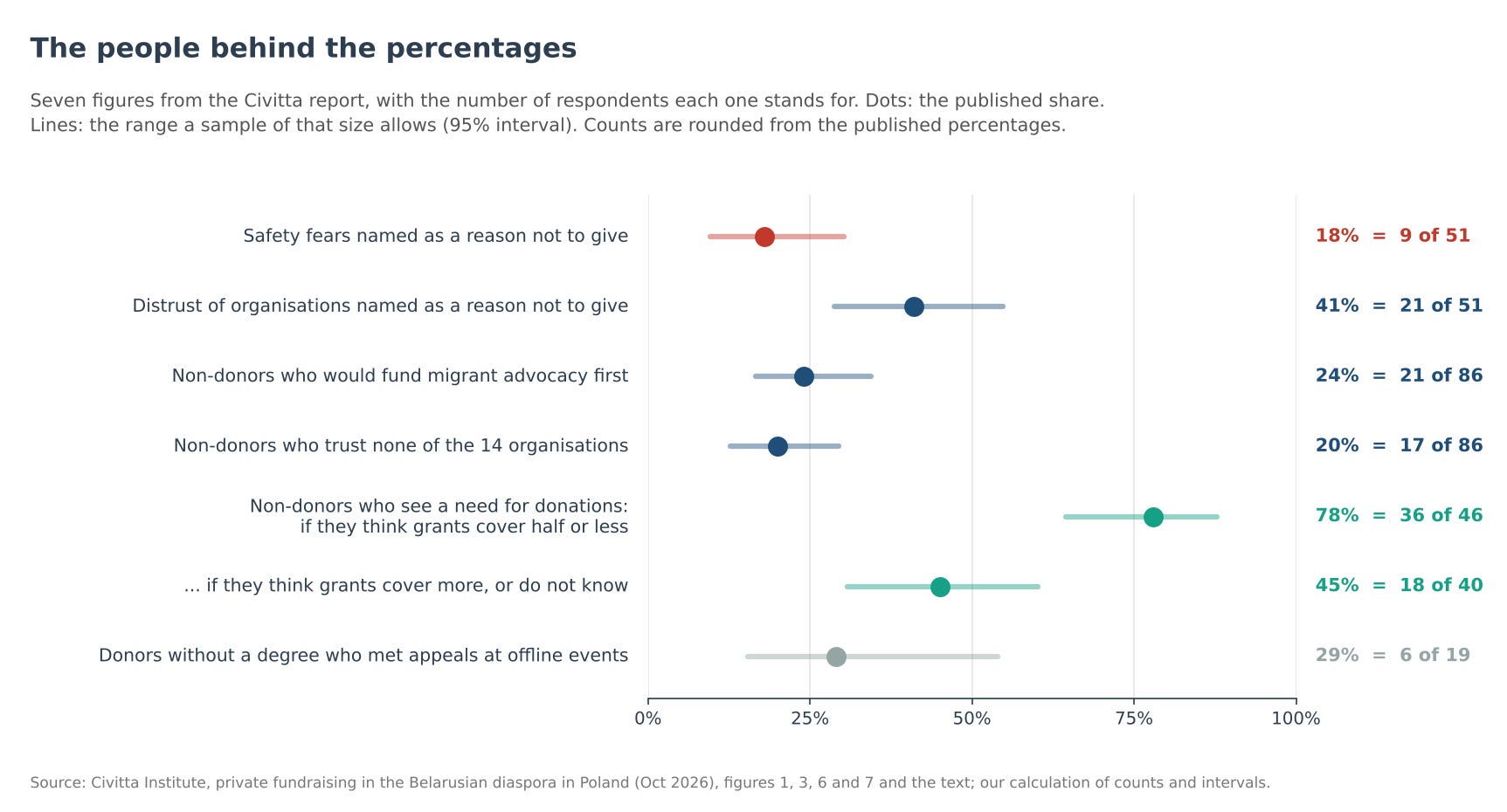
Several headline findings stand on small groups. The idea that non-donors would pay first for advocacy before the Polish authorities comes from 21 people. The finding that grants push out private gifts compares 36 answers with 18.
The authors read that last result as cause and effect. In their account people hear about grants and decide that their money is not needed. The data allow the reverse reading, in which people who do not want to give find a reason afterwards. The report’s own figure supports the doubt. Donors hold the same view of grants as non-donors, and they give anyway.
What the report does well
It publishes its statistics with coefficients and p-values, so a reader can test them. We recomputed them from the group sizes, and they hold.
Donors hold the same view of grants as non-donors, and they give anyway.
The section on amounts is the most useful one. Donors’ answers place an easy gift between 50 and 80 zloty. The average donation on the Gronka platform, €15 to €20, falls in the same range, so two independent sources agree.
The report also draws attention to a Polish tax rule. Taxpayers may direct 1.5% of their income tax to a public-benefit organisation at no cost to themselves, and 63% of donors call this convenient. Large donors often leave their tax returns to accountants and forget to mention it. The report suggests that organisations brief those accountants, which is a concrete task.
A case study that points elsewhere
The report studies four campaigns of one unnamed cultural organisation in Poland. None reached its goal, and the authors blame weak communication. Posts were rare, pictures came from stock libraries, and donors got almost no reports.
Their own table reads differently.
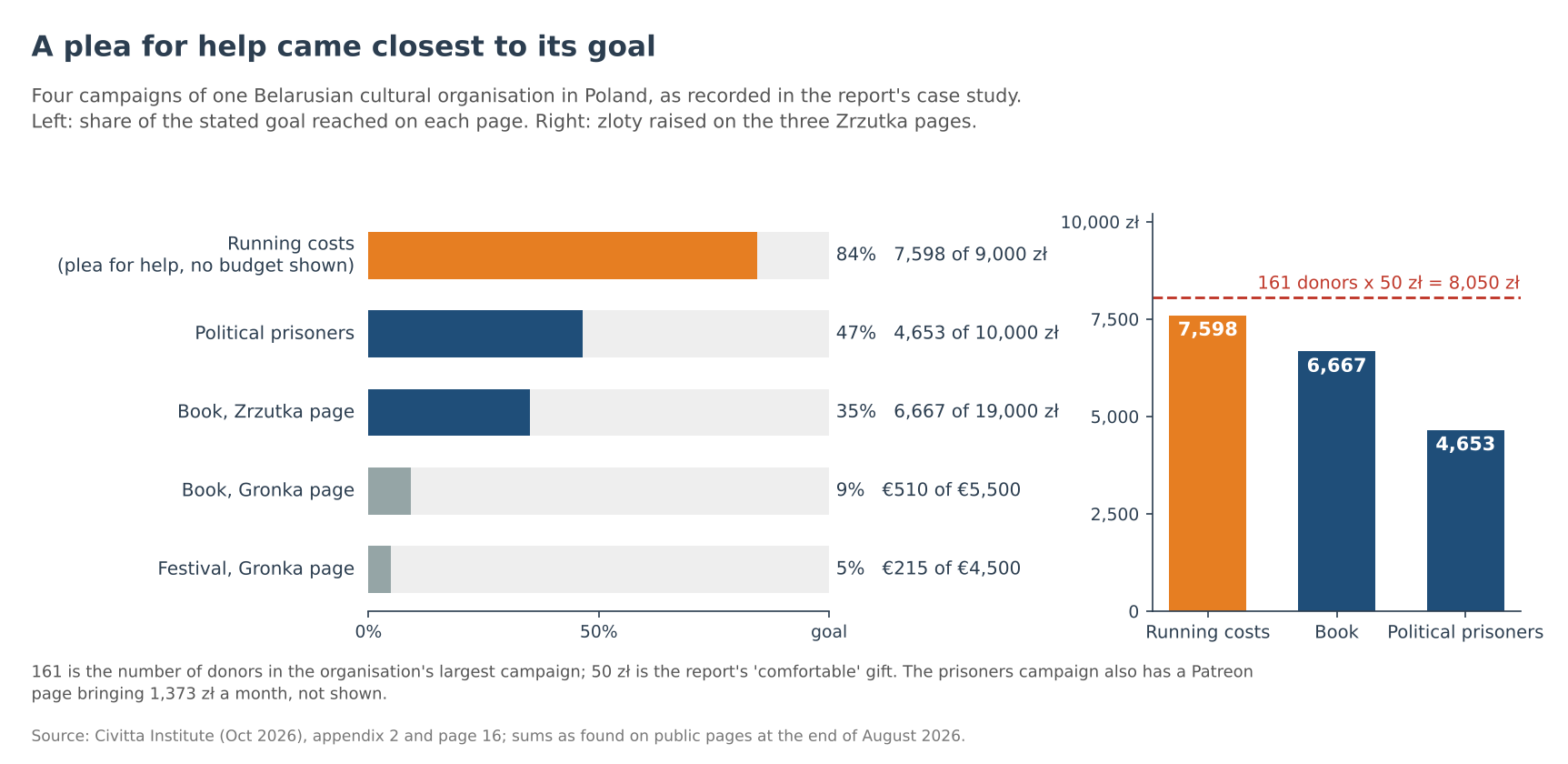
The campaign for running costs showed no budget and offered only a plea for help, and it reached 84% of its goal. The campaign for political prisoners, the cause the survey ranks first, reached 47%. The book had three media articles and a blogger’s video behind it, and it reached 35% on one page and 9% on another.
In zloty the three Zrzutka pages sit close together, at 7,598, 6,667 and 4,653. The report says the organisation’s largest campaign drew 161 donors. It has about 1,400 followers on Instagram and 400 on Telegram. At the report’s comfortable gift of 50 zloty, 161 donors give 8,050 zloty. The goals ran from 9,000 to 19,000 zloty, and the sums did not follow them.
Two explanations compete here. The report’s is that better appeals would have closed the gaps. Ours is that an audience of this size gives a few thousand zloty whatever it is asked for. The case study cannot separate them, because it contains no campaign that succeeded.
One outside case leans our way. In August 2024 the New Land hub in Białystok asked for help to stay open and raised 9,800 zloty in three days (Pozirk, 18 August 2024). The Mieroszewski Centre counts about 120 Belarusian cultural organisations and initiatives in Poland (Mieroszewski Centre). They all work within the same community.
At the report’s comfortable gift of 50 zloty, 161 donors give 8,050 zloty.
Where the large sums came from
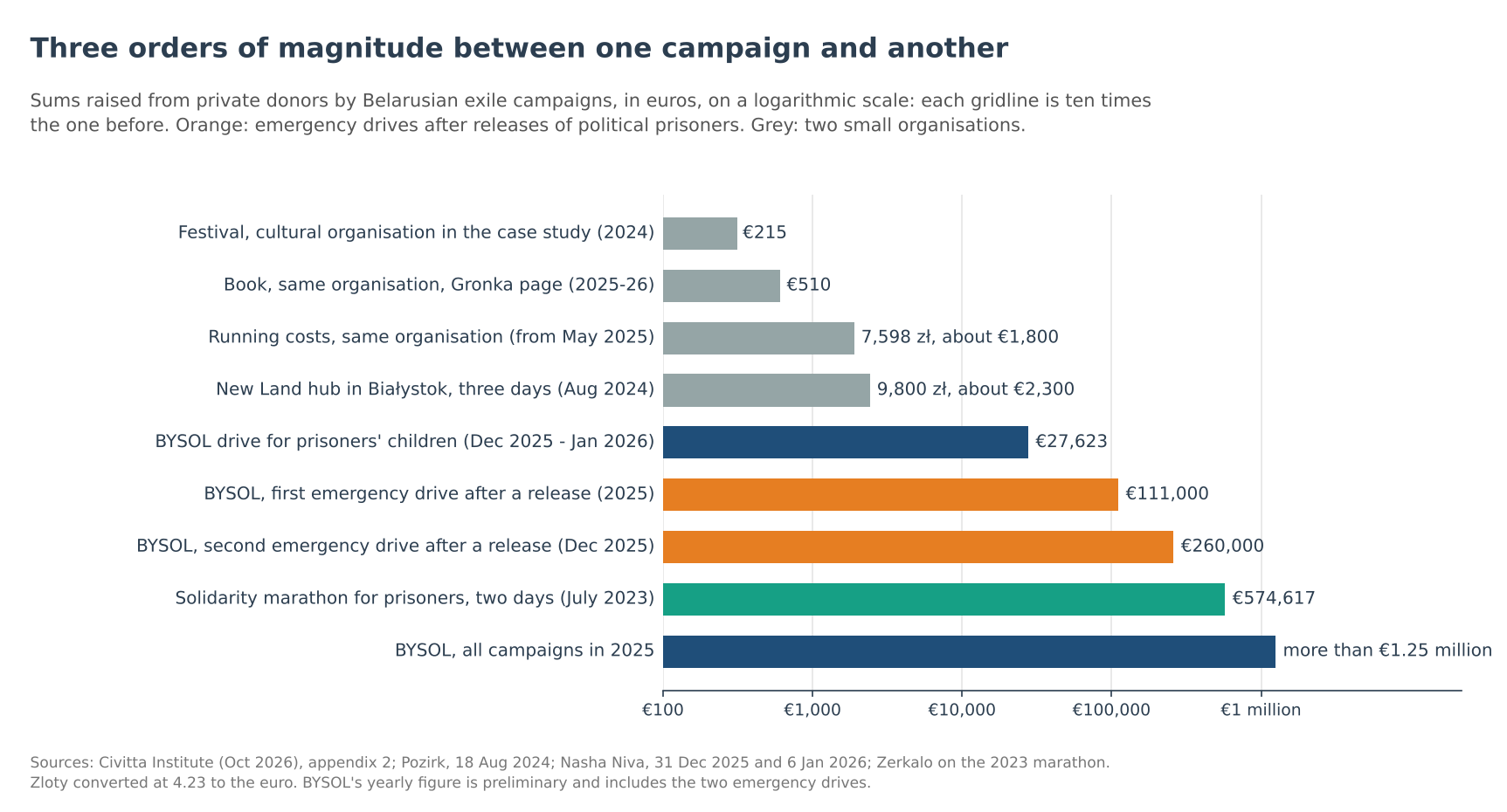
BYSOL raised more than €1.25 million in 2025, twice its total for 2024 by Nasha Niva’s account (Nasha Niva, 31 December 2025, in Belarusian). Two emergency drives for released political prisoners brought €111,000 and €260,000. Each doubled its goal. A two-day media marathon in July 2023 raised €574,617 (Zerkalo). The team behind it said in 2024 that it would not run one that year (Zerkalo).
The report cites these drives as proof that strong messages work. The figures fit a second reading as well. People give when prisoners walk free and a fund they know asks at once. We cannot rank the two readings, because we found no monthly series from BYSOL.
The distance between these drives and a cultural campaign is hundreds of times. Better posts may lift a campaign from a third of its goal to the whole of it. A gap of that size is unlikely to come from the wording of posts alone, and the survey points to another cause. Only a few organisations on its list of 14, Viasna among them, are known and trusted by most respondents.
Two emergency drives for released political prisoners brought €111,000 and €260,000.
The fear the survey could not reach
Among the 51 respondents who neither give nor plan to, 18% named safety for themselves or for relatives in Belarus. The report concludes that safety matters less than distrust, which 41% named. It also relays the organisers’ view that donors in Poland who use foreign bank accounts face almost no risk.
The same report explains its low response by fear. It says that people who avoid donating for safety reasons tended to avoid the questionnaire for the same reason. Both statements cannot carry weight at once. Eighteen per cent of 51 respondents is nine people. If fearful people did not answer, those nine are the ones who answered anyway.
Viasna counts at least 159 people convicted in Belarus for donations (Zerkalo, 19 June 2026). In 2025 alone, courts convicted 36 people under the article on financing extremist activity (Nasha Niva). One case that became known in May 2026 shows the scale. Pavel Kaberda, an IT specialist, made about ten PayPal transfers to BYSOL, BY_help, BYPOL and other funds between 2020 and 2022. Most were between €10 and €50. He was detained after he came back from Poland and got five years in a colony.
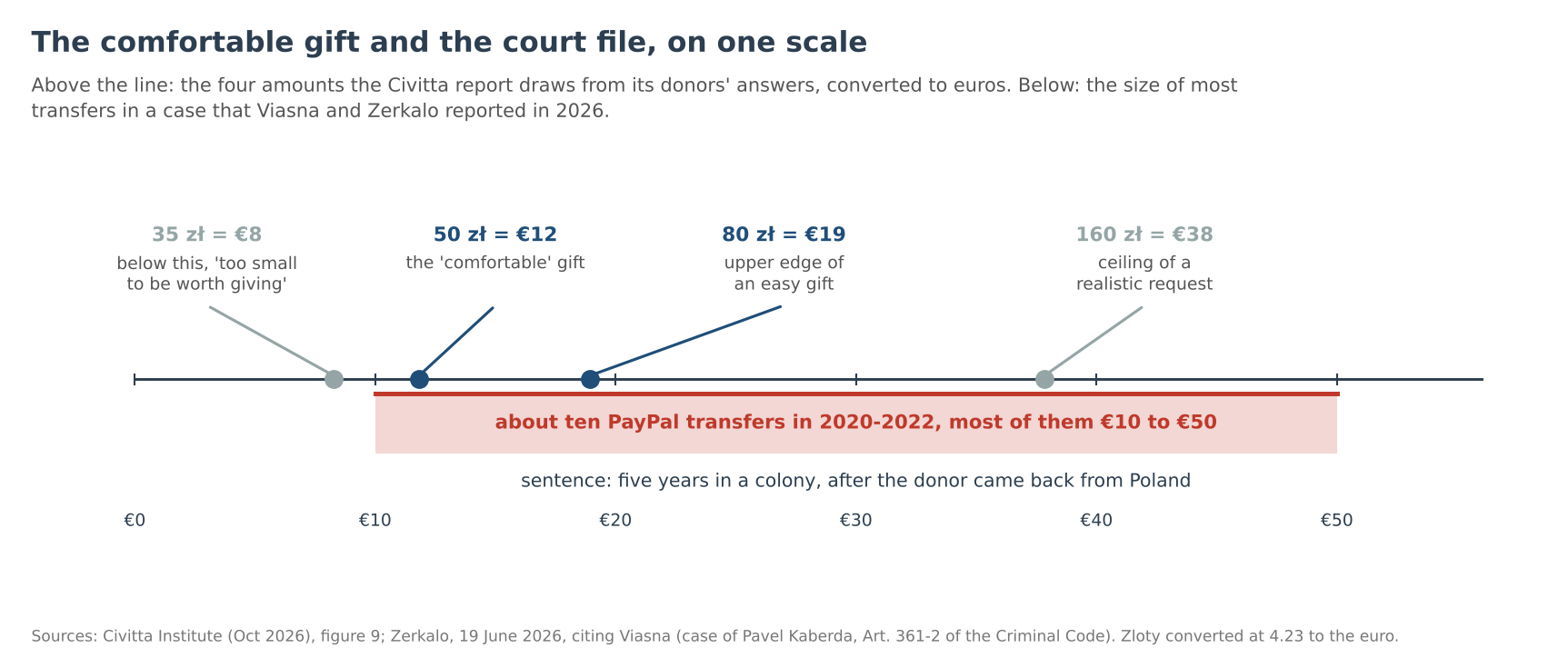
Fifty zloty is about €12. The gift that the survey’s donors call comfortable lies inside the range of transfers in that court file. The risk falls on people who still travel to Belarus or have family there. The report does not say whether anyone was asked about trips home.
A competing explanation deserves its place. The low share may be accurate for settled exiles who never go back. In that case the fearful form a separate group, and better appeals will not reach them either.
He was detained after he came back from Poland and got five years in a colony.
Confidence
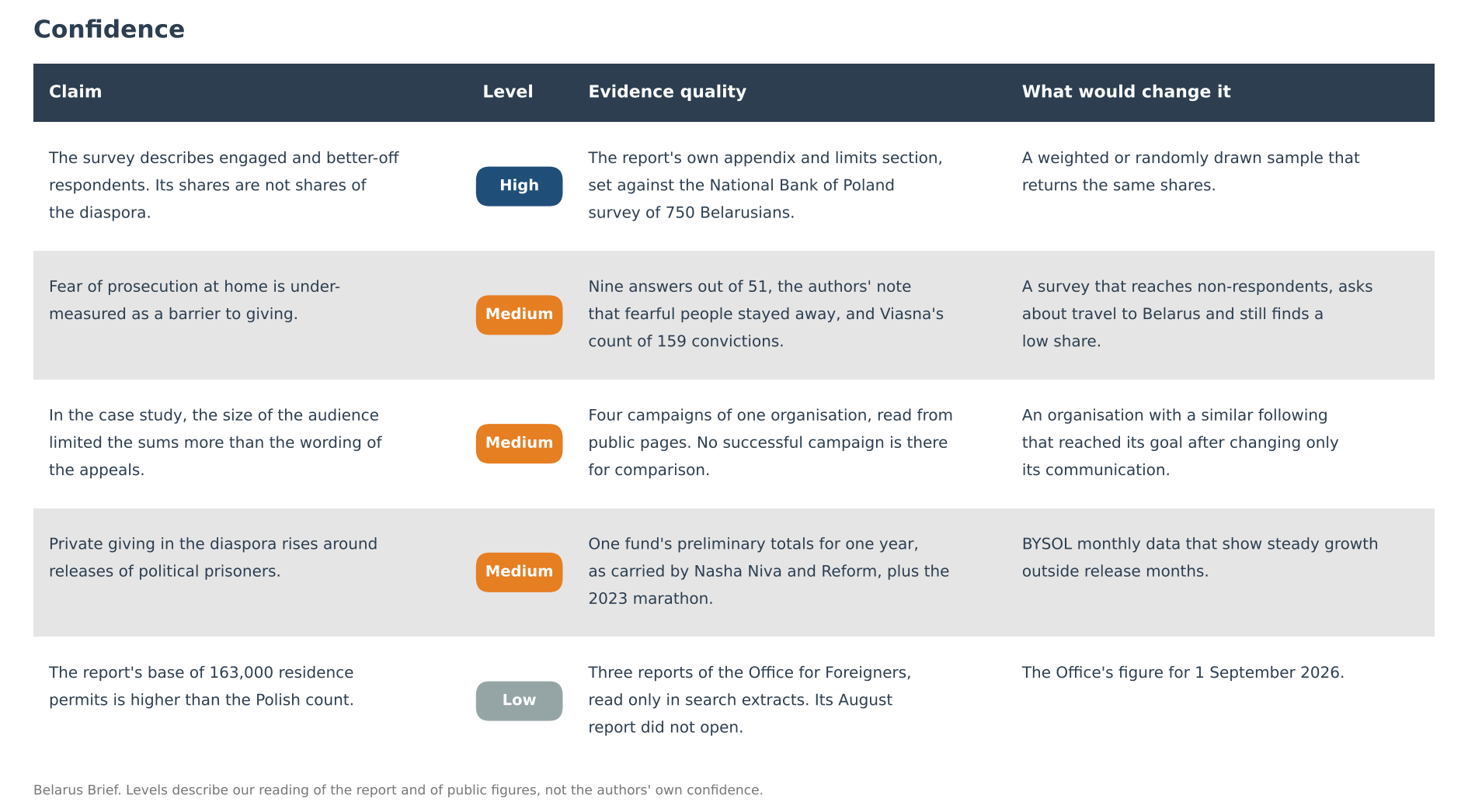
The survey describes engaged and better-off respondents, and its shares are not shares of the diaspora. High. Evidence quality: the report’s own appendix and limits section, set against the National Bank of Poland survey of 750 Belarusians. A weighted or randomly drawn sample that returns the same shares would change it.
Fear of prosecution at home is under-measured as a barrier to giving. Medium. Evidence quality: nine answers out of 51, the authors’ note that fearful people stayed away, and Viasna’s count of 159 convictions. A survey that reaches non-respondents, asks about travel to Belarus and still finds a low share would change it.
In the case study, the size of the audience limited the sums more than the wording of the appeals. Medium. Evidence quality: four campaigns of one organisation, read from public pages, with no successful campaign for comparison. An organisation with a similar following that reached its goal after changing only its communication would change it.
Private giving in the diaspora rises around releases of political prisoners. Medium. Evidence quality: one fund’s preliminary totals for one year, as carried by Nasha Niva and Reform, plus the 2023 marathon. BYSOL monthly data that show steady growth outside release months would change it.
The report’s base of 163,000 residence permits is higher than the Polish count. Low. Evidence quality: three reports of the Office for Foreigners, read only in search extracts, while its August report did not open. The Office’s figure for 1 September 2026 would settle it.
How it fits
In Both Cats, No Grin we measured exile participation by votes. The Coordination Council election drew 6,723 voters in 2024 and 2,113 in 2026. Money moved the other way, since BYSOL’s receipts doubled in 2025. Our thesis T7 says that exile participation is falling, and this observation does not fit it.
One alternative is that T7 holds for standing institutions and fails for one-off help to named people. Another is that fewer donors now give larger sums to one trusted fund. BYSOL says that the number of donations and their average size both grew, which says nothing about the number of donors. A count of donors by year would separate the two readings. Neither BYSOL’s summary nor the Civitta report gives one.
What to watch
By 31 January 2027. BYSOL publishes its total for 2026. Expectation: above €1.25 million, since 250 people were released in March 2026. Confidence: low.
By 31 January 2027. The Office for Foreigners reports how many Belarusians held valid residence documents on 1 January. Expectation: below 150,000. Confidence: medium.
By 31 March 2027. If 20 or more political prisoners are released in one round, BYSOL’s emergency drive passes its stated goal. Confidence: medium.
By 30 June 2027. Viasna updates its count of people convicted for donations. Expectation: above 185. Confidence: medium.
Method and limits
We read the Russian edition of the report, 34 pages dated October 2026. Counts behind percentages are rounded from the published shares and group sizes, and the intervals in the first chart are 95% Wilson intervals. We recomputed p-values from the published coefficients. One of them, for trust and the intention to give, matches a group of about 75 people that the report does not name. Zloty were converted at 4.23 to the euro. The figures of the Office for Foreigners come from search extracts of its reports. BYSOL’s total for 2025 is preliminary. The questionnaire is not published, so we rely on the wording printed under the figures. The organisation in the case study is unnamed in the report and stays unnamed here. No FORESIGHT corpus query stands behind this piece.
Thesis tag: T7.