
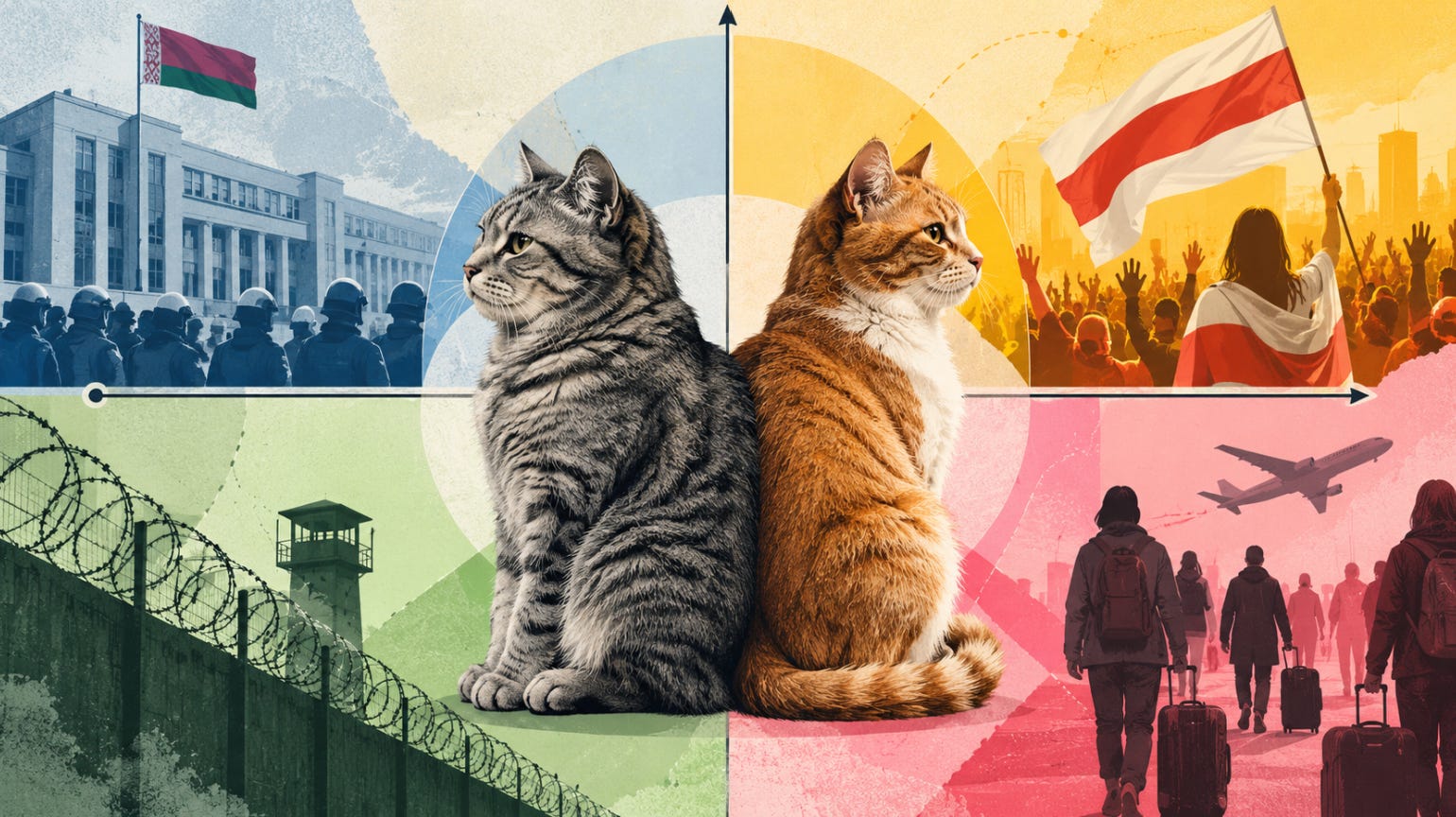
Last week we put two Belarusian registers on Anton Jäger’s diagram and followed one point across it for sixteen years. This piece reads the diagram the other way. Hyperpolitics (Verso, 2026) ends with a chapter called “Escape Routes”. Its answer is short. Politics with no organisations has one way out: rebuild the organisations. Belarus is a country where that has been tried twice since 2020, once by the exile and once by the state. Both attempts can be counted.
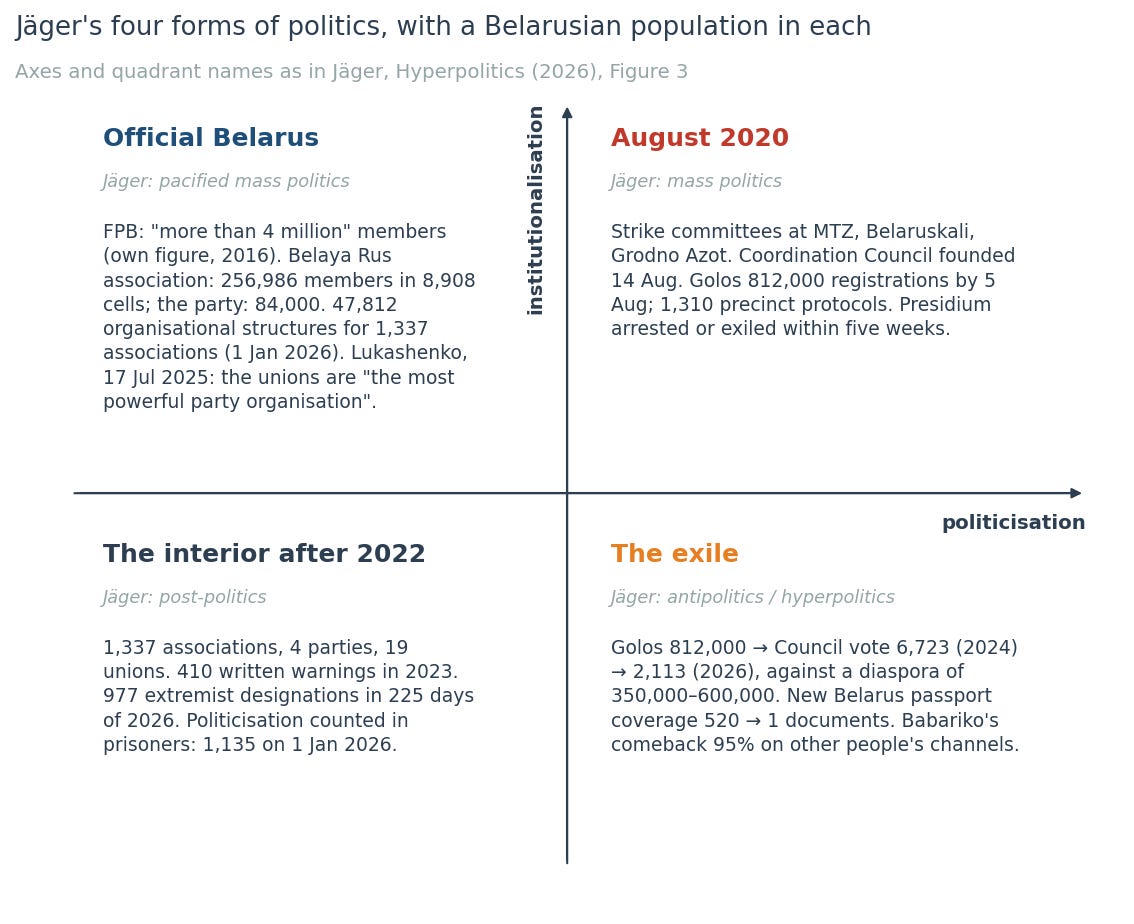
Jäger’s Figure 3 has two axes, politicisation and institutionalisation, and four quadrants. Mass politics sits high on both. Post-politics sits low on both. Antipolitics and hyperpolitics share the quadrant of high politicisation and low institutionalisation. The fourth quadrant, high institutionalisation and low politicisation, he gives to the pacified second phase of mass politics. Those were the post-war decades of parties and unions that kept their members and stopped fighting. Western countries, in his account, move through these quadrants one at a time. Belarus has a population in each.
Two weeks in the mass-politics quadrant
For most of August 2020 Belarus was in the upper-right corner. Strike committees formed at MTZ, Belaruskali, Grodno Azot and the Minsk Wheel Tractor Plant. The Coordination Council was founded on 14 August with a presidium of seven. The Golos platform had 812,000 registered users by 5 August, before the vote. Honest People collected photographs of 1,310 precinct protocols out of 5,767. Those alone gave Tsikhanouskaya more than 80 per cent of what the Central Election Commission had credited to her nationwide. That is what high on both axes looks like: mobilisation with a count, a structure and an address.
It lasted as long as it took the state to find the addresses. Presidium members were arrested or pushed abroad within five weeks. Strike committee leaders were detained in September. The independent trade union federation was liquidated in 2022. The parties were re-registered down to four in 2023. The register of public associations lost 56 per cent of its entries between 2021 and 2026. The order is the point. The state worked down Jäger’s vertical axis first and left the horizontal one to the prison and pardon system.
The state worked down Jäger’s vertical axis first and left the horizontal one to the prison and pardon system.
The exile in the hyperpolitics quadrant
Jäger describes hyperpolitical membership as low-cost, low-commitment and easy to leave. The Belarusian exile has now measured that three times with the same instrument. Golos in August 2020: more than 800,000 registrations in two weeks. The Coordination Council election of May 2024, the first attempt to give the exile an elected body: 6,723 votes from twelve countries. The Coordination Council election of May 2026: 2,113 votes, after a DDoS attack on the platform and a three-day extension. Belsat set that against seven million eligible Belarusians and printed a turnout of 0.03 per cent. Against the diaspora the denominator is kinder and the picture is the same. Estimates of how many Belarusians have left since 2020 vary. PACE and Freedom House cite 200,000 to 500,000. The deputy interior minister put it at 350,000 by mid-2023. The materials submitted to the International Criminal Court in early 2026 say about 600,000. On the lowest of those, 2,113 votes is 0.6 per cent of the diaspora; on the highest, 0.35 per cent. In 2024 the same arithmetic gave about 1.3 per cent. The share fell while the diaspora grew.
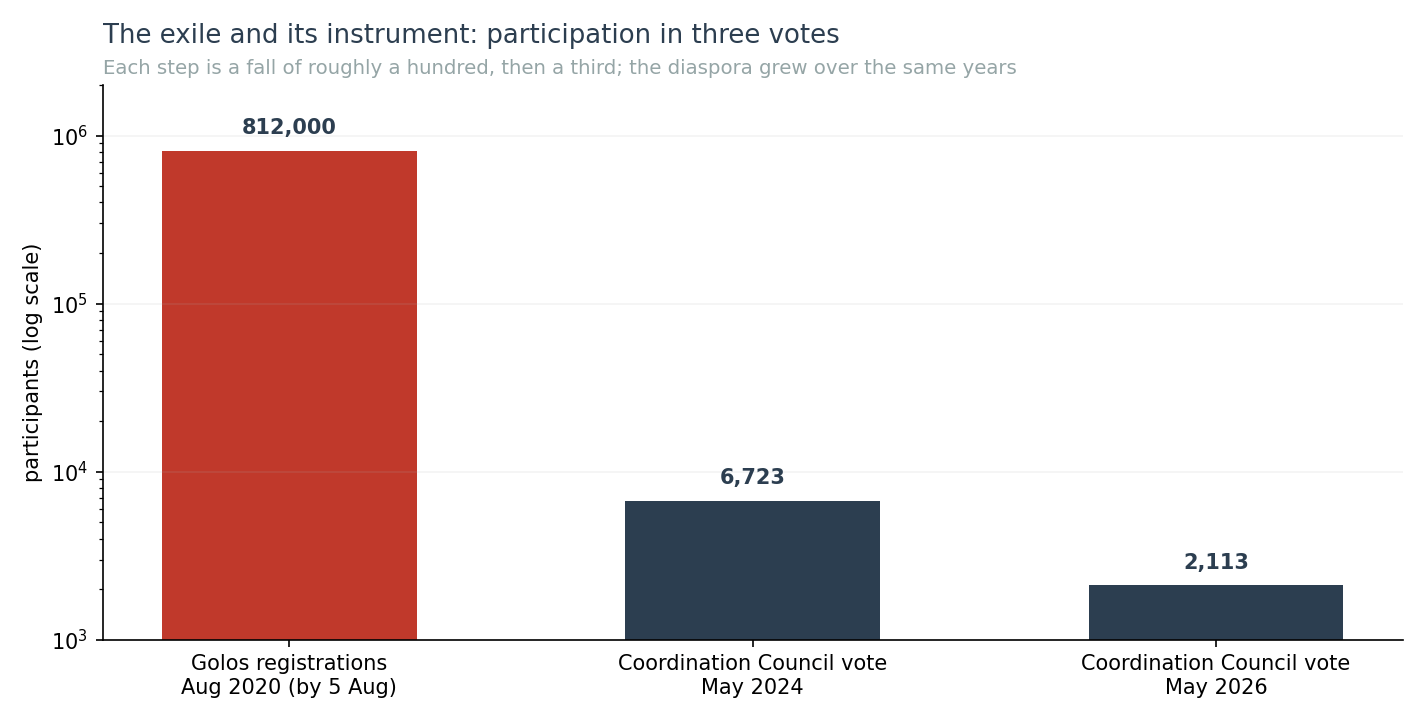
Pavel Latushka, whose list won both elections, told Zerkalo that Belarusians he met in Warsaw had not known there was a vote. That is an accurate description of hyperpolitics. Attention is available; it is simply not attached to the institution. Our earlier counts point the same way. Coverage of the New Belarus passport went from 520 documents at its January 2025 peak to one in July 2026. Babariko’s return in August 2026 reached 95 per cent of its views on other people’s channels. The exile still has the grin. The Council is the cat, and fewer people each year notice it is there.
The exile still has the grin. The Council is the cat, and fewer people each year notice it is there.
The interior in the post-politics quadrant
Jäger makes a point that is easy to miss. Post-politics and hyperpolitics share most of their features: a weak civil society, hollow parties and a state insulated from pressure. What separates them is the noise. Inside Belarus the noise is illegal. The extremist-materials register added 977 items in the first 225 days of 2026. The association register stands at 1,337. In 2023 the ministry inspected more than a thousand of the survivors and warned 410 of them in writing. The result matches Jäger’s post-political corner on every indicator except one. His post-politics arrived when people stopped caring. This one arrived by sentence, and the people who cared are the 1,135 on Viasna’s list.
The state in the quadrant Jäger keeps for the past
The fourth quadrant is where the argument turns. Jäger reserves high institutionalisation with low politicisation for pacified mass politics, the world of large memberships and small stakes. Belarus’s official society sits there today, and its size is on the record. The Federation of Trade Unions puts its membership at more than four million, 94.8 per cent of the working population, a figure it has carried on its site since 2016. The Belaya Rus association reports 256,986 members in 8,908 primary organisations; the party of the same name, created in 2023, reported 84,000 members at its congress this year. Those 8,908 primary organisations are close to a fifth of the 47,812 organisational structures the ministry counted on 1 January 2026 for the whole country. The five organisations that the ministry lists as “subjects of civil society” hold most of the rest. That is 36 branches for every surviving association.
Lukashenko described this quadrant himself. Receiving the head of the Federation on 17 July 2025, he said the unions were already “probably the most powerful party organisation” in the country. In organisational terms, he added, they rated higher than any party that exists. He was not complaining. A union that outranks the parties and never strikes is the institution he wants, and it is Jäger’s pacified mass politics built to order.
What this does to the escape route
Jäger’s exit from hyperpolitics is reinstitutionalisation: bring back the mass organisation, the party with dues, the union with a strike fund. Belarus shows what the prescription produces when only one axis moves.
Move institutionalisation up without politicisation and you get the Federation of Trade Unions: four million members, 8,908 Belaya Rus cells beside them, and a leader who reports to the president. That is Jäger’s escape route, completed, in the hands of the regime. Move politicisation without a territory to institutionalise it in and you get the Coordination Council. It is an elected body whose electorate fell from 6,723 to 2,113 while the population it represents grew. Both are cats. Neither has a grin.
Both are cats. Neither has a grin.
The only moment Belarus held both axes at once was August 2020, and it was the institutional half that the state removed first. Chris Marker’s film, which gives Jäger his chapter title, is about the decade after 1968, when the mood survived the organisations. Belarus is the case where the organisations were taken away on purpose, and the mood was allowed to leave the country. Jäger’s diagram describes that well. His escape route does not, because it assumes the state is absent from the drawing. In Minsk the state is the one holding the pen.
What to watch
The next Coordination Council election, due in 2028 on the current two-year cycle. A third fall, below 2,000 votes, would settle whether the 2026 result was the DDoS attack or the trend. A rise above 6,723 would refute this piece.
The Federation’s next reported membership. Its public figure has stood at “more than four million” since 2016; a dated update below that would mean the pacified quadrant is emptying too.
The Ministry of Justice line for 1 January 2027, due in February. If organisational structures pass 48,000 while associations fall again, the two lines are still moving apart.
Takeaways
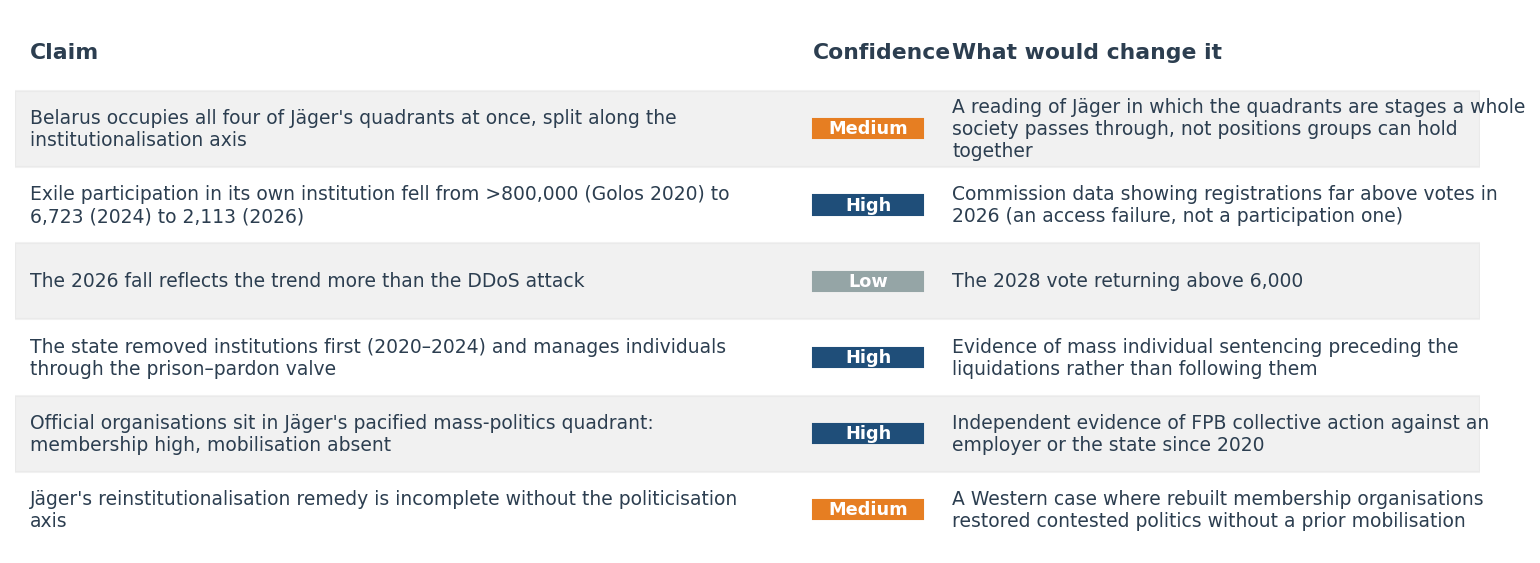
Belarus has a population in each of Jäger’s four quadrants at the same time. The state cut society along his vertical axis: strike committees and the Council in 2020, unions in 2022, parties in 2023, associations through 2024.
Exile participation in its own institution fell from more than 800,000 Golos registrations in 2020 to 6,723 Council votes in 2024 and 2,113 in 2026. The number of Belarusians abroad rose over the same years.
The state’s own organisations sit in the quadrant Jäger gives to pacified mass politics: 47,812 branches for 1,337 associations. The president calls the union the strongest party in the country.
Jäger’s remedy of reinstitutionalisation has been carried out in Belarus by the regime; the exile’s version is losing its voters. Neither moves both axes at once, and August 2020 is the only point in the series that did.
Method and limits. Association and structure counts are the Ministry of Justice “as of 1 January” line as reconstructed last week. Golos registrations are the platform’s own counter as reported on 5 August 2020; the final figure was higher. Coordination Council votes are the election commission’s final results for 2024 and 2026 as reported by Nasha Niva, Reform and Zerkalo; the 2026 vote followed a DDoS attack and an extension, and the commission has not published registrations separately, so conversion from registered to voted cannot be checked.
The diaspora denominator is a range of published estimates (PACE, Freedom House, the deputy interior minister, Korshunau’s 500,000–600,000 for 2020–2024, and the ICC submission), as compiled by Belsat; none is a count.
Federation and Belaya Rus membership figures are the organisations’ own claims and have no independent check; the Federation’s page dates from 2016 and has not been updated. The Belaya Rus association and the Belaya Rus party are two registered bodies with separate memberships.
The 17 July 2025 quotation is from the president’s website as reprinted by pravo.by. Jäger’s diagram is used as he draws it; nothing here tests his account of Western Europe or the United States.