

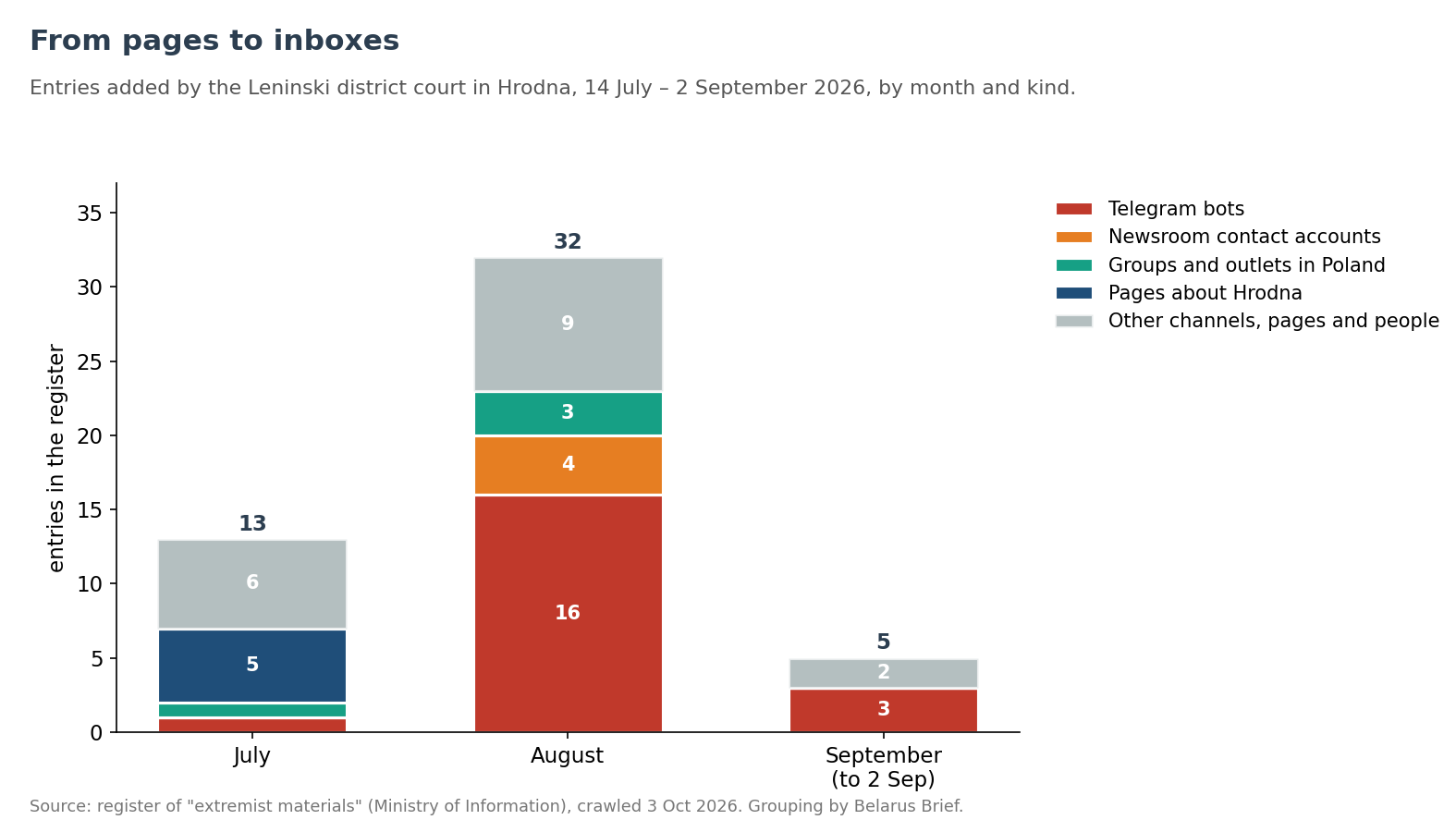
Between 14 July and 2 September 2026, the Leninski district court in Hrodna added 50 entries to the register of “extremist materials”, more than any other court in the quarter. In July it named mostly pages and channels; from August, mostly the bots and accounts that readers use to write to exile media. Twenty of the 25 Telegram bots in the whole register come from this one court. We do not know whether the change reflects one investigation feeding one court or a wider practice, because the register gives no reasons.
A busy summer in Hrodna
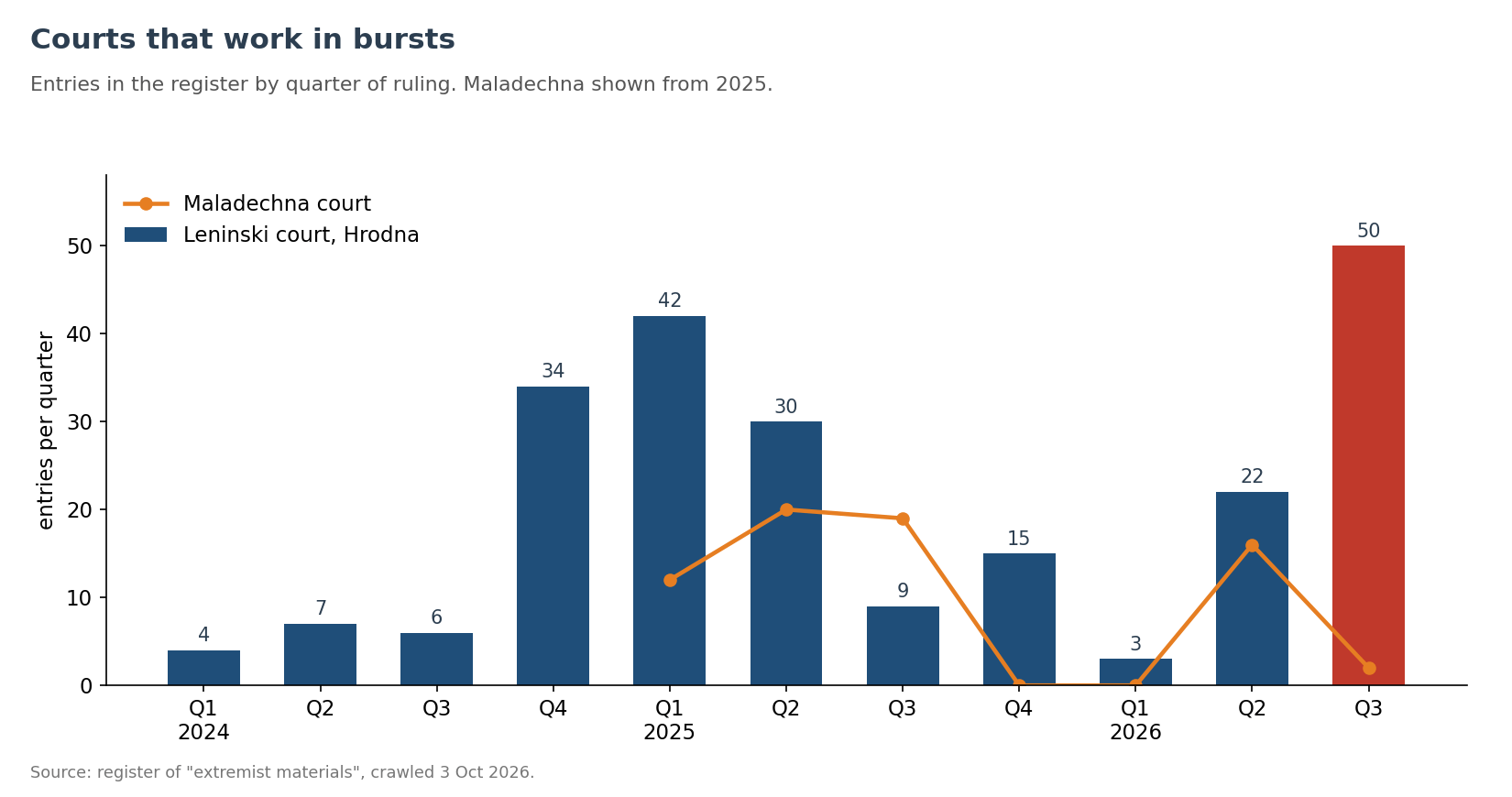
The court issued its 50 entries in 16 sittings, with two to five items each, and all of them were marked for immediate execution. Its record is uneven. It issued four to seven entries a quarter in early 2024 and 30 to 42 a quarter from late 2024 to mid-2025. Then came nine and 15 in the second half of 2025, three in the first quarter of this year, 22 in the second and now 50. The Maladechna court, which led our ranking of courts in August, works the same way. It issued 16 entries in the second quarter of 2026 and two in the third.
In July the rulings named content pages. Five of the 13 July entries were about Hrodna itself. They included the Harodnia civic initiative on Facebook, the harodnia.com channel on YouTube, the news site Hrodna.life on X and two Instagram pages about the city. The rest were Belarusian channels and pages, such as the YouTube channels “Dzieciuki” and “Hordyja Bielarusy”, a meme page and two personal pages. The Polish foundation Okno na Wschód was listed too, and on 30 July so was the bot of the Cyber Partisans.
Twenty of the 25 Telegram bots in the whole register come from this one court.
The turn to the inbox
From August the court’s attention moved. Of its 37 entries from 3 August to 2 September, 19 were Telegram bots and four were editorial contact accounts. Before 30 July the whole register held five bot entries, from four courts, the last of them in March 2025. Few of these are channels that people read. They are the addresses that people write to. Among them are the feedback bot of BelaMedia, the newsroom bot of Mediazona Belarus and the contact bots of Brest Gazeta and of Dissidentby, which helps political prisoners. There are also the editors’ accounts of Salidarnasts and of the railway workers’ community BelZhD. The list includes a bot for sending leaflets, a “black map of occupiers” bot and an information bot called “GULAG”. Two entries are advertising contacts, of NEXTA and of the sports portal Tribuna.
Several entries reach the Belarusian community in Poland. The court named the Polish Catholic weekly Gość Niedzielny and a channel for small adverts among Belarusians in Poznań. It also named a volunteer group in Poland and the anonymous admin bot of a Belarusian chat, apparently in Kraków. None of these is a Hrodna resource, and few of them publish news at all.
They are the addresses that people write to.
In “The Busiest Bench” we called the register the domestic leg of transnational repression, because it reaches nobody abroad and acts on the people who stayed. The Hrodna rulings make that concrete: they name the routes that residents use to reach newsrooms abroad. Belarusian law makes it an offence to distribute designated material. What a listing means for a bot that people only write to, the register does not say.
Horki, one entry at a time
The court in Horki, a town of about 30,000 in Mahiliou region, works differently. It issued 37 entries in 2026 across 31 sittings, almost always one item at a time, and 17 of them fell in the third quarter. In spring it named the Instagram accounts of international rights groups, among them FIDH, the Human Rights House Foundation and the Center for Civil Liberties. From July it turned to foreign news sites. It named JAM News on 10 July, the Polish news agency PAP on 28 July and the Ukrainian site Slovo i Dilo on 29 July, then Euronews on 4 August and the Estonian daily Postimees on 6 August. EUvsDisinfo, listed in the same week, came from a different court, the Leninski district court in Mahiliou.
What a listing means for a bot that people only write to, the register does not say.
Both courts point outward, but in different ways. Horki names foreign outlets and organisations one by one. Hrodna names the contact points of Belarusian exile media in small batches. The two lines meet in the register, which lists Postimees twice on the same day from Horki, and the BelaMedia bot twice, on 3 and 4 August, from Hrodna.
Two readings
The Hrodna turn may follow a single case. One seized phone or one subscription list can hold dozens of such contacts, and steady small batches over five weeks fit a file being worked through. It may also be a line of work that this court has taken on, as Horki took on foreign websites. The two readings predict different futures. A single case should end, as the Maladechna run did, while a practice should spread to other courts.
Horki names foreign outlets and organisations one by one.
How sure we are
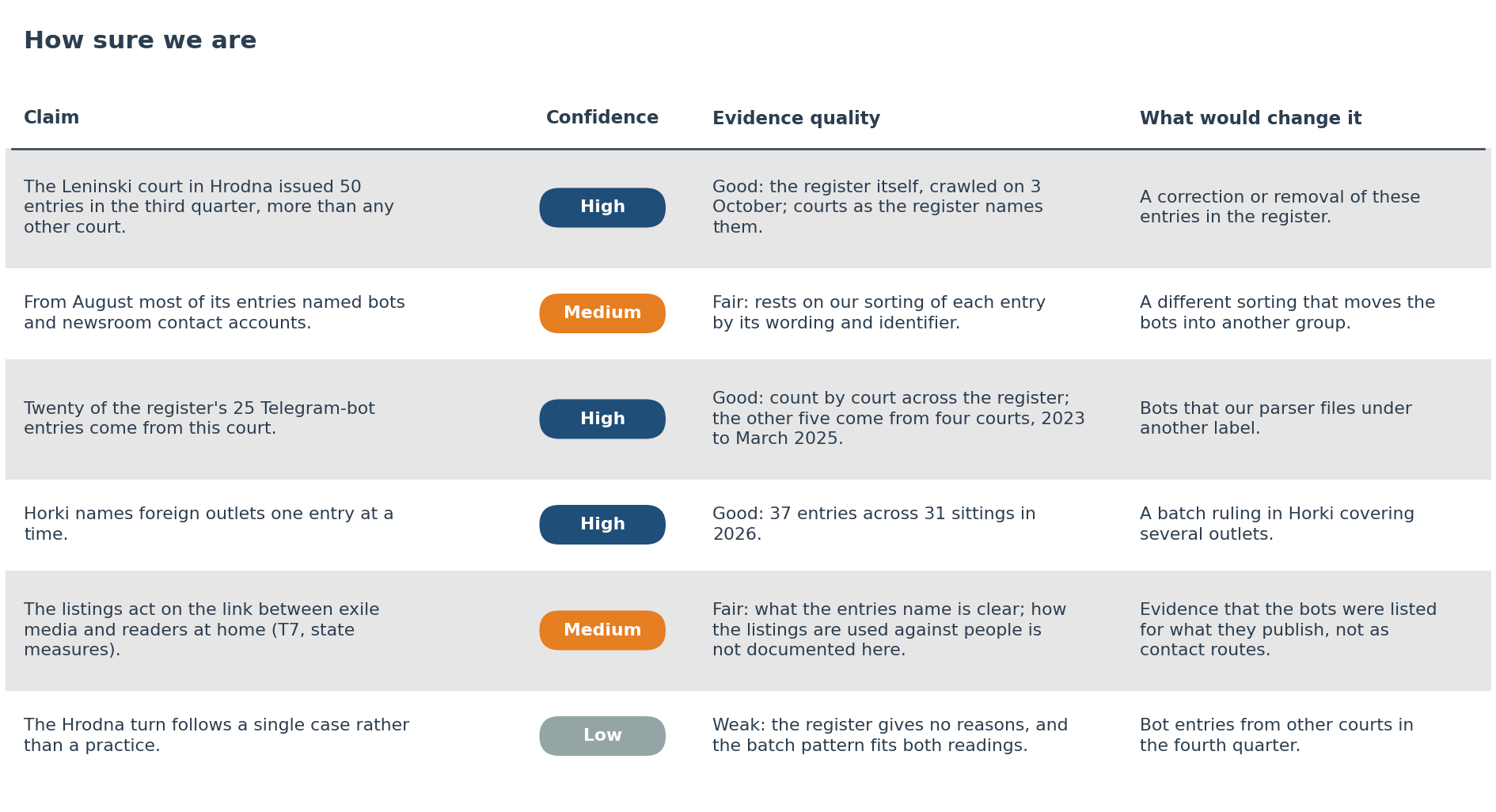
The counts rest on the register itself, crawled on 3 October. The Medium rows depend on how we sorted the entries and how we read them against T7. The Low row asks why the turn happened, which the register cannot show.
How it fits
How it fits. In five weeks one court listed 20 of the 25 Telegram bots in the register, most of them the inboxes of exile newsrooms. This is consistent with the second half of T7 as one more documented state measure on the link between the exile and those at home, beside the passport decree, but it says nothing about whether participation falls. The data do not rule out a single case file worked through one court rather than a practice. Bot entries from other courts in the fourth quarter would favour the practice reading, and their absence the single case.
What to watch
By 15 January 2027, courts other than the Leninski court in Hrodna issue fewer than five Telegram-bot entries in the fourth quarter. We expect the bot line to stay with one court.
By 15 January 2027, the Leninski court in Hrodna issues fewer than 20 entries in the fourth quarter. We expect its run to slow, as its runs did in 2025.
By 31 December 2026, the Horki court names at least one more foreign news website. We expect it to, since it named five in four weeks this summer.
Method and limits
The register of “extremist materials” was crawled in full on 3 October 2026 and parsed into one row per entry; entries from 2026 sit on its first pages and are complete. Courts are named as the register names them. We sorted the Hrodna entries into five groups by the wording of each entry and its identifier. The groups are Telegram bots, newsroom contact accounts, pages about Hrodna, groups and outlets in Poland, and other channels, pages or people. “Telegram bot” follows our parser’s label, which applies when the entry names a bot as its object. We do not name private individuals whose accounts were listed, and we do not link to any designated channel. The register gives the court, the date and the item, never the reasoning, so nothing here describes why a court acted. Thesis tag: T7, the half on state measures.