

The Belarusian register of extremist materials holds 5,952 entries issued by 159 district courts since September 2008. Every one of the country’s 118 raions (districts) appears in it, so the instrument has reached everywhere. It has also concentrated: five units account for 41% of all designations and twenty account for 77%. Divide the work by the number of courts sitting in each district and the ranking inverts — the busiest bench in Belarus is not in Minsk or any oblast capital but in Maladechna, a single court that has designated 236 items against a national median of twelve.
What the register is, as a countable object
Each entry names the material, the court, the date of the ruling and the date the ban took effect. Nothing in it names a person’s location, a case number or a plaintiff. What it does support is arithmetic about which courts do this work, and that has not been published before because the list is paginated across 596 pages and has no export.
Harvested in full on 17 August, it yields 5,952 unique positions, 159 courts, and a span from 4 September 2008 to 13 August 2026. Volumes before 2020 were negligible — 36 designations in 2016, 22 in 2019 — and the annual figure reached 1,462 in 2024. Since 2021 between 91 and 112 courts have been issuing designations every year.
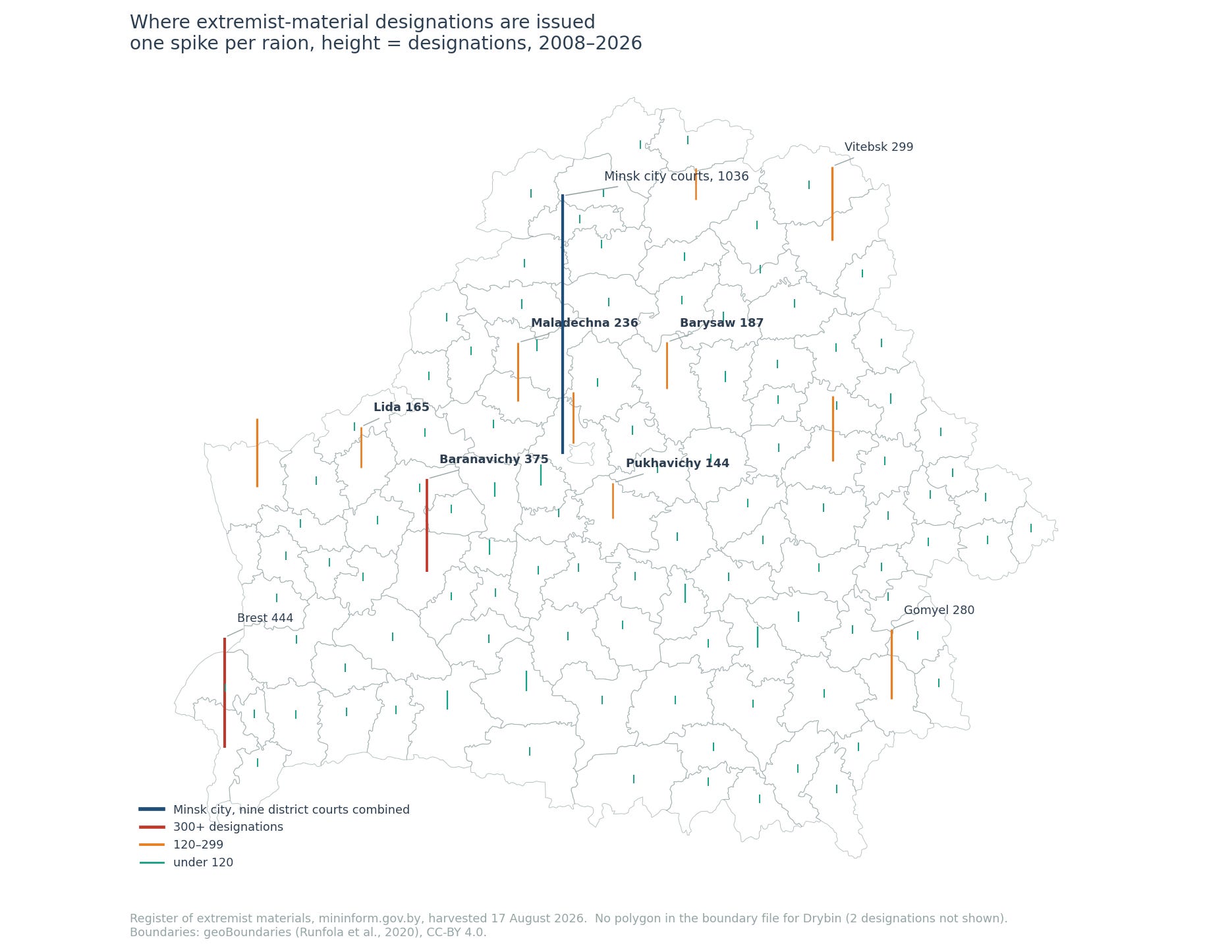
Where
]
The spikes follow neither the border nor administrative rank. There is no western concentration, no clustering along the Polish or Lithuanian frontier, and no orderly descent from capitals to towns. Minsk dominates, and behind it the second tier lands in places that population and status do not explain: Baranavichy at 375, Maladechna at 236, Pukhavichy at 144.
Regional shares are almost flat: Minsk region 21.8%, Brest 19.4%, Minsk city 17.4%, Viciebsk 12.4%, Homel 10.8%, Mahiliou 9.5%, Hrodna 8.8%. An oblast-level map of this would be seven gentle hills and would say nothing. The unevenness lives below that level.
Regional shares run from 21.8% down to 8.8%. At oblast level there is almost nothing to see; the unevenness is entirely beneath it.
How uneven
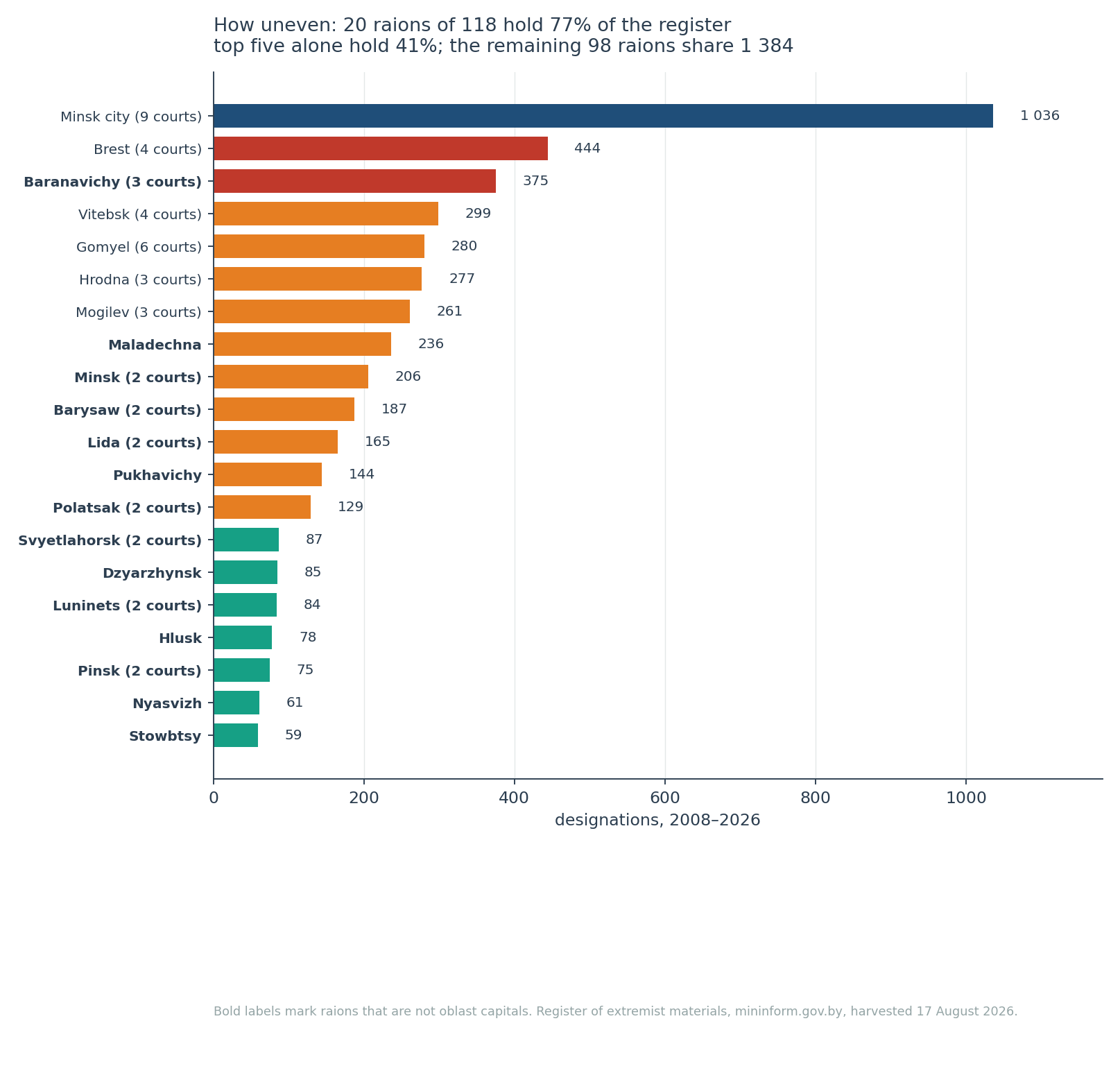
Minsk city holds 1,036 designations across nine district courts. Brest follows with 444 across four, Baranavichy 375 across three. The twenty busiest raions hold 77% of the register; the remaining 98 share 1,384 positions, an average of fourteen each.
That average is the point. The instrument is present in every raion of the country, and in most of them it is barely used. Presence and intensity are different properties, and a single national total conceals both.
Per bench
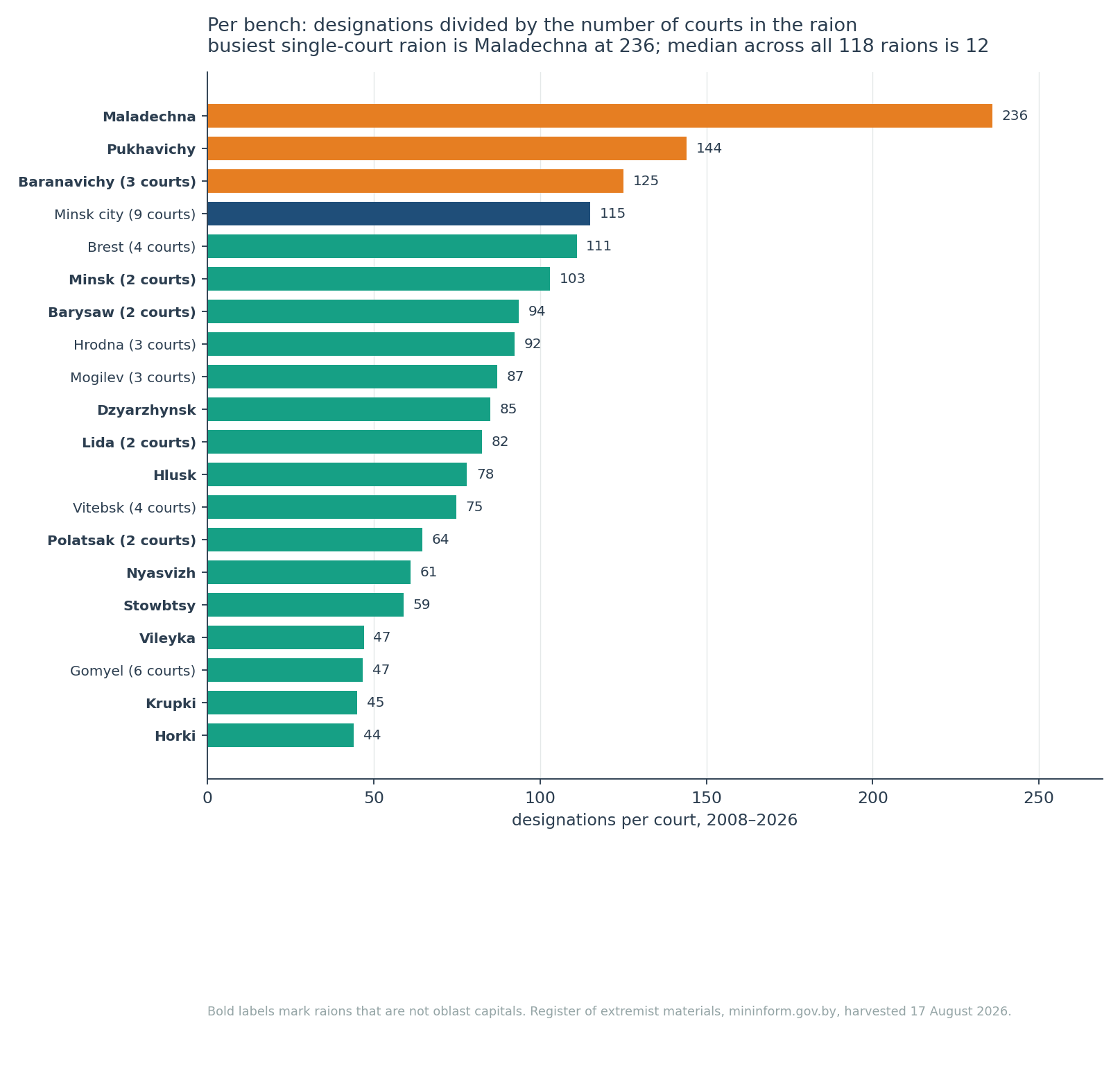
A raion (district) is not a comparable unit. Minsk city is nine courts, Homel six, Brest and Viciebsk four each, while Maladechna and Pukhavichy are one apiece. Dividing by the number of courts asks how much one bench produces, and the answer rearranges everything.
Maladechna’s single court leads the country at 236. Pukhavichy follows at 144, then Baranavichy at 125 per court and Minsk city at 115. The oblast capitals drop into mid-table: Brest 111, Hrodna 92, Mahiliou 87, Viciebsk 75, Homel 47. The median across all 118 raions is twelve.
Nine of the twenty busiest benches sit in Minsk region — Maladechna, Pukhavichy, Minsk raion, Barysaw, Dzyarzhynsk, Nyasvizh, Stowbtsy, Vileyka, Krupki. Neither population nor administrative weight accounts for that. Something about how this work is assigned, or who volunteers for it, is regional, and the register alone cannot say which.
One court in Maladechna has designated 236 items. The median raion has designated twelve.
Nine of the twenty busiest benches sit in Minsk region, and neither population nor administrative weight accounts for it.
The transnational leg
Sviatlana Tsikhanouskaya, asked by Rus.Postimees about her own outlet’s designation, described the practice as one of the simplest instruments the authorities use for what she classes as transnational repression, or TNR: declaring people, organisations and media extremist or terrorist formations in order to sever the ties between those who left and those who stayed.
The register carries partial evidence for the outward-facing half of that. Designations of foreign sites and resources come to 214 positions issued by 38 different courts, spread across every region. The Horki district court in Mahiliou region, a town of some thirty thousand, began this line of work only in January 2025 and between February and June 2026 designated the Instagram accounts of the International Society for Human Rights, the Human Rights House Foundation, FIDH, the Center for Civil Liberties, the Dignity Institute, the Lutskevich museum and the campaign Release: NOW.
What the register cannot show is who the designations are aimed at. It names accounts, sites and books, never locations or nationalities. So the defensible reading is narrower than the claim: the register is the domestic leg of TNR. It does not reach anyone abroad. It makes contact with exile media a punishable act inside the country, which means the tie is cut at the resident’s end, not the emigrant’s. Tsikhanouskaya’s account of the purpose stays hers; the mechanism is what the data shows.
We should also correct our own earlier reading. After a district court in Horki designated Euronews on 4 August and Postimees on 6 August, we treated that court as the venue for foreign-media designations. The full register refutes it: Horki holds 11 of the 214, sixth place behind Central Minsk at 50, Leninski Brest at 30 and Leninski Mahiliou at 25. Nothing is concentrated there. What actually happened is that we were reading coverage rather than the register, and coverage of the Postimees ruling arrived a week after the ruling itself.
The register reaches nobody abroad. It makes contact with exile media punishable inside the country, so the tie is cut at the resident’s end.
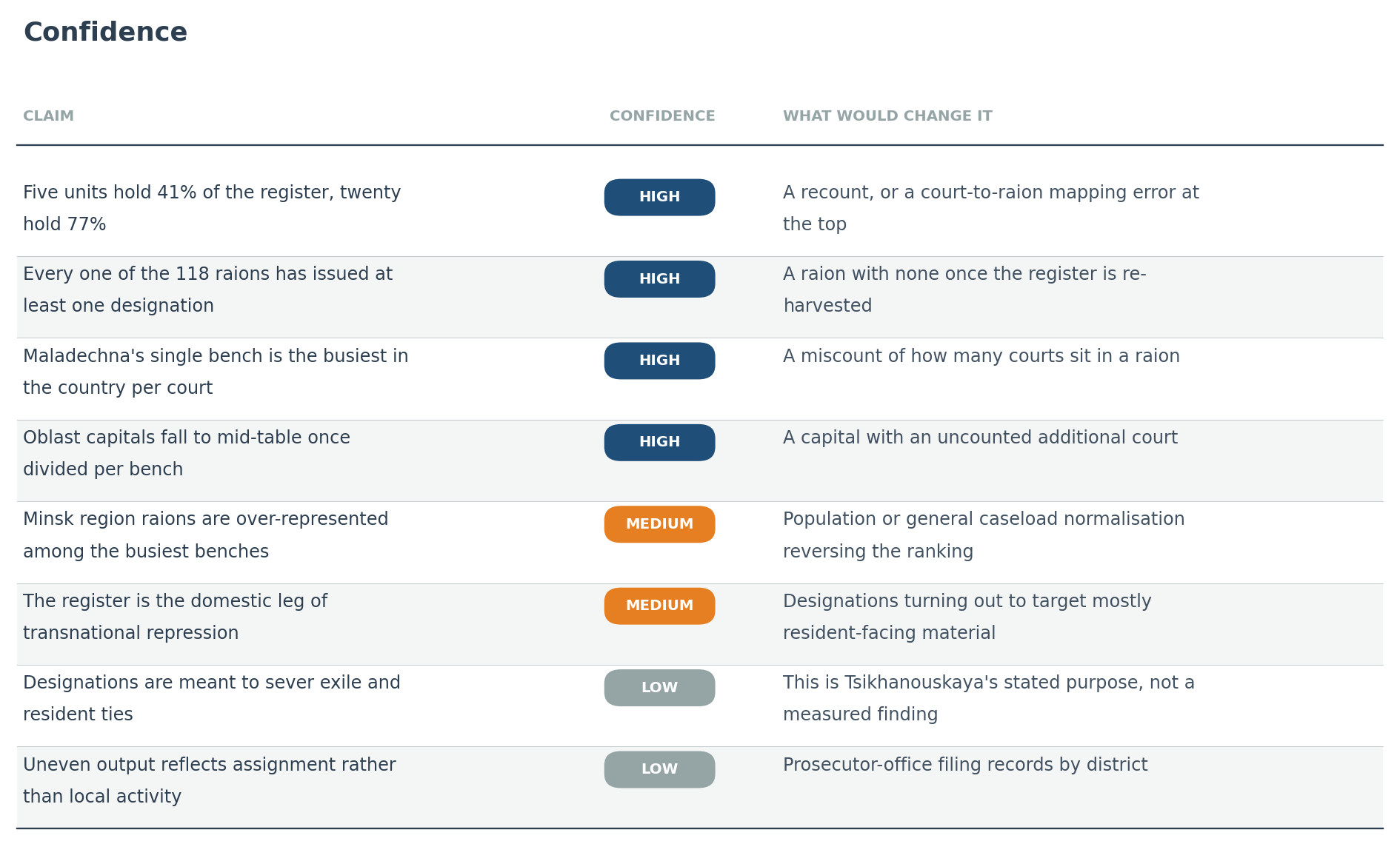
Confidence
Watch items
By 30 September 2026: whether Maladechna keeps its per-bench lead through the third quarter, or whether the 236 turns out to be a run that has ended.
By 31 October 2026: whether any new raion court enters the register for the first time, which would show the 118-raion coverage is still being deepened rather than merely maintained.
By 31 December 2026: whether the twenty-raion share moves off 77% in either direction — falling would mean the work is spreading, rising would mean it is consolidating.
At the next Horki ruling on an international organisation: whether the pattern of the past five months continues, and whether any other court takes up the same category.
Method and limits
All 596 pages of the Republican List of Extremist Materials were harvested from mininform.gov.by on 17 August 2026 and parsed into 5,952 unique entries. Court names in the register are inconsistent — the same court appears with and without a space after “г.”, with ё and with е, and the ministry’s own misspellings of two raion names sit in the data — so courts were matched to administrative units through an explicit table of 118 entries rather than by string similarity, and all 159 court names resolve.
Boundaries are geoBoundaries ADM2 (Runfola et al., 2020, CC-BY 4.0), which carries Minsk city as its own unit and has no unit for Drybin raion; Drybin’s two designations therefore appear in the counts but not on the map. Minsk city’s nine district courts are drawn as one spike, offset slightly from the surrounding raion so both remain visible.
Per-court figures divide a raion’s designations by the number of distinct courts appearing in the register for that raion. That is a count of benches that have done this work, not of benches that exist, so a court which has never issued a designation does not lower its raion’s average. Nothing here measures the number of judges, hearings or hours.