

A new study puts the number of Belarusians in Council of Europe states at about half a million. The figure counts passports and permits, and the permit count fell in 2024. Minsk’s commission for returns has reported 30 people back in nearly three years.
The People’s Embassies of Belarus and the Kaściuška Security Studies Institute published the study with support from KAS Belarus. They estimate that about 490,000 Belarusian citizens lived in Council of Europe states in 2024. The figure is a stock of residence permits and estimates. It is not a count of people who left after 2020, and the permit count peaked in 2023. The prosecutor’s commission for returns reported 323 applications and 30 returns by October 2025. What we cannot see is why about 60,000 permits disappeared from the EU count in 2024: return, onward migration, naturalisation or simple expiry.
What the half million counts
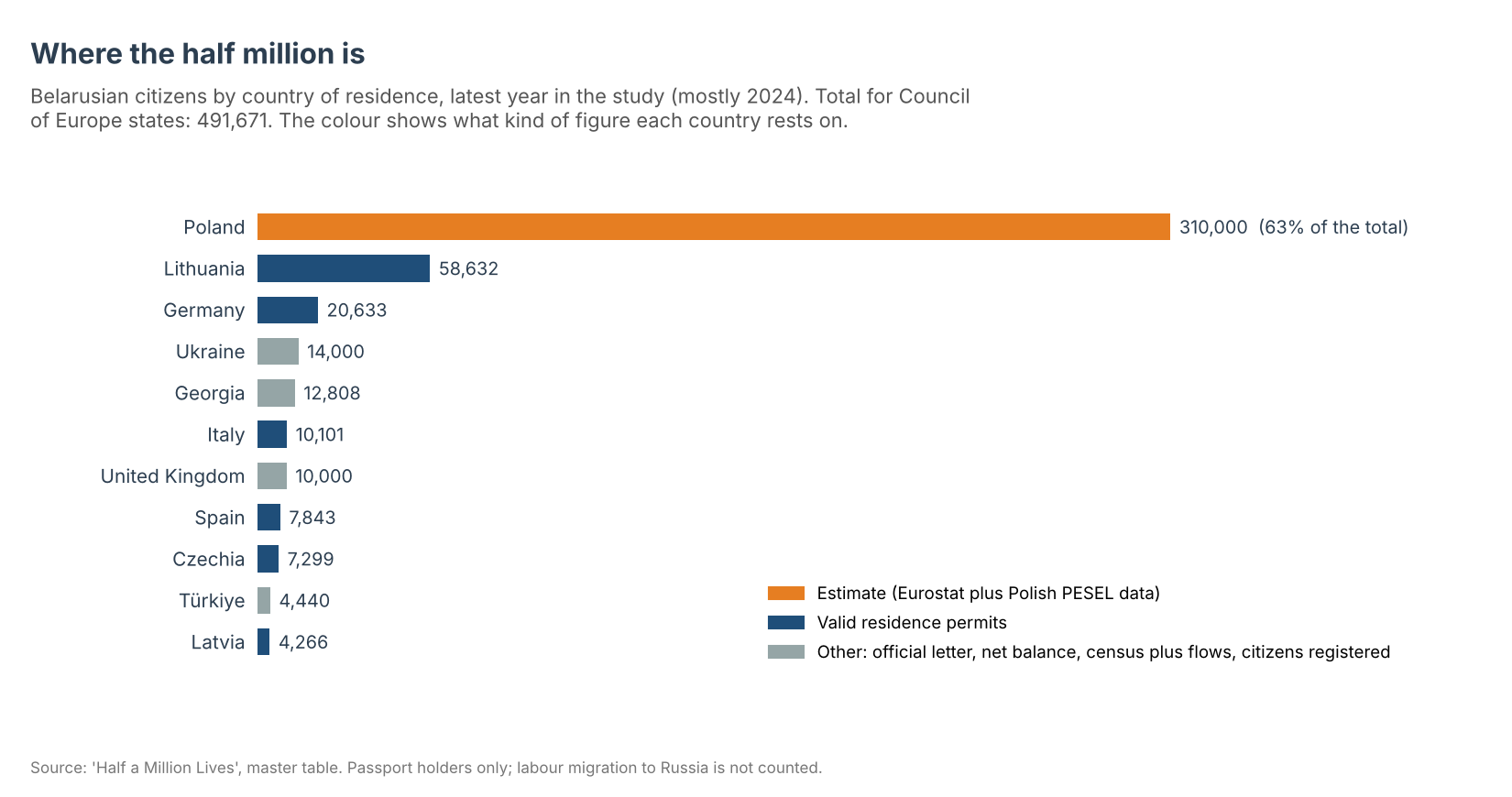
The study’s master table adds up to 491,671. The authors call it a rounded figure that “should not be regarded as an exact population count” (People’s Embassies of Belarus and Kaściuška Institute, KAS Belarus, 12 November 2026; PDF). Its base is 386,834 valid residence permits held by Belarusian citizens in the EU at the end of 2024. The authors adjust it with national data and add estimates for states outside the EU.
One country carries most of the total. Poland accounts for 310,000, or 63%, and that number is an estimate built from Eurostat and Polish population-register data. Lithuania follows with 58,632 permits and Germany with 20,633. Ukraine’s 14,000 comes from an official letter, and Georgia’s 12,808 is a net balance of arrivals and departures. The study counts passport holders only and leaves out labour migration to Russia.
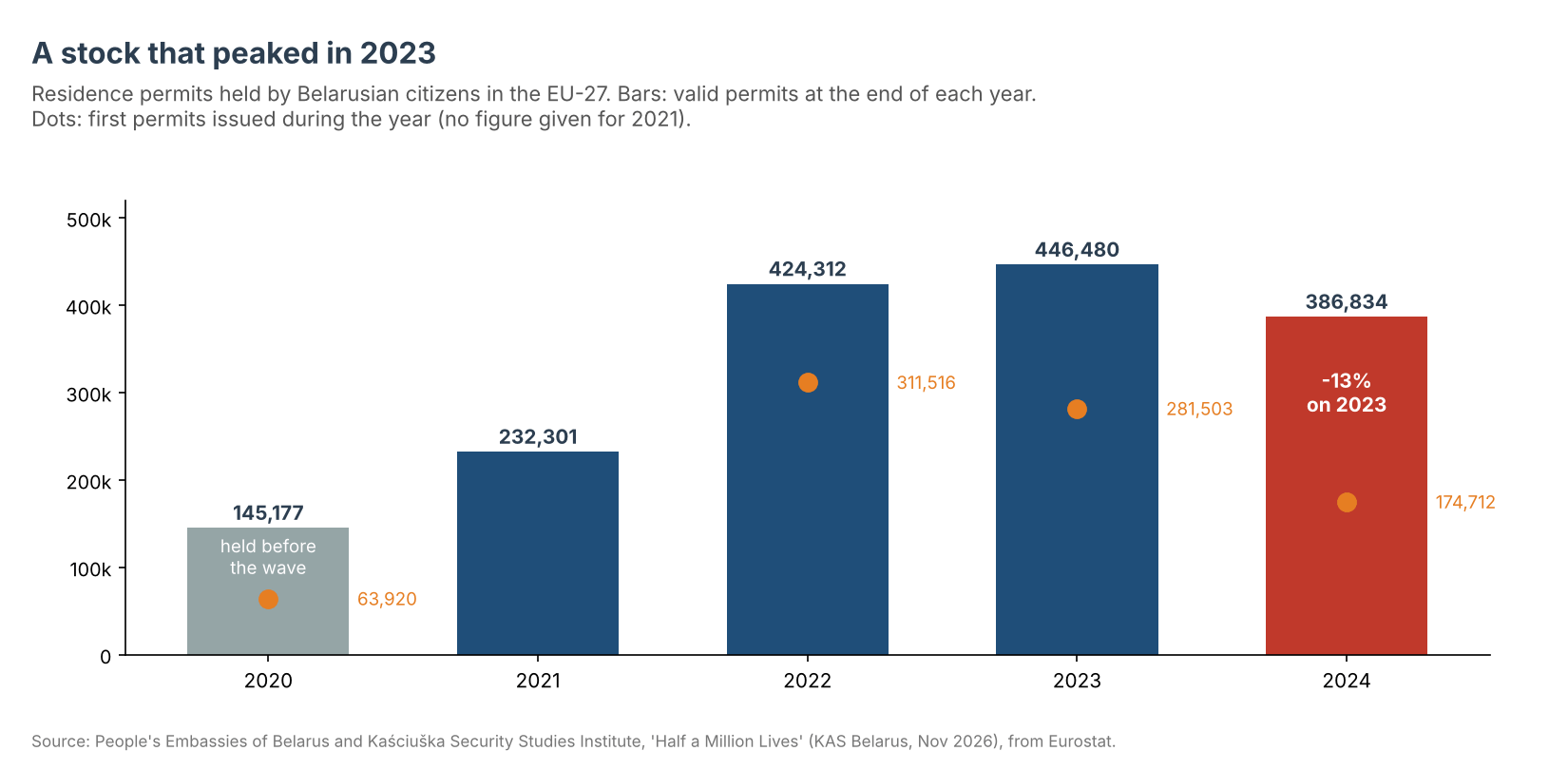
The time series matters more than the total. About 145,000 Belarusians already held EU permits in 2020, before the wave. The stock rose to 424,312 in 2022 and 446,480 in 2023, then fell to 386,834 in 2024, a drop of 13%. First permits peaked at 311,516 in 2022 and were down to 174,712 in 2024. The authors themselves warn that permit data alone cannot show permanent settlement.
Who puts a number on it
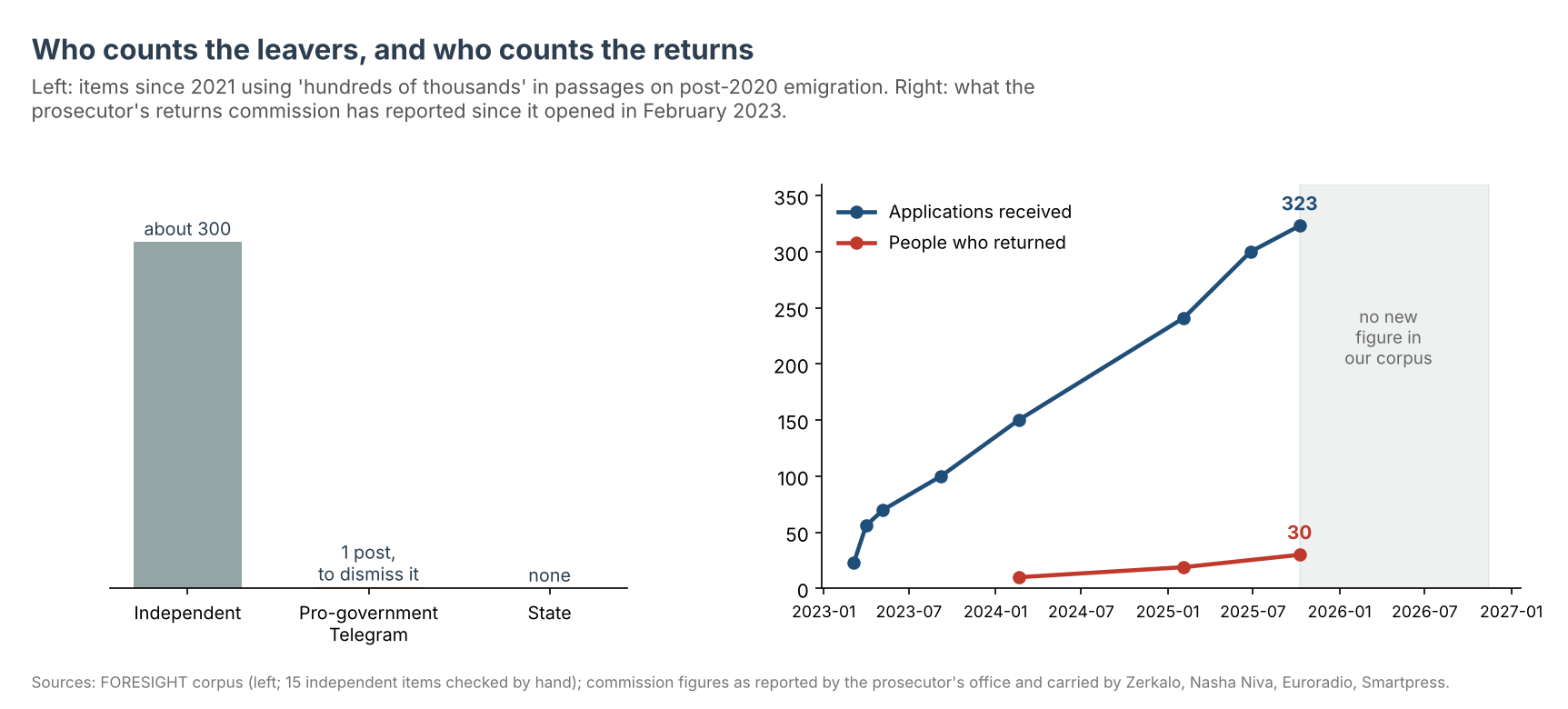
Since 2021 about 300 items in independent outlets have used “hundreds of thousands” in passages on the post-2020 emigration. In a hand check of 15, twelve applied it to the number who left, and three to everyone touched by repression, forced emigration included. State outlets never used it that way. The two state items in our corpus that use the phrase in an emigration context are about Cuba and Chile.
About 145,000 Belarusians already held EU permits in 2020, before the wave.
Pro-government Telegram used it once, to dismiss it. A post copied across four channels on 28 March 2023 put the figure in the mouths of opposition “experts”, in scare quotes. They “kept insisting”, it said, that hundreds of thousands, “almost millions”, of the brightest minds had left (Zheltye Slivy, 28 March 2023). In August 2021 Lukashenko had used the round figure for people inside the country. Asked whether opponents who had left could come back, he said that “half a million living in Belarus” certainly disagreed with his policy (BelTA, 9 August 2021).
State outlets never used it that way.
The commission’s count
The state side does count one thing: returns. The prosecutor’s commission for people who left opened on 6 February 2023. By 6 March it had 23 applications (Zerkalo, 6 March 2023), by 1 April 56 (Zerkalo, 1 April 2023), and by September more than 100 (Smartpress, 7 September 2023). In July 2023 the Cyber Partisans said only 16 people had sent documents (Zerkalo, 17 July 2023).
Set against the study’s total, 30 returns are 0.006% of the stock.
The figures kept growing slowly. In February 2024 the prosecutor general reported 150 applications for 2023, and about ten people had come back (Euroradio, 19 February 2024; Nasha Niva, 19 February 2024). A year later it was 241 applications and 19 returns (Nasha Niva, 4 February 2025). The last figure we found is from October 2025: 323 applications, 70 examined on their merits and 30 people returned (Euroradio, 9 October 2025). Our corpus holds no newer one.
Set against the study’s total, 30 returns are 0.006% of the stock. The 323 applications are 0.07%. They explain almost none of the 60,000 permits that left the EU count in 2024. Returning also carries a risk the commission does not remove. Viasna counted at least 58 people detained on return in 2022 (Viasna, 7 February 2023). In June 2025 a court convicted a former political prisoner who had applied to the commission (Zerkalo, 12 June 2025).
The state side does count one thing: returns.
How sure we are
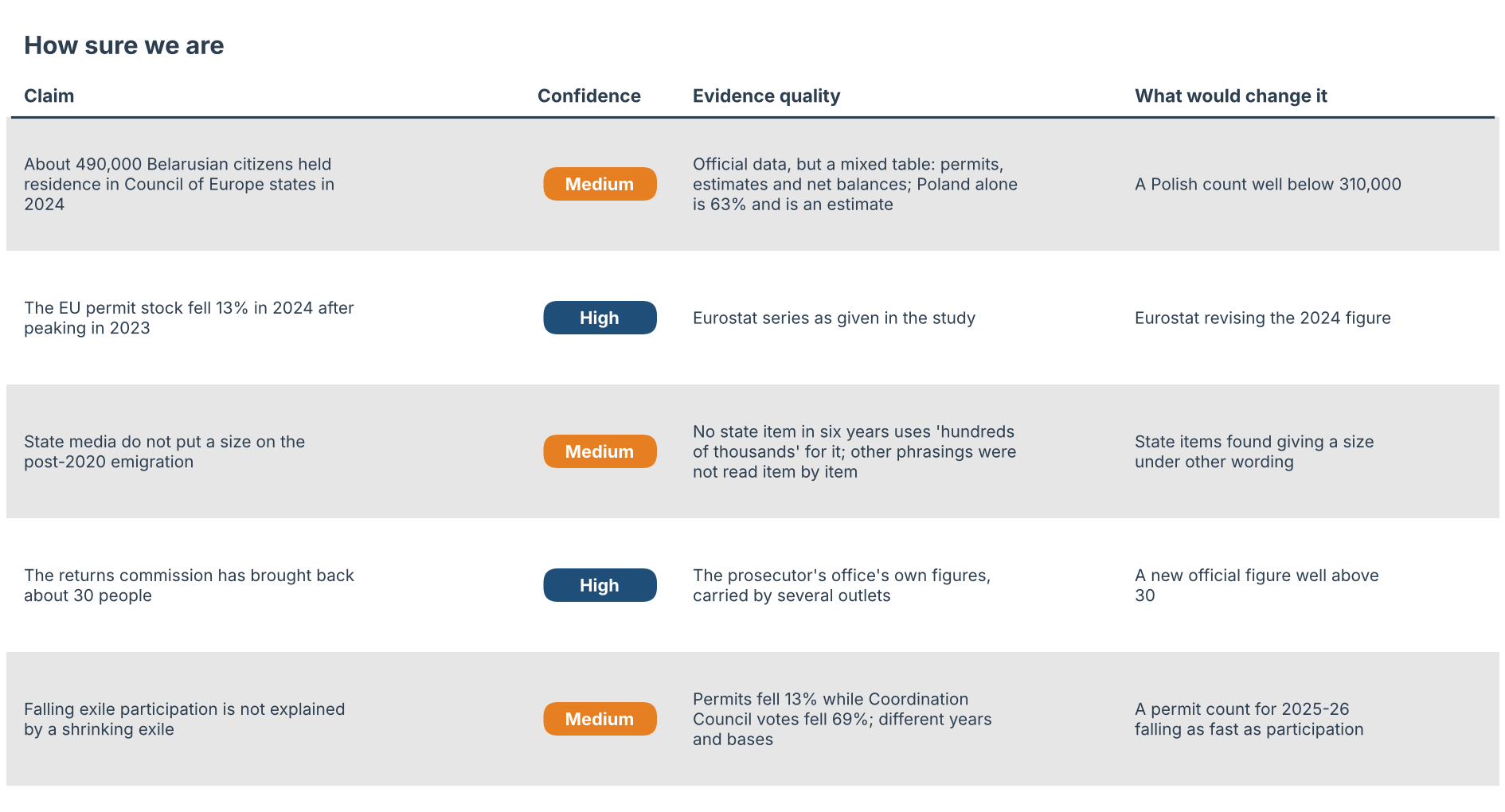
About 490,000 Belarusian citizens held residence in Council of Europe states in 2024. Medium. The data are official, but the table mixes permits, estimates and net balances, and Poland alone is 63% of it as an estimate. A Polish count well below 310,000 would change it.
The EU permit stock fell 13% in 2024 after peaking in 2023. High. It is the Eurostat series as given in the study. A Eurostat revision of the 2024 figure would change it.
State media do not put a size on the post-2020 emigration. Medium. No state item in six years uses “hundreds of thousands” for it, but other phrasings were not read item by item. State items that give a size in other words would change it.
The returns commission has brought back about 30 people. High. These are the prosecutor’s office’s own figures, carried by several outlets. A new official figure well above 30 would change it.
Falling exile participation is not explained by a shrinking exile. Medium. Permits fell 13% while Coordination Council votes fell by more than two thirds, over different years and on different bases. A permit count for 2025 and 2026 that falls as fast as participation would change it.
How it fits
This bears on T7, that exile participation is falling while the causal link to state measures is unproven. Votes in the Coordination Council elections fell from 6,723 in May 2024 to 2,113 in May 2026, as we wrote in “Both Cats, No Grin”. One alternative explanation is that the exile itself shrank. The permit series lets us size that: a 13% drop in the stock cannot account for a fall of more than two thirds in votes. The shrinking stock is real, though, and every per-capita measure of exile life should now be based on a smaller number than half a million. If the 2025 permit count falls much further, the alternative gains weight.
What to watch
By 30 June 2027. Eurostat’s count of valid EU permits held by Belarusians at the end of 2025. Expectation: below 386,834. Confidence: medium.
By 31 March 2027. A new official figure from the commission for returns. Expectation: fewer than 50 people returned in total. Confidence: medium.
By 31 December 2026. A state outlet gives its own estimate of how many people left after 2020. Expectation: none does. Confidence: medium.
Method and limits
Country figures and the permit series come from the study’s tables. Emigration-size phrases were searched in the FORESIGHT corpus from 2021, with the CTV website left out, within 80 characters of a word for leaving, and kept only when Belarus was named nearby. Fifteen independent items were checked by hand; the state and pro-government items were all read. Commission figures are the prosecutor’s office’s own, as carried by the outlets linked above. The study gives no figures on returns or naturalisation, and its 2022 figure for Georgia differs between the text and the annex.
Thesis tag: T7.