
On 17 September Belarus marked the Day of People’s Unity for the sixth time, and a university rector told SB that it now stands in one row with Independence Day and Victory Day. We tested that against six years of state coverage. It was true in 2021, the first year, and has become less true every year since. What we cannot yet say is whether the video channels, which we have not collected for September, tell the same story.
The claim, counted
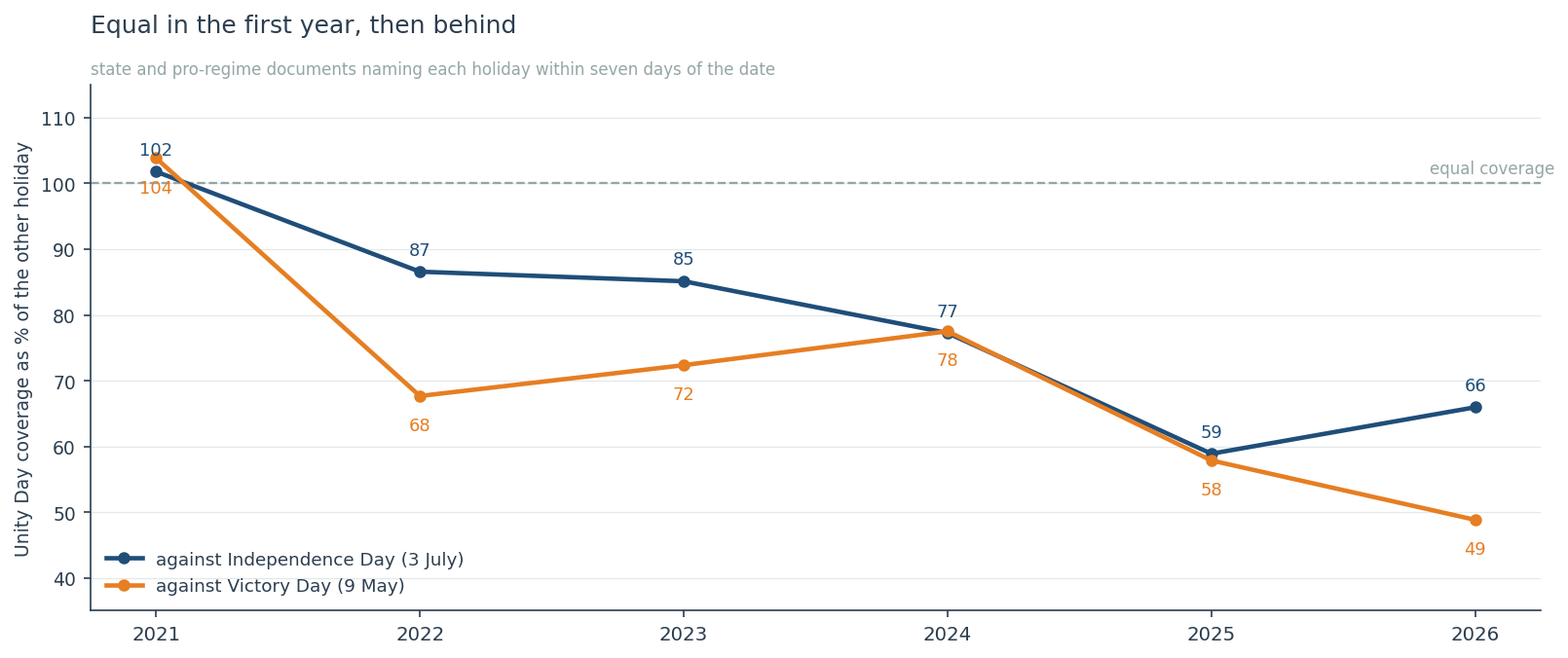
We counted state and pro-regime documents that name each holiday in the headline or the first lines, within seven days of the date.
In 2021 the three were level: 566 documents for Unity Day, 556 for Independence Day, 545 for Victory Day. From the second year the new holiday fell behind. Against Independence Day it ran at 87% of the coverage in 2022, 85% in 2023, 77% in 2024, 59% in 2025 and 66% this year. Against Victory Day it fell to 49% this year.
These are ratios inside a single year, so they do not depend on how much our collection has grown. In absolute terms the holiday peaked in 2023, at 984 documents, and this year’s 707 is the lowest since 2022.
Independent outlets largely ignore the date: between 17 and 64 documents a year. Yesterday we looked at how the same state media treated a drone from Belarus over Lithuania; this piece looks at how they treat Poland.
In 2021 the three holidays were level. They have not been level since.
The other explanation
The ratios could fall for a reason that has nothing to do with Unity Day. The holidays it is measured against had large anniversaries: 2024 marked eighty years since the liberation of Belarus, which Independence Day commemorates, and 2025 marked eighty years since the end of the war. Jubilee years inflate coverage, and a flat Unity Day would look smaller beside them.
That is part of the picture, but not all of it. Unity Day’s own count also fell, from 984 documents in 2023 to 707 this year, while our archive grew over the same period. The holiday shrank on its own terms, and the anniversaries widened a gap that was already opening.
What the holiday says
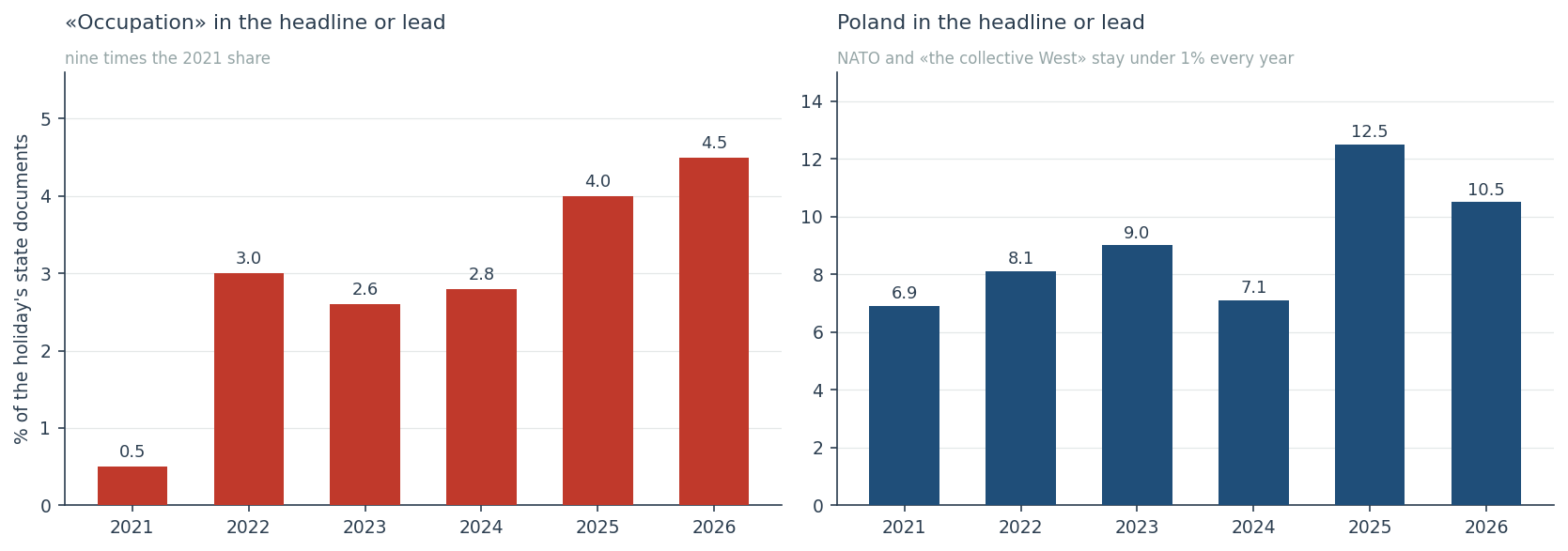
The volume has not grown. The content has changed.
In 2021, 0.5% of the state documents about the holiday used the word “occupation” in the headline or lead. This year it was 4.5%, nine times more. Poland appeared in 6.9% in the first year and in 10.5–12.5% over the past two. “Reunification”, the word the date is officially about, stayed near 6% for three years and jumped to 16.3% this year. That jump came mostly from the top. Of the 81 state documents using the word this year, about fifty were copies of the president’s own greeting and speech, each reposted by up to ten channels. The word spread because he used it, not because newsrooms changed how they write about the date.
What does not appear is the wider West. NATO and “the collective West” stay under 1% in every year. The holiday is built against one neighbour, and more so each year.
The 17 September date marks the Soviet entry into eastern Poland in 1939, which Minsk presents as the reunification of western and eastern Belarus. In state usage, “occupation” refers to the Polish period before it, not the Soviet one after.
The holiday is built against one neighbour, and more so each year.
Who takes part
This year’s state coverage came from the expected places: SB with 159 documents, BelTA with 120, the television channels CTV and ONT and their Telegram accounts. It also came from places that rarely write about history. The Telegram channels of the ministries of health, industry, communications and education posted about the holiday, as did the State Border Committee, the upper house of parliament and the Belaya Rus party.
Almost none of this is copying. SB’s 159 documents carry 159 different headlines. Each body wrote its own text, which is what an instruction to mark the day looks like when it reaches every part of the state.
The same pattern shows in the logos. State media accounts on TikTok and elsewhere changed their avatars for 17 September, as they do for Independence Day and for Victory Day, when the Belarusian symbol is an apple blossom. In ceremony, the new holiday has been made equal to the other two. In attention, it has not.
Each body wrote its own text, down to the health ministry.
Confidence
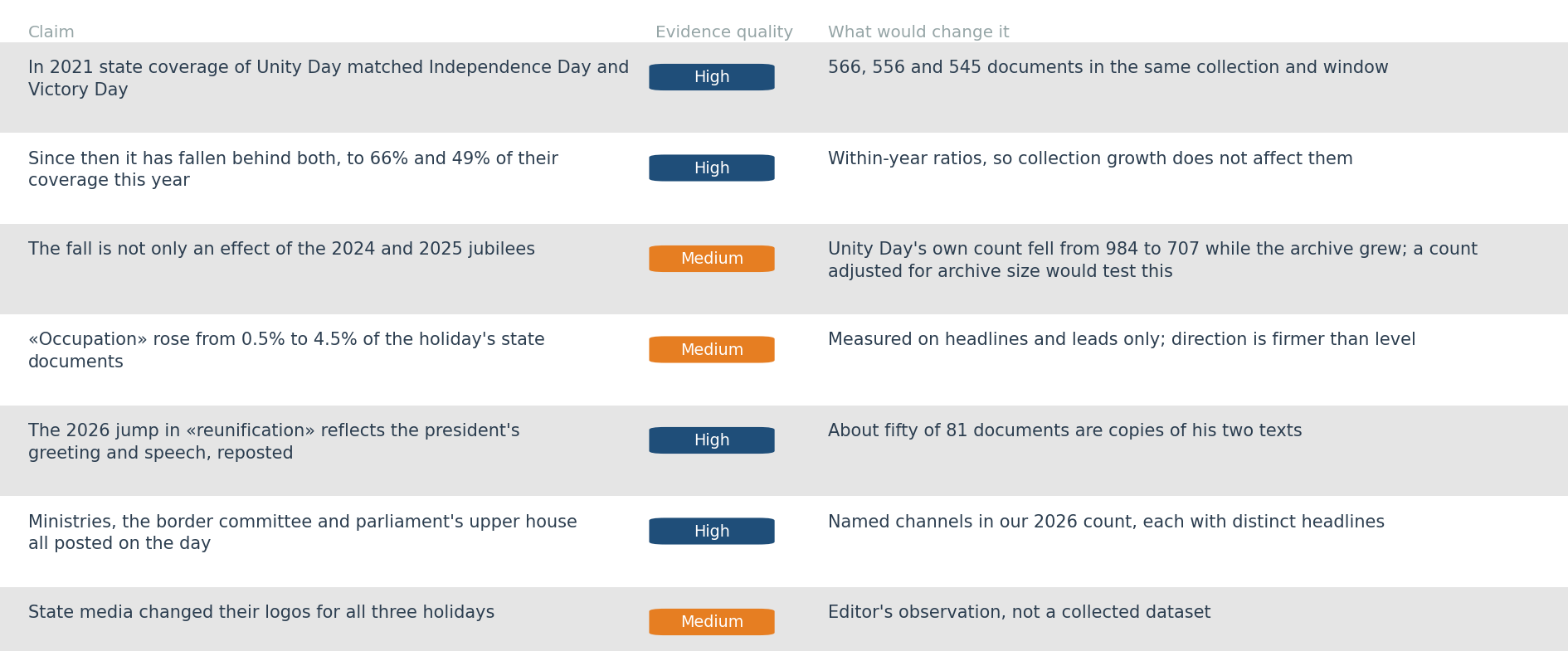
In text: the counts and ratios come straight from our corpus, and the within-year comparison is robust to collection growth, so the evidence for the ranking is strong. The shift in content is measured on headlines and leads only, which is solid for direction but not for exact levels. The jump in “reunification” this year is mostly the president’s own text, reposted, and we say so.
Watch
Our September video and TikTok collection, once complete. If video coverage of 17 September holds level with 3 July and 9 May, the gap is a text-media effect rather than a change in the holiday’s rank.
Whether “reunification” stays high in 2027 without a presidential text to carry it.
The share of “occupation” in 2027. A seventh year above 4% would make the shift durable.
Whether any state source stops describing the day as equal in rank to Independence Day and Victory Day.
Method and limits
We counted documents from state media, state-affiliated channels, ministry and pro-regime Telegram channels that name the holiday in the headline or first 600 characters, within seven days either side of the date, for 2021 to 2026. Searching only the opening avoids navigation blocks that some sites store inside article text.
Document counts measure recorded coverage in our archive, not public attention or the size of events. The ratios compare holidays within the same year and the same collection, which is why we rely on them rather than on raw totals.
The content shares use a smaller vocabulary and a slightly wider match on the holiday’s name, so their base differs from the ranking counts. They show direction; they do not give precise levels.
The logo changes are the editor’s observation, not a collected dataset. Video and TikTok for September are not yet in our archive, and this piece rests on text alone.