

BIPART, a Belarusian public-administration think tank working in exile, has published a study by Andrei Sushko on artificial intelligence in the country’s state apparatus. We reviewed a BIPART product once before, in “Two Ledgers” . This study is broader, and its argument is simple. The technical base for state AI in Belarus is already built. The rules that should govern it are missing.
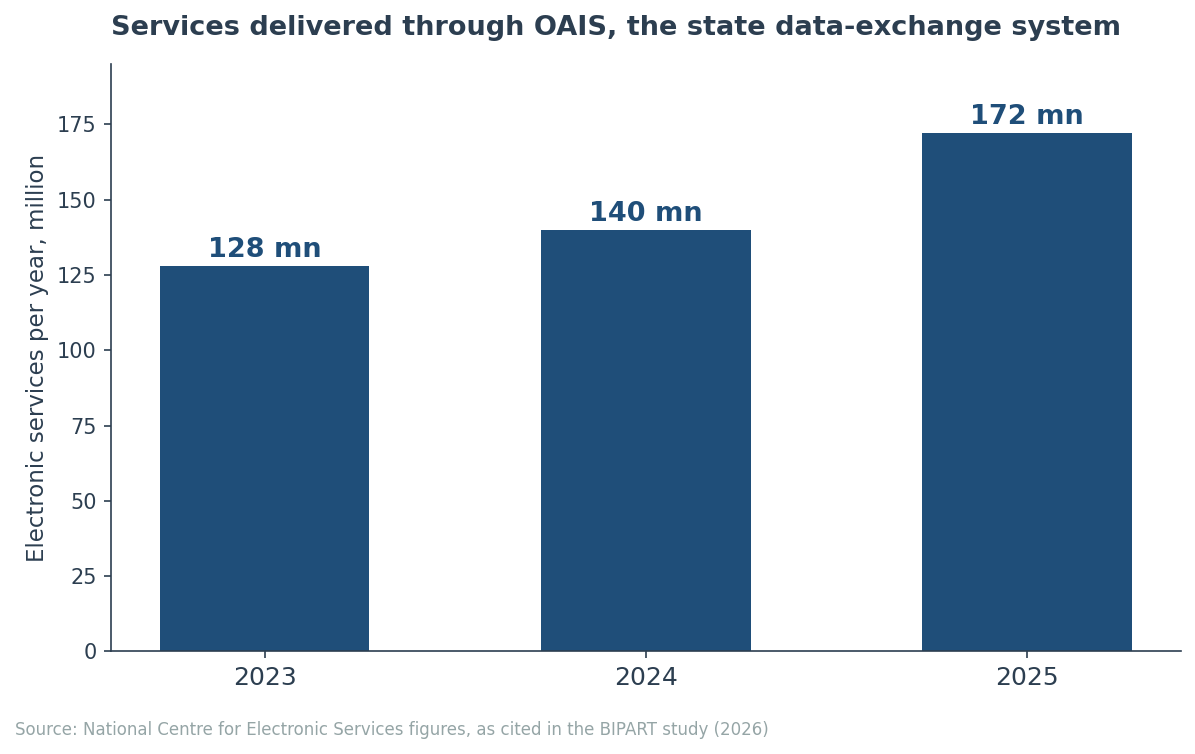
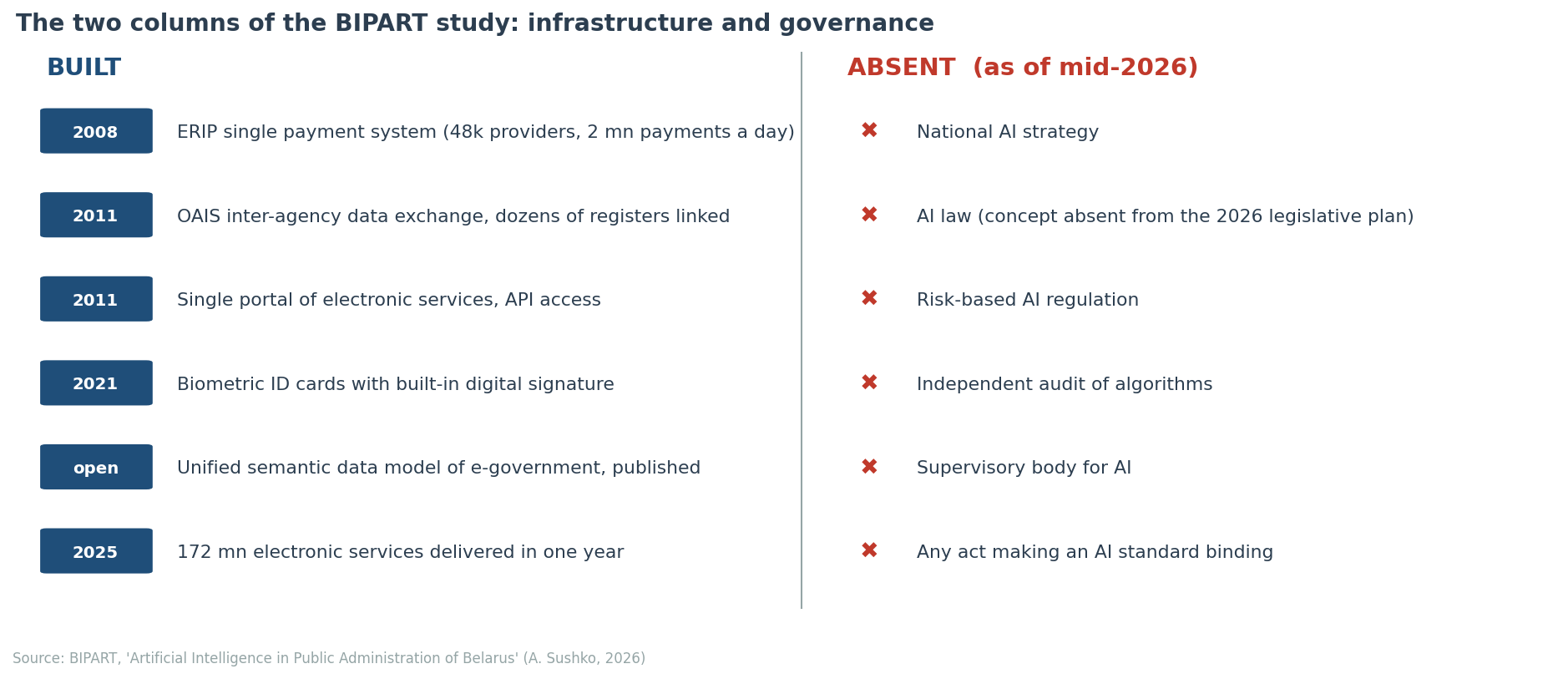
The built side comes with numbers. ERIP, the single payment system, has run since 2008. It now connects about 48,000 service providers and 82,000 services, and it handles over two million payments a day. OAIS, the inter-agency data system, has run since 2011. It links dozens of state registers: population, tax, customs, migration, law enforcement. Services delivered through it grew from 128 million in 2023 to 140 million in 2024, and to 172 million in 2025. Biometric ID cards arrived on 1 September 2021. The semantic model that describes all these registers, and the links between them, is published openly on the state e-services portal. About 94 percent of the population is online.
The other column of the study is a list of things that do not exist. Belarus has no national AI strategy and no AI law. There is no risk-based regulation and no independent audit of algorithms. Belarus has named no supervisory body for AI. A working group at the Academy of Sciences appeared in 2025, and officials promised that drafting of a law concept would start in 2026. The study found no trace of that work in public sources. The 2026 legislative plan does not mention it. Technical standards for AI exist, but they apply on a voluntary basis by default.
The technical base for state AI in Belarus is already built. The rules that should govern it are missing.
The authors searched for any normative act that makes an AI standard binding in Belarus. They found none. That single negative result carries most of the study’s weight, and it is dated: the check stands “as of 2026”.
The 2026–2030 state digital programme is the first one to treat AI as a separate track. It sets one target: 15 percent of state organisations should use AI by 2030. The programme gives no baseline and never defines what counts as using AI. Two planned systems stand out from the list, and the programme assigns both to the KGB. One is “automated intelligent processing of special-purpose unstructured data”. The other is “information processing with the use of AI for the purposes of information-technical and psychological counteraction”. The same programme calls for language-model services that run “without recourse to foreign servers”.
Two planned systems stand out from the list, and the programme assigns both to the KGB.
Documented practice is much thinner than the plans. The one well-documented case remains Kipod, the video platform built by Synesis. The EU Council’s sanctions decision describes search across video with face and licence-plate recognition, supplied to state bodies including the KGB and the interior ministry. A Mediazona Belarus investigation reported its use on 2020 protest footage. The study’s section on social rating, profiling of citizens and predictive policing is scenario work built on the register map, and the author says so himself. The distinction matters when the report gets quoted. A capability described twice starts reading like a practice.
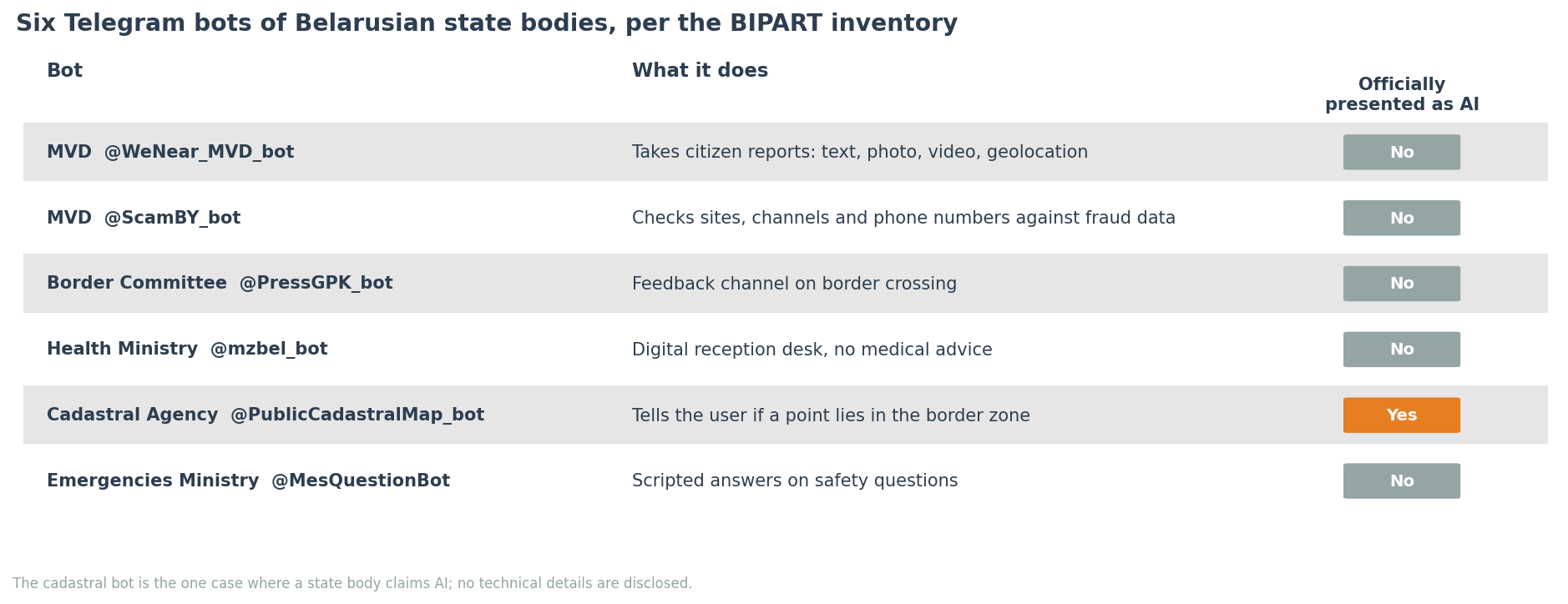
The bot inventory is the study’s most concrete new material. Six Telegram bots of state bodies are examined one by one. The interior ministry takes citizen reports and checks scam links. The border committee and the health ministry run reception desks. The emergencies ministry answers from a script. One bot, the cadastral agency’s border-zone checker, is officially presented as an AI product, with no technical details disclosed. Nothing in the set looks like a working generative assistant. Those exist only in programme text.
The authors searched for any normative act that makes an AI standard binding in Belarus. They found none.
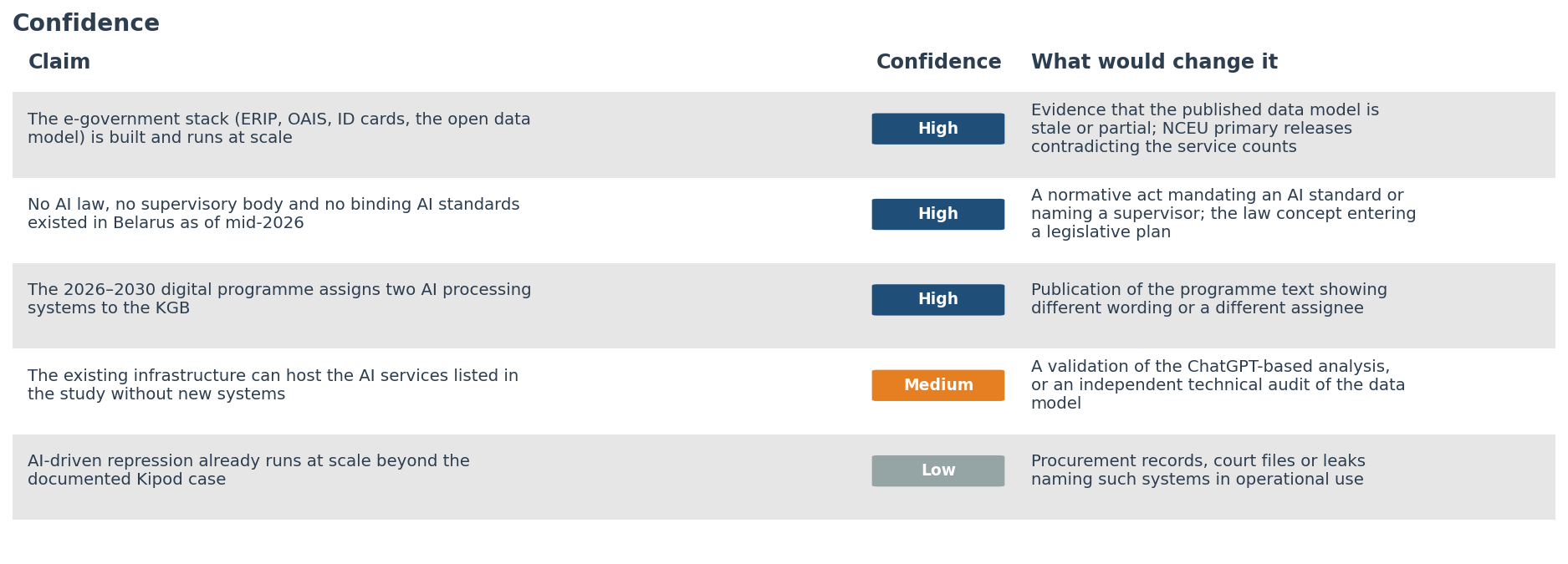
One flag on the study’s own method. The semantic data model was analysed with ChatGPT, which “formed hypotheses” about where AI could be applied. A later section describes the same exercise as “machine learning methods”. The appendix that lists possible AI services is written in the conditional mood throughout. The register mapping is solid; the feasibility claims rest on an unvalidated model run, in a paper that calls for algorithm audits. A second gap: the CIS model law of 2025 is covered, and Russia is absent from the governance analysis. Russia is the most likely template for Belarusian AI regulation, and the most likely supplier of the tools. The sanctions section says Western cooperation is closed, and does not ask what fills that space from the east. Kipod already answered part of that question: the platform that identified protesters needed no Western partner.
The feasibility claims rest on an unvalidated model run, in a paper that calls for algorithm audits.
What to watch
By 28 February 2027. The concept of an AI law appears in the 2027 legislative-activity plan. The Academy of Sciences promised drafting for 2026, and the 2026 plan omitted it. A second omission would date that promise as rhetoric.
By 30 June 2027. A procurement notice, a budget line or a vendor statement ties a named contractor to either of the two KGB systems from the 2026–2030 programme. Absence keeps both systems in the declared column.
By 31 December 2026. The unified semantic data model remains openly accessible on the e-services portal. This study shows outsiders what the model is good for. Its removal after publication would be a dated, observable reaction.
Method and limits. This brief rests on one document: the BIPART study “Artificial Intelligence in Public Administration of Belarus” (Andrei Sushko, 32 pp., 2026), read against the programme texts and sanctions decisions it cites. No corpus query stands behind today’s counts; the service and payment figures are the study’s own, sourced to the National Centre for Electronic Services, and we did not verify them against primary releases. The bot descriptions come from the study’s inspection of user interfaces, which cannot see the software behind them. We quote the KGB assignments from the programme text as the study renders them.