

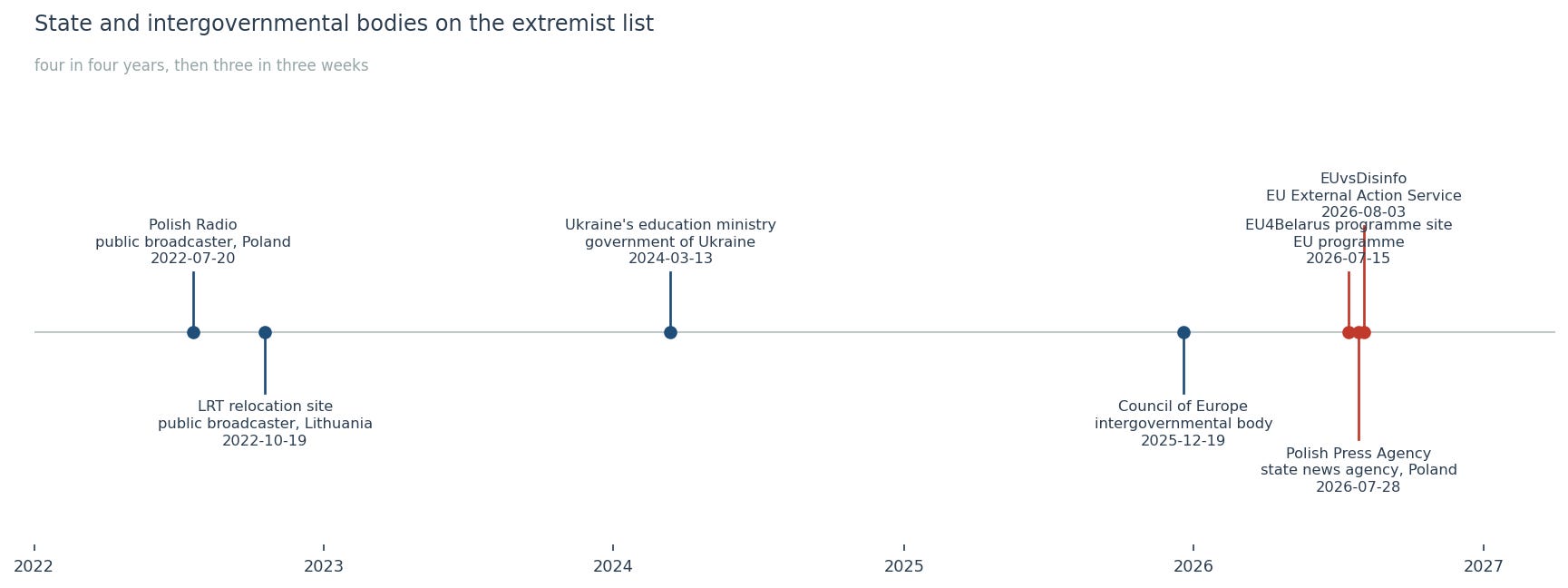
On 15 July a Belarusian court declared two websites extremist: the EU4Belarus programmes and the Central Project Management Agency of Lithuania, the state body that administers them. On 28 July another did the same to the Polish Press Agency, Poland’s state news agency. On 3 August a third designated EUvsDisinfo, a project of the European Union’s own diplomatic service. Before this summer, the register had reached that class of target four times in four years. It reached it three times in three weeks.
A new kind of target
The register has listed foreign websites for years. Almost all of them were Belarusian: exile newsrooms, human rights groups, campaigns run by people who left. Bodies belonging to other states were rare.
There were four of them: Polish Radio in July 2022, a Lithuanian public broadcaster’s relocation site three months later, the website of Ukraine’s education ministry in March 2024, and the Council of Europe in December 2025.
Then came this summer, and the EU4Belarus programme site, the Polish Press Agency and EUvsDisinfo were all listed inside three weeks. Around them sits a wider shift. Foreign websites that are not Belarusian exile projects were designated five times in 2025 and fourteen times in the first eight months of 2026. Eight of those fourteen fall between 10 July and 6 August. They include Postimees of Estonia, Euronews, JAMnews, Ukraine’s Slovo i Dilo and the Polish ONW.
Four in four years. Three in three weeks.
What this does to the transnational reading
In August we argued that this register is the home end of transnational repression. It reaches nobody abroad. It makes contact with exile media a punishable act for people inside Belarus, so the tie is cut at the resident’s end, not the emigrant’s.
That still holds, and the new targets sharpen it.
Designating the Polish Press Agency does nothing to that agency, but it changes what a person in Homel or Brest may safely read. Designating EUvsDisinfo does not inconvenience the European External Action Service. It makes the EU’s own record of Russian and Belarusian disinformation an offence to share inside the country that record describes.
The EU4Belarus case is the clearest. That site is where Belarusians apply for EU-funded study programmes. The same ruling covered CPVA, the Lithuanian state agency that administers public investment and international development projects, along with its LinkedIn page and its account on X. Nobody in Vilnius is affected. What changes is that the page you use to apply for a scholarship now carries a criminal risk for the applicant.
The ban does not reach Warsaw or Brussels. It reaches the reader in Homel.
The tie is no longer only between those who left and those who stayed.
So the target class has moved from the diaspora to the institutions the diaspora deals with, while the effect stays exactly where it was. The tie being cut is no longer only between those who left and those who stayed. It is between residents and the public bodies of the countries next door.
There is a further oddity. These bodies appear to find out by other means. When Euronews was designated in August, its editorial director said the decision reached the channel without any notification. The register is published, but nobody tells the institution it now names.
A different bench does this work
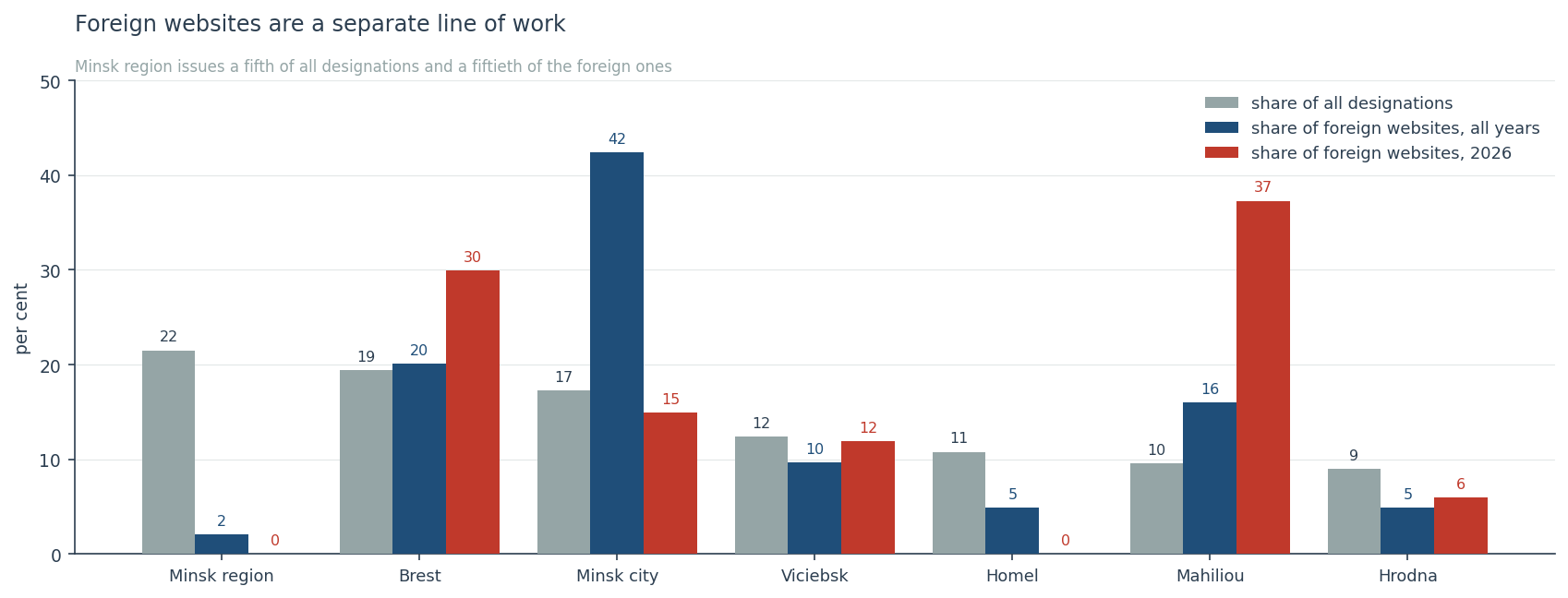
The register holds 6,052 entries, of which 288 are foreign websites issued by 41 courts. That work is not spread the way the rest of the register is.
Minsk region issues 21.5% of all designations in the country and 2.1% of the foreign ones. Minsk city is the mirror image, with 17.3% of everything and 42.4% of foreign sites, while Mahiliou region sits at 9.6% and 16.0%. Foreign resources are a separate line of work, and only some courts do it.
In 2026 that line moved. Minsk city’s share of foreign designations fell from 42% across all years to 15% this year, while Mahiliou region’s rose from 16% to 37%. Minsk region issued none at all. Within Mahiliou the work sits in two courts: the Leninski district court with fifteen this year, and the Horki district court with ten.
This updates our own reading. In August we wrote that nothing was concentrated in Horki, which held eleven of the foreign designations and sixth place. Across the whole period that is still true, but for 2026 it is not. Horki began this work only in February 2025, and ten of its thirteen rulings fall in the current year. The concentration was not there when we looked, and it has formed since.
The concentration was not there when we looked. It has formed since.
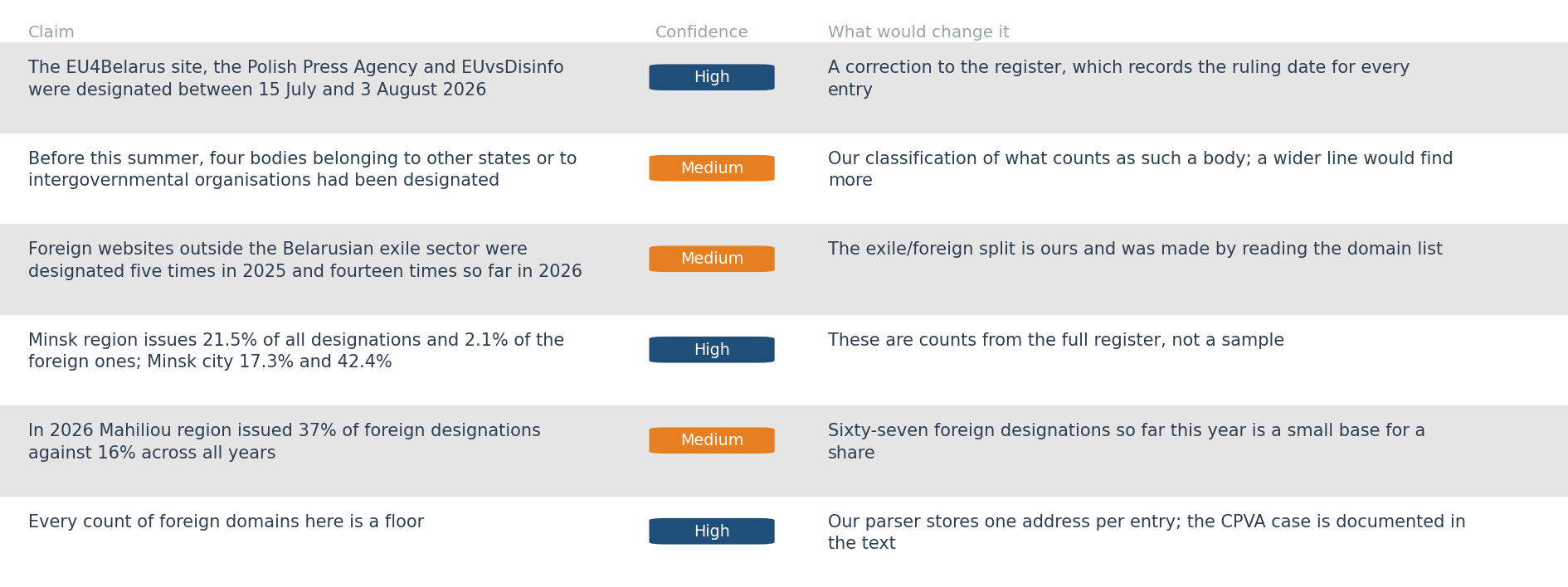
Confidence
Watch
Another state or intergovernmental body is designated before 31 October. Three in three weeks is a rate only if it continues.
Mahiliou region keeps its lead in foreign designations through the fourth quarter, or Minsk city takes it back.
Any designated foreign institution says it was told of its listing through official channels. When Euronews was designated in August, its editorial director said the decision came with no notification to the channel at all.
The reasoning behind any of these rulings is published. It has not been in any case so far.
Method and limits
The register was parsed in full and holds 6,052 entries at the current pass. Foreign websites here means entries whose stored address sits outside the .by zone and is not a social platform account, with Belarusian exile projects on foreign domains separated by hand from the domain list.
The classification of what counts as a state or intergovernmental body is ours. Public broadcasters are included and commercial foreign media are not, so a different line would produce a different four, though not a different three.