
Belarusian organisations earned 5.5% more in the first nine months of 2026, and a third more of them ended the period with a loss. For most of the year those losses shrank as their number grew. In August the losses grew too, and the state’s main outlets still report loss-making firms one farm at a time.
On 16 November National Statistical Committee of the Republic of Belarus published the financial results of Belarusian organisations for January to September. Net profit rose 5.5% to 18.52 billion roubles. In the same period 1,547 organisations made a loss, 32.1% more than a year earlier (Reform.news, 16 November 2026). Both numbers are true. The second has risen in every release this year, and since August it has come with a larger bill.
One in five
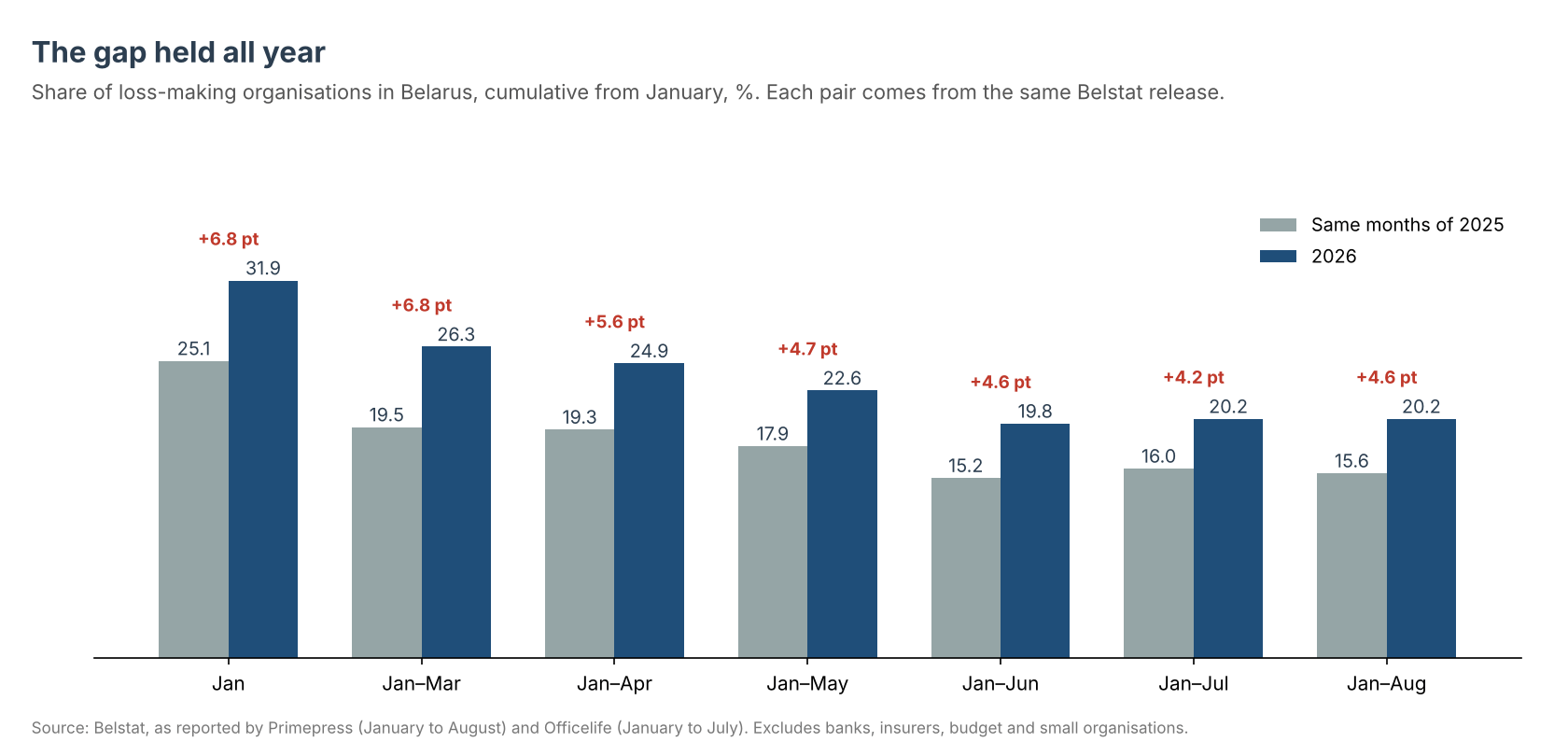
National Statistical Committee of the Republic of Belarus counts loss-making organisations from the start of the year. The share is always highest in January and falls as more months are added, so the fair comparison is with the same months a year earlier. On that measure 2026 has stayed above 2025 in every release. In January 31.9% of organisations made a loss, against 25.1% a year before (Primepress, 27 March 2026). For January to June the figures were 19.8% and 15.2%. For January to August they were 20.2% and 15.6% (Primepress, 29 October 2026). The gap has stayed between 4.2 and 6.8 percentage points all year.
The level is also high by recent standards. For the whole of 2024 National Statistical Committee of the Republic of Belarus put the share at 11.9%, and for 2025 at 13.3% (Primepress, 26 February 2026). Pozirk compared January to July with the same months of 2021 and found 20.2% against 16.5%. In Minsk, almost one organisation in four was in the red (Pozirk, 23 September 2026).
The gap has stayed between 4.2 and 6.8 percentage points all year.
Wider first
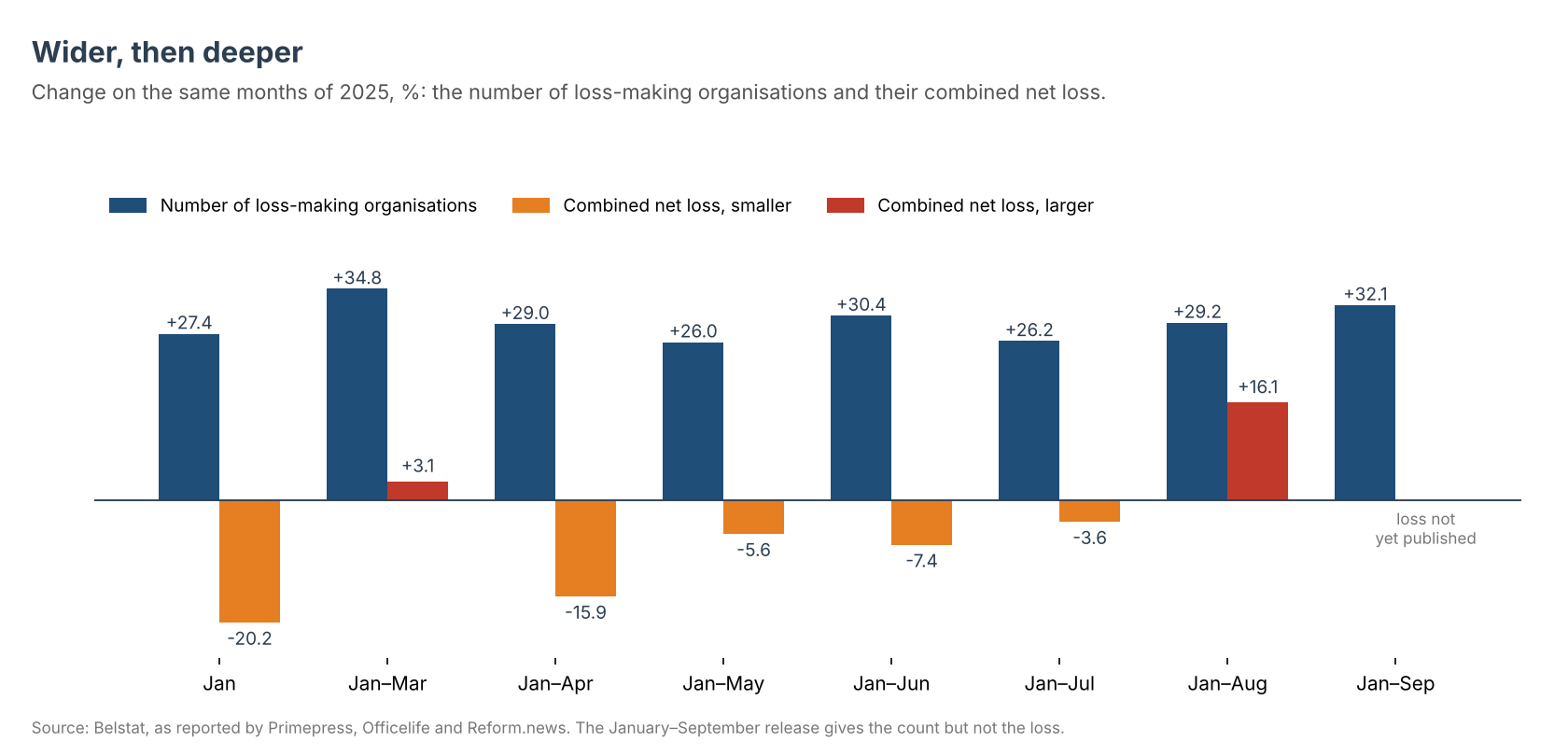
Until the summer the spread looked shallow. In the first half of the year the number of loss-making organisations rose 30.4% to 1,682. Their combined net loss fell 7.4% to 3.46 billion roubles (Primepress, 28 August 2026). By our arithmetic the average loss per loss-making organisation fell from about 2.9 million roubles to 2.06 million. Industry showed the same pattern more sharply. It had 582 loss-making firms against 396 a year earlier, while their combined loss fell 14.7% and the average loss almost halved (Thinktanks, 28 August 2026). Many more firms were losing money, and each was losing less.
January to August broke that pattern. There were 1,702 loss-making organisations, 29.2% more than a year earlier, and their net loss was 16.1% larger, at 4.66 billion roubles (Primepress, 29 October 2026). The average loss per firm was still about a tenth below its 2025 level. The total had turned anyway, because there were so many more firms in the red. In five of the first seven releases the combined loss had been smaller than a year earlier. Belstat’s short release for January to September gives the count and the profit but not the loss, so the next reading will come with the detailed tables.
A rising profit total says less than it seems. In February Alexander Yegorov, first deputy chairman of the National Bank, wrote that the 3-billion-rouble rise in net profit in 2025 had gone almost entirely into stocks of unsold goods. Firms’ working capital had not improved (Reform.news, 18 February 2026).
Where the red spread
Every sector named in these releases has more loss-making firms than a year ago. In January to August 26.8% of industrial organisations made a loss, against 18.5%. In agriculture the share rose from 5.1% to 9.3%, and in construction from 10.5% to 13.8% (Primepress, 29 October 2026). The highest shares are in trade and in hotels and restaurants. In the first half 28.3% of trading organisations made a loss, up from 22.6%, and their return on sales fell from 1.5% to 1.2% (Officelife, 8 September 2026). Hotels and restaurants stood at 28.8% (Thinktanks, 1 September 2026).
Trade is where price controls bite most directly, through caps on markups. In August 2025 Officelife already wrote that almost a third of trading organisations worked at a loss, and named administrative pricing among the reasons (Officelife, 26 August 2025). The largest retailer shows the squeeze. In January to September Eurotorg’s revenue rose 4.6% and its cost of sales 5.7%, and its net profit fell 60% (Reform.news, 5 November 2026). By Lukashenko’s meeting on trade on 7 August, the government had cut the list of goods with regulated prices from 200 to 76 (BelTA, 7 August 2026). These figures cannot show how much of trade’s loss comes from price rules. The trade share in the year-end tables will be the first test.
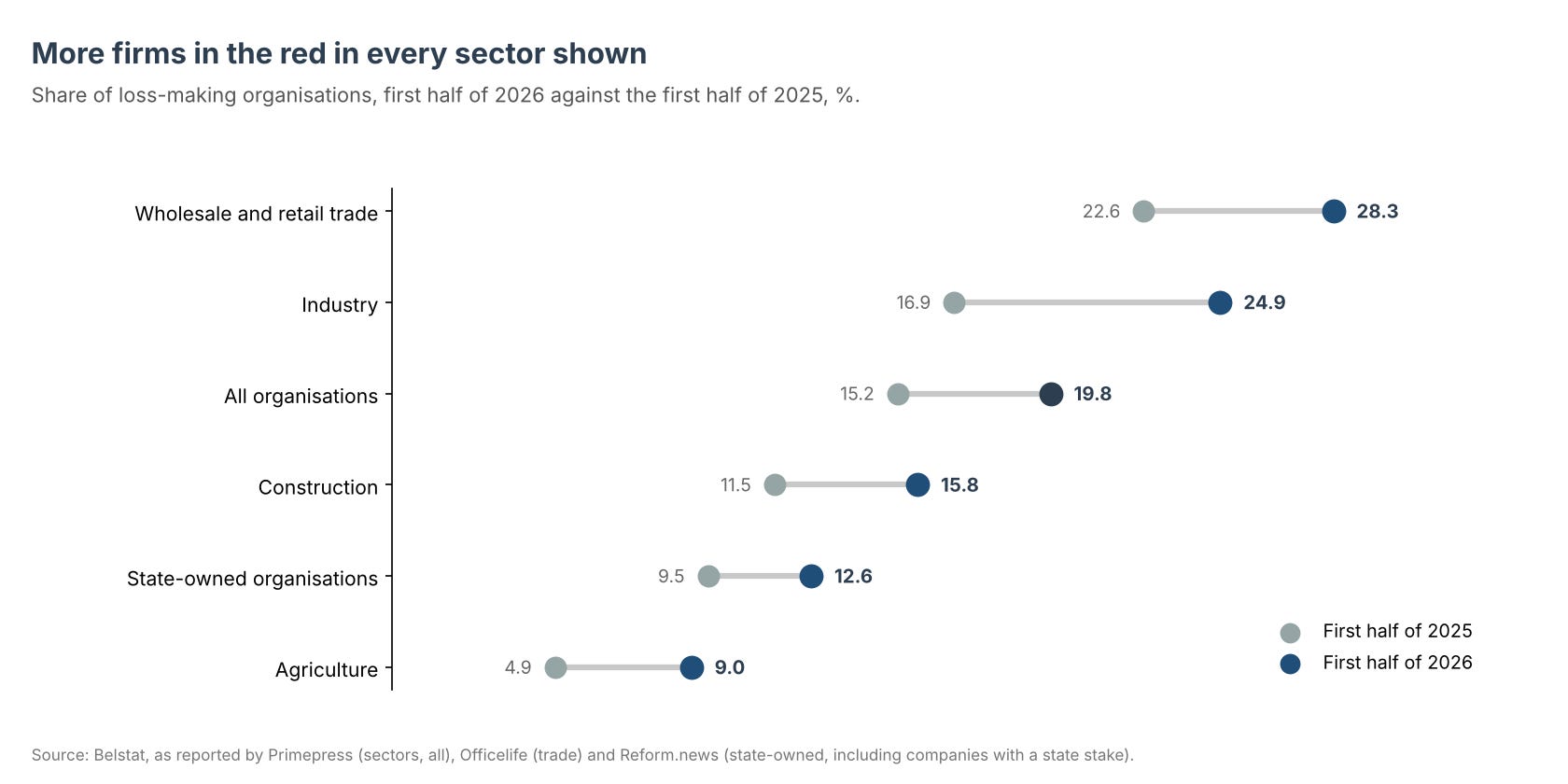
The state sector is in the red more often too, though less than the rest. Among state-owned organisations and companies with a state stake, 12.6% made a loss in the first half, 3.1 points more than a year earlier (Reform.news, 27 August 2026). The national share rose 4.6 points. If the mix of firms did not change much, the share outside the state sector must have risen by more than 4.6 points. In October 2025 the state daily SB set 8.8% for state organisations against 16.2% for the whole country. It concluded that the statistics “do not confirm the myth that the state sector is loss-making” (SB, 24 October 2025). Both of its figures have since risen.
Many more firms were losing money, and each was losing less.
A farm, a plant, a trade-union site
The outlets that made the count their headline were independent. “More and more companies in Belarus are working at a loss,” Zerkalo wrote on 14 October (Zerkalo, 14 October 2026). Charter97 reported on 28 August that the share had risen in all regions (Charter97, 28 August 2026). In 2026 our corpus holds about 50 independent items that give the national share. Primepress, a private business agency, prints the full table every month under a headline about profit. Reform.news headlined three of its four reports on these releases since August on profit, and the fourth on the state sector’s improved results. By 20 November, Reform’s item was the only report of the January to September release in our corpus.
In the state segment one outlet gives the national figure. The site 1prof.by, run by the trade-union federation, reported it five times between January and August. On 14 July its headline said that the number of loss-making companies in Belarus had grown (1prof.by, 14 July 2026). We found no item from BelTA, SB, ONT or CTV with the national share in 2026. The loss-making figures they did print were mostly falls. The number of loss-making firms under the construction ministry fell (BelTA, 10 February 2026). In agriculture, the number fell by 37% over January to October 2025 (SB, 12 February 2026). In Brest it fell almost threefold (SB, 24 April 2026). One regional official broke the pattern. On 26 February the deputy head of the Minsk region said that the rise in loss-making organisations “cannot but worry us” (BelTA, 26 February 2026).
When Lukashenko says “loss-making”, he usually means a single farm or plant. On 17 February he told managers who fail that at most they would “go to raise a loss-making kolkhoz or plant” (BelTA, 17 February 2026). On the same day he said half of the country’s farms live on debts and advances and are loss-making without support (pravo.by, 17 February 2026). On 5 May his meeting with the government considered handing the loss-making Orsha meat-canning plant to the agrokombinat Dzerzhinsky (Mlyn, 5 May 2026). In Shklov on 13 July he said that prices “must not be loss-making” (pravo.by, 13 July 2026). On 28 September he warned district heads not to merge strong farms with loss-making ones (Zarya, 28 September 2026). On 9 November he asked for subsidies to go to “heavy, loss-making enterprises” (NEWS.BY, 9 November 2026). In none of these did he cite the national share.
The loss-making figures they did print were mostly falls.
A record that changed speakers
On 26 June Zerkalo reported the January to April share of 24.9% and called it the worst in at least seven years. The same article quoted the prime minister, Alexander Turchin, saying only that some enterprises work well and “a number of enterprises have problems” (Zerkalo, 26 June 2026). The comparison with seven years was the newspaper’s own reading of National Statistical Committee of the Republic of Belarus. By 23 September Svaboda wrote that Turchin himself had said in June that the number was the highest in seven years (Svaboda, 23 September 2026). The 24.9% is Belstat’s. We found no statement in which the prime minister makes the comparison himself.
In none of these did he cite the national share.
How sure we are
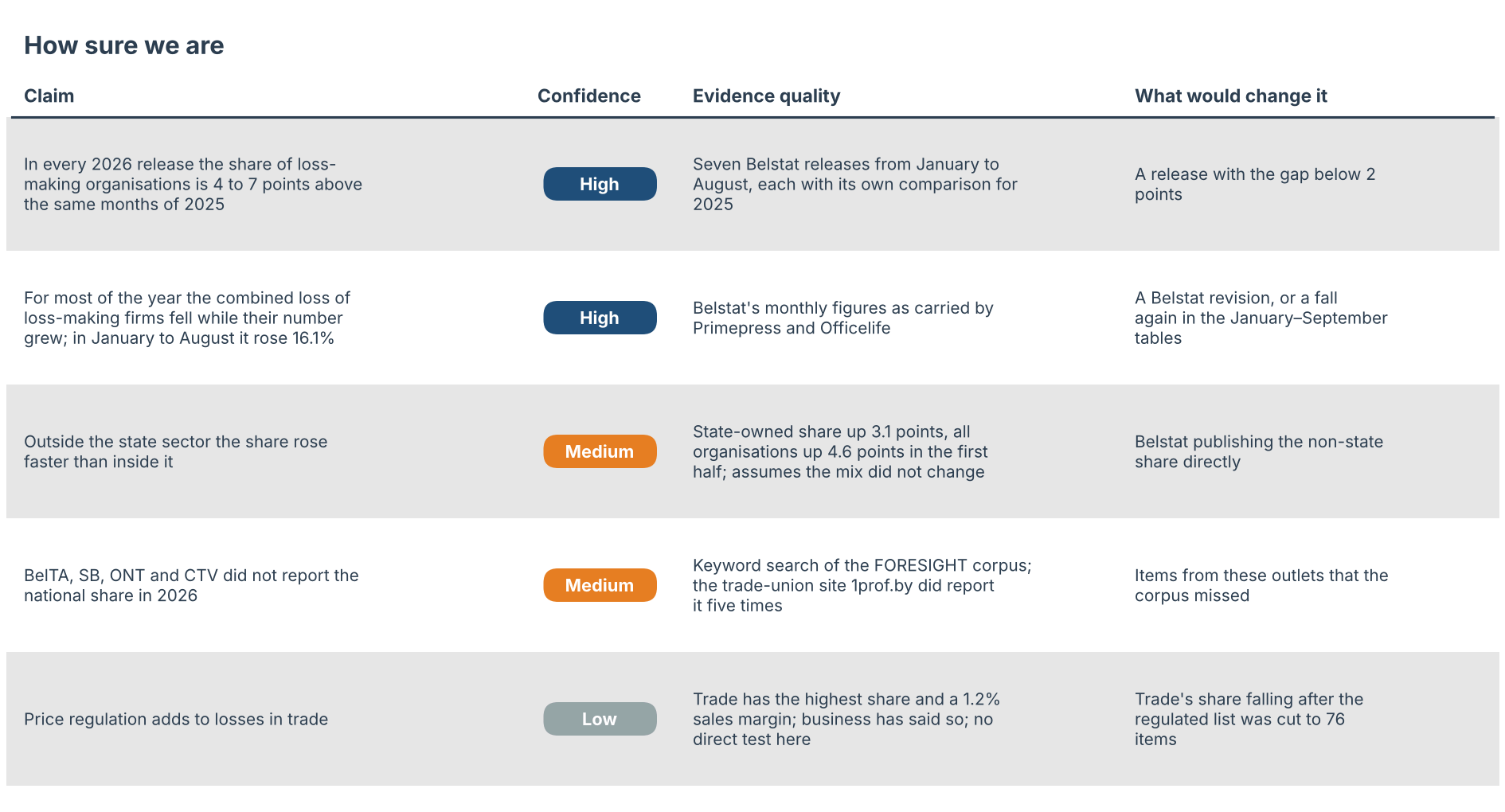
In every 2026 release the share of loss-making organisations is 4 to 7 points above the same months of 2025. High. Seven National Statistical Committee of the Republic of Belarus releases from January to August, each with its own comparison for 2025. A release with the gap below 2 points would change it.
For most of the year the combined loss of loss-making firms fell while their number grew, and in January to August it rose 16.1%. High. Belstat’s monthly figures as carried by Primepress and Officelife. A National Statistical Committee of the Republic of Belarus revision, or a fall again in the January to September tables, would change it.
Outside the state sector the share rose faster than inside it. Medium. The state-owned share rose 3.1 points and the national share 4.6 points in the first half; this assumes the mix of firms did not change. National Statistical Committee of the Republic of Belarus publishing the non-state share directly would change it.
BelTA, SB, ONT and CTV did not report the national share in 2026. Medium. Keyword search of the FORESIGHT corpus; the trade-union site 1prof.by did report it five times. Items from these outlets that the corpus missed would change it.
Price regulation adds to losses in trade. Low. Trade has the highest share and a 1.2% return on sales, and business has said so; we ran no direct test. Trade’s share falling after the regulated list was cut to 76 items would change it.
How it fits
In “Two Per Cent”, state outlets repeated growth of 2% and the sectors that led it. The financial results travel the same way. Profit leads, and the count of loss-making firms appears in full only in independent and business outlets and on the trade-union site. Lukashenko’s way of handling the problem also matches what we saw in “Forty-Five Rubles”, where loss-making farms in Vitebsk region went to stronger owners. Each case is solved with a new owner or a new subsidy. The national share, which says whether such cases are becoming more common, does not appear in his speech.
Thesis tag: none (observation).
What to watch
By 31 December 2026. Belstat’s detailed tables for January to September show the combined net loss of loss-making organisations above the level of a year earlier. Expectation: yes. Confidence: medium.
By 31 March 2027. The share of loss-making organisations for the whole of 2026 is above 16%, against 13.3% for 2025. Expectation: yes. Confidence: medium.
By 31 March 2027. BelTA or SB reports the national share of loss-making organisations for 2026. Expectation: no. Confidence: low.
Method and limits
The figures are Belstat’s, as reported by Primepress, Officelife, Thinktanks and Reform.news. Belstat’s website refuses automated access, so we did not check them against the original releases. Belstat’s financial results leave out banks, other financial and insurance companies, budget organisations and small organisations without a supervising ministry. Each release compares with a recalculated base for the year before, so the 2025 figures differ between releases. January to September 2025 was first published as 1,285 loss-making organisations and 15%. The 2026 release implies about 1,170. We therefore compare each 2026 figure only with the 2025 figure printed beside it. Averages per organisation are our own arithmetic. Coverage counts come from the FORESIGHT corpus since January 2024, using keyword markers for loss-making organisations in Russian and Belarusian. A document counts as giving the national share if a sentence names the share or the number of loss-making organisations for the whole country.