

Term starts today. Three days ago the expert club Nashe Mniennie published the record of a seminar on the militarisation of schooling in Belarus and Russia. The seminar ran under Chatham House rules, so no speaker is named, and I take part in the same series of discussions. For that reason this piece uses the report’s figures and does not judge between its participants. One of its conclusions deserves a wider audience: we can measure how far these practices have been installed, but not whether they have worked.
What can be counted
The installation is easy to count, and the numbers are large.
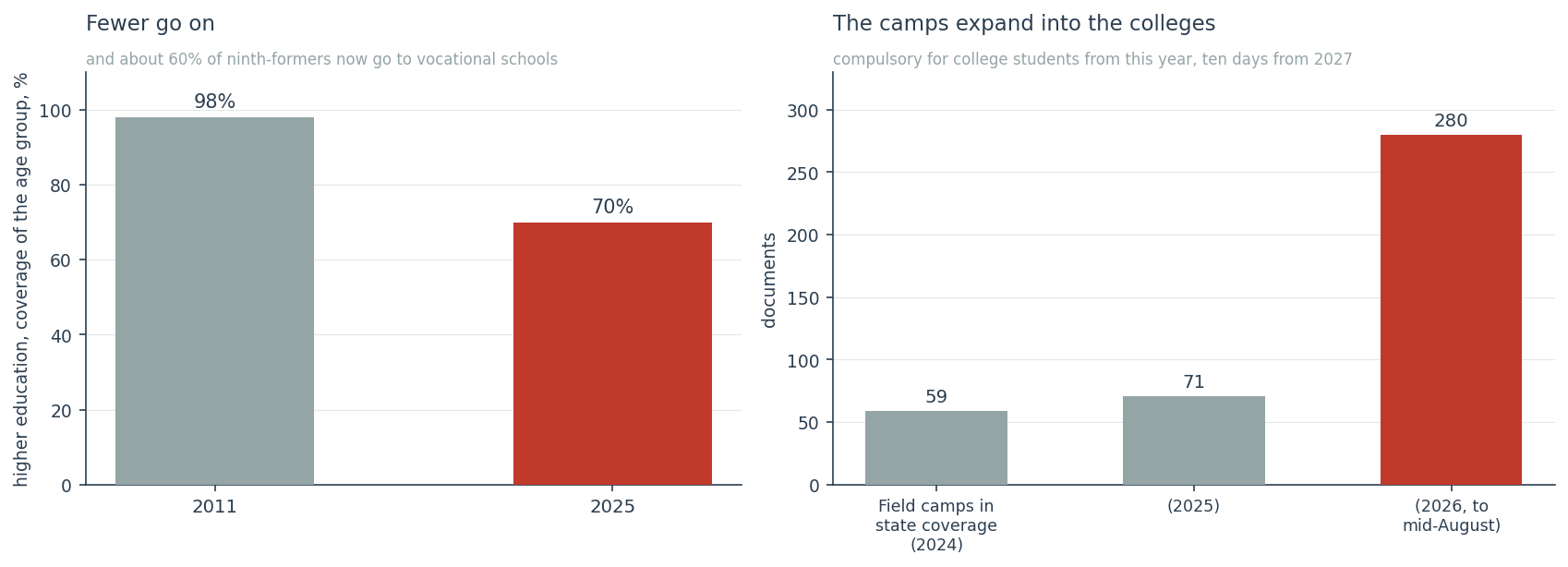
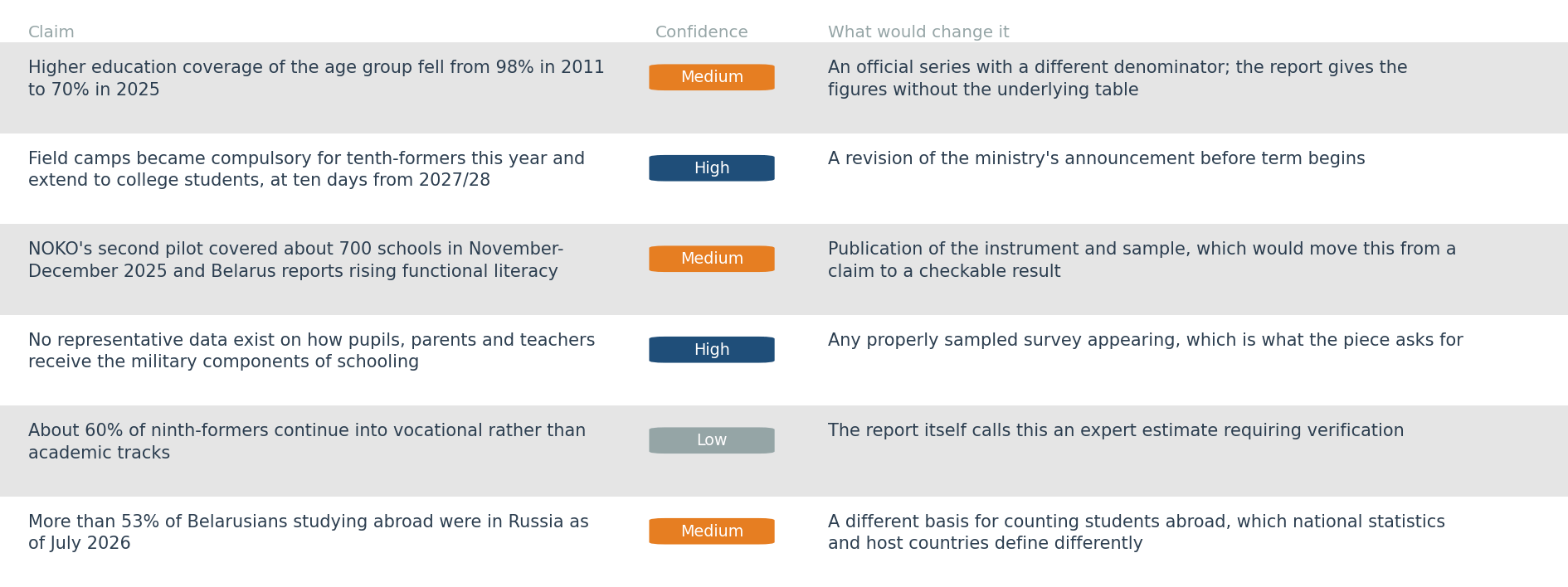
In 2011, higher education covered 98% of the relevant age group; in 2025 it covered 70%. About 60% of pupils in the ninth year now go on to vocational schools instead of academic ones, and the state has pushed them that way for several years. Of Belarusians studying abroad, more than 53% were in Russia in July 2026.
Field camps have moved the same way. In mid-August we counted how often state media mentioned them: 59 documents in 2024, 71 in 2025, and 280 in the first seven and a half months of 2026. That rise tracks the year the camps became compulsory for pupils in the tenth year and moved onto military bases. The education minister has now announced the next step: five-day camps become compulsory for college students too, and grow to ten days from the 2027/28 year. We set that as a watch item a fortnight ago, and it has already been answered.
Ninety-eight per cent to seventy. Fifty-nine documents to two hundred and eighty.
What cannot
None of this tells you what any of it has done to anyone.
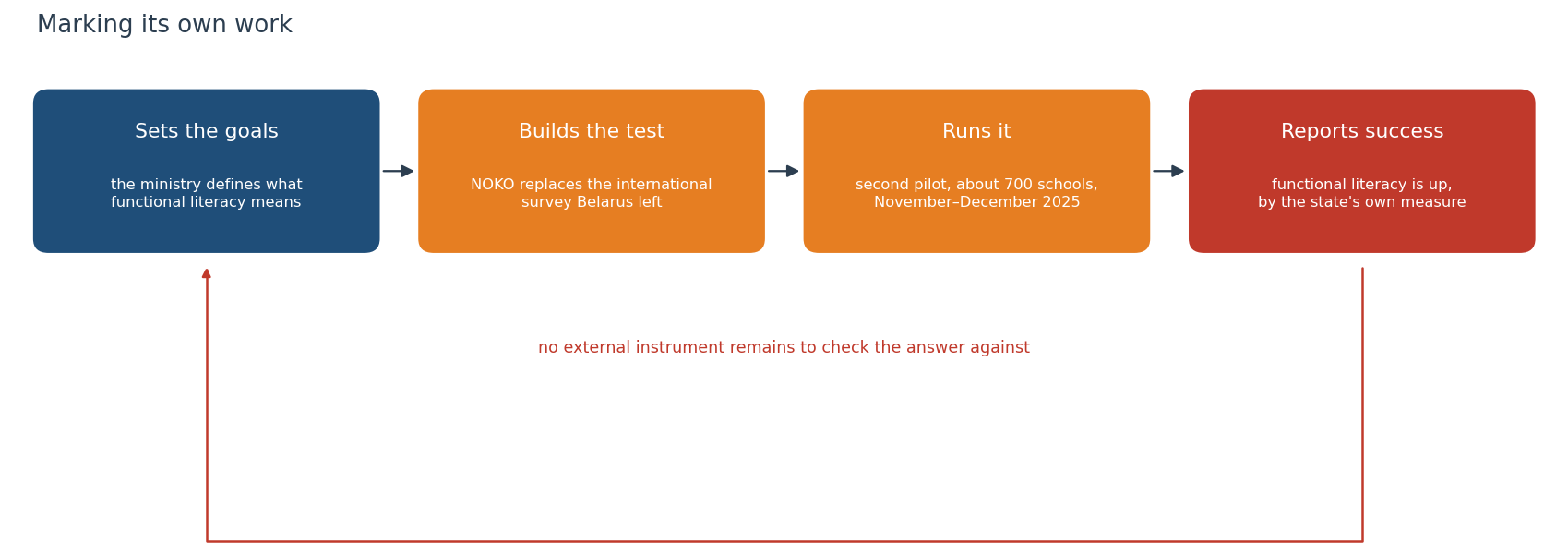
Belarus has left the international school surveys that once allowed comparison with other countries. It has replaced them with a national test of its own, called NOKO. The second pilot ran in about 700 schools in November and December 2025, and Belarus now reports rising functional literacy, as Russia does.
Look at who does what there. The ministry decides what should be measured, builds the test, runs it, and announces the result. Nothing outside the system checks the answer.
The ministry decides what to measure, builds the test, runs it and announces the result.
The same gap runs through the rest. There is no representative Belarusian data on how pupils, parents and teachers actually receive military training, flag ceremonies or the change of language in class. The seminar was clear about this: a large apparatus is not the same thing as an effective one. Children’s military parades and photographs with weapons show that somebody organised them, not that anybody was convinced.
Why the difference matters
The two readings point to opposite futures. Only one of them has evidence behind it.
Suppose that installing the system means the system works. In that case a decade of this produces a generation shaped by it.
Now suppose the system is absorbed as ritual, with teachers reporting it, photographing it, filing it and privately discounting it. Then it produces something older and plainer: people who separate what they say from what they think. The late Soviet school produced exactly that.
The Belarusian participants leaned to the second reading, for a specific reason. Even the official line says this is not Belarus’s war. The militarist stories arriving from the east reach an audience that accepts them less readily than the Russian one. In those conditions the machine can be built to specification and still fail to do its job.
That is not a comfort. A system can fail to convince anyone and still succeed at everything else: it can sort children into tracks at fifteen, thin out the teaching profession, and remove the subjects where awkward questions get asked. None of that needs anyone to believe anything.
A system can fail to convince anyone and still succeed at everything else.
What would settle it
A survey would settle it. Not a state one, and not one paid for to confirm what its funders already believe. A properly sampled study of pupils, parents and teachers, broken down by region and type of school. It would ask about the war, the camps and the language of instruction, and it would publish its questions alongside its results.
It is the most useful thing anyone could commission about Belarusian schooling right now, and it is also the thing nobody has. Until it exists, everything written about how well indoctrination works in Belarus is a guess from the size of the apparatus. That includes what is written by people who agree with us.
Confidence
Watch
The five-day college camps take place this term as announced, and state media report how many students attended.
NOKO results for 2026 are published with the test, the sample and the scoring, and not only as a headline figure.
A representative survey of pupils, parents or teachers on the military parts of schooling appears, from any source.
The 2026 figure for higher education coverage is published and can be read against 70%.
Method and limits
The figures on coverage, vocational schooling, students abroad and the NOKO pilot come from the seminar report of 29 August. That seminar ran under Chatham House rules and names no participants, and neither do we. The field camp counts are our own, from our corpus, and we published them on 14 August.
I take part in the same series of discussions. This piece therefore reports the seminar’s figures and leaves its disagreements alone. The report records two of them: how deeply militarisation has been absorbed, and whether staying inside the system protects the profession or props the system up. We leave both as they stand.
Two figures need care. The fall in higher education coverage from 98% to 70% mixes three causes: a falling birth rate, the move of pupils into vocational schools, and emigration. No one of those causes explains it. And the 60% share of ninth-year pupils going to vocational schools is an expert estimate, which the report itself says needs checking.