
From 11 to 16 October five CSTO armies trained in Belarus, and no foreign observer was reported watching. State outlets covered ceremonies, arrivals and a convoy for five days, and named the scenario, mass protests in an imagined country, on the sixth.
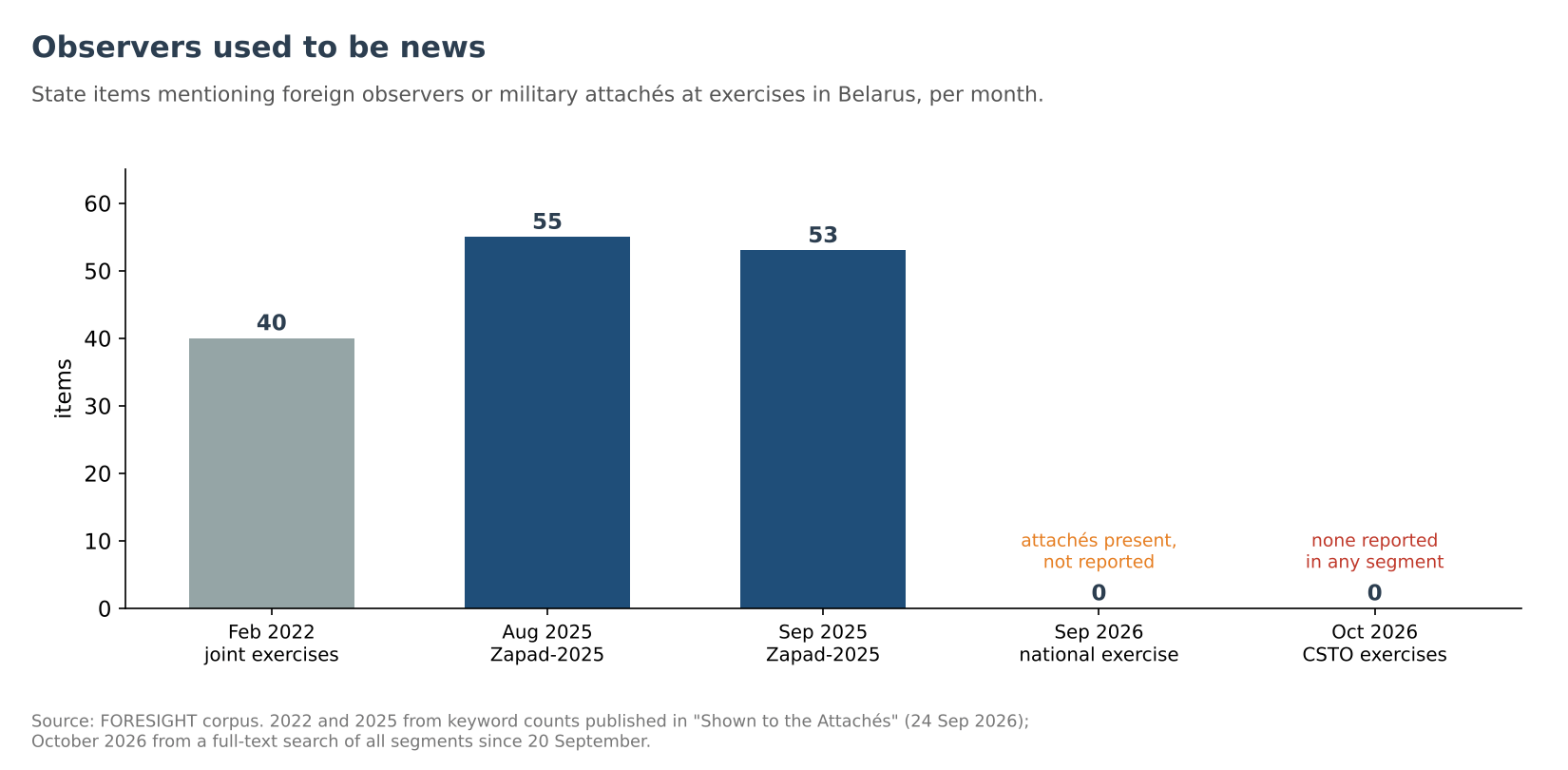
In September we asked two questions about the CSTO exercises planned for October: would Belarus invite foreign observers, and would Lithuanian intelligence change its view of Belarus afterwards. Both answers, as far as our archive shows, are no. The two exercises, “Unbreakable Brotherhood-2026” and “Barrier-2026”, brought more than 1,500 troops from Belarus, Russia, Kazakhstan, Kyrgyzstan and Tajikistan to two ranges, and state outlets published 124 items about them in six days. The scenario behind the peacekeeping title appeared in those outlets only on the last day. What we cannot see is whether observers were invited and stayed away, or were never asked.
Two questions, two answers
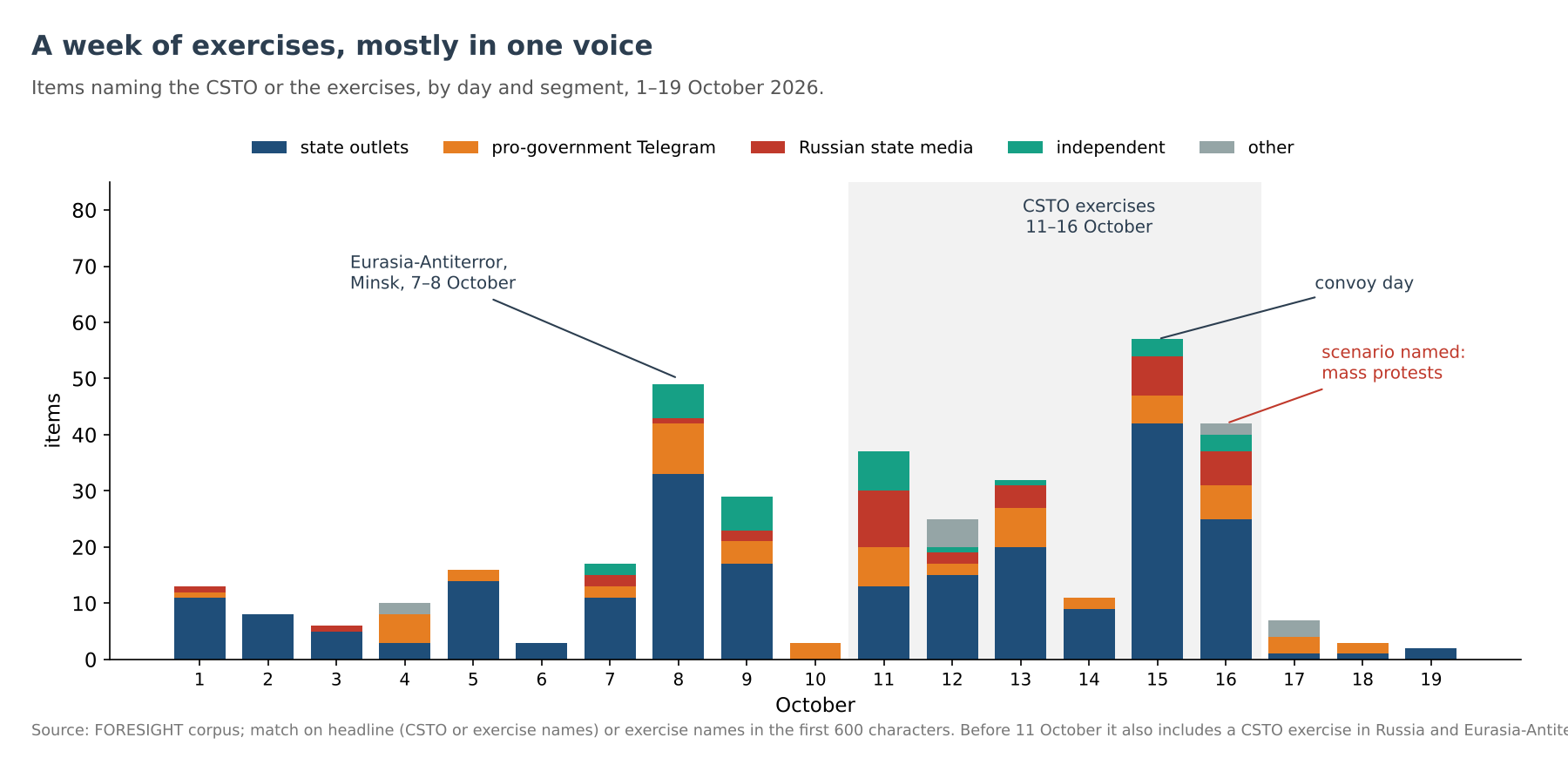
On 24 September we reported that attachés from five NATO countries had watched a national exercise in September, and that no state outlet passed this on. We asked whether the CSTO exercises would have observers, and whether state media would say so.
We searched every segment of our archive from 20 September for observers, attachés and invited foreign delegations. Five state items matched, all published on 16 October. In each, the word was part of the scenario: a peacekeeping unit defended an “observation post”. The only outside visitors named were defence officials of the five participating states and staff of the CSTO itself, who came “to assess” the contingents, in the words of Vitebskie Vesti.
The second question came from our piece of 12 September. On 4 September the Lithuanian president’s adviser Deividas Matulionis had said that Lithuanian intelligence saw no growing military threat from Belarus. We found no statement from Lithuanian intelligence after the exercises, either way. Both items were questions, not forecasts, so they close without a score.
The only outside visitors named were defence officials of the five participating states.
Five days of convoys, one day of protests
The exercise opened in Vitebsk on 11 October. The chief of the general staff, Uladzimir Bely, told the troops that the West was in fact preparing “for a new hot war”. The CSTO deputy secretary general, Mirlan Turgunbekov, called the drill “particularly relevant given the escalating military and political situation”, as the Kyiv Independent reported.
The scenario behind the peacekeeping title appeared in those outlets only on the last day.
After that the tone changed. On 13 October BelTA reported the plan of the operation: separate the “opposing sides”, guard infrastructure, then hand the area back to local authorities. It did not say who the sides were. On 15 October, the busiest day of coverage with 42 state items, the story was a convoy of humanitarian aid defended from attack.
Only on 16 October did the state reports say what the peacekeepers had been sent into. In the imagined state, BelTA wrote, political instability “led to mass protests and sharper inter-ethnic tensions”, and the troops “eliminated mass riots”. SB, CTV and Belarus News used the same lines that day. We read the opening paragraphs of 88 state items about the exercises. The protest scenario appears in eight state items, all dated 16 October. The humanitarian convoy appears in fifteen.
What the host region added
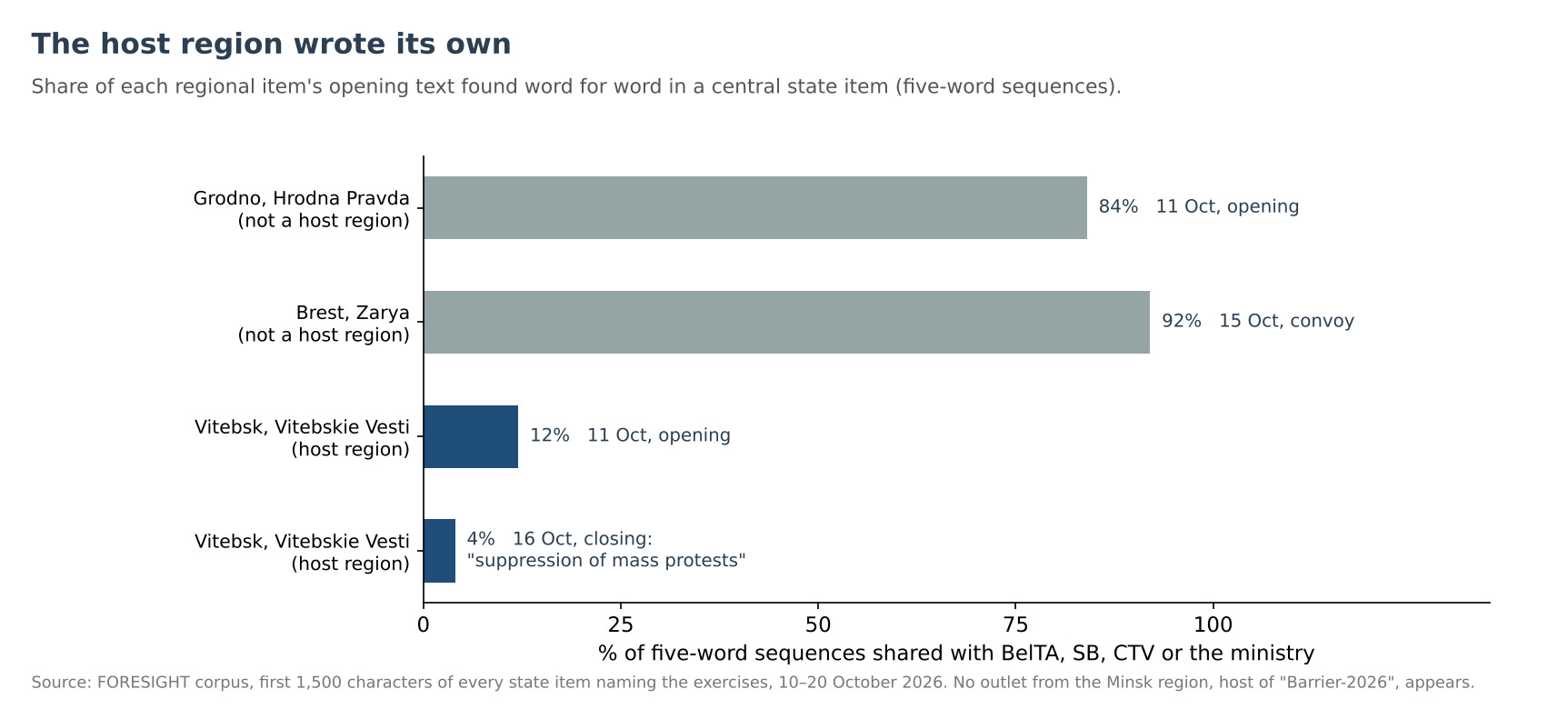
Our working model says that regional state media take the central supply and add a layer of their own. These exercises let us test that for the first time. We compared every regional state item about them with the central outlets, BelTA, SB, CTV and the defence ministry, by counting shared five-word sequences.
The protest scenario appears in eight state items, all dated 16 October.
The two papers from regions that did not host the exercise copied the wire. Hrodna Pravda shares 84% of its opening text with BelTA, and Brest’s Zarya 92%. Vitebskie Vesti, in the host region, wrote its own two reports, sharing 12% and 4%. Its closing report put the scenario in its first lines: the final stage was “practical action to suppress mass protests and inter-ethnic clashes”.
The central outlets said the troops eliminated riots in an imagined country. The local paper said they practised suppressing protests. The difference is a few words, but only the regional text used the verb.
The exercise a week earlier
The CSTO drill was the second foreign exercise in Belarus that month. On 7 and 8 October security services from ten countries of the CIS and the Shanghai Cooperation Organisation held “Eurasia-Antiterror-2026” in Minsk, with special units from six of them on the ground. According to the CIS press service and the Belarusian interior ministry, as Zerkalo reported, one scenario was a hostage-taking at the Chyzhouka Arena during a hockey final.
Iran was among the six. The Islamic Revolutionary Guard Corps said on its own site, Sepahnews, that a special forces unit of its ground force had flown in. Reform and Pozirk reported this on 6 October.
State outlets did name Iran. BelTA wrote that assault groups “of Belarus, China and Iran” stormed a building, and CTV listed Iran among the six countries. The interior ministry added that its SOBR unit had trained with Iranian colleagues in Tabriz in December 2025. None of the state items we found used the name of the Revolutionary Guard. That name reached a Belarusian state-aligned audience a week later, when five pro-government Telegram channels, among them Dzermant and Nikitin, posted one identical text. It named the Guard’s 33rd “Al-Mahdi” special forces brigade and asked whether the visit was “a tactical manoeuvre or a geopolitical manifesto”. In the same weeks BelTA and SB named the IRGC almost daily, in reports about tankers in the Strait of Hormuz.
Only the regional text used the verb.
How sure we are
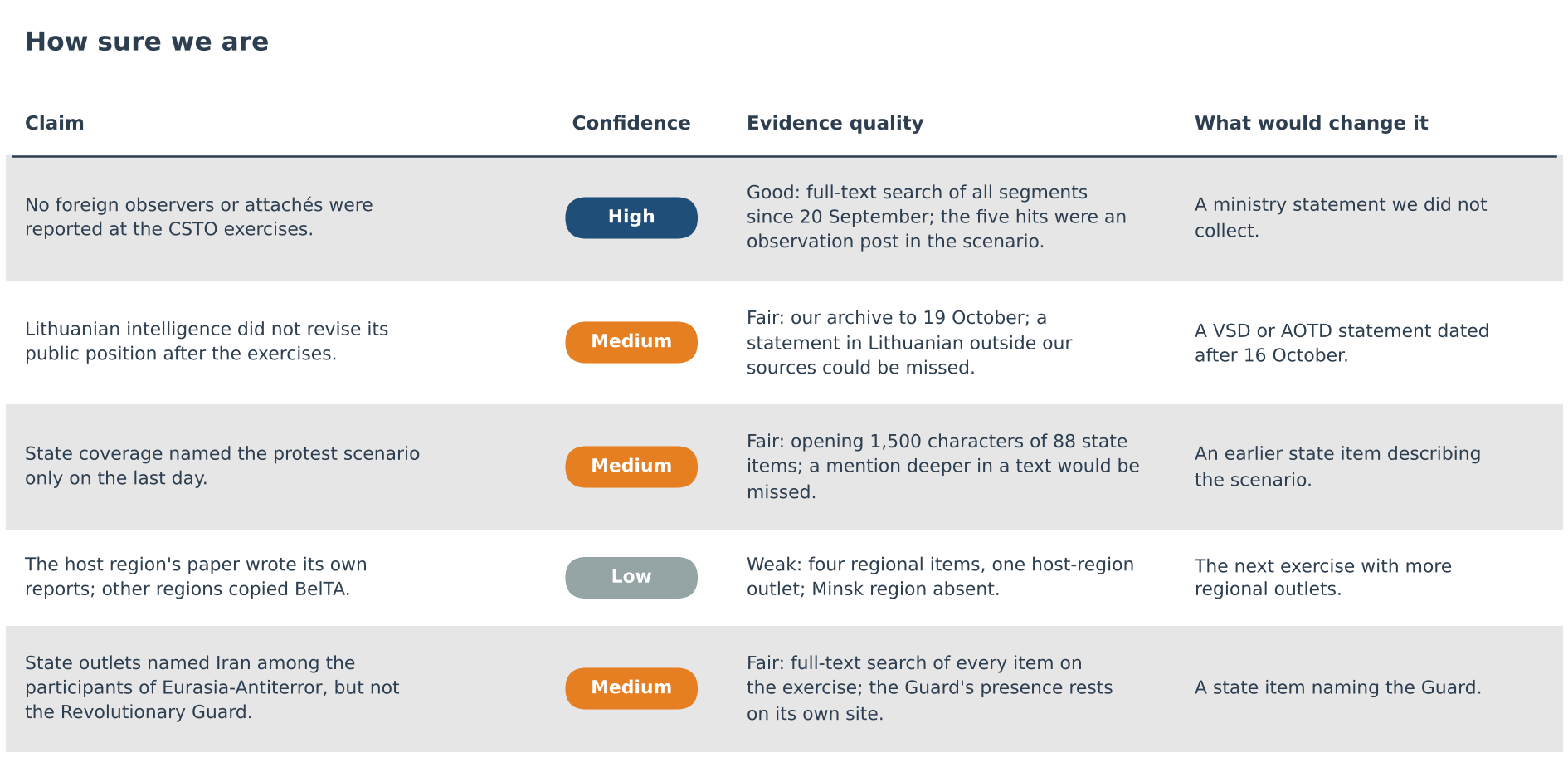
The absence of observers is High, because we searched the full text of every segment and checked each hit by hand. The protest timing is Medium, since we read only the opening part of each state item. The regional comparison is the weakest row: four items from three papers, and no outlet at all from the Minsk region, where “Barrier-2026” took place.
How it fits
How it fits. The papers from Grodno and Brest copied BelTA word for word, while the paper in the host region wrote its own reports and named the protest scenario more directly than the centre did. This fits T2, two modes of regional production: central supply, plus a local layer where the news happens nearby. It is the first test of T2, and it rests on one outlet. A simpler reading is that Vitebskie Vesti had a reporter at the range and the other papers did not, so the local layer is about access, not about a different way of producing news. If host-region papers write their own texts at the next exercise and other regions copy, the access reading is enough. If papers far from the range also add local material, T2 gains support.
What to watch
By 31 December 2026, BelTA reports foreign observers or attachés at any exercise held in Belarus. We expect it does not, with Medium confidence.
By 31 March 2027, Lithuania’s annual national threat assessment names the October 2026 CSTO exercises. We expect it does not name them, with Low confidence.
By 30 November 2026, a Belarusian state outlet names the Revolutionary Guard as a participant in “Eurasia-Antiterror-2026”. We expect it does not, with Medium confidence.
Method and limits
We counted items in our archive naming the CSTO or the exercises in the headline, or the exercise names in the first 600 characters, from 1 to 19 October 2026, by segment. Before 11 October that count also includes a CSTO exercise in Russia (1–5 October) and “Eurasia-Antiterror-2026” (7–8 October). For Iran we searched the full text of every item on “Eurasia-Antiterror-2026” for Iran and for the Revolutionary Guard. For observers we searched the full text of all segments from 20 September for observers, attachés and invited foreign delegations, and read every hit. For the scenario and the regional test we used the first 1,500 characters of the 88 state items naming the exercises from 10 to 20 October; a mention deeper in a text would be missed. Overlap was measured as the share of a regional item’s five-word sequences that also appear in any central state item. Figures for troops, equipment and drones come from the CSTO and the Belarusian defence ministry and are the same in every outlet we checked. CTV pages carry a block of related headlines that made unrelated items match our search; we read the CTV hits by hand. Thesis tag: T2.