
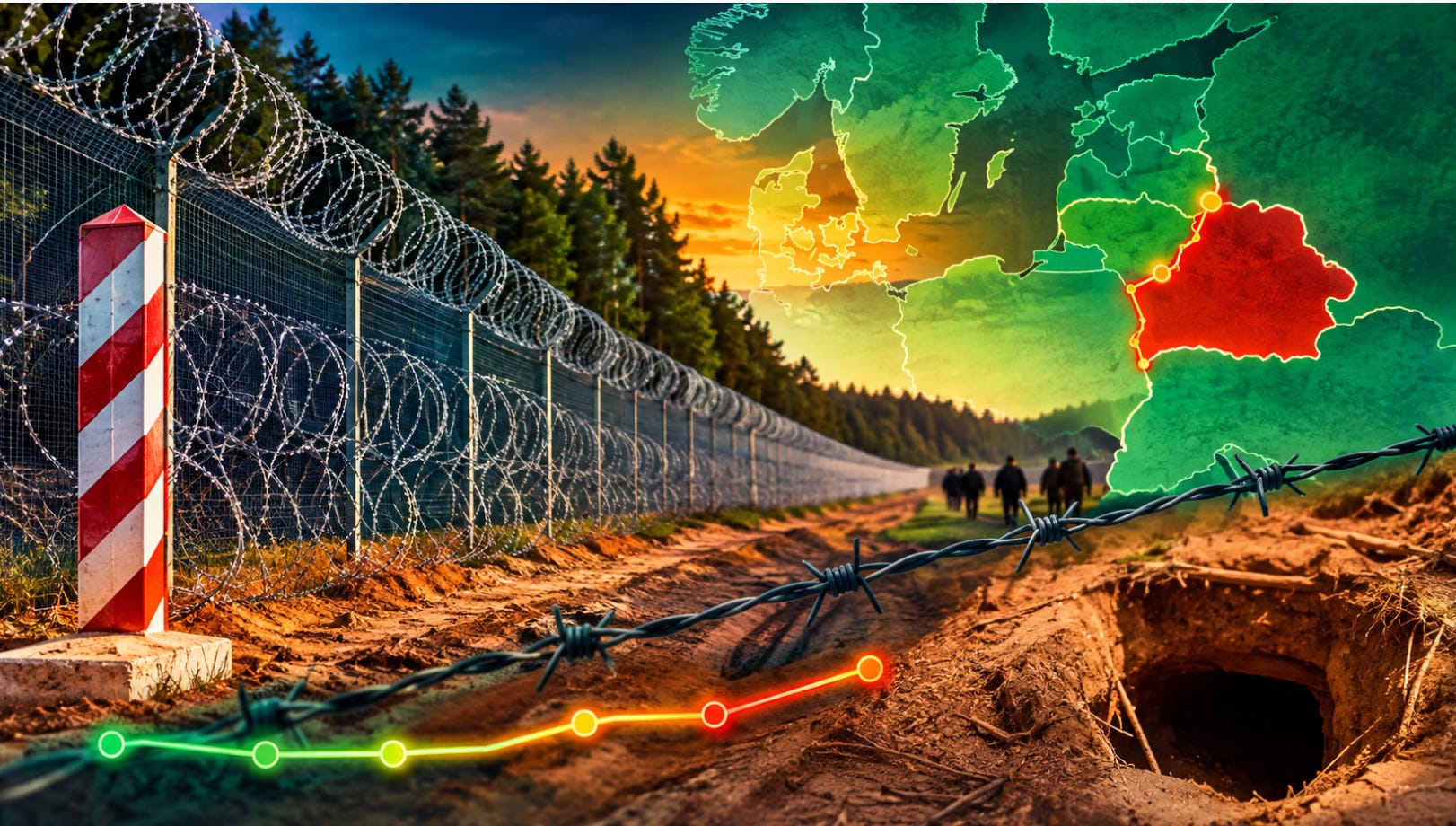
On 31 July we wrote that Lithuania’s fence had worked and the route had gone underground, and we set a test: if a third tunnel appeared on any of the three borders, the engineering answer to fencing would be the story of the autumn rather than an incident. Three weeks later the Lithuanian count for the year stands at twelve, and the method has crossed to a border that had never seen it.
The test, answered
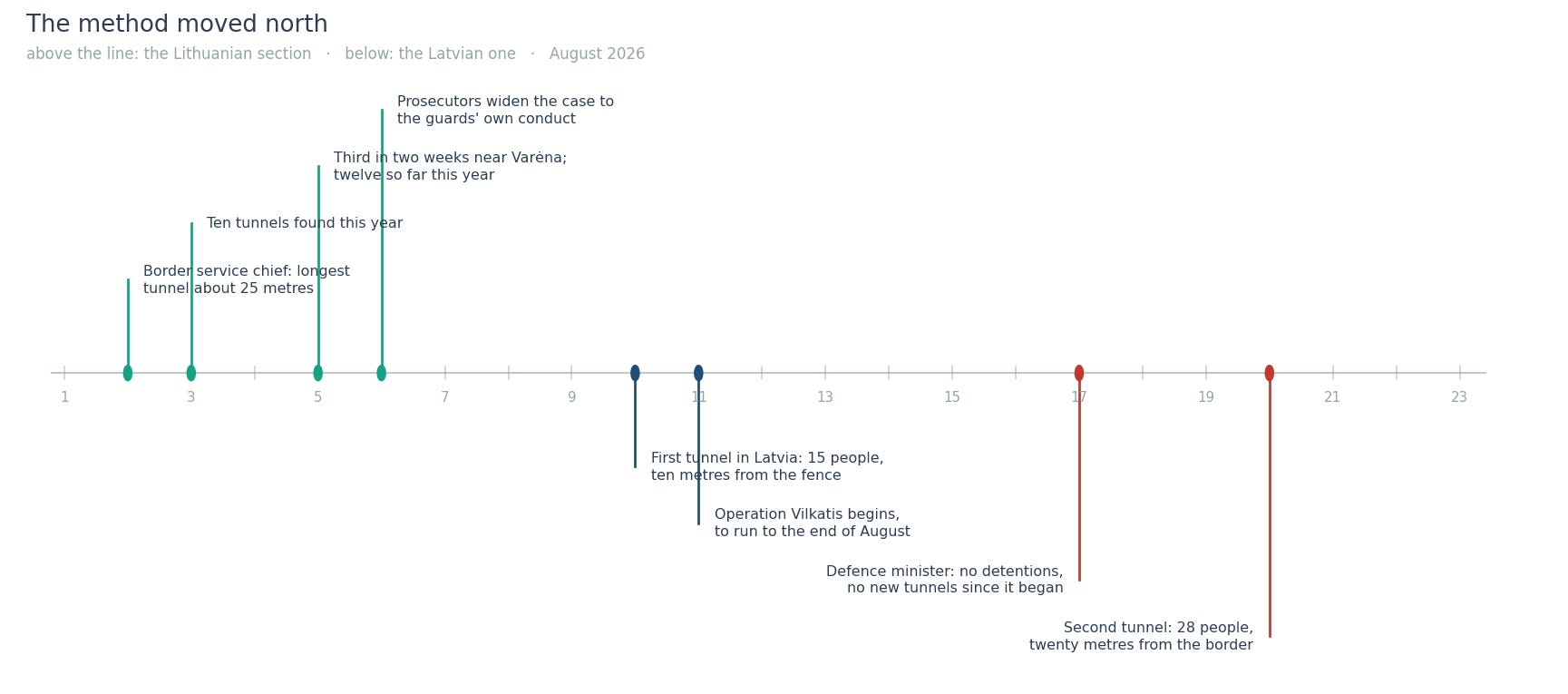
On 2 August the head of Lithuania’s border service described tunnels as a working method of entry and put the longest one found at about twenty-five metres. The following day his service’s count for the year was ten. By 5 August it was twelve, after a third passage in two weeks was found near Varėna. In the same week Lithuanian prosecutors widened their investigation to examine the conduct of the officers involved, and Lithuania announced it would buy detection equipment — a state does not procure ground-scanning gear for an incident.
Then it moved. On 10 August Latvian border guards in Skrudaliena parish found fifteen people who had come in from Belarus underground; tracing their route, they found the passage ten metres from the fence, in the Silene unit’s sector. It was the first ever found in Latvia. On 20 August a second one turned up near Krāslava, camouflaged under moss twenty metres from the border, with twenty-eight people through it. The interior minister ordered ground scans along the whole external border, which is what you do when you doubt the two you found are the only two.
Two tunnels in July. Twelve by 5 August, and the method across a second border by the 20th.
The operation and the three days
A state does not buy ground-scanning equipment for an incident.
Riga launched Operation Vilkatis on 11 August, the day after the Silene find, coordinating border guards, police, the army and the security services through to the end of the month, with expanded aerial surveillance.
On 17 August the defence minister told Latvian radio and television that since the operation began nobody had been detained and no further tunnels had been found. Three days later the guards at Kaplava found the second tunnel and the twenty-eight people who had already used it.
That is not an argument against the operation, which had been running six days. It is an argument about what a quiet week on this border is worth as evidence. In July we set out the per-kilometre arithmetic that makes the Latvian section the pressure point; nothing since has eased it. Latvia has stopped close to ten thousand attempts in the first eight months of this year against twelve thousand in the whole of last year, and on some days the count passes a hundred along a hundred and seventy-three kilometres.
The silence, measured twice
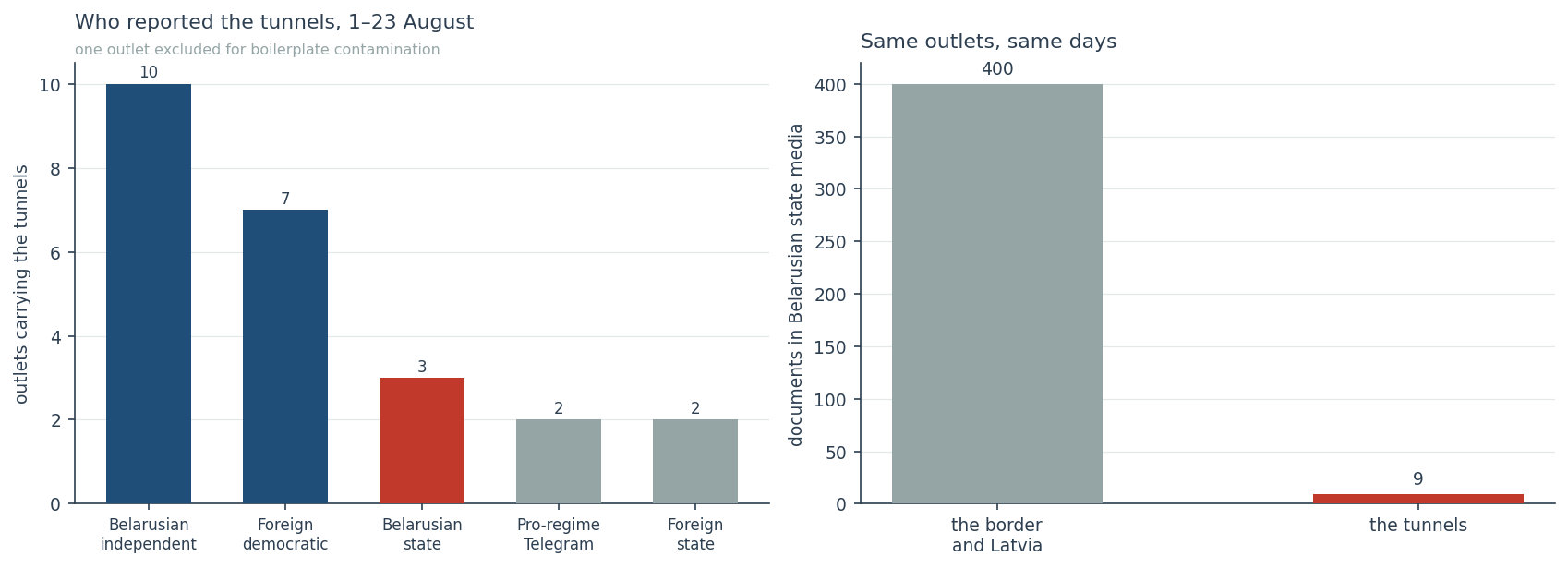
In July we ran the corpus and found fifty-two documents from Belarusian state and pro-regime outlets on the border, with tunnels in none of them, while BelTA covered in detail a man detained near the Lithuanian border with a home-made drone.
We ran it again for the first twenty-three days of August, with one independent outlet excluded because its documents carry site furniture in the text field and its counts are not trustworthy. Ten Belarusian independent outlets and seven foreign ones carried the tunnels. Belarusian state media produced nine matching documents from three outlets, and the headlines that are visible concern a relict oak grove, a bus factory’s export plans and talks between Lebanon and Israel — the words match in passing, not in substance.
The same state outlets published four hundred documents on the border and Latvia over those days. The gap is not inattention to the border. It is a gap in one place, and it held while the volume around it grew eightfold.
Fifty-two documents in July, four hundred in August. The passages under the border appear in neither count.
Ceuta got the airtime. Skrudaliena did not.
What filled the migration slot instead was Ceuta: the barrier on the breakwater, the death toll, the tens of thousands returned to Morocco, the emergency meeting of EU interior ministers. Where Latvia does appear, the frame is financial — on 3 August the Belarusian foreign ministry promised Riga asymmetric measures for closing the crossing, and on 10 August the foreign minister said Latvia wanted the closure to extract extra funding from European structures. The border is a story about Latvian budgets, not about anyone crossing it.
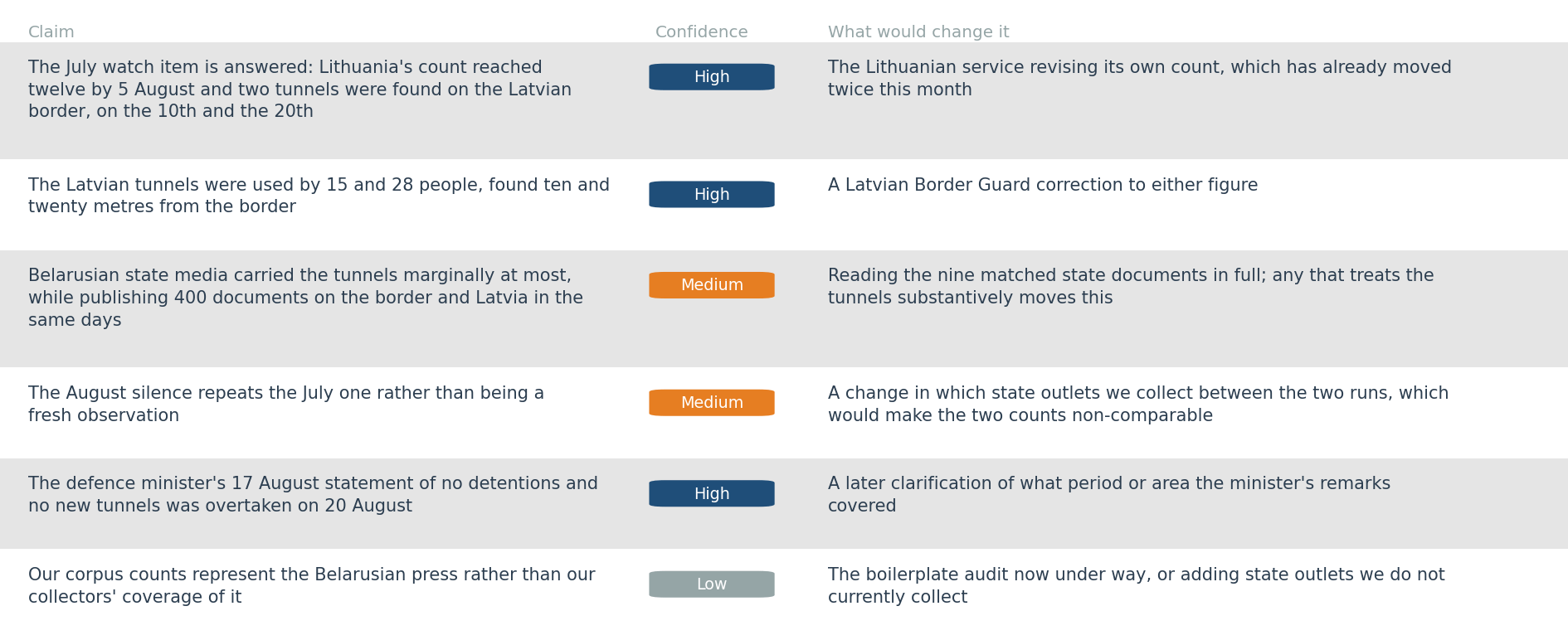
Confidence
Watch
· By 15 September, a third tunnel on the Latvian section. Two in eleven days is a rate unless it stops.
· Latvia’s ground scans of the external border produce a published result, in either direction.
· Operation Vilkatis is extended past the end of August, or is not.
· By 15 September, Belarusian state media report a tunnel on any section in their own words rather than quoting a foreign denial. The July count and the August count agree; a third reading would make it a standing property rather than a fortnight’s choice.
Method and limits
Counts come from our own corpus for 1 to 23 August 2026, matching documents that mention a tunnel or a dug passage together with a border or migration term. The July counts are those published here on 31 July. Facts about events are taken from Latvian and Lithuanian reporting and official statements, not from corpus counts.
The attempt totals quoted in July and in August are different aggregates — the July figure counted attempts on all three borders since January, the August one counts Latvia’s own eight-month total — and they should not be read as a single series.