
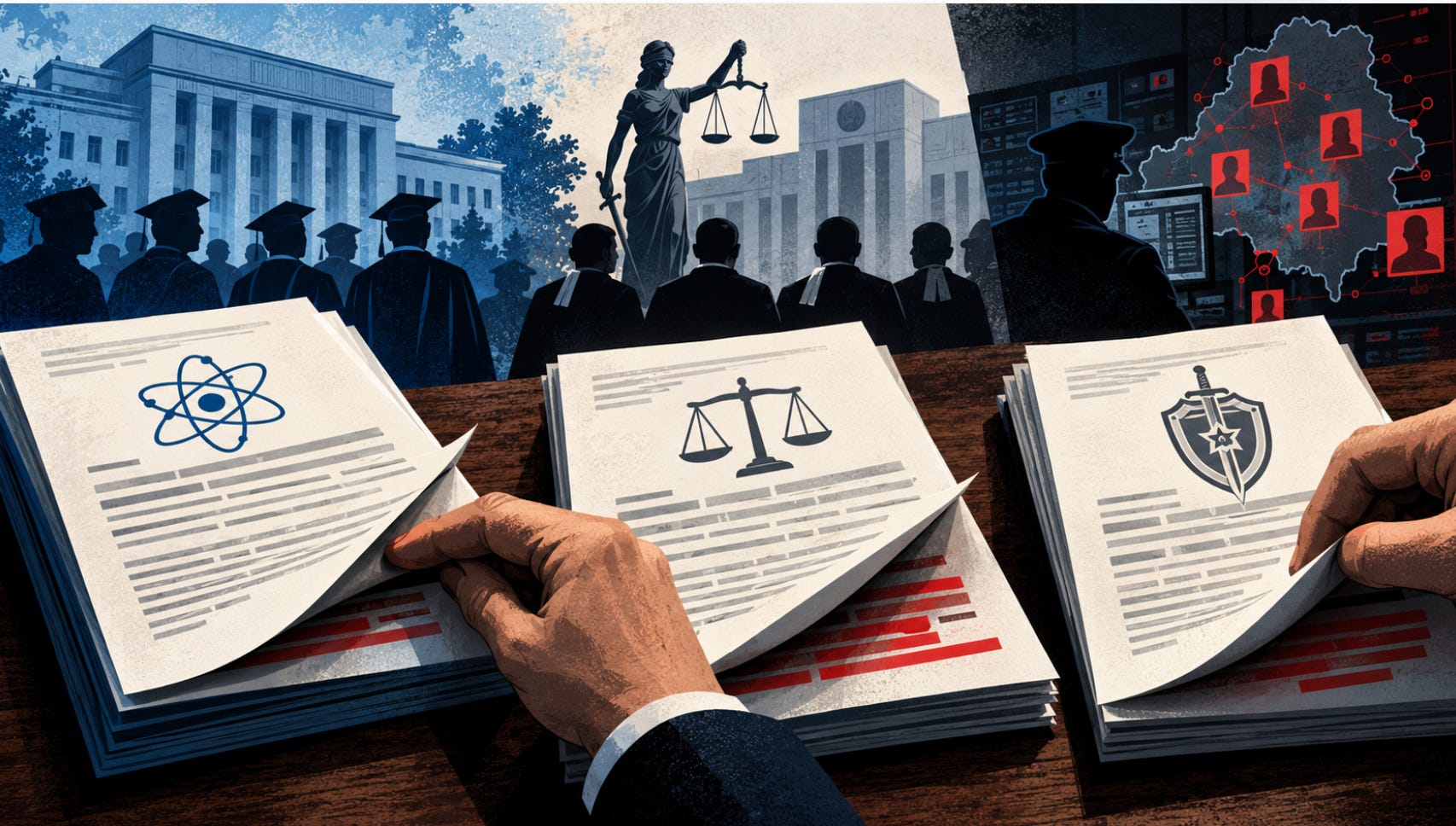
In October Belarus changed how it chooses academicians, moved its judges and shortened the KGB’s list of “terrorists”. Each time, state outlets published the decision. Each time, the part about political loyalty was missing, and it came out only when someone read the document.
Three decisions in October touched three parts of the Belarusian state: the Academy of Sciences, the courts and the KGB’s list of people “involved in terrorist activity”. State outlets announced each of them with a short official text. Each official text left out the political conditions behind the decision. Independent outlets and the human rights centre Viasna found them in the documents. What we cannot see is how the new rules will be used, because the Academy’s rules start only in spring 2027 and the KGB does not explain its decisions.
A filter in paragraph 31
Lukashenko signed decree No. 367 on the Academy of Sciences on 19 October. The official summary, repeated by state outlets, listed new age limits for candidates, 70 for academicians and 60 for corresponding members. It also listed a doctoral degree and a professor’s title as requirements, and a new right for Lukashenko to give academic titles by decree (pravo.by). It said nothing about security checks.
The Academy’s new charter appeared on the legal portal on 21 October (pravo.by). The same day, independent outlets read it. Under paragraph 31, nobody can stand as a candidate after an “extremist” crime, or after an administrative offence for “violating the procedure for mass events”, the article used against protesters in 2020, as Pozirk quoted. The list ends with “other actions that harm state or public interests”. Nasha Niva noted that no time limit is given, and that the presidium registers a candidate only after the State Secretariat of the Security Council finds “no information that prevents election”. A refusal by the Academy’s presidium is final. Academicians who are abroad on election day cannot vote, as BelNovosti reported. The number of seats falls from 100 to 90 for academicians and from 145 to 120 for corresponding members.
Each official text left out the political conditions behind the decision.
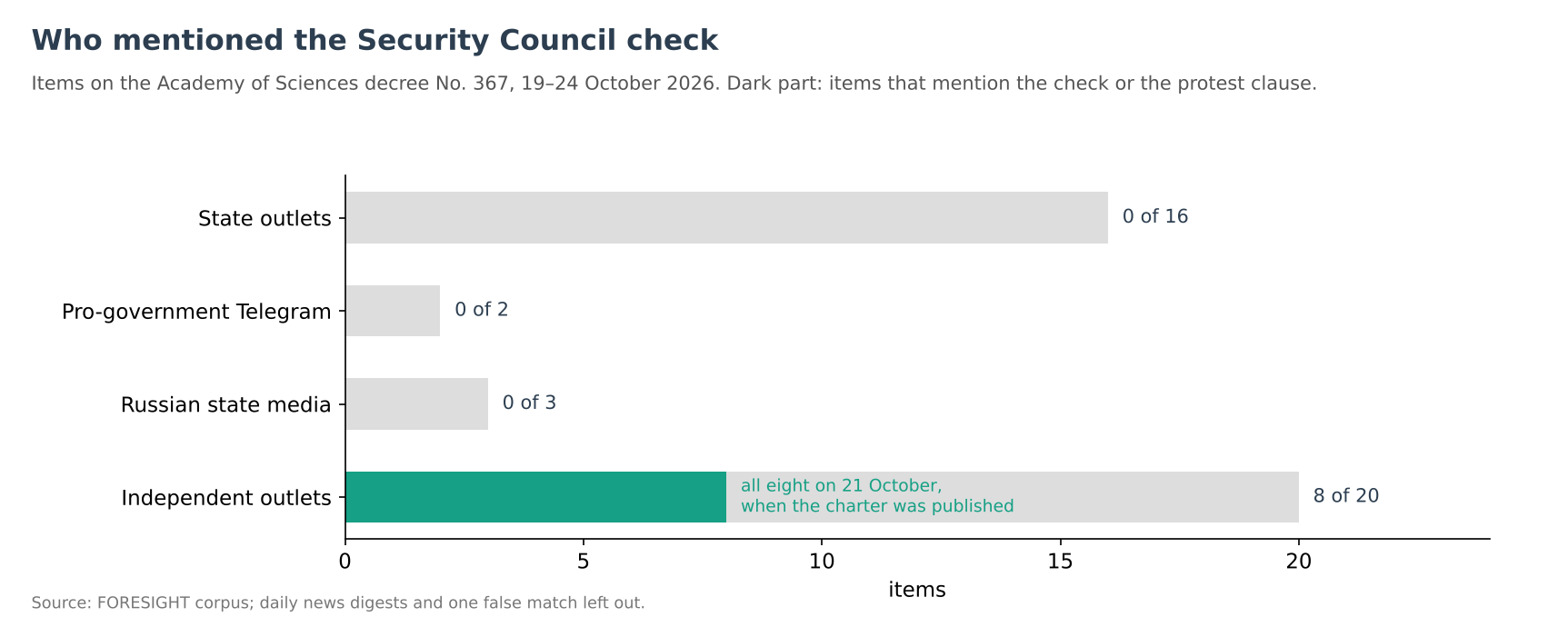
In our archive, 16 state items covered the decree from 19 to 24 October, not counting daily news digests. All of them repeated the official summary. None mentioned the Security Council or the protest clause. Of 20 independent items, 8 did, all on 21 October.
The change has a history. In 2017 academicians voted by secret ballot to fill only 5 of 13 vacant seats and turned down officials who were candidates (Nasha Niva). After the 2021 vote, Lukashenko said that “not everyone took the elections unambiguously” and that titles “must be earned” (BelTA). The new rules move the choice away from the secret ballot, towards the presidium, the Security Council and the decree.
One name in the release
On 7 October Lukashenko signed decree No. 355 on judges. BelTA’s report named one person, Tatiana Tupik, reappointed as chair of the Minsk City Court, and said that 20 new judges had joined (BelTA). BelTA reported the June decree on judges the same way, with one name, Oleg Lapeko of the Minsk Regional Court (BelTA). In 2024 Lapeko chaired the appeal panel in the case of political prisoner Vasily Kovalev (Viasna).
Viasna checked the October decree against its own databases (Viasna). It named 24 judges whom the decree moved or reappointed and who appear in its records. Fourteen had sentenced people in political criminal cases. Ten appear for administrative cases, such as fines and short jail terms for protests or for “extremist materials”. Three went up to regional or city courts, and six became chairs of district courts. Five other judges with political cases on record left the bench, by retirement or at their own request.
Natalia Gorbach went up to the Grodno Regional Court, with at least six political criminal cases and 60 administrative ones. Alexander Mokhorev, under EU sanctions, went up to the Gomel Regional Court; by December 2024 he had given at least 31 rulings in political cases. Yulia Inchina became deputy chair of a Minsk district court. Her record includes at least 73 administrative cases, among them cases under the article on mass events; Angelina Lapaeva, appointed to a district court, has at least 28 such cases. Irina Detsuk, who gave a man two years in a penal colony for tearing down a state flag, received a new five-year term in Kobrin.
The same administrative offence now closes the Academy to a scientist and appears in the records of at least five judges whom the October decree has just appointed. This is the line where the two October decrees meet. We continue here the question we asked in What the Apparatus Is Owed: what careers inside the state reward.
Removals that nobody announces
The KGB keeps a list of people “involved in terrorist activity”. On 23 September it held 738 citizens of Belarus, according to UDF. People on the list cannot easily use bank accounts, buy property or receive money from relatives in prison.
The same administrative offence now closes the Academy to a scientist and appears in the records of at least five judges whom the October decree has just appointed.
Since May the KGB has removed 40 people, Viasna counted (Viasna). Most are former political prisoners convicted for online comments or protests. Some received pardons in 2024 but left the list only this year; lawyers link the removals to their convictions expiring, UDF reported. Removal is not rehabilitation, and the list keeps growing at the same time. According to the same report, the KGB added 14 people in July alone.
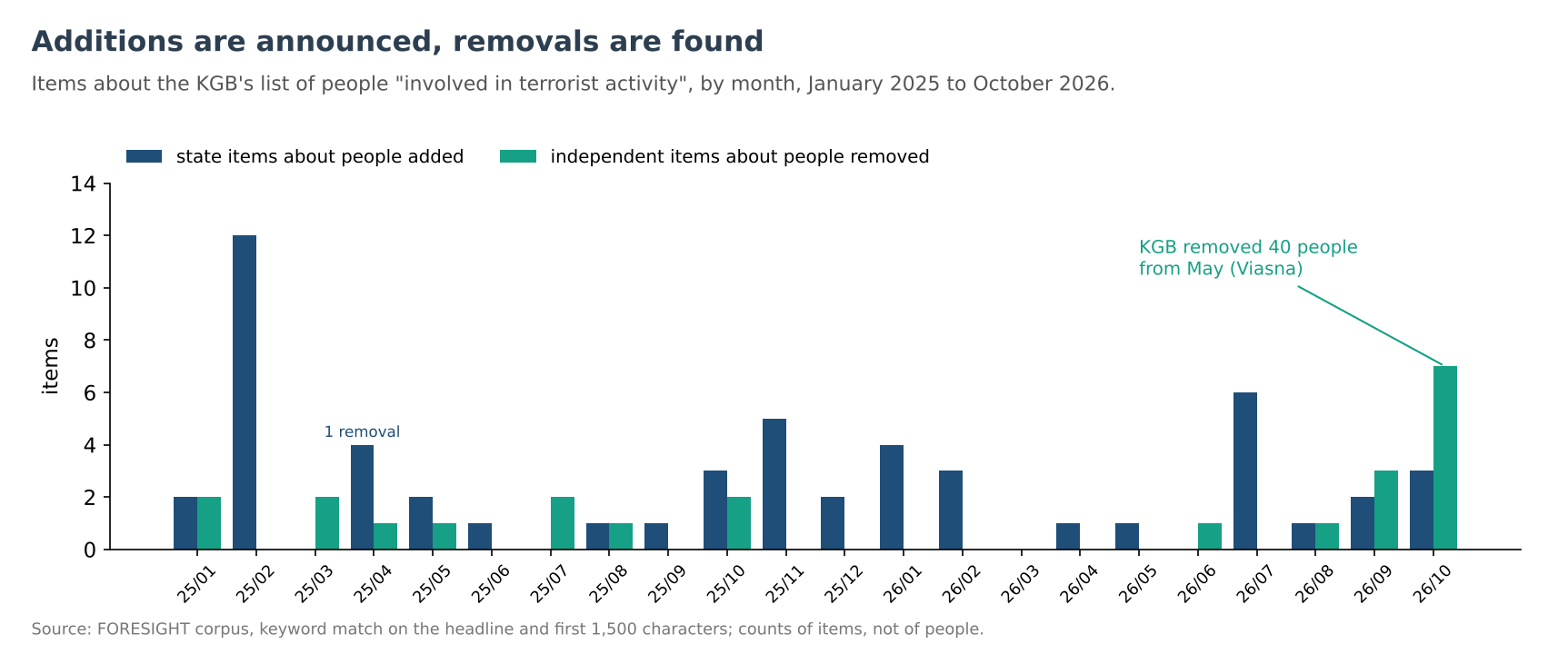
The KGB publishes each new version of the list on Telegram, Zerkalo noted, and does not say why a name has gone. Only a comparison of versions shows the removals. Since January 2025 our archive holds 67 state items about the list. Most report people being added, and one mentions a removal. In independent outlets, items about removals rose from one or two a month to three in September and seven in October.
Removal is not rehabilitation, and the list keeps growing at the same time.
How sure we are
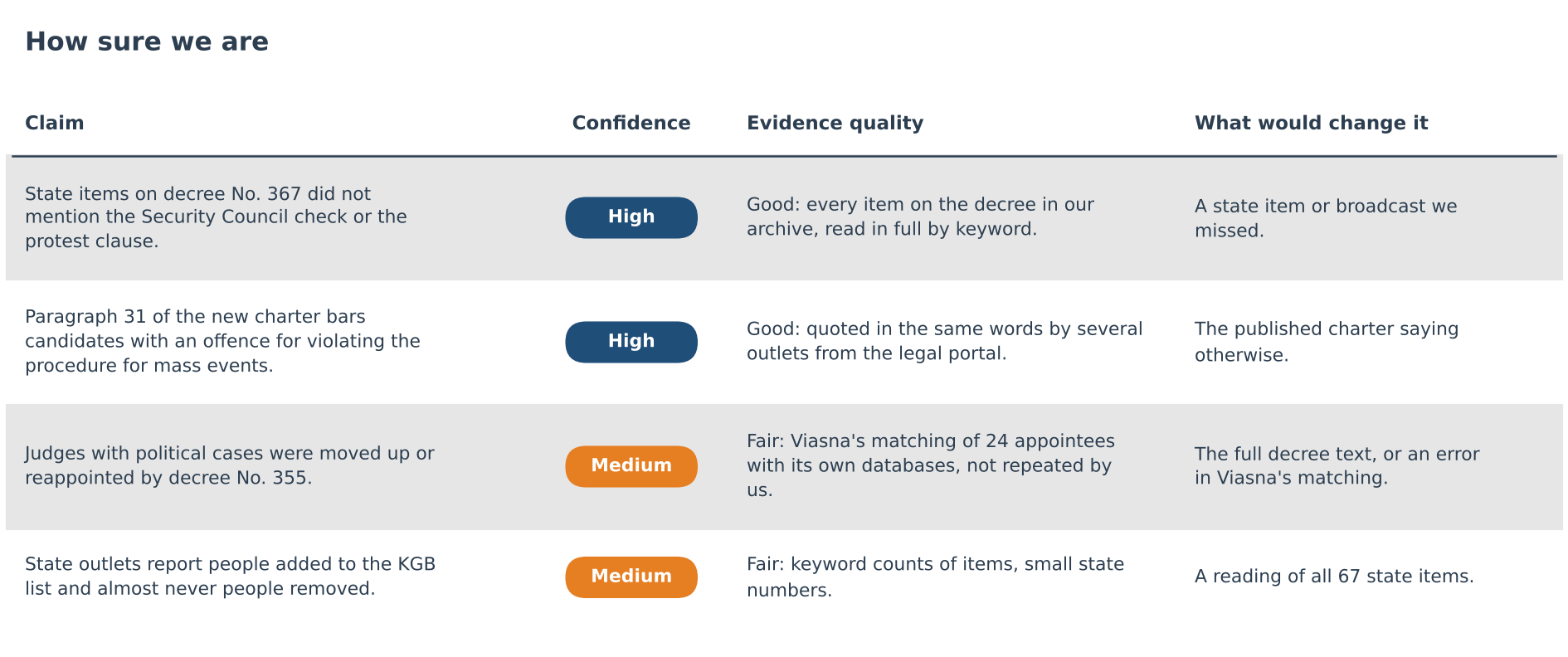
The Academy result is High. We read every item on the decree in our archive, and several outlets quote paragraph 31 of the charter in the same words. A state television broadcast that mentioned the check could still have escaped us, because our archive holds only the websites and Telegram channels of television stations. The judges’ section is Medium. It rests on Viasna’s matching of names with its own records, which we did not repeat, and BelTA’s reports give us almost no names to check it against. The list figures are Medium too. Our counts are of items, not of people, the keyword match is rough, and the number 40 comes from Viasna, not from the KGB.
The new rules move the choice away from the secret ballot, towards the presidium, the Security Council and the decree.
How it fits
How it fits. In three October decisions, state outlets published what was decided and left out the political criteria, which independent outlets and Viasna then found in the documents. None of the seven theses in our working model covers this, so we record it as an observation. It is close to T4, the silence that comes with incidents, but these were routine acts, not incidents. The simpler reading is that official summaries are always short: BelTA never lists all judges in a decree, and the Academy summary may just follow the decree’s own preamble. On that reading, nothing was hidden, only shortened. If state outlets explain the Security Council check when the first elections under the new rules are announced, the omission was format. If they still do not, it was choice.
What to watch
By 30 April 2027, a state outlet mentions that candidates for the Academy are checked by the Security Council. We expect it does not, with Medium confidence.
From 1 November to 31 December 2026, Viasna reports at least 10 more people removed from the KGB list. We expect it does, with Medium confidence.
The next decree on judges, whenever it comes, is reported by BelTA with more than two names. We expect it is not, with High confidence.
Method and limits
We collected every item in our archive from 15 to 27 October that names the Academy of Sciences together with the decree. We then sorted state, pro-government and independent items by whether they mention the Security Council check or the protest clause. We left out daily news digests and one false match. For the courts we read all state reports on decrees about judges since January 2025, and Viasna’s analysis of decree No. 355. Viasna’s analysis names 24 appointed and five departing judges; we did not check its matching against court records. For the KGB list we counted items since January 2025 that mention the list together with words for adding or removing, by month and segment. These are counts of items, not of people. We quote the Academy’s charter from outlets that read it on the legal portal. Thesis tag: none (observation).