

In the twelve months to 9 August 2026, Minsk pardoned 425 prisoners in three deals brokered by Washington. The groups included foreign citizens as well as people on Viasna’s list of political prisoners. In the same twelve months Viasna recognised 538 new ones. We reported both numbers in “The Offer in the Same Speech” and left them side by side. A book published last winter gives a way to read them together.
The book is Making a Career in Dictatorship by Christian Gläßel and Adam Scharpf (Oxford University Press, 2025). Belarus is not one of its cases: the main evidence is the personnel files of the Argentine army, with shorter studies of the SS, Stalin’s NKVD and the Gambian army. We use the book as a peg. The material below is our own counted series, the test they allow is a limited one, and we say where it stops.
The argument, briefly
Security organisations are pyramids in which many officers enter and few reach the top, and those who fall behind usually know it early. The authors call this career pressure, and they describe two extreme ways out of it. An officer can join a coup, or he can volunteer for the work that others avoid and hope that loyalty will be rewarded.
In Argentina the second route ran through Battalion 601, the intelligence unit at the centre of the “Dirty War”. Officers with poor grades from the military academy were more likely to join it, and those who joined stayed in the service longer than their peers.
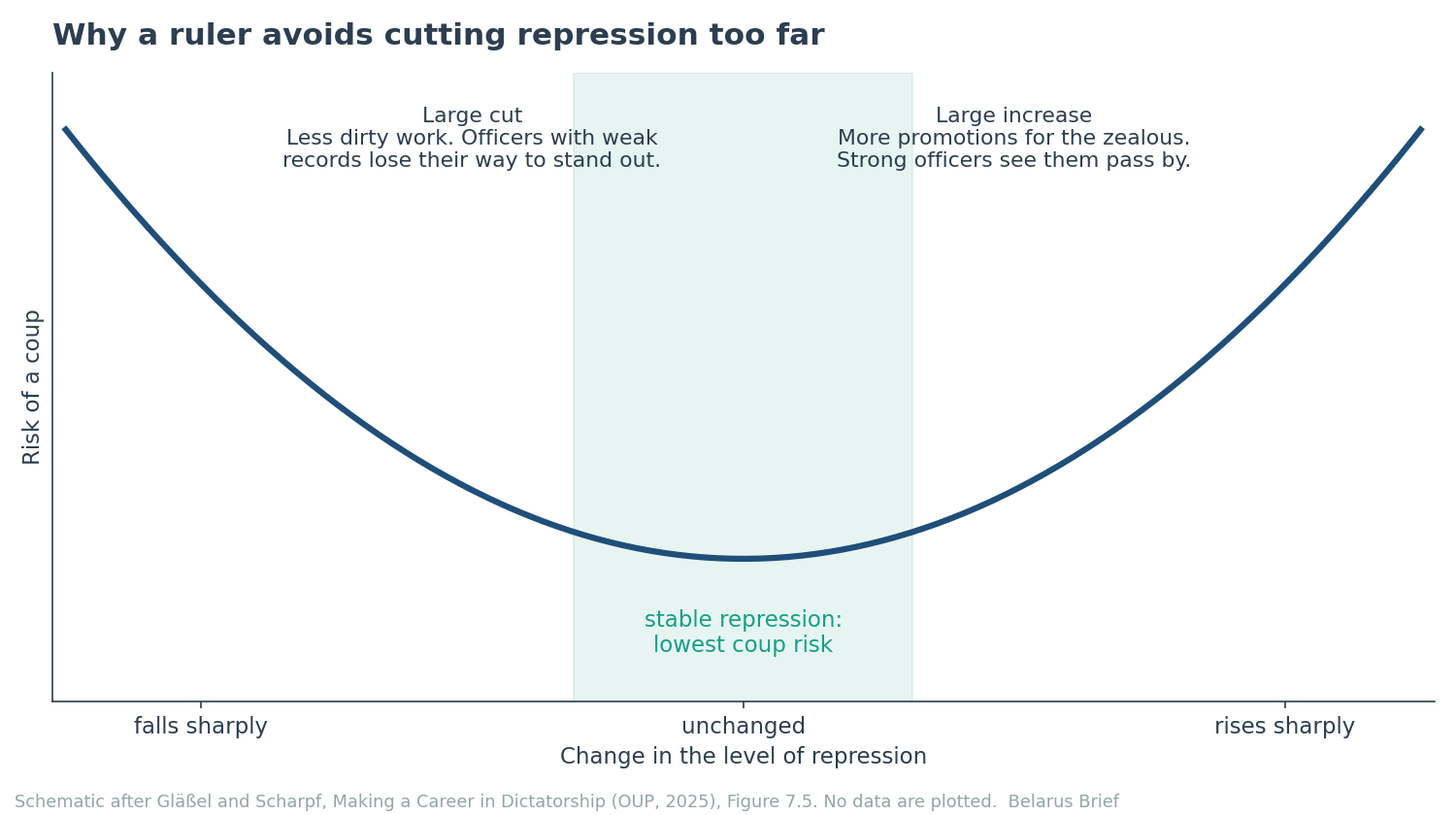
The second half of the book turns to the ruler, because if dirty work keeps weak officers loyal, then the amount of dirty work matters to him. The authors test this on all authoritarian regimes since 1945. Coup risk is lowest when repression is stable. It rises after large increases and after large cuts. A ruler who understands this, they write, will “invent threats, expand repressive institutions, and delegate violent tasks” so that his officers stay busy.
A stock and a flow
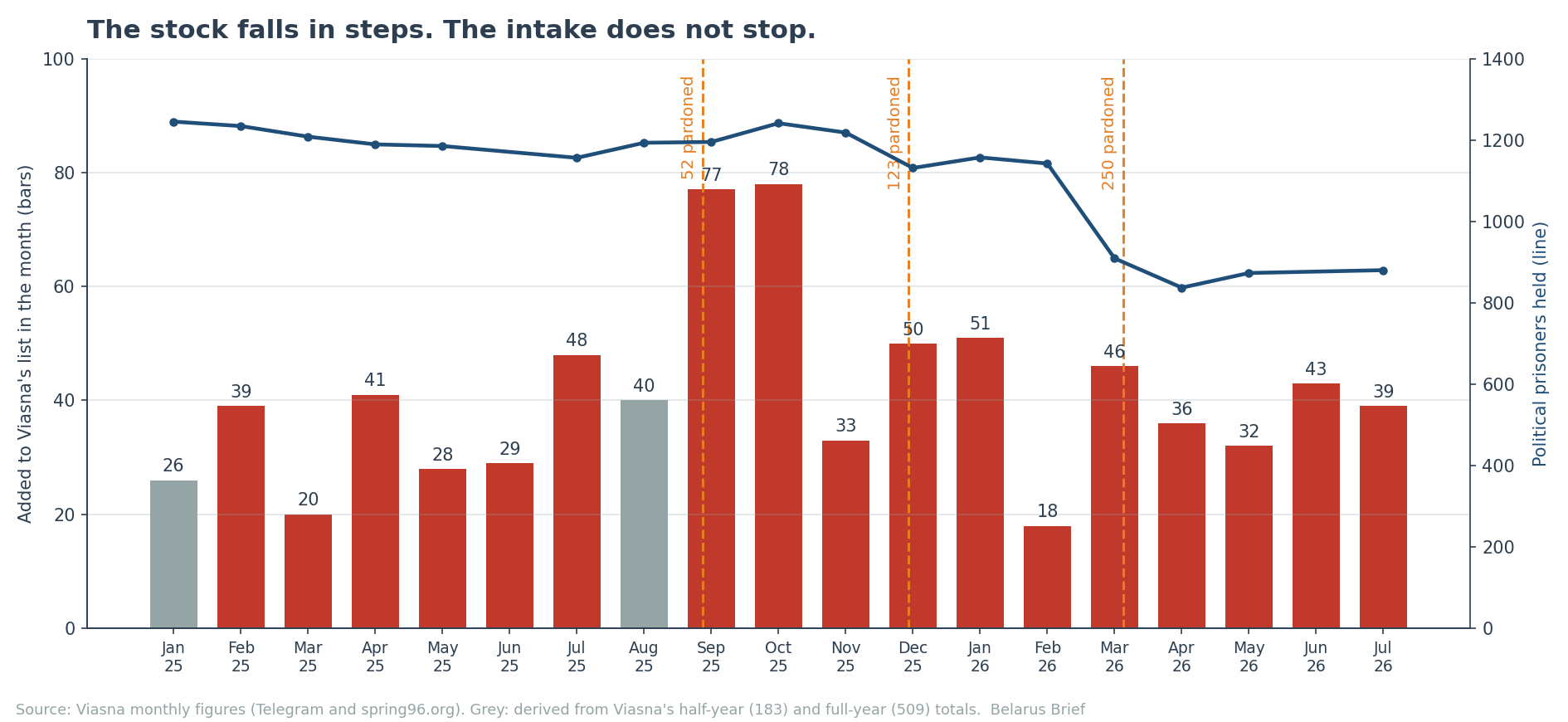
Read this way, the prisoner figures hold two different quantities. One is a stock, the number of people held on a given day: Viasna counted 1,135 on 23 December 2025, then 911 at the end of March after 250 people were freed, and 879 on 9 August. The other is a flow, the number of new cases. Viasna publishes it every month, and over these twelve months it averaged about 45. It never stopped: the lowest month was 18, in February 2026, and the highest was 78, in October 2025. Viasna’s review for December 2025 draws the same contrast for the whole calendar year. Up to 360 political prisoners were pardoned in 2025, and at least 509 people were newly recognised.
The stock is what Minsk trades, and each release had a price that was named in public. On 11 September 2025, when 52 people were pardoned, Washington lifted its sanctions on Belavia. On 13 December, with 123 pardons, it began to lift sanctions on potash. On 19 March 2026, the day 250 people were pardoned, the US envoy John Coale announced that Belaruskali and the Belarusian Potash Company were leaving all US sanctions lists, together with two banks and the Finance Ministry. In a year the stock fell by a little more than a fifth. Pardons were one of three ways off the list. People also finish their sentences, and in April 2026 Viasna reviewed the list and moved about 100 people to the status of former political prisoner.
Coup risk is lowest when repression is stable. It rises after large increases and after large cuts.
The flow is a different kind of number. No published term of any deal covers it, and it entered the talks only at the third deal. After the March release Coale said this was the first time he had raised new arrests with Lukashenko. “We free ten people and they arrest ten more,” he said, and he hoped Lukashenko had understood that this was unacceptable, Zerkalo reported. In the same remarks he said that everyone would be freed by the end of the year. The flow belongs to the people who produce it: investigators, GUBOPiK officers, prosecutors and judges. The book’s claim is that a ruler cuts this number at his own risk. The Belarusian series shows a ruler who has reduced the stock and left the flow alone.
The two highest months came straight after the first deal. Fifty-two people were pardoned on 11 September 2025. Viasna added 77 people to its list in September and 78 in October. Recognition follows arrest with a delay, so this does not prove a response. It does show that the first release did not slow the intake.
After the March release, and after Coale’s remark, the monthly figure ran lower: 36, 32, 43 and 39 from April to July. That is 150 people in four months, and a mean of 37.5 against 49.1 in the eight months before. Viasna warns against reading that as relief. Its review for May 2026 says that fewer recognitions do not mean less repression, because information on new cases has become harder to obtain. The stock points the same way. It stood at 837 at the start of May, at 873 a month later and at 880 at the end of July. A list can grow only if more people enter it than leave.
Output that does not follow the threat
The usual account of repression starts from a threat: people protest and the state answers. On that account the Belarusian numbers should have fallen by now. The last large street marches were in the autumn of 2020. Registered public associations went from 3,021 in January 2021 to 1,337 this year, as we showed in “The Cat Without the Grin”. Independent newsrooms work from abroad.
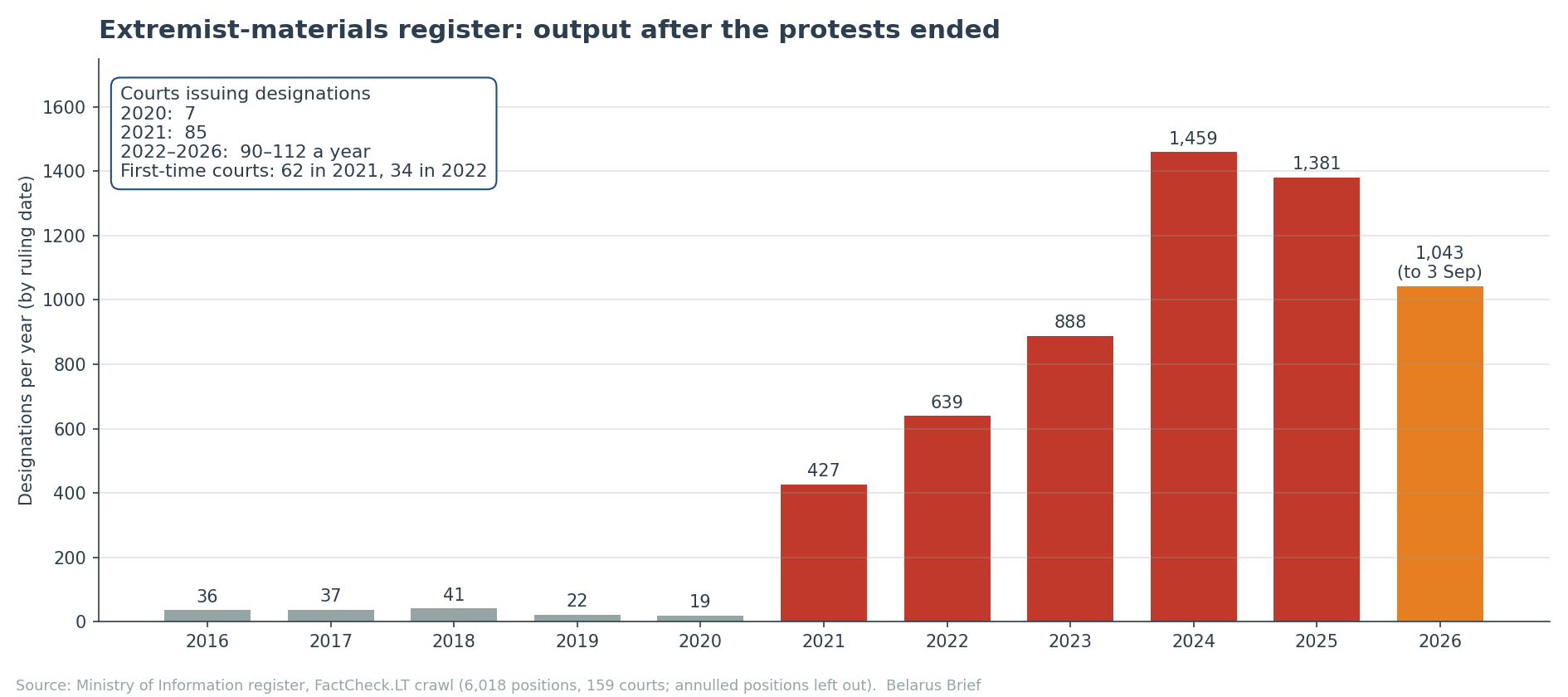
The Ministry of Information’s register of extremist materials moved the other way. Courts made 19 designations in 2020, then 427 in 2021, 639 in 2022 and 888 in 2023. The figure was 1,459 in 2024 and 1,381 in 2025. By 3 September this year it was 1,043, which is a pace of about 1,550 for the full year.
The number of courts matters more than the number of rulings. Seven courts issued designations in 2020. In 2021 there were 85, and in every year since there have been between 90 and 112. Sixty-two courts made their first designation in 2021 and another 34 in 2022. For each of them this was a new line of work, and it came with a public count attached. Viasna describes the process in similar terms. Its December review calls the designation of materials mechanical and conveyor-like, and says that new entries now mainly keep up the statistics of the “fight against extremism”.
The stock is what Minsk trades. No published term of any deal covers the flow.
The cases themselves often come from material the state already holds. In the second quarter of 2026, Human Constanta counted 297 people added to the “extremist” lists. Of these, 227 came from one case, the Belaruski Hajun chat bot, which closed in February 2025 after it was hacked. A seized database can supply a quarter’s work, and no new protest is needed for that.
The bench at twenty times the median
The book’s chapter on the NKVD in 1937 describes regional offices with wide freedom over whom to arrest, and numerical targets set by the centre. The authors call the result a perverse incentive system, one that officers with weak records used in order to stand out.
We have no evidence of quotas in Belarus and we do not claim any. What the register shows is how unevenly the work is spread. All 118 raions have at least one designation, and the median raion has 12. The single court in Maladechna has 236, the highest figure per bench in the country, as we found in “The Busiest Bench”. Neither population nor administrative rank explains a bench that works at twenty times the median.
In August we could only describe that gap, and the book turns it into a question about people. Who sits on that bench, and where were their careers in 2020? Belarusian judges are appointed and reappointed by Lukashenko’s decree, so the pressure the authors describe has an obvious channel. We have not yet looked.
For 96 courts this was a new line of work, and it came with a public count attached.
Where the fit stops
Belarus has had no coup attempt from inside the security services, so half of the book’s mechanism cannot be seen here. In 2020 the officers who disagreed left the service, and some of them formed BYPOL. The authors advise outside actors to make that kind of exit easy, and Minsk made it costly. On 4 May 2021 Lukashenko signed decree No. 174, which stripped more than 80 former officers of their ranks. Outlets that counted the published list found 86 or 87 names. The Interior Ministry listed BYPOL as an extremist formation on 8 November 2021, and the Supreme Court declared it a terrorist organisation in August 2022. The group split in 2023, and most of its staff now work under the name BELPOL.
A larger limit concerns the evidence, because our series fit the ordinary explanation too. The state may simply see an exile Instagram account as a threat and designate it for that reason. A steady policy would produce a steady flow, and so would an apparatus that needs work. The two readings separate only when the stock moves sharply, and that is happening now. If new cases fall for two quarters after a large release, the ordinary reading is the better one.
The book rests on personnel files and this piece rests on output counts, which is weaker evidence. Part two will use the book’s own kind of data. The EU listed 84 Belarusian officials between October and December 2020, and most of them served in law enforcement or the courts. We are coding where each of them stood in August 2020 and where each stands now. We will also count how many have ever been removed from the list. The authors argue that sanctions change behaviour only when they offer a way out.
If new cases fall for two quarters after a large release, the ordinary reading is the better one.
What to take from this
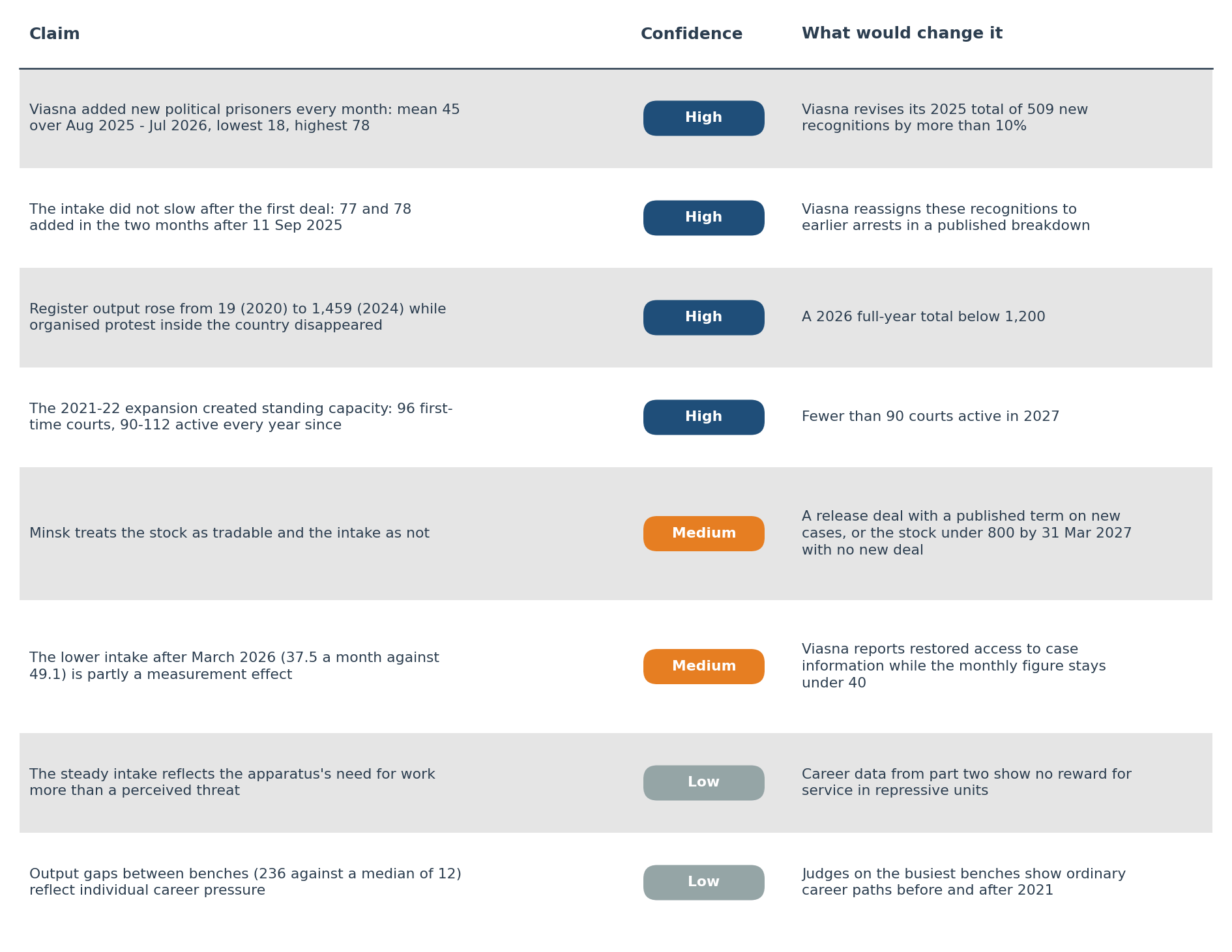
Minsk reduced the number of political prisoners by about a fifth in a year. Viasna added new ones every month: 45 on average, never fewer than 18.
The two highest months, 77 and 78, followed the first US-brokered release. Since May 2026 the total has been rising again.
The extremist register grew from 19 designations in 2020 to 1,459 in 2024, while organised protest inside the country disappeared.
In 2021 and 2022, 96 courts began this work for the first time. Between 90 and 112 courts have done it every year since.
The book’s explanation is possible, and our data cannot yet confirm it. The confirming evidence would be careers, and that is part two.
Watch items
9 August 2027. Viasna’s count of new political prisoners for the twelve months before that date. If the book’s reading holds, the figure stays above 450 even if another release of 200 or more takes place. A figure below 300 counts against it.
31 December 2026. Coale’s own deadline: “by the end of the year we will free everyone.” Viasna’s list stood at 880 at the end of July. We expect more than 600 names on it on 1 January 2027. If the list is emptied, the test moves to the intake: at 45 a month it would hold about 270 names again by mid-2027.
31 March 2027. The stock, read together with the monthly figure. Viasna says its count of new cases is losing coverage, so a low monthly figure alone proves little. The stock is the check: sentences end every month, and the list shrinks unless new people enter it. If the stock is under 800 on this date and no new release deal has taken place, the intake has really fallen and the ordinary reading gains. If it is at 880 or above, the intake has held.
15 January 2027. The register’s total for 2026. We expect between 1,450 and 1,650 designations. A total under 1,200 would mean the pace broke in the autumn.
The next release deal. Whether any published term of it concerns new cases. So far none has.
Method and limits
The release dates, the sanctions steps, decree No. 174, the two BYPOL designations and the three EU listing rounds of 2020 (40, 15 and 29 people) were checked against dated reports in our corpus before publication. Coale’s remarks are given as Zerkalo and Radio Svaboda carried them on 20 March 2026, in Russian and Belarusian. The English here is our translation of those versions, and we have not found the original wording.
Prisoner counts are Viasna’s, read from its Telegram channel by a parser and checked by hand against named posts. Viasna’s list is a recognition list: it lags behind arrests, and people leave it by finishing their sentences as well as by pardon. Monthly figures are Viasna’s own. They come from two recurring posts on its Telegram channel, the list of people recognised in the month and the monthly human rights review, and from the same reviews on spring96.org. Where the two posts differ (February 2025: 33 and 39, April 2025: 33 and 41) we use the review, which matches Viasna’s half-year total of 183. December 2025, 50, comes from the review on spring96.org. Two months are derived. For January 2025 we use 26, which is the half-year total less the other five months; the Telegram post of 28 January said 18. For August 2025 we use 40, which is Viasna’s total of 509 for 2025 less the other eleven months; the post of 27 August said 37 so far. The twelve calendar months from August 2025 to July 2026 add up to 543. The published figure of 538 covers 10 August to 9 August, so the two agree to within one per cent.
We first tried to build this series by adding up single recognition statements from all outlets. The result was 1,948 against a known 538, because recaps, pardons and lists of former prisoners were counted as new cases. We discarded it.
Register figures come from our crawl of the Ministry of Information’s list: 6,018 positions by 159 courts, with ruling dates from 4 September 2008 to 3 September 2026. Counts are by ruling date and leave out the six annulled positions, which is why 2024 stands at 1,459 here and at 1,462 in “Written in Pencil”. “Courts” means courts that appear in the register in a given year. It does not measure judges or hearings.
The U-shaped curve is drawn after Figure 7.5 of the book and carries no data. The book’s cross-national test concerns coups, and this piece makes no forecast about one. The sentence on judicial appointments describes the formal procedure. We hold no career data on any judge and name none.
The lists of “extremist formations” and of persons kept by the Interior Ministry are separate instruments from the register of materials. The Human Constanta figure refers to those lists.