
Belarusian GDP grew 1.9% in January to August, down from 2.1% a month earlier — the first fall after six months of steady rise. Belstat says the shift in the grain and rapeseed harvest between 2025 and 2026 explains the change, and the Eurasian Development Bank puts a number on it: agricultural growth fell from 12.9% to 6.5%. What we do not yet know is whether the harvest explains all of the slowdown or only part of it. The answer comes with the full-year figures.
What changed
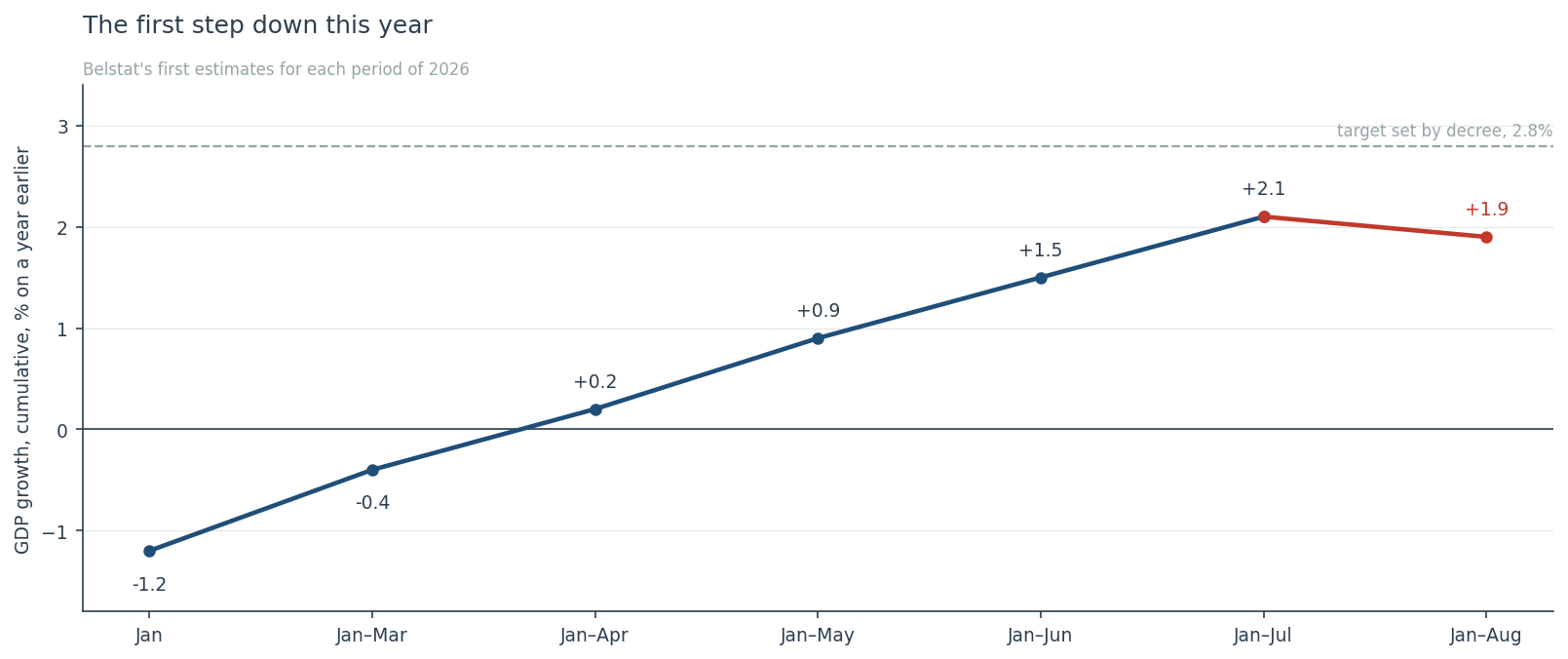
Through the first seven months of 2026 the cumulative growth rate rose every month. It started at −1.2% in January and reached 2.1% by the end of July, about six tenths of a point per release.
The first estimate for January to August puts GDP at 209.1 billion rubles in current prices, 1.9% above the same period of 2025. The deflator is 113%, almost unchanged from July.
A cumulative rate that falls from 2.1% to 1.9% means August itself grew more slowly than the months before it. We cannot say how much more slowly, because Belstat does not publish single-month GDP and the months carry different weights.
Six months of rise, then the first step down.
The explanation on offer
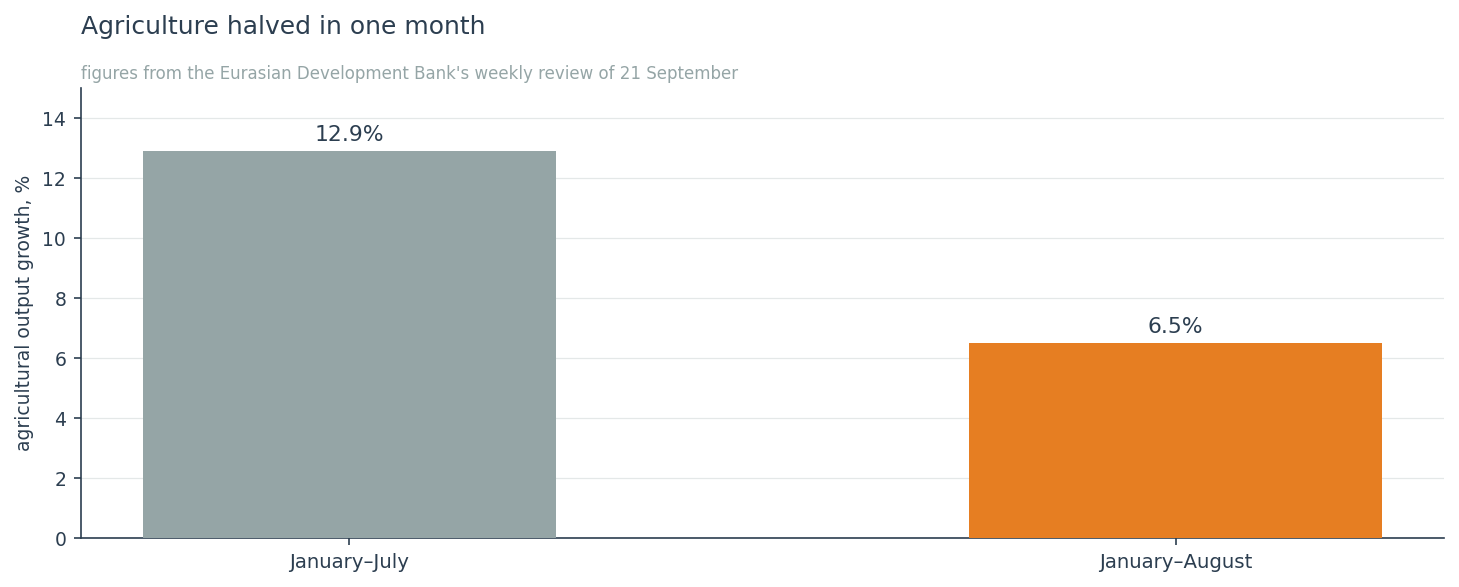
Belstat added one sentence to the release: the shift in the timing of the grain and rapeseed harvest in 2026 compared with 2025 affected value added and GDP. The Eurasian Development Bank’s weekly review of 21 September gives the figure: growth in agriculture slowed to 6.5% from 12.9%.
The direction is also on record. In late August the same bank raised its forecast for Belarus and gave the earlier harvest as the reason. The mechanism is simple: July 2026 compared well against a July 2025 when little had yet been gathered. By August, last year’s harvest was in, and the comparison became fair again. The same crop, counted a month earlier, raises one month and lowers the next.
The same crop, counted a month earlier, raises one month and lowers the next.
A second explanation
There is another reading, and it predicts something different.
Industry contributed almost nothing to growth this year. Over January to July industrial output stood at 100.1% of the year before; we did not find a January–August figure in the releases we checked. If the economy is slowing more broadly, the harvest shift is a real effect but not the whole of it, and other parts of the economy will weaken in the months ahead.
The two readings separate at the end of the year. If timing is the whole story, the full-year agricultural figure will settle well below the mid-year 12.9%, and total GDP will hold near 2%. If a wider slowdown is also under way, industry and services will weaken as well, and the full-year rate will fall below 2%.
The Eurasian Development Bank leans to the first reading: without new shocks, it says, growth for the year could exceed 2%.
The two readings separate at the end of the year.
Does this change what we wrote in August?
In Climbing Toward the Decree on 19 August we described the steady climb toward the 2.8% target and found that it rested on agriculture and retail, with industry adding almost nothing.
That finding about composition still holds. What changes is how to read the agricultural part. Some of it was calendar rather than output, which makes the climb look less like a trend than it did a month ago. The gap to the decreed target has also widened again, from 0.7 points to 0.9, and the bank’s own forecast of just over 2% would leave it short.
The composition finding holds. Part of the agricultural boost was calendar.
Confidence
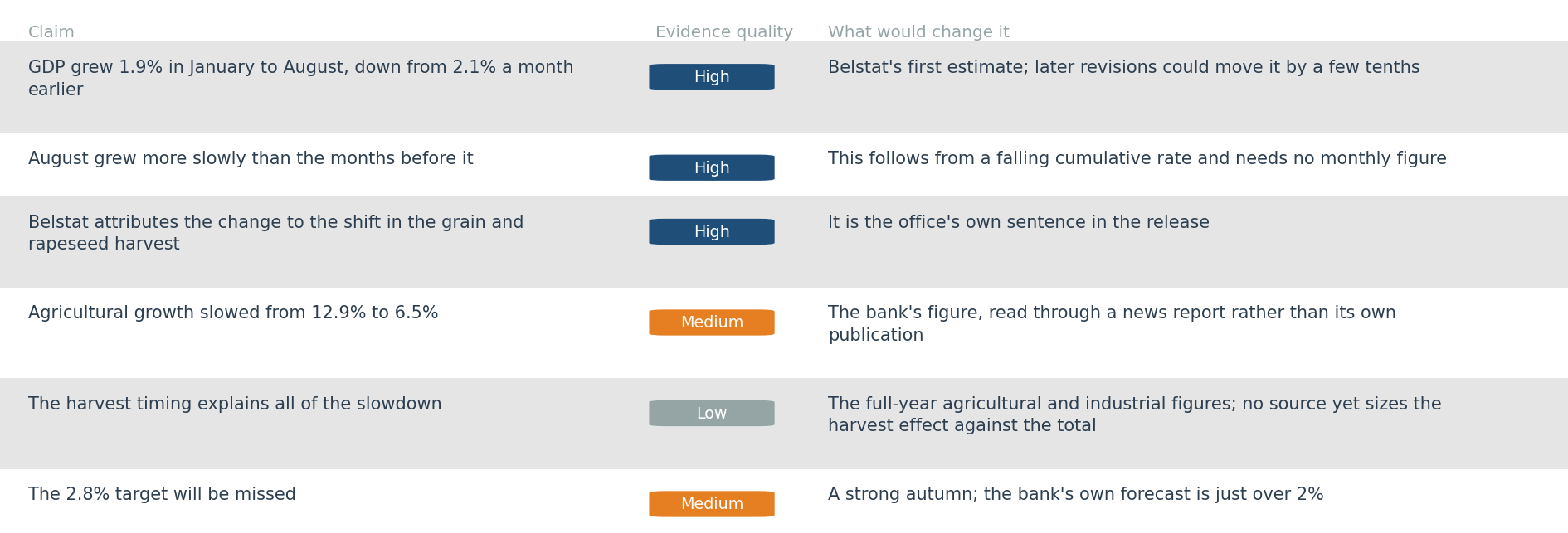
In text: the growth figures and Belstat’s harvest explanation come straight from the release, so the evidence is strong. The agricultural figures are the bank’s, read at second hand. Whether the harvest explains all of the slowdown is not yet known, and the evidence for it is weak.
Watch
The January–September estimate, due in mid-October. If timing is the whole story, the agricultural contribution keeps normalising and total growth stays near 1.9–2.0%.
The full-year agricultural figure for 2026, early next year. Well below 12.9% supports the timing reading.
A January–August industrial output figure, and whether it has moved off 100%.
Whether the 2.8% target is quietly dropped from official statements before the year ends.
Method and limits
The GDP figures are Belstat’s first estimates as carried by BelTA and SB; first estimates are revised later, sometimes upward. The agricultural figures are from the Eurasian Development Bank’s review, which we read through a Belarusian news report rather than the bank’s own publication.
We do not estimate August’s single-month growth. It would require monthly weights that Belstat does not publish, and a rough calculation could mislead.
Belstat’s explanation names the harvest timing but not its size. The bank’s figures give the size for agriculture. Neither source says how much of the overall slowdown the harvest accounts for, and that is the question the year-end data should answer.