

Last week Media IQ reported that Belarusian state television now gives Polish society a much larger share of its talk about Poland than a year ago. We tested that finding on 6,400 sentences about Poland from state websites, state YouTube channels and pro-government Telegram, January 2025 to October 2026. The rise is real on video and smaller in text, and most of it comes from one theme: how Poles treat Ukrainians. We cannot yet say whether it will outlive the summer that produced it.
The number holds
Media IQ’s report, published on 6 November, studies the image of Poland in Belarusian state media from January 2025 to September 2026 (Media IQ). One finding concerns the subject of each statement. In Belteleradio’s weekly talk show «Editors’ Club», 74% of statements about Poland in September 2025 concerned the government and its institutions. Only 9% concerned society. In July–September 2026, the share about society was 26%.
Media IQ adds a caveat of its own. The figure, it says, shows who is being talked about. It does not measure hostility. The report also suggests that in some of these statements the line between the authorities and the people disappears. That second point is a claim about hostility, and it can be tested.
We did not code the talk show itself. Our corpus holds the websites of BelTA, SB, CTV and ONT, eleven state YouTube channels and pro-government Telegram channels, 99 of which appear in our sample. Only two YouTube channels, NEWS.BY and SB TV, were collected for the whole period, so we use them as a fixed panel.
On that panel, September 2025 looks almost exactly like Media IQ’s talk show, although our sample for that month is small (44 sentences): 73% of statements about Poland concern the state and 9% concern society. In July and August 2026, society rises to 19%. Media IQ’s 26% sits at the top edge of our margin of error. Different programmes and a separate coding run give the same direction and a similar size. That is good evidence that the original measurement is sound. In August we were critical of a reach study that Media IQ presented with Press Club (Belarus Brief). This measurement holds up better.
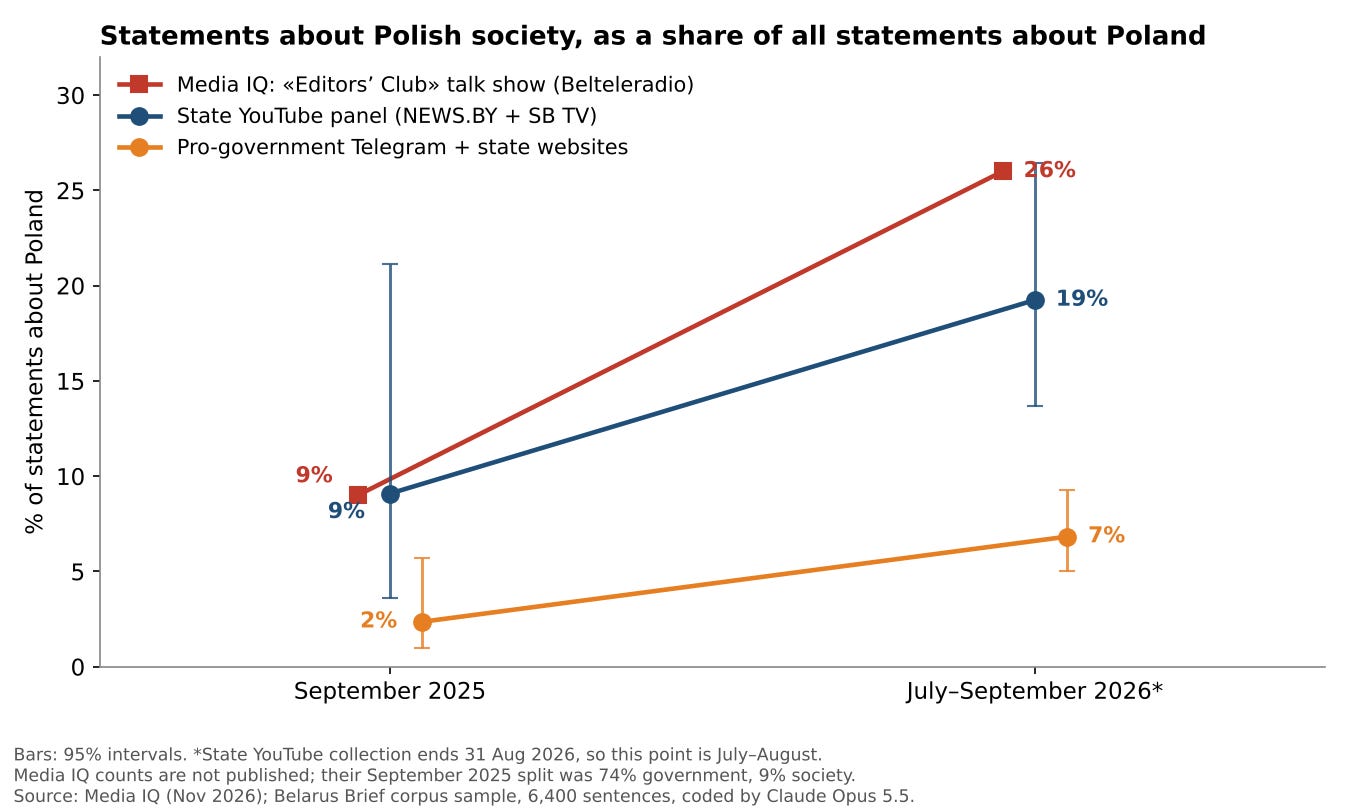
Text channels move less. In pro-government Telegram and on the state websites, the share about society goes from 2% in September 2025 to 7% in July–September 2026. From here on we compare society with the state only and leave out history, sport and other topics. This keeps quarters with a lot of history talk comparable.
Different programmes and a separate coding run give the same direction and a similar size.
What the summer was about
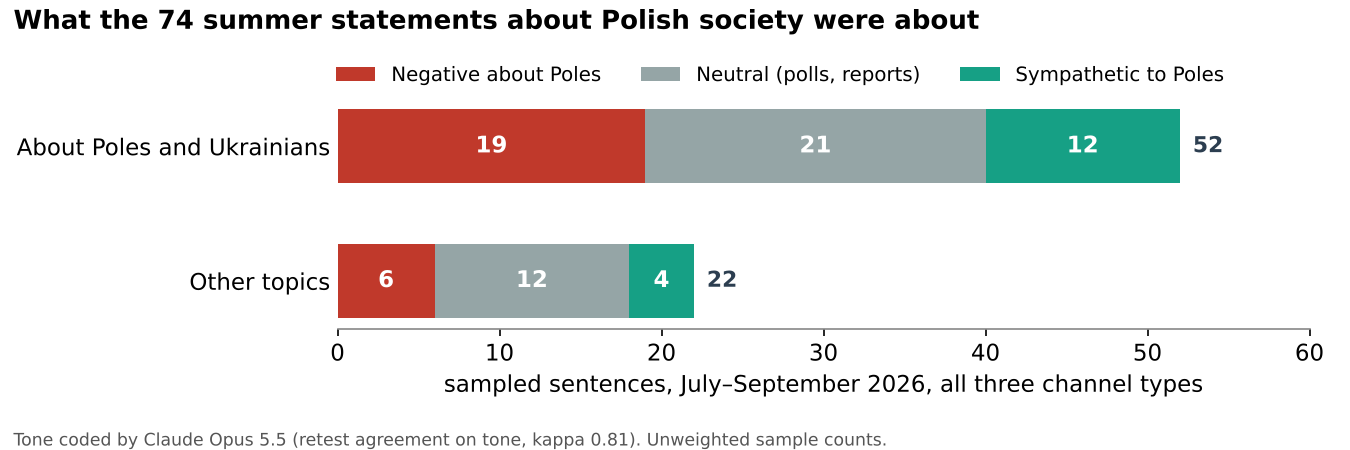
We read all 74 summer statements about Polish society in the sample. Fifty-two of them, or 70%, are about Poles and Ukrainians.
Some report polls. On 12 August BelTA wrote that most Poles supported deporting unemployed Ukrainians (BelTA). The opposition party PiS had proposed it, and an IBRiS poll for Rzeczpospolita put support at 67% (Kyiv Independent). Others go back to the Volhynia massacre or describe violence against Ukrainians in Poland today. On 11 July NEWS.BY said that Poles “cannot and will not forgive” how the UPA killed thousands of their ancestors (NEWS.BY). On 30 July the same channel said that Poles who hear Ukrainian spoken “start using their fists” (NEWS.BY).
The calendar gave these stories material. The march in memory of the Volhynia victims took place in Warsaw on 4 July (BelTA). Ukraine reburied the OUN leader Andriy Melnyk in May and brought home the remains of Yevhen Konovalets in August. At the same time, concern grew in Poland that a planned national pantheon could honour the UPA (Euromaidan Press).
Take this theme out and the summer rise disappears. In Telegram and on the websites, society made up 4.5% of statements about the state or society in July–September 2026, against 7.6% in early 2025. On the YouTube panel the figure was 7.4%, against 9.0% in early 2025.
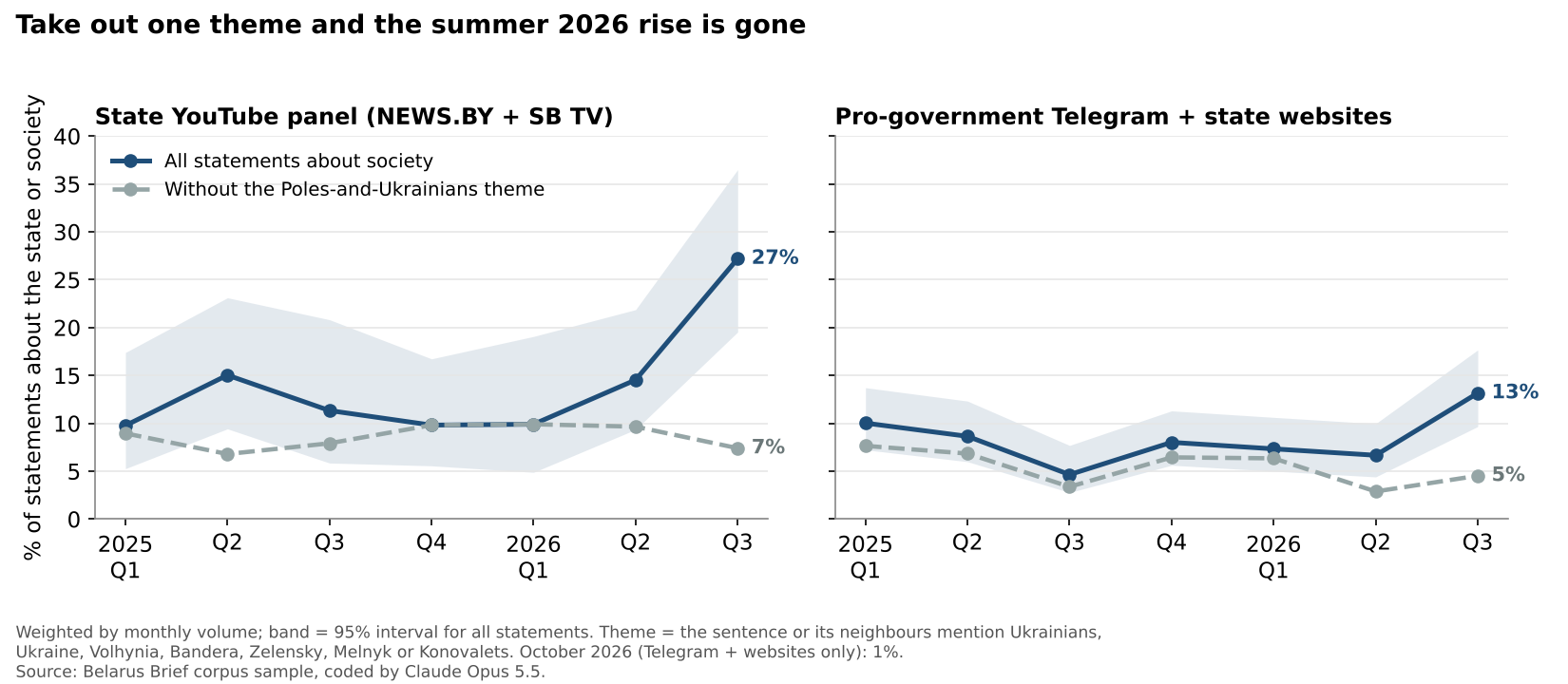
There is another way to read this. The Polish–Ukrainian theme could be the door through which a wider habit of talking about Poles as a group enters state media. In that case, the share without the theme should start to grow after the summer. In October 2026 it went the other way. Only 2 of 200 sampled sentences from Telegram and the websites were about Polish society.
How much of it is hostile
Talking about a people is a different act from attacking it. Only 25 of the 74 summer statements were negative about Poles. Thirty-three were neutral, mostly polls and reports, and 16 were sympathetic. The sympathetic ones often take the Polish side against Kyiv, with Volhynia as the main example.
Take this theme out and the summer rise disappears.
A cleaner test looks at negative statements only. In September 2025, about 1 in 70 negative statements about the Polish state or society was aimed at society. In July–September 2026 it was about 1 in 9: 11% in Telegram and on the websites, 12% on YouTube. That is a real increase. Nearly nine in ten hostile statements are still aimed at the state and its security services.
Some of the negative statements carry a message for Belarusians. On 5 August the Telegram channel of CTV presenter Grigory Azarenok listed “insults on the streets, beatings” and demands to “go home”. It called this “the new reality for those who only yesterday called Belarus a dictatorship” and went to Poland (Telegram). The post is addressed to Belarusian emigrants, and Polish society appears in it as a warning.
Media IQ’s point about a blurred line also finds some support. In 18 of the 74 summer statements, a trait is given to Poles as a whole, and 12 of these are about Poles and Ukrainians. A commentator quoted by BelTA said that Poles are pragmatic, “but nationalism, which is very strongly developed in Poland, is gaining momentum” (BelTA). Such generalisations were also present in early 2025, in 8 of 48 statements about society.
A baseline near the bottom
September 2025 is a convenient starting point, but an unusual one. Poland closed its border with Belarus on 12 September because of the Zapad 2025 exercises (Polish interior ministry) and reopened it two weeks later (Novaya Gazeta Europe). That month the state dominated: it was the subject of 64% of statements about Poland in Telegram and on the websites, and of 78% on YouTube. It was also the busiest month for Poland in our data. Pro-government Telegram produced 14,627 sentences about Poland, more than twice its usual monthly number.
Nearly nine in ten hostile statements are still aimed at the state and its security services.
So September 2025 sits near the bottom of the series for society. In Telegram and on the websites, society took 3.5% of statements about the state or society that month, against 10% in early 2025. With 133 statements in that comparison, part of the dip may also be chance. Any comparison that starts there will look steeper than the full series. The YouTube panel rise survives this test, because no earlier quarter was above 15%. The text-channel rise does not survive it. The summer 2026 figure of 13% is within the margin of error of early 2025.
What the word «поляки» hides
A simple count of the word «поляки» (Poles) would mislead. In our sample, 24% of text-channel sentences that use «поляки» or «польский народ» are about the Polish state, and on YouTube the figure is 33%. Only about 30% are about the people. In a September 2025 report, a driver told SB: “We arrived, reloaded, and then the Poles closed the border” (SB). The Poles in that sentence are the Polish government.
Talking about a people is a different act from attacking it.
This matters for any study that counts words. It also matters for Media IQ’s question. If state media were erasing the line between government and people, ethnic words for the state should become more common. They did not. The share of «поляки» used for the state was 24% in early 2025 and 17% in the summer of 2026, a difference within the margin of error.
Confidence
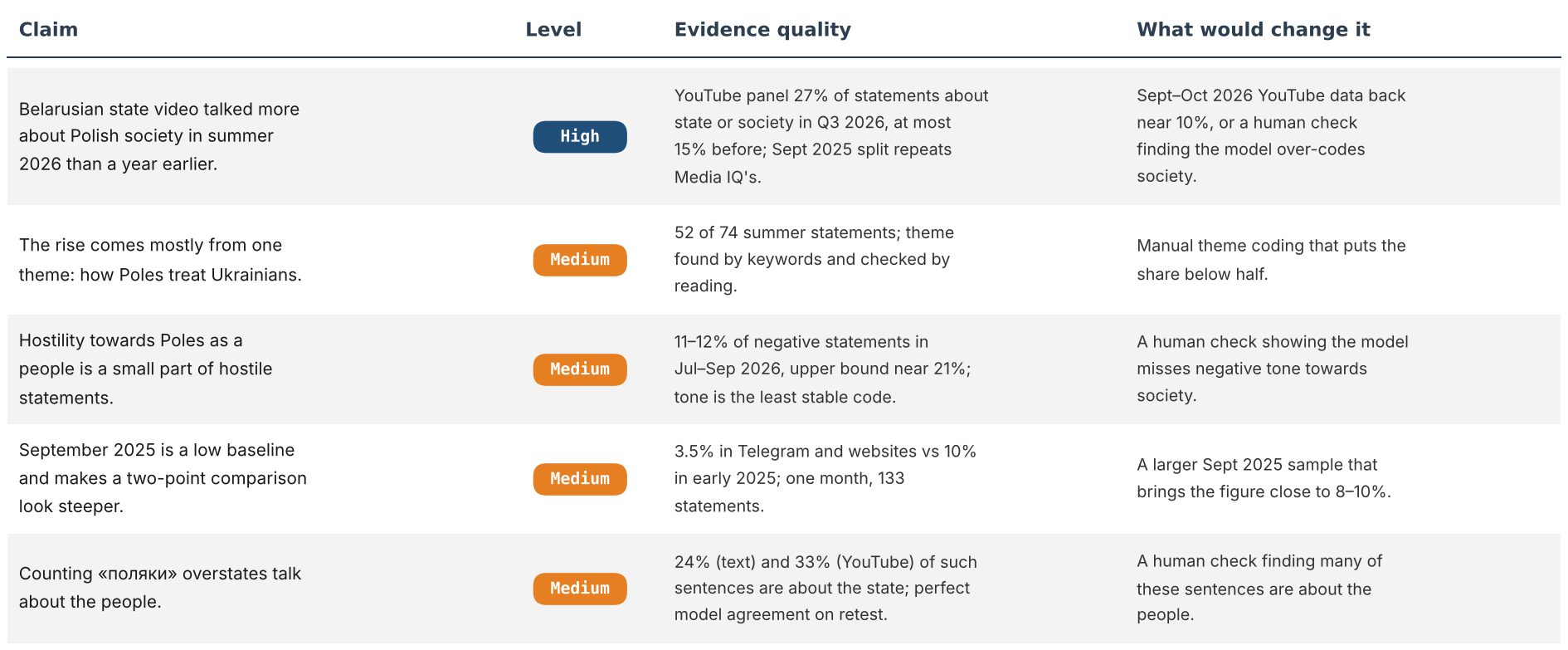
Belarusian state video talked more about Polish society in summer 2026 than a year earlier. High. Evidence: YouTube panel at 27% of statements about the state or society in Q3 2026, against at most 15% in earlier quarters; the September 2025 split repeats Media IQ’s. Would change it: September–October 2026 YouTube data falling back to 10%, or a human check finding that the model over-codes society.
The rise comes mostly from one theme, how Poles treat Ukrainians. Medium. Evidence: 52 of 74 summer statements; theme found by keywords and checked by reading. Would change it: a manual theme coding that puts the share below half.
Hostility towards Poles as a people is a small part of hostile statements. Medium. Evidence: 11–12% of negative statements in July–September 2026, with an upper bound near 21%; tone is the least stable code. Would change it: a human check showing that the model misses negative tone towards society.
September 2025 is a low baseline and makes a two-point comparison look steeper. Medium. Evidence: 3.5% in Telegram and on websites against 10% in early 2025; one month, 133 statements in the comparison. Would change it: a larger September 2025 sample that brings the figure close to 8–10%.
Counting «поляки» overstates talk about the people. Medium. Evidence: 24% (text) and 33% (YouTube) of such sentences are about the state, with perfect model agreement on retest. Would change it: a human check that finds many of these sentences are about the people.
Evidence quality. All codes come from one model, Claude Opus 5.5, checked against itself but not against a human coder. The YouTube layer covers two channels for the full period and ends on 31 August 2026. Media IQ has not published the counts behind its 9% and 26%, so the comparison uses their percentages only.
Watch items
By 31 January 2027: in Q4 2026, society will stay below 8% of statements about the Polish state or society in pro-government Telegram and on state websites. Medium.
By 15 August 2027: in July 2027, the month of the Volhynia remembrance, the same share will rise above 10%, and at least half of the statements about Polish society will be about Ukrainians. Medium.
By 31 December 2027: in the three months before Poland’s 2027 parliamentary election, the share without the Polish–Ukrainian theme will stay below 8%. Low.
How it fits
Observation: in July–August 2026, Belarusian state media turned a Polish domestic dispute, about Ukrainian refugees and the UPA legacy, into the main reason to talk about Polish society. Fifty-two of the 74 summer statements about Polish society came from it.
Fit: our working thesis T3 says that state media amplify neighbours’ internal conflicts, and more so around elections. The first half fits. The second half does not. There was no Polish election in summer 2026, although PiS presented its deportation plan as a promise for when it returns to power.
Alternative: the amplification followed the news calendar. The Volhynia march, two reburials and a poll gave state media ready material.
What would separate them: a rise in the share in the months before the 2027 election, with no Volhynia-type event, would support T3. A rise only around July anniversaries would support the calendar.
Method and limits
The data come from the FORESIGHT corpus: the websites of BelTA, SB, CTV and ONT; eleven state YouTube channels; and pro-government Telegram channels. The period is January 2025 to October 2026. We took every sentence that names Poland, Poles, Warsaw or Polish leaders: 201,386 sentences. Of these, 66,476 were reposts or repeated texts and were removed before sampling. Before the count we removed a feed of other headlines from CTV texts. We re-fetched SB texts that had been cut short in the first half of 2026. We also excluded independent channels, such as Belsat and Radio Svaboda, that a one-off April 2026 YouTube collection had labelled as state media. News digests were left out.
The sample is 100 sentences per month for each of the three channel types, 6,400 in total. Each sentence was coded together with the sentence before and after it. Results are weighted by the monthly number of unique sentences, and the intervals are 95% intervals adjusted for the weights.
Coding was done by Claude Opus 5.5 (Anthropic) through the Message Batches API, with a written codebook. It records who the statement is about (ten categories, including the government, the security services and society), whether a word for the people stands for the state, the tone, any trait given to the whole people, and insulting labels. We chose the model after a pilot of three Claude models on 50 sentences, where Opus made the fewest clear errors on the subject of the statement. The codebook was then tightened on the cases the pilot found. Two hundred sentences were coded a second time, mixed with different sentences. Agreement was 0.84 on the subject of the statement (Cohen’s kappa), 0.87 for state, society and other, 0.81 for tone and 1.0 for the ethnic word used for the state. No human coder checked the labels. Media IQ also coded with Claude, and a researcher checked its codes: in full for its first talk-show corpus, in part (33–53% of coded units) for the other episode groups.
The Polish–Ukrainian theme was marked by keywords in the sentence and its neighbours (Ukrainians, Ukraine, Kyiv, Volhynia, Bandera, Zelensky, Melnyk, Konovalets). It is an exploratory tag. Claude also read all 74 summer statements about Polish society in full.
The YouTube layer has gaps. Collection for ONT, CTV and BelTA stopped in March 2026, and the whole layer ends on 31 August 2026. SB TV changed its channel name in March 2026, and both names are counted as one channel. Our YouTube layer has no Belarus-1 channel, and we did not code the talk show that Media IQ studied.
Thesis tag: T3. Coding, analysis and the drafting of this text were done with Claude.