
A new monitoring report maps how the Belarusian state turned its schools and universities into instruments of loyalty. Its foreword warns that the state has begun to hide its own count. We checked which counts still run, and what the remaining ones can show.
On 29 October the SCIENCE AT RISK Emergency Office in Berlin published “Coercion, Isolation, Defiance”, its 2026 monitoring report on Belarus. It follows education from kindergarten to the National Academy of Sciences. Its foreword warns that since 18 September the Ministry of Internal Affairs no longer publishes its weekly list of people designated “extremist”. We do not know whether that silence hides a rise in repression or follows a fall, and nobody outside the state can yet tell the two apart.
The whole path in one place
The report’s main strength is its reach. Most writing on Belarusian education looks at one level, usually the university. This report follows one child through the whole system and shows that each stage now has its own instrument.
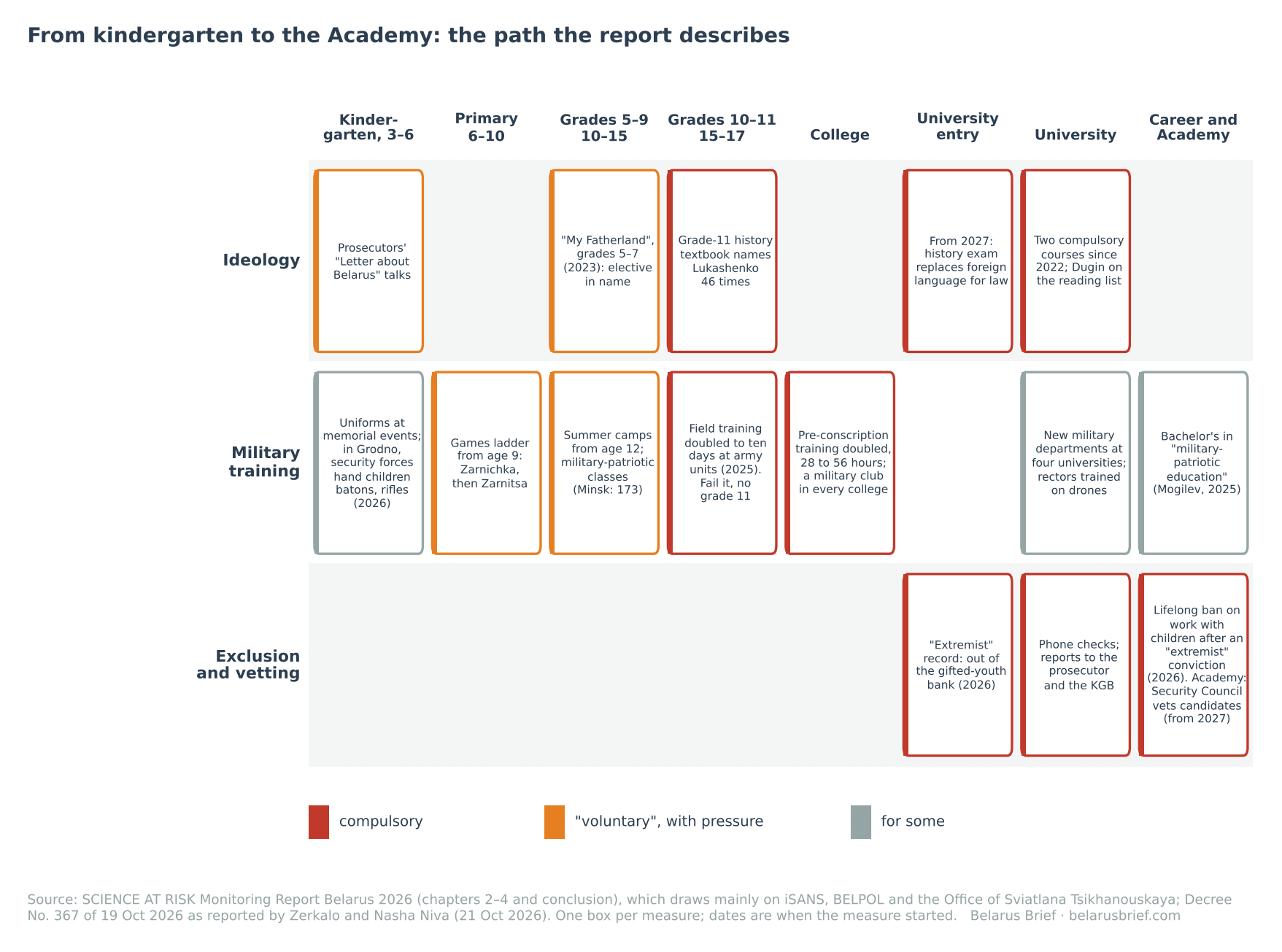
At the kindergarten level, prosecutors run talks on the “Great Patriotic War” and state symbols. In grades 5 to 7 there is an elective called “My Fatherland”; the report says such “elective” courses are often made mandatory in practice. Its first topic reads: “The President of the Republic of Belarus is A.G. Lukashenko.” Since September 2025, tenth-graders spend ten days and nights at army units and in tent camps, twice as long as before. A pupil who fails this training cannot move up to grade 11. From 2027, a state history exam will replace a foreign language as an entry subject for law. At university, two ideological courses have been compulsory for every student since 2022.
The last step is the newest. On 19 October Lukashenko signed Decree No. 367, a new statute for the National Academy of Sciences. From spring 2027, the State Secretariat of the Security Council must clear every candidate for academician or corresponding member, Nasha Niva reported. A fine for joining a protest is enough to block a nomination. The number of seats falls from 100 to 90 for academicians and from 145 to 120 for corresponding members, according to Zerkalo.
State media reported the decree on the day it was signed, under headlines about “large-scale transformations” in the Academy, for example BelTA and SB. Belarus Segodnya. In the texts our corpus holds, none of these state reports mentions the Security Council check. It appears in our corpus only from 21 October, two days later, and only in independent outlets.
The report also names people. Its Table 1 lists fourteen teachers, students, researchers and college staff added to the “extremist” list in 2026, with their institution, town and charge. Its last chapter describes quiet resistance. Universities may design their own versions of the compulsory courses, and many used that room to drop Dugin from the reading list, Pavel Tereshkovich told the authors.
This finding sits uneasily with the report’s title. The introduction says that state control over education and science “has become systemic and total”. The last chapter says that universities “retain some room to develop their own teaching materials”, and that many used it. It adds that this “does not amount to academic autonomy”. The evidence the report collects describes near-complete formal control with small gaps that staff still use. The word “total” in the title hides those gaps. They matter to funders and partners who want to know where support can still reach people inside Belarus.
Which counts still run
The foreword’s warning deserves a closer look. Belarus keeps several public registers, and they did not all stop at once.
The lists of people went dark. The list of materials did not.
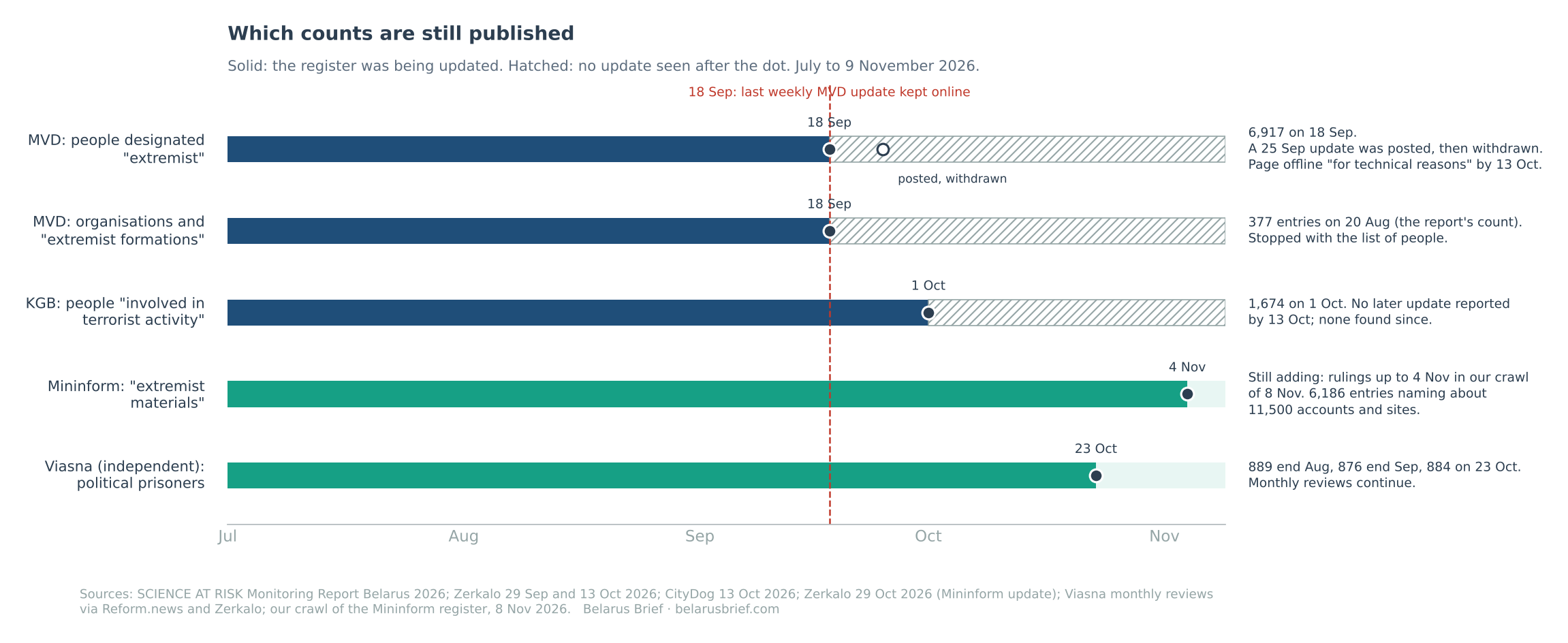
The Ministry of Internal Affairs updated its list of people every Friday. On 25 September it published an update with 13 new names, bringing the total to 6,930. A few days later it put the 18 September version back online, Zerkalo reported. By 13 October the page said it was “temporarily unavailable for technical reasons”, according to CityDog. The KGB list of people “involved in terrorist activity” was last updated on 1 October, with 1,674 names, Zerkalo wrote on 13 October. We found no report of a later update. In our corpus, every item about the halt from 29 September to 6 November came from independent or exile media, starting with Zerkalo and UDF on 29 September. We found none in state outlets.
The Ministry of Information’s register of “extremist materials” kept growing. On 29 October Zerkalo reported a new batch that included TikTok, Threads, Facebook and Telegram accounts and one website. Our own crawl on 8 November found court rulings up to 4 November. The registers that stopped list people. The one that continues lists things people may read, follow or share. Liking or sharing a listed item can bring a fine or detention, the report notes, so this is the register that ordinary readers inside Belarus most need to check.
It also did not slow down in the summer, when the list of people did.
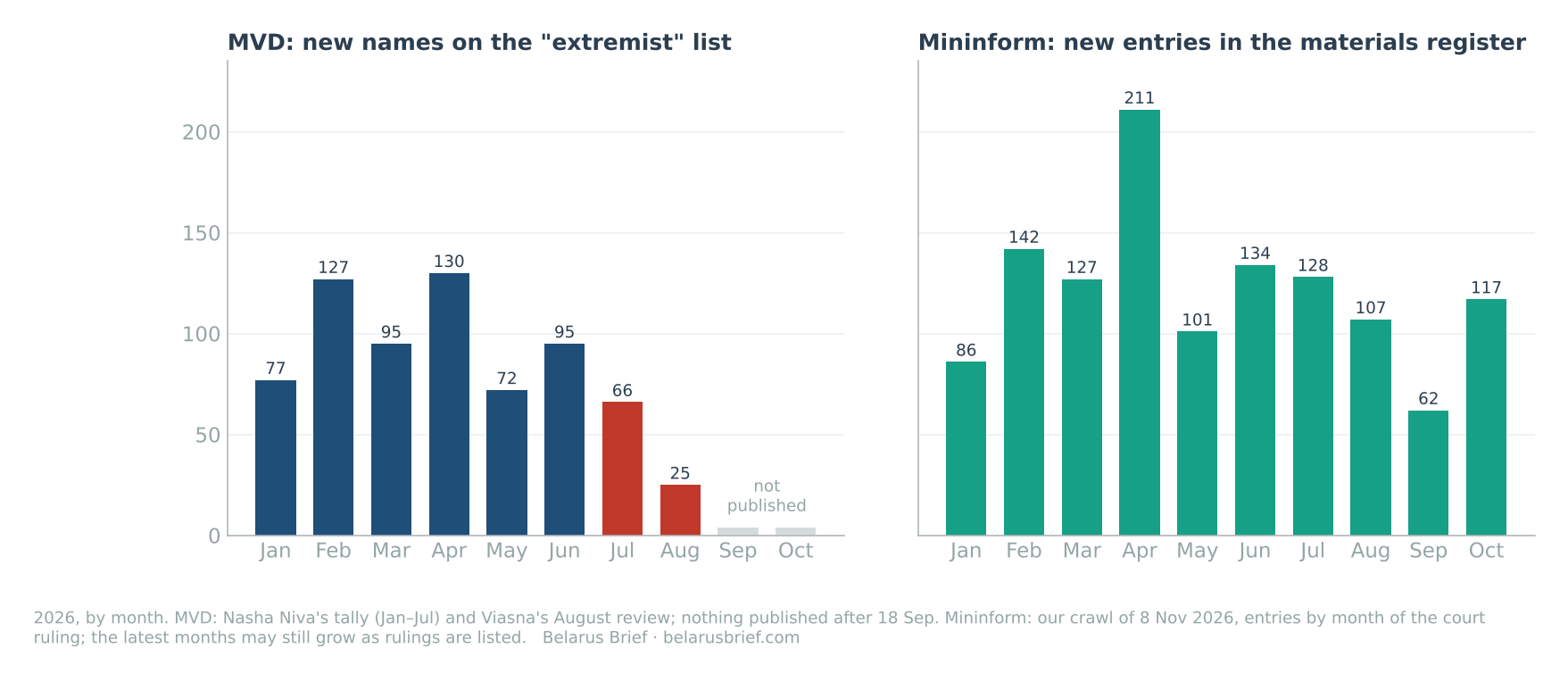
In July and August the ministry added 66 and 25 names to its list of people, against an average of 99 a month earlier in the year. In the same two months, courts issued rulings behind 128 and 107 new entries in the register of materials, close to its earlier average of 134. The two lists come from different procedures, so one cannot stand in for the other. The register of materials then added 117 entries in October.
The flow before the stop
The report reads the halt as an attempt to hide the scale of repression. Viasna and other rights groups say the same. A monthly series that the report does not use makes the picture less simple.
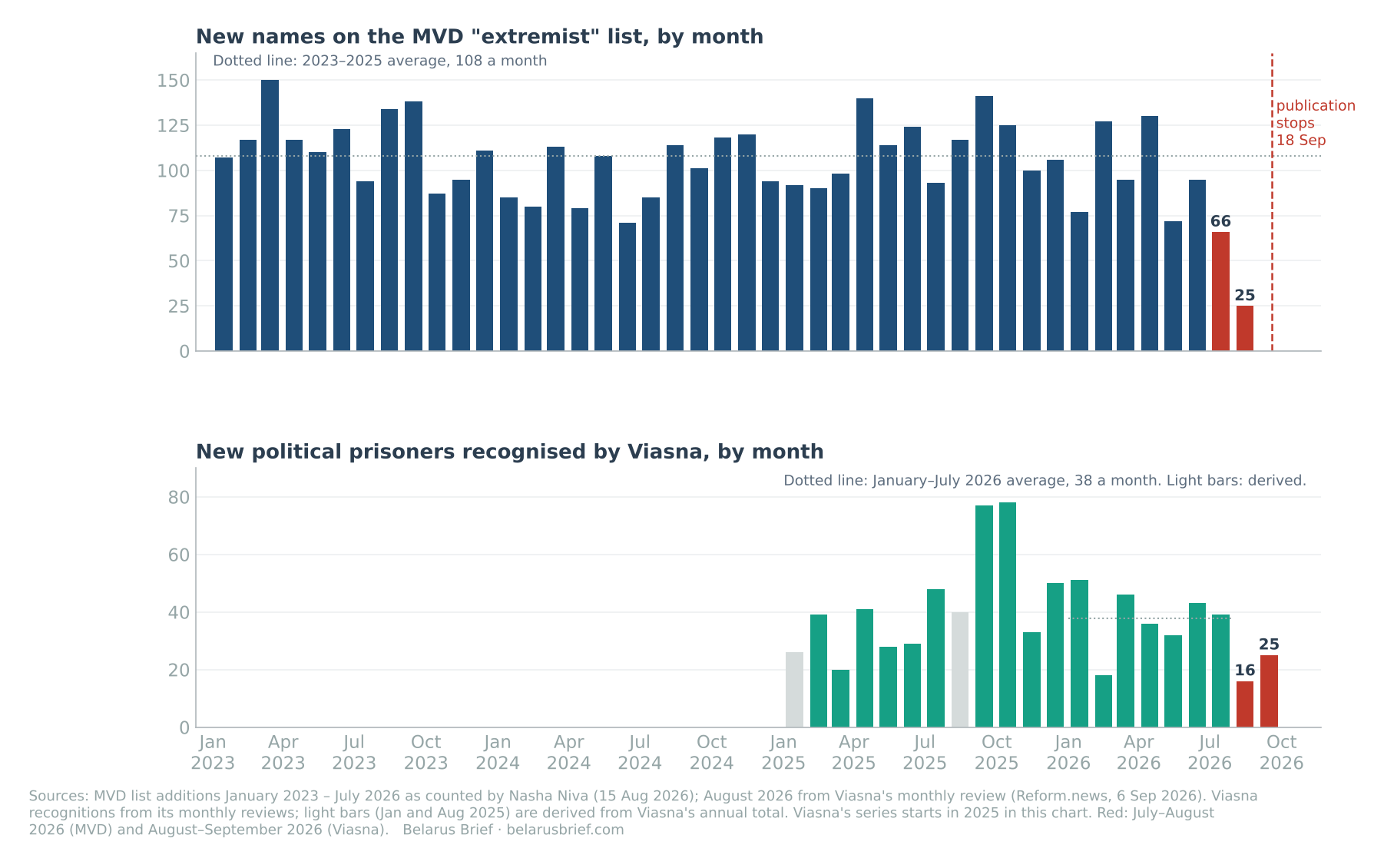
Nasha Niva counted the names added to the ministry’s list every month since 2023. The average for 2023 to 2025 was 108 a month. In July 2026 the figure fell to 66, the lowest month in the series. In August only 25 names were added, according to Viasna’s monthly review. Nasha Niva linked the fall to the end of the main phase of the case against people who sent information to Belaruski Hajun. It also checked one alternative and rejected it: every recently convicted political prisoner it knew of did appear on the list.
Viasna’s own count moved the same way. It recognised 38 new political prisoners a month on average from January to July. It recognised 16 in August and, Zerkalo reported, 25 in September. The number held in prison was 889 at the end of August and 876 at the end of September. The report gives 884 on 23 October.
There is one figure that does not fit. The report says 768 names were added to the list in 2026 up to 18 September. Nasha Niva’s tally for January to July is 662, and Viasna counted 25 for August. If all three numbers are right, the three September updates added about 80 names in eighteen days, faster than the 2023–2025 average. We cannot see those updates, and the report does not show its calculation.
So two readings remain open, although the data we have lean towards the first. In the first, prosecutions really fell in the summer, and the halt came after the fall. In the second, the fall is in what outsiders can see, because trials are more closed and Viasna itself has written that it has lost access to information. The ministry’s list was the one state source that could help separate these readings. Without it, only Viasna’s count remains, and Viasna says its access has shrunk.
Everyone’s shift
The report’s chapter on prosecution makes a specific claim about academia. From 2020 to 2023, it says, only 13 of 108 convictions of teachers, students and scientists were for “extremist” offences. From 2024 to 2026 the figure was 23 of 50. The report presents this as a shift in how academia is charged.
Its own Figure 2 shows something wider. The figure has two panels: one for all politically motivated convictions in Viasna’s database, one for the academic groups. We read the values from the chart and set them on one scale.
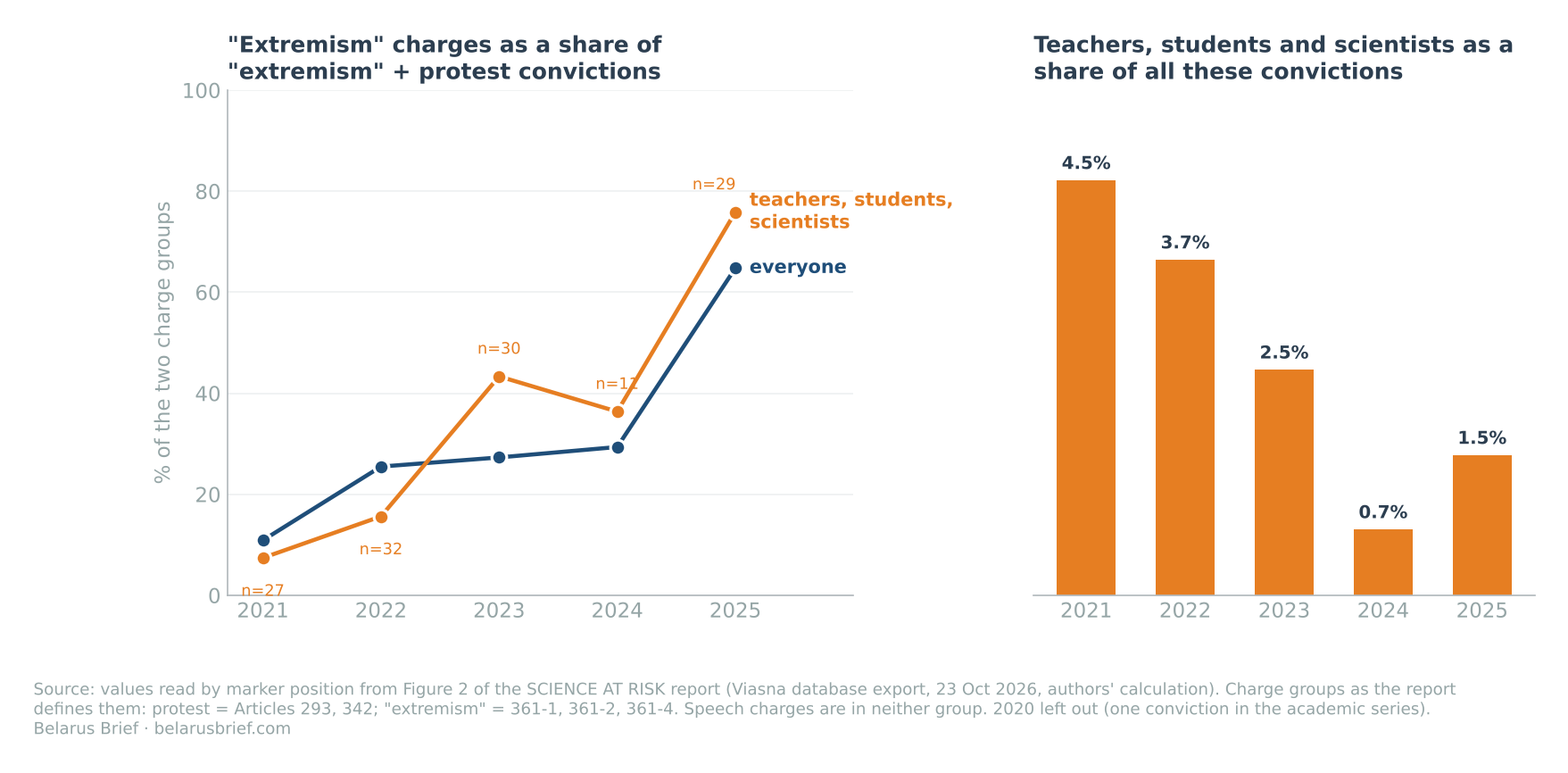
The move to “extremism” charges happened for everyone. Among all convictions in the two charge groups, the “extremism” share rose from about 11% in 2021 to 65% in 2025. For teachers, students and scientists it rose from 7% to 76%, on much smaller numbers. The academic line runs ahead from 2023, when it rests on 30 convictions, and in 2024 on only 11.
At the same time, the academic groups became a smaller part of the total. They were 4.5% of these convictions in 2021 and 1.5% in 2025. This may mean that fewer people from universities and schools are left to prosecute, because many have gone abroad. It may also mean that pressure on academia now runs through dismissals and loyalty checks, which a database of criminal cases does not record. The report itself describes that second channel in detail.
The move to “extremism” charges happened for everyone, and the report’s own chart shows it.
There is also a problem inside the report. Its Figure 2 shows 20 “extremist” convictions in the academic groups for 2020 to 2023, while the text says 13. For 2024 and 2025 alone the figure shows 26, while the text gives 23 for 2024 to 2026. The figure is also titled “Share of persons convicted”, but it plots numbers of people.
What the headcount shows
The report’s conclusion says that “the brain drain empties universities and research institutes”. It gives no number for this. Belstat does publish one.
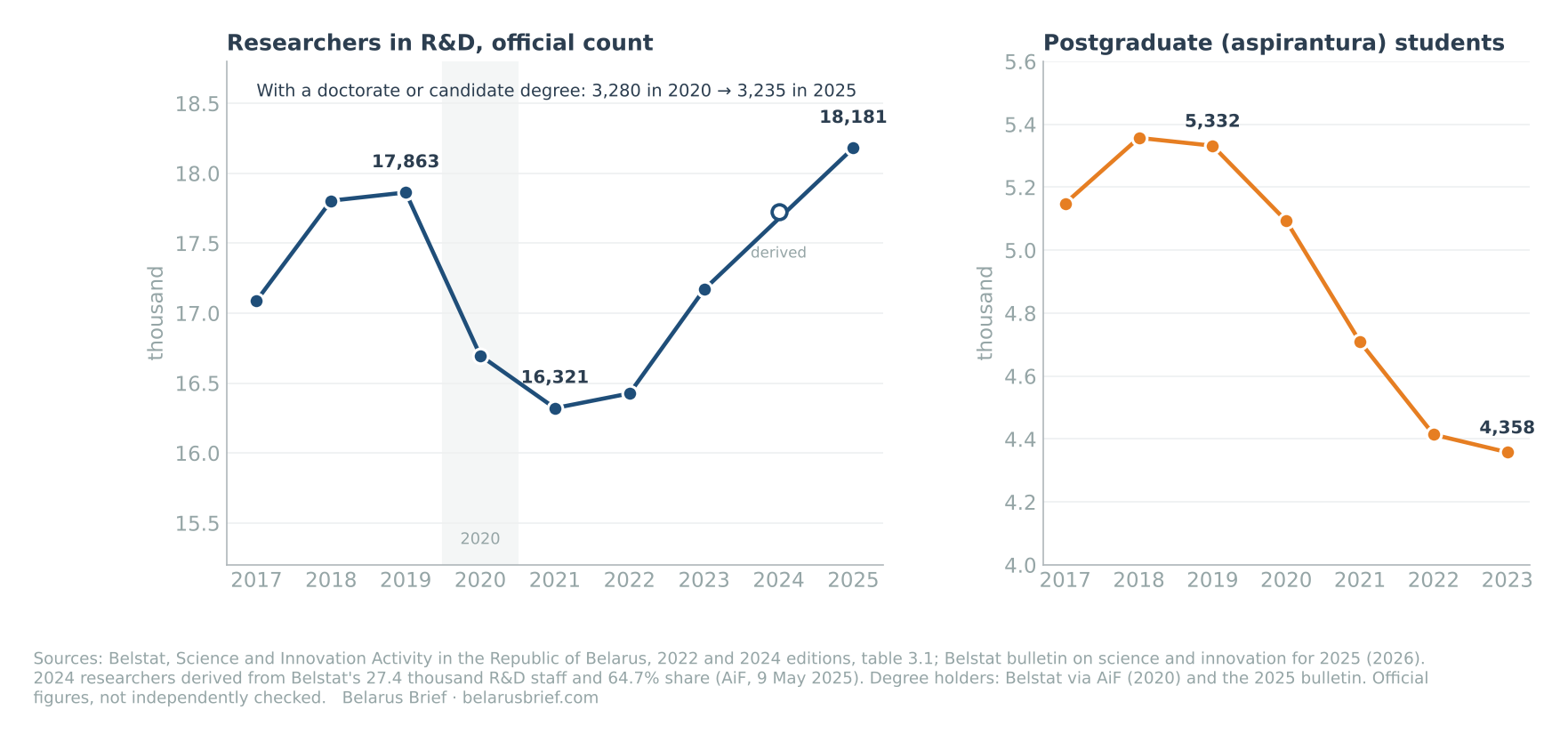
Belstat counted 17,863 researchers in 2019, according to its yearbook. The count fell to 16,321 in 2021. Then it rose again: 17,169 in 2023 and 18,181 in 2025. On the official count, Belarus now has more researchers than before 2020.
Two other series point the other way. The number of postgraduate students fell from 5,332 in 2019 to 4,358 in 2023, a drop of 18%. And the number of researchers with a doctorate or a candidate degree did not grow with the total. It was 3,280 in 2020 (AiF, citing Belstat) and 3,235 in 2025. So the growth since 2020 is among researchers without a degree. In 2024, 21.7% of researchers were aged 29 or younger, AiF reported.
These numbers fit more than one story. Experienced people may have left and been replaced by younger staff, so the headcount recovered while the quality did not. Applied and military research may be hiring engineers; the report itself says the Academy of Sciences now develops combat drones. Or institutions may be reporting staff differently. The official tables cannot separate these explanations.
The growth since 2020 is among researchers without a degree.
Two counts of one list
The report says the register of “extremist materials” grew from 6,982 entries at the start of 2025 to more than 10,000 in August 2026. It takes this from Human Constanta’s quarterly review, summarised by Reform.news. Our own crawl of the same register gives a much smaller number: 6,186 live entries on 8 November, and 5,952 in August, the figure we used in The Busiest Bench.
The difference is the unit. One entry in the ministry’s table often names several accounts or sites from the same court decision. When we count those accounts and sites, our crawl gives about 7,300 by the end of 2024 and passes 10,000 in spring 2026. That is within about 5% of Human Constanta’s figures.
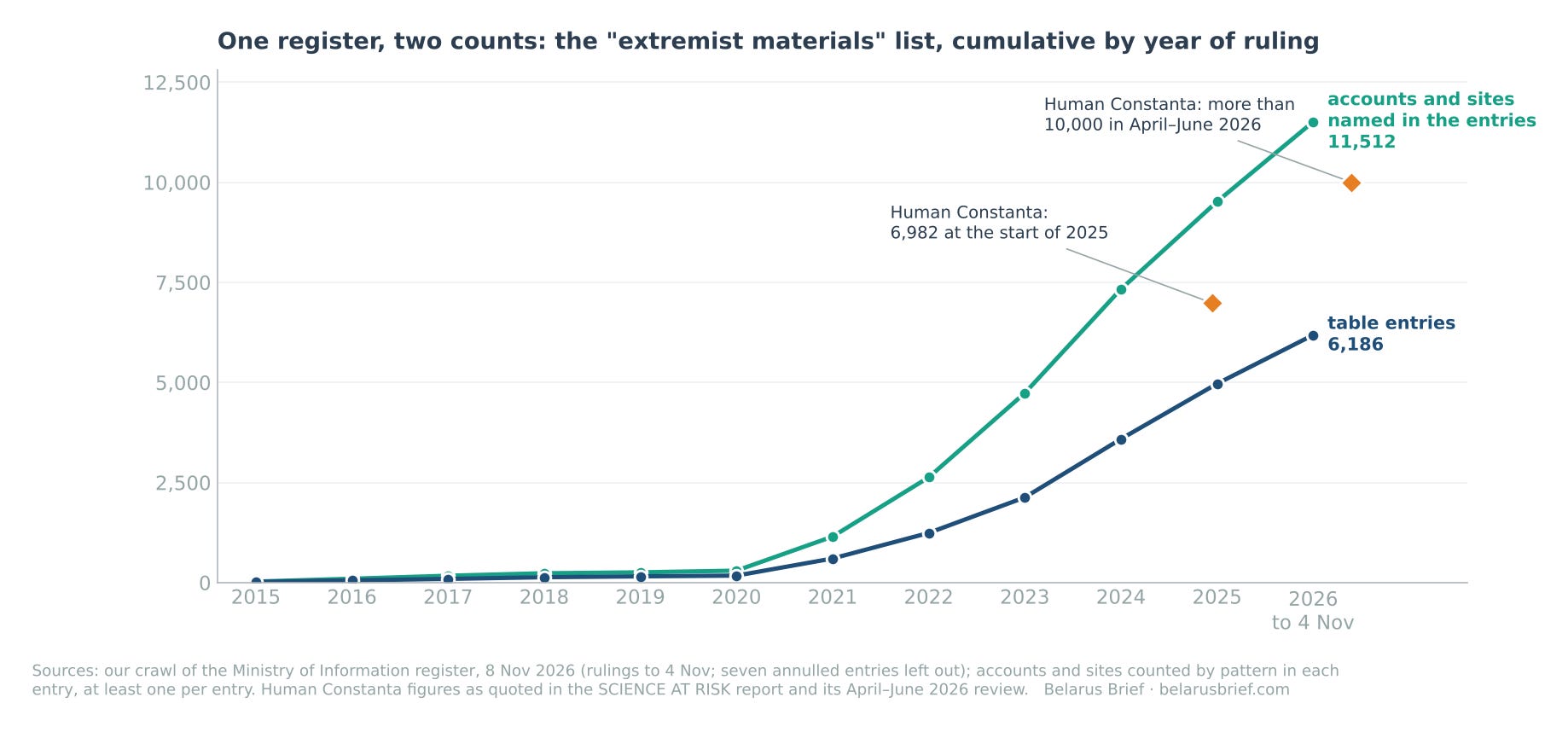
Both counts are correct. They measure different things: Human Constanta counts accounts and sites, while the ministry’s table counts entries. The report uses the word “entries” for the larger count. Its figure of 110 court decisions in August may mix units too. Our table holds 107 entries with August ruling dates, issued on 60 court days, each a single court on a single date.
A claim we could test
One of the report’s boxes, signed by Andrei Laurukhin, says the Russian Houses in Belarus use film screenings to spread Russia’s account of its war against Ukraine. It says this grew stronger from December 2025. It also gives a number: 13 such screenings in February 2026 at the Russian Houses in Brest, Gomel, Grodno and Minsk. We collect six Telegram channels of the Russian Houses and Rossotrudnichestvo in Belarus, so we could test both claims.
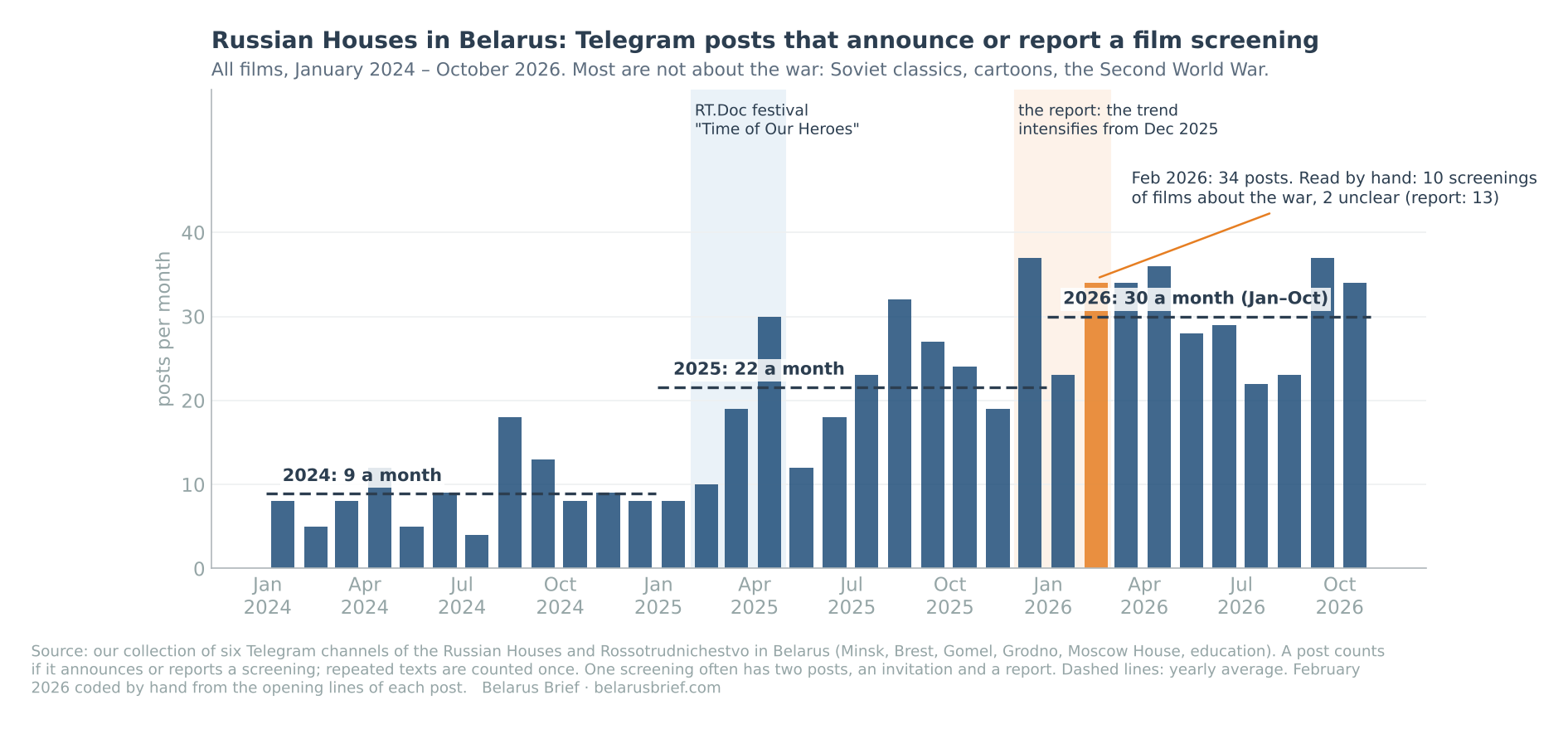
Film screenings did become far more frequent. In 2024 the channels posted about nine invitations to a screening or reports of one each month. In 2026 the figure is about thirty, even though the channels post less overall. Most of these films are not about the current war. They include Soviet classics, cartoons and many films about the Second World War.
For February 2026 we read every screening post. We count ten screenings of films about the war or the people fighting in it, such as the RT documentary “Call Sign Bukhanka” in Gomel and Brest. Two more RT films may belong on the list, but the opening lines of their posts do not show the subject. That is close to the report’s 13. In the months whose titles we read, December 2025 to October 2026, no other month comes near it.
The timing is less simple. Films about the war came in an earlier wave, from February to April 2025, during RT’s “Time of Our Heroes” documentary festival. In those three months, 15 of 59 screening posts named the war in their opening lines, against 2 of 107 in all of 2024. December 2025 and January 2026 were quieter, with most films marking the Nuremberg trials and the siege of Leningrad. After February, judging by the titles, one to five films about the war were shown each month, fewest in May and June, when the programme turned to Victory Day. They included RT premieres set in Pokrovsk, which Russia calls Krasnoarmeysk, in July, and about the Aidar battalion in September. The report also says that almost every screening includes a meeting with people who fought in the war. The opening lines of the posts cannot confirm this.
What the report stands on
A monitoring report is only as strong as its sources. We sorted all 207 source footnotes by the first source each one cites.
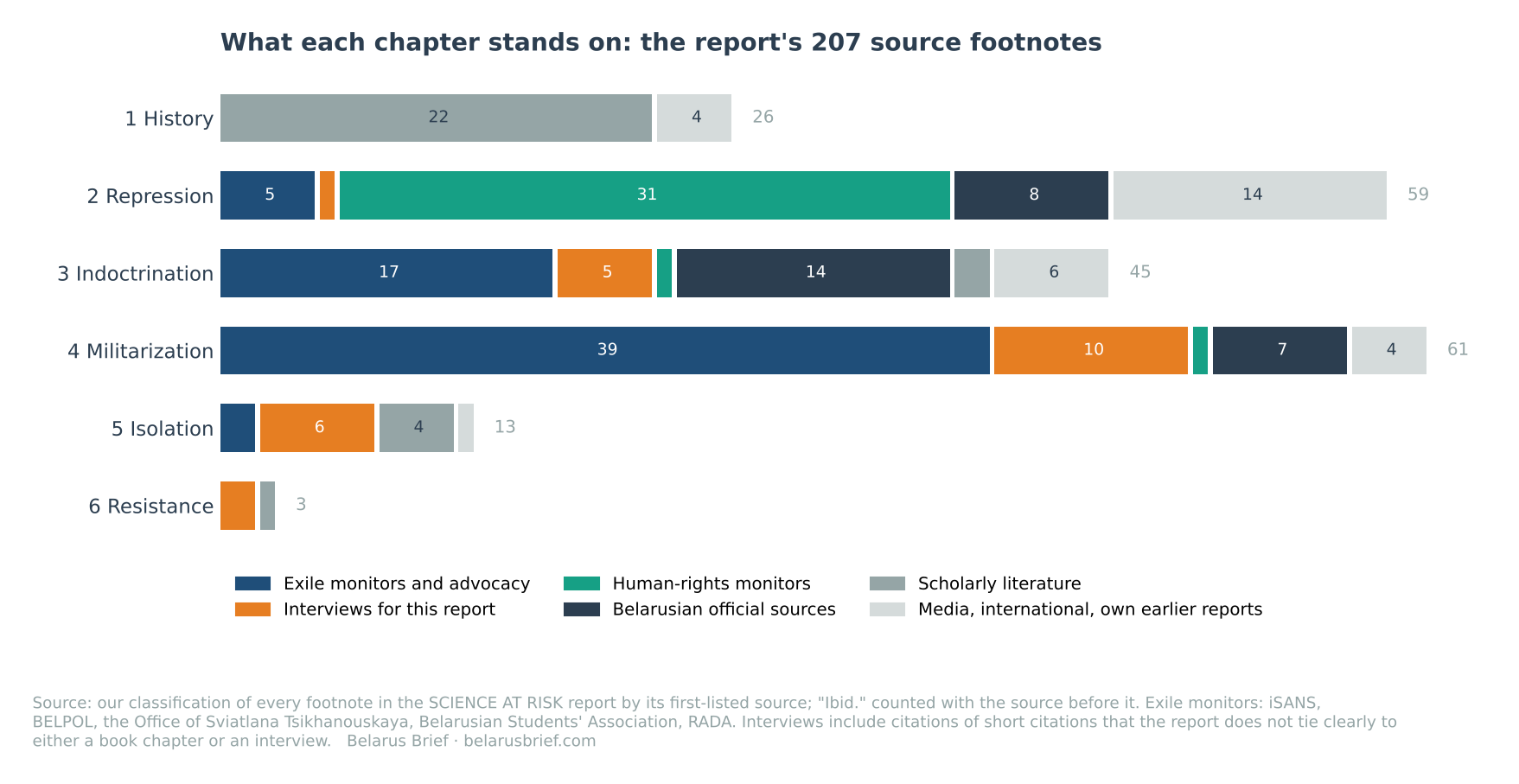
The chapters differ a lot. The history chapter rests on scholarly work, 22 of 26 footnotes. The repression chapter rests mainly on human-rights monitors such as Viasna, Human Constanta and PEN Belarus. The militarization chapter is different: 32 of its 61 footnotes cite iSANS or the BELPOL report first, and ten more cite interviews. These are serious sources. They are also advocacy sources, and the report seldom goes back to the official document behind a claim.
The interviews need a word too. The report thanks four experts. Two of them hold posts in the democratic forces’ structures: Andrei Laurukhin in the United Transitional Cabinet and Pavel Tereshkovich in Sviatlana Tsikhanouskaya’s Office. Tereshkovich’s written overviews for the Office are also cited as documents. The report lists these roles openly. What it does not discuss is how much of its evidence comes from the democratic forces’ own monitoring.
Some figures are hard to trace. The report says Russian state-funded places for Belarusian students rose from 72 in 2019 to 1,300 in 2023, citing an interview and iSANS. The 1,300 matches what Russia’s minister of science and higher education, Valery Falkov, said in 2024. The 72 is harder to square with other figures. Russia’s ambassador put the 2022 quota at 1,100, and a 2021 report said the 700 places of that year were twice the earlier number. The report then compares the 1,300 with about 100 Polish Kalinowski scholarships a year. That comparison leaves out the 10,710 Belarusians who studied at Polish universities at the end of 2025, according to Poland’s deputy minister of science and higher education.
Nor does the report test its central claim. Its introduction says that, one year after the 2025 edition, “each of these dynamics has intensified”. There is no table that compares the two years. Some new measures support the claim, such as the doubled field training and the new Academy statute. For most counts, the report gives no earlier value to compare with. The ministry’s list and Viasna’s recognitions, the two monthly series shown above, were both lower in the summer of 2026 than a year earlier.
Smaller problems add up. The summary says that “more than 90% of students are taught only in Russian”, while the chapter it summarises speaks of pupils in schools. One source is cited three times but never listed in full. Footnote 199 is empty. “Laurukhin (2026)” sometimes means a book chapter and sometimes an interview, and the reader cannot tell which. The report also counts 8,804 people “prosecuted” in Viasna’s database. Viasna’s own August review gives at least 10,058 who faced prosecution and 8,696 who were convicted, so the report’s figure looks like a count of convictions.
Thirty-two of the 61 footnotes in the militarization chapter cite iSANS or BELPOL first.
How it fits
Observation: the report shows Belarusian and Russian education moving in step, and it reads this as Russia setting the agenda. The dates we checked do not all run one way. Belarus made “History of Belarusian Statehood” compulsory for all students in 2022. Russia’s course “Fundamentals of Russian Statehood” entered its universities a year later, from September 2023. The unified history textbooks run the other way. They come from a commission led by Vladimir Medinsky, although Andrei Laurukhin told the authors that the Belarusian edition is “less imperial” than the Russian one. Two pairs are too few to settle the direction.
Fit: this is consistent with thesis T1 of our working model, same frame as Moscow, own timing, but it does not test it.
Alternative: the report’s reading, in which Moscow drives and Minsk institutionalises what Moscow wants.
What would separate them: a dated list of paired measures. If Belarusian steps keep appearing before their Russian twins, T1 holds. If they come only after, the report’s reading is stronger.
Confidence
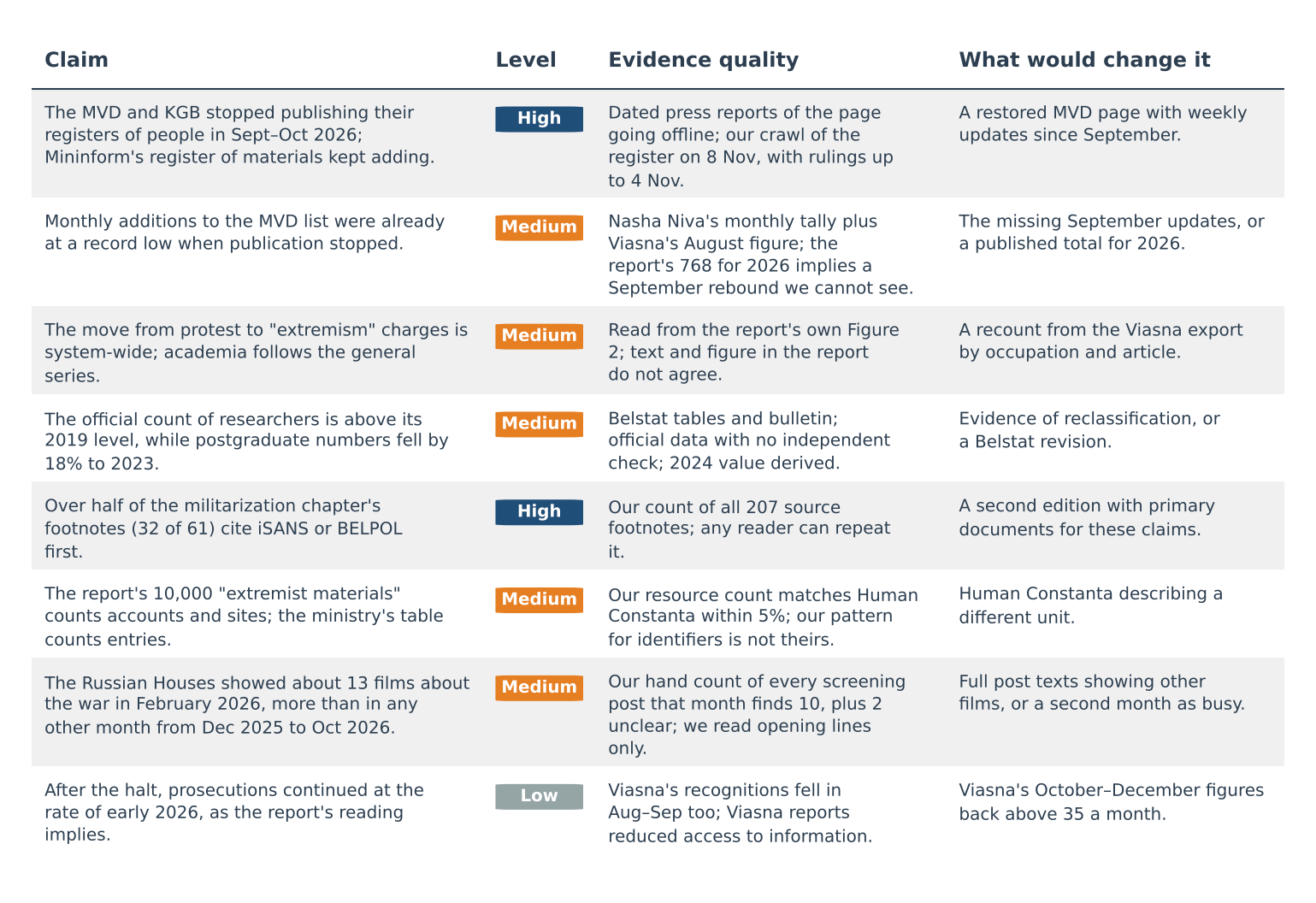
Evidence quality. The two High rows rest on things anyone can check: dated reports and our crawl of the registers, and a count of the report’s own footnotes. The Medium rows depend on numbers we read from a chart, on official statistics that nobody outside the state can audit, on a pattern match that is close to Human Constanta’s count but not the same method, or on our reading of short post openings. The Low row is the report’s main interpretation of the halt. Both series we have point the other way, but one of them depends on Viasna’s access to information, which has shrunk, so we do not rule it out.
What to watch
By 31 January 2027, the Ministry of Internal Affairs will not have restored weekly updates of its list of people. Medium.
Through 31 December 2026, the register of “extremist materials” will keep adding new batches at least every two weeks. High.
Viasna’s monthly recognitions of new political prisoners will average below 35 for October to December 2026. Medium. A higher figure would support the report’s reading of the halt.
In February 2027, around the anniversary of the full-scale invasion, the Russian Houses in Belarus will again show at least ten films about the war. Medium.
Belstat’s count of researchers for 2026, due around the Day of Belarusian Science on 25 January 2027, will again be above 18,000. Medium.
Takeaways
The report is the most complete map so far of how Belarusian education works as a system of control, from kindergarten to the Academy of Sciences. Its numbers need checking before anyone cites them: several differ from their sources or from the report’s own charts.
The title speaks of “total” control, while the report’s last chapter shows universities still using small gaps, such as dropping Dugin from their courses.
The state stopped publishing its lists of people, but the list of banned materials keeps growing and did not slow down in the summer.
The ministry’s list was already shrinking month by month before it went dark, so the halt may hide a fall as well as a rise.
The report’s “10,000 extremist materials” and our “6,186 entries” describe the same register in different units.
The official count of researchers has recovered since 2021, while postgraduate numbers and degree holders have not.
The report’s count of war films shown at the Russian Houses in February 2026 is close to what their own channels show. Screenings of all kinds had been rising since early 2025.
The militarization chapter, the report’s strongest in tone, takes more than half of its footnotes from two advocacy sources.
Method and limits
We read the full English PDF of the report (48 pages, dated 29 October 2026). Footnotes were sorted by the first source each one cites, with “Ibid.” counted as the source before it; three explanatory or empty footnotes were left out, leaving 207. Values from the report’s Figure 2 were read by the position of each marker on the chart, so the shares are close to the authors’ numbers but not exact. The monthly MVD series is Nasha Niva’s tally, not our own count. Belstat figures are official and were not checked against any independent source; the 2024 researcher figure is derived from a published share. Our count of the materials register comes from a crawl on 8 November 2026 (rulings up to 4 November, seven annulled entries left out). Accounts and sites were counted by a pattern for links, domains, handles and Telegram IDs in each entry, with at least one per entry. Monthly figures are by the month of the court ruling, so the latest months can still grow. The Russian Houses figures come from our collection of six Telegram channels, January 2024 to October 2026. A post counts if it announces or reports a screening, and a repeated text counts once; one screening often has both an invitation and a report. We read the first 200 characters of every screening post for February 2026 and the film titles from December 2025 to October 2026. Counts of posts that name the war rest on a keyword list and are a lower bound. “No state outlet” and “only in independent outlets” refer to our corpus, which covers the main state media and pro-government Telegram channels. Links were opened between 5 and 9 November 2026.
Working-model tag: T1.