

In late 2020 the EU sanctioned 84 Belarusian officials for the crackdown after the election. Six years on, 83 are still on the list, and the only one removed has died. We traced the careers of the 57 security officials and judges among them.
Reading. In three rounds in October, November and December 2020, the EU listed 84 Belarusian officials over the repression that followed that year’s presidential election. Six years later 83 are still listed; the one removed, a former KGB deputy chairman, died in May 2024. We found no prosecution and no defection among the 57 security officials and judges. Of the 25 who moved up or sideways, 13 now sit outside the security agencies: in the government apparatus, regional executive committees, parliament, sport and the universities. What we cannot tell is whether the sanctions changed any of this. We have no group of unsanctioned officials of the same rank to compare with.
The question
The first part of this series, What the Apparatus Is Owed, read Belarus’s prisoner numbers through Christian Gläßel and Adam Scharpf’s book Making a Career in Dictatorship. The book’s case is that security organisations put their officers under career pressure, and that one way out of it is to volunteer for the work others avoid. In Argentina, officers with weak records joined the intelligence unit at the centre of the “Dirty War”, and those who joined stayed in the service longer than their peers. Belarus is not one of the book’s cases.
That first part rested on output counts, and we said the confirming evidence would be careers. The EU’s lists give Belarus something close to a personnel file: the names of the people who ran the crackdown of 2020, with their posts at the time. This part asks where those people are now. It also asks whether anyone has ever left the list, because the authors argue that sanctions change behaviour only when they offer a way out.
Nobody left the list alive
The EU Council listed 40 people on 2 October 2020, 15 on 6 November, including Lukashenko himself, and 29 on 17 December. We checked the current EU list, through the OpenSanctions export, against the annex of the first round.
Eighty-three are still listed. The missing one is Vladimir Kalach, in 2020 a deputy chairman of the KGB, from 2021 Lukashenko’s aide-inspector for the Minsk region. He died on 13 May 2024, aged 54.
In six years, then, no one has left the EU’s 2020 list alive. The British list has not caught up even with his death: in January 2026 it still described Kalach as the serving aide-inspector.
Delisting itself is possible. On 22 September the EU removed two Russian businessmen from its Russia list after member states pressed for it. For the Belarusian officials of 2020, the way out the authors describe has not been used once.
In six years, no one has left the list alive.
What happened to their careers
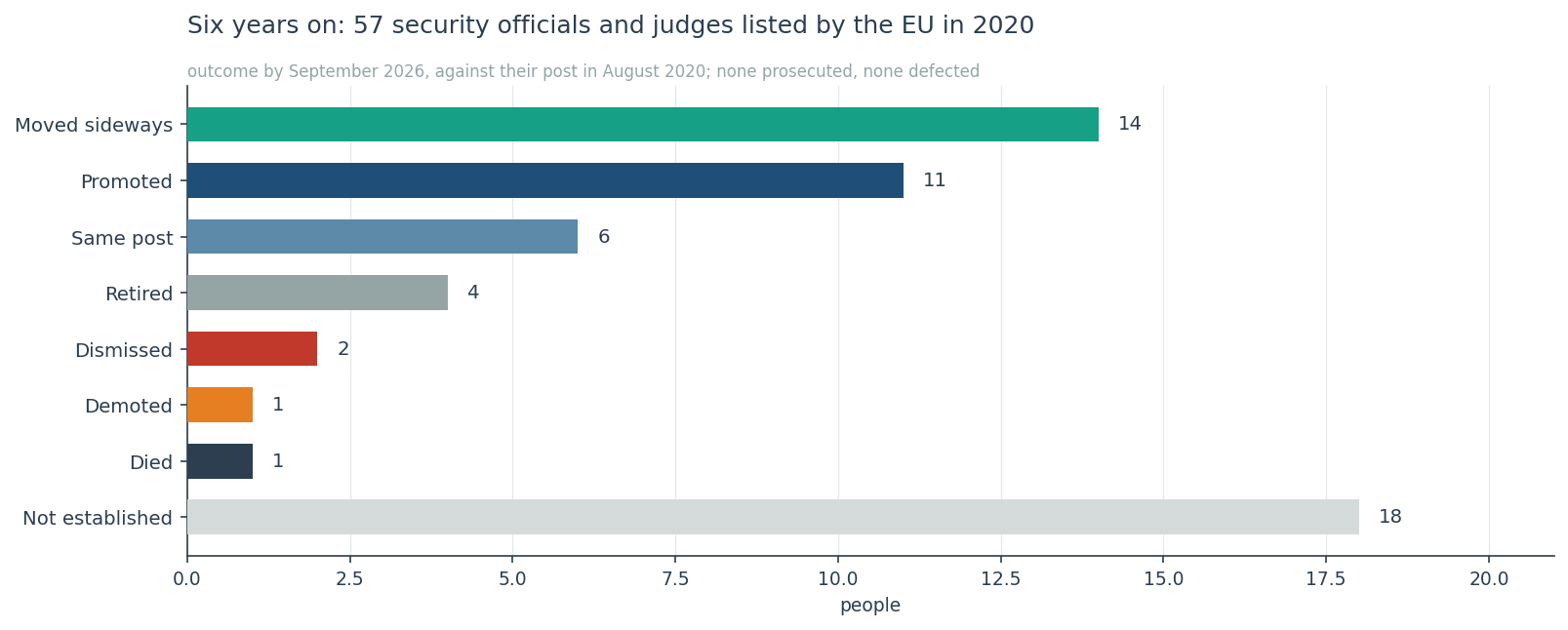
We traced the 57 security officials and judges among the 84. We used their posts in the EU’s own listing texts and their most recent mentions in our news archive.
The British list still calls a man who died in 2024 a serving official.
For 39 we could establish where they are now. Fourteen have moved sideways, eleven have been promoted, six hold the same post, four have retired, two were dismissed, one was demoted and one has died. For the other 18 we found no public record of their current post.
We found no prosecution and no defection among all 57; either would almost certainly have been reported. The two dismissals were both at the top of the Investigative Committee in the spring of 2021: its chairman Ivan Noskevich and a deputy, Andrei Smal. In 2020, 46 of them served in the units that detained, held or sentenced protesters: the militia, the internal troops, OMON, the KGB, detention centres and district courts. We could trace 28 of them, and none of the 28 was dismissed.
The shape of the moves is consistent. The regime moved the people who led in 2020 sideways. The interior minister, Yuri Karayev, became Lukashenko’s aide-inspector for the Hrodna region and then chairman of the Hrodna regional executive committee. The people just below them moved up. The head of the Minsk city militia, Ivan Kubrakov, became interior minister. The deputy prosecutor general, Andrei Shved, became prosecutor general and now chairs the Supreme Court.
Both dismissals came at the Investigative Committee. Among those we traced who did the detaining, none.
Into the civilian state
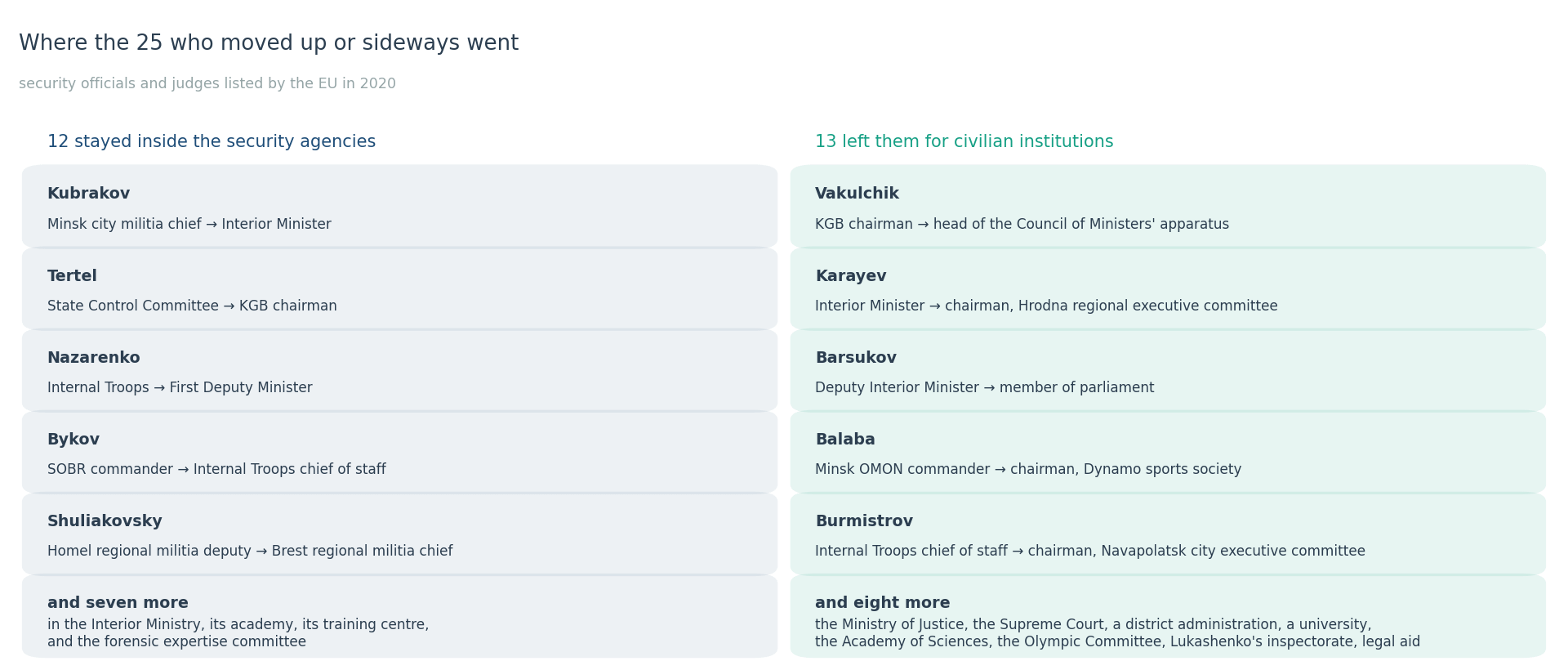
Of the 25 who moved up or sideways, 12 stayed inside the security agencies. Thirteen left them.
The former KGB chairman, Valery Vakulchik, now heads the apparatus of the Council of Ministers, a body that is not part of the security system at all. A deputy interior minister, Alexander Barsukov, sits in parliament as deputy chair of its national security committee. The former chief of staff of the internal troops chairs the Navapolatsk city executive committee. A former head of the ministry’s law and order directorate runs a district administration in Minsk. Another officer became vice-rector for ideology at a university.
Sport shows the same pattern. Dmitry Balaba, who commanded the Minsk OMON in 2020, left it in March 2026 to chair the central council of the Dynamo sports society. The interior minister heads Dynamo’s supervisory board, and a deputy interior minister sits on the board of the ice hockey federation.
Read together, these moves say something the list alone does not. The regime kept the apparatus of 2020, and a large part of it now staffs civilian institutions.
The regime kept the apparatus of 2020. Much of it now staffs civilian institutions.
The other explanation
There is a plainer reading, and it deserves weight. After any crisis, governments rotate their officials. Ministers change jobs, deputies step up, and some people leave for regional or ceremonial posts. The same pattern might appear among unsanctioned officials of the same rank. If it does, the sanctions list is simply a well-documented sample of a normal rotation, and says nothing about reward.
We cannot rule this out, because we have not traced a comparison group. What we can say is narrower. For the people the EU named, the list did not end a single career, removed no one alive, and coincided with a movement of security officials into civilian posts. Whether sanctioned officials fared better or worse than others is a question this data cannot answer.
Does this change what we wrote?
The first part said the book’s explanation was possible and that the confirming evidence would be careers. The careers we could trace fit it in one respect: those who did the work of 2020 stayed in service, and none of those we traced from the detaining units was dismissed. That is the outcome the authors measured in Argentina.
They also fit the ordinary reading set out above, so this is support, not proof. And on the question the first part left open, whether sanctions offered a way out, the answer is now clear: in six years they have offered none.
What to take from this
Of the 84 officials the EU listed in 2020, 83 are still listed. The only one removed died in 2024.
Among the 57 security officials and judges, we found no prosecution and no defection. The two dismissals were at the top of the Investigative Committee.
The leaders of 2020 moved sideways, and their deputies moved up.
Of the 25 who moved, 13 now work outside the security agencies: in the government apparatus, regional and city executive committees, parliament, sport and the universities.
Whether the sanctions made any difference cannot be tested without a comparison group, and that is the next step.
Confidence
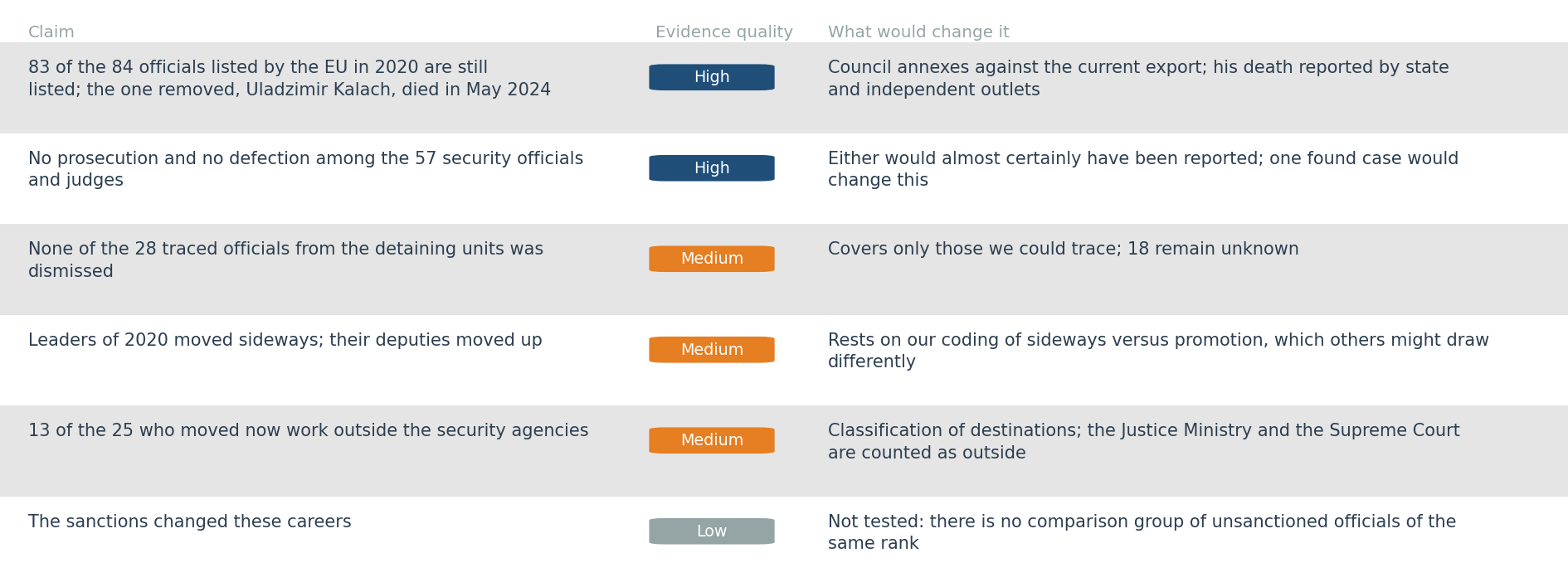
In text: the list count and Kalach’s death are documented and linked, so the evidence is strong. The career outcomes rest on public mentions and our own coding, and are firm where a person is named with a post. The 18 unknowns and the absence of a comparison group limit what the pattern can be said to mean.
Watch
The EU’s next review of its Belarus listings, due by the end of February 2027. Any 2020 listing removed while alive would be the first.
Any of the 18 officials whose current post we could not establish appearing in a public role.
A correction to the British list’s entry for Vladimir Kalach.
A dismissal or criminal case against any of the 46 who served in 2020 in the units that detained, held or sentenced protesters. So far we have found none among the 28 we could trace.
Method and limits
The list of 84 comes from the three Council implementing regulations of 2 October, 6 November and 17 December 2020. We checked it against the current EU list as exported by OpenSanctions (sanctions data: OpenSanctions, CC BY-NC 4.0). One of the 84, Vladimir Kalach, is no longer listed; we confirmed his death from Belarusian state and independent reports.
For careers, we searched our news archive from August 2020 for each person’s surname in all Russian and Belarusian spellings. We kept only mentions where the given name and surname appear together. We coded each person’s position in August 2020 against their latest documented post as promoted, sideways, same, demoted, retired, dismissed, prosecuted, defected or dead. A move is “sideways” when the new post carries comparable weight in a different institution. The chairman of a regional executive committee is an appointed official, and we do not call the post a governorship.
“Units that detained, held or sentenced protesters” covers all Interior Ministry militia and troop structures, the KGB, detention facilities and the district courts that heard protest cases. Under a narrower definition, limited to OMON, the troops and detention centres, the conclusions about dismissals are unchanged.
Most of the 18 people we could not trace are regional OMON commanders, district judges, the director of the Akrestsina detention centre and the commander of the KGB’s Alfa unit. Their absence from public view is itself part of the picture, but it means any comparison between them and more senior officials would be biased.