

The Republican List of Extremist Materials runs to 596 pages and 5,952 entries, issued by 159 district courts between 4 September 2008 and 13 August 2026. We downloaded the whole of it on 17 August, and again on 19 August. Between the two crawls the register gained nothing. It changed seventy-five entries it already held, and the change left no mark on the page.
The first thirteen years
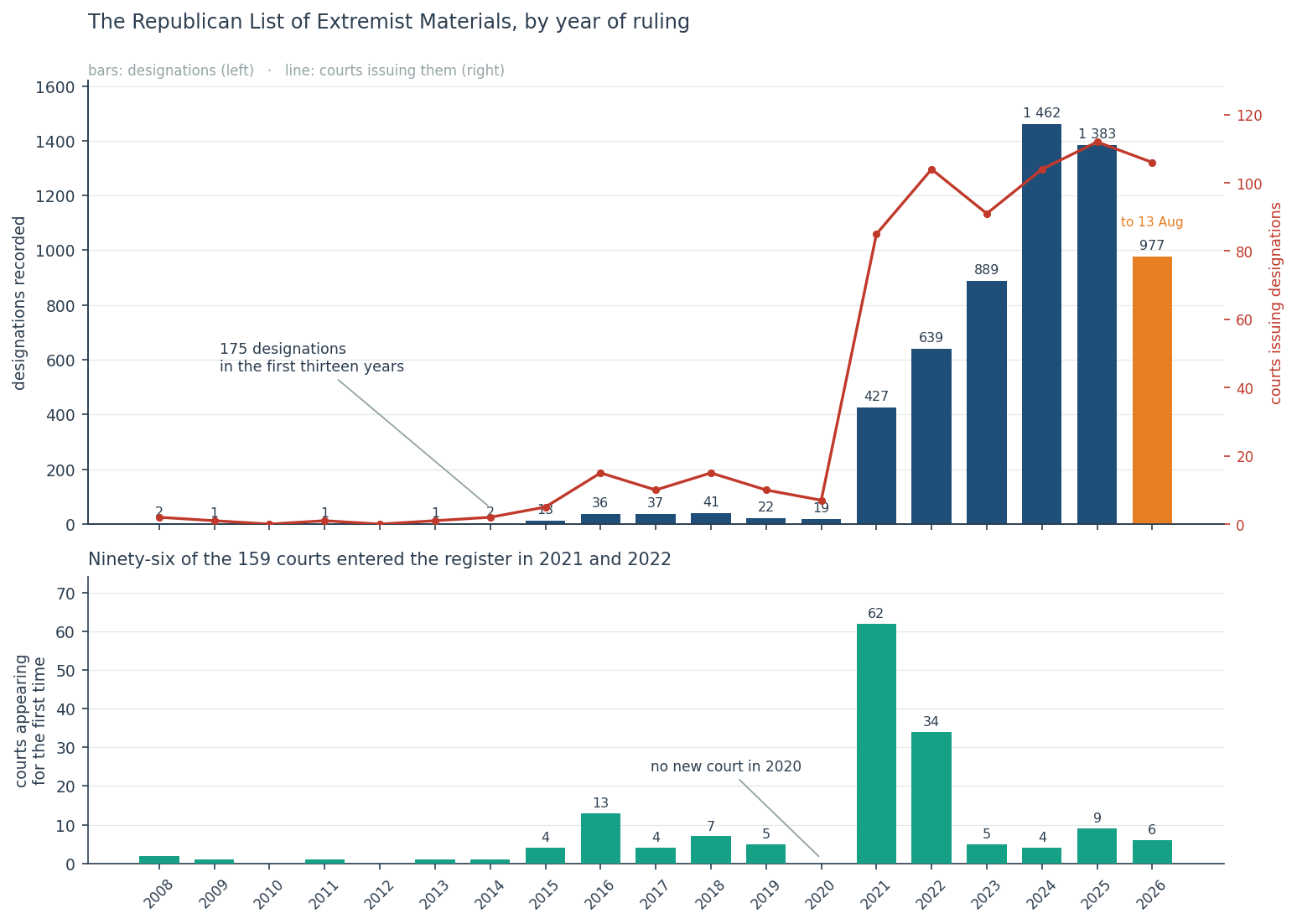
Between 2008 and 2020 the register accumulated 175 entries. Two calendar years, 2010 and 2012, hold nothing at all; three others hold a single entry apiece. The first two designations came from Oktyabrski district court in Hrodna on 4 September 2008 and Sovetski district court in Minsk that December. The busiest year of the whole first decade was 2018, with 41.
Then 427 in 2021, 639 in 2022, 889 in 2023, 1,462 in 2024, 1,383 in 2025, and 977 in the first 225 days of 2026. The instrument is twelve years older than the use now made of it, which is why the register is a poor witness to its own history: read from the top, it looks like a machine built after 2020, and the pages at the bottom show it sitting mostly idle through three presidential terms.
The benches were recruited once
Sixty-two courts appear in the register for the first time in 2021 and thirty-four more in 2022. Five joined in 2023, four in 2024, nine in 2025, six so far in 2026. In 2020 not one new court entered the list.
175 designations in thirteen years. 977 since January.
So the number of benches doing this work has been flat since 2022, between 91 and 112 in any year. What has moved is how much each one produces. Designations per sitting day ran at 2.75 in 2021 and 2.81 in 2022, then 3.78, then 5.92 in 2024, 5.74 in 2025 and 6.34 so far this year. Entries per ruling went from 1.36 to 1.72 over the same span. In 2024 the register records rulings on 247 separate days, and in 2025 on 241 — near enough every working day of the year.
Sixty-two courts joined in 2021. Twenty-four have joined in the four years since.
The recruitment phase closed and the throughput phase did not. That distinction matters for anyone forecasting the register’s size: adding benches has a ceiling, since Belarus has a finite number of district courts, while raising the yield of a sitting does not.
What the shelf shows
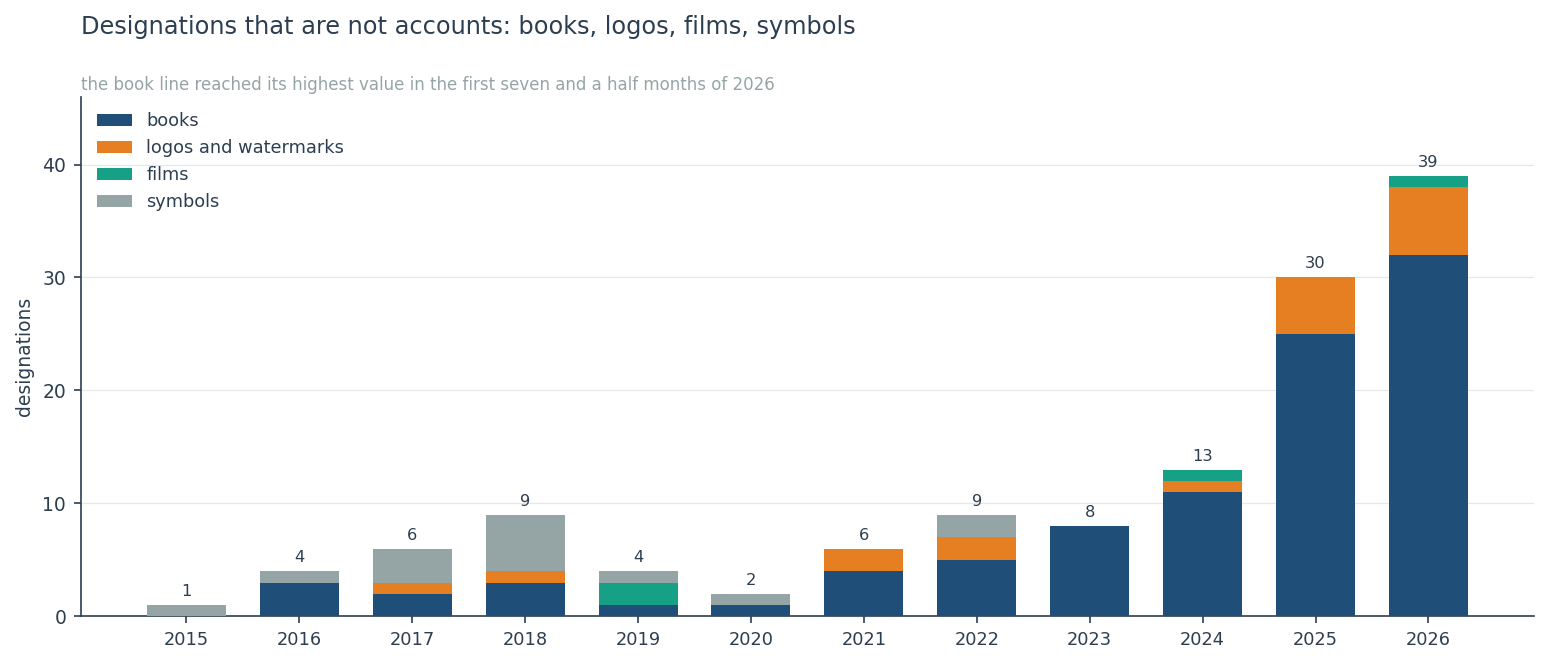
Most of the register is social media accounts. The remainder — books, films, logos, watermarks and symbols — is small enough to count by hand, and it moves against the assumption that this is a platform-era instrument.
Books designated per year: three in 2016, two in 2017, three in 2018, one in 2019, one in 2020. Then four, five, eight, eleven, twenty-five, and thirty-two in the first seven and a half months of 2026. On 12 August the Zavodski district court of Minsk designated six of them in one sitting, among them Skrabets’s prison memoir, Sieviarynets’s history of the Young Front, a Radio Svaboda collection on Bykaŭ, Roŭda’s university textbook on the political system of Belarus published in Vilnius in 2011, and a 1999 Warsaw volume on non-violence.
Logos and watermarks follow the same late curve: five in 2025, six by August this year. A designated watermark means that any image carrying it is itself banned material, which is a broader instrument than banning an account.
Thirty-two books in seven and a half months, against three in 2016.
A correction to The Ledger That Cannot Shrink
On 15 August we wrote that these registers only grow, and that the direction of travel is one way. The first half of that stands. The second needs qualifying twice.
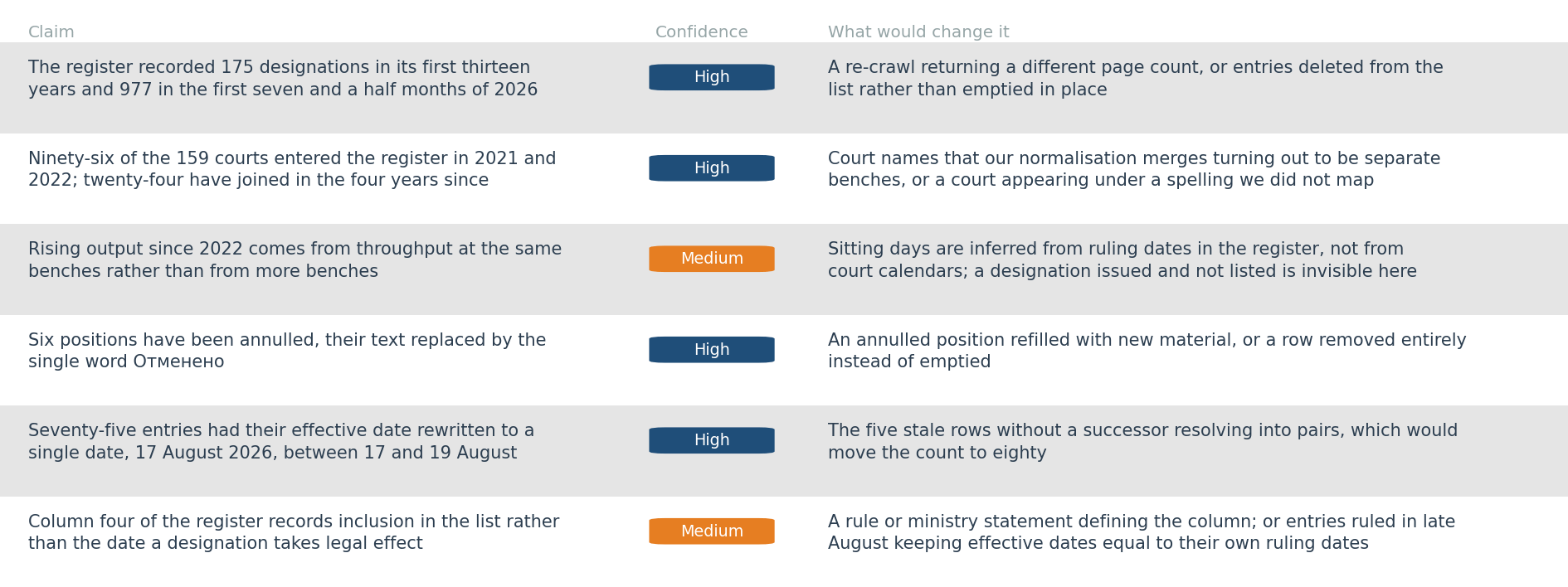
Six positions in the register have been annulled. Zhytkavichy on 8 November 2023, Leninski district court of Mahiliou on 9 April 2024, Baranavichy on 7 June 2024, Zheleznodorozhny in Homel on 6 September 2024, Minsk raion on 10 April 2025, Partyzanski in Minsk on 5 December 2025. In each case the row survives with its court, its dates and its number intact, and the description of the banned material is replaced by a single word: cancelled. That is 0.1% of the register, so the direction we described holds; the absolute claim does not. The length of the list stops being a measure of anything, since a position can be emptied without the list getting shorter.
The second qualification is larger and it is why this piece exists. Between our two crawls, seventy-five entries had their effective date changed, spread across forty-eight rulings by courts in every region. Every one of them received the same new date: 17 August 2026. Their old effective date was the day of their own ruling, and those rulings run from 15 July to 13 August, so the shift is four days at the shortest and reaches thirty-three.
Six positions hold one word each.
The third column of those rows did not change by a single character. It still reads that the ruling is subject to immediate execution under article 302 of the Civil Procedure Code. The register now asserts, of the same entry, that it took effect at once and that it took effect on 17 August.
The same entry now says immediate execution in one column and 17 August in another.
Among the seventy-five: the EUvsDisinfo site, designated in Mahiliou on 3 August; a Threads page in Pavel Latushka’s name, Maladechna, 7 August; the Instagram account of the imprisoned human-rights defender Leanid Sudalenka, Baranavichy, 5 August; the Volny Chor account and one belonging to a samizdat paper, both Viciebsk, 3 August; five of the six Zavodski books.
The clearest case sits a month further back. On 15 July the Leninski district court of Mahiliou designated the site of the EU4Belarus programmes — SALT, SALT II, SALT III and Education for Belarusians — along with the site of the Lithuanian agency that administers them, and that agency’s LinkedIn and X accounts. The row carries the immediate-execution formula. When we read it on 17 August its effective date was 15 July, the day of the ruling. Two days later the same row read 17 August, thirty-three days after it. The entry had been on public display for a month with the first value. The same court designated EUvsDisinfo three weeks later, and it accounts for 25 of the 214 foreign resources in the register.
We cannot tell from the register what the change means. A ruling enforced at once and dated into effect five weeks later is hard to read as a statement about legal force, and the likeliest reading is that column four records the date an entry was formally added to the list. On that reading the ministry brought a batch of rows onto a common listing date and left the rulings alone. It stays a hypothesis about administrative practice: the register publishes no revision history against which to test it, and no rule stating what the column holds. Five further rows from the 17 August crawl were gone on 19 August with no successor carrying their text, and the cached pages will settle what happened to them.
Confidence
Watch
By 20 September, entries ruled in the second half of August carry a single common effective date later than their own ruling. If they do, column four records listing and not legal effect, and every lag calculated from it measures the ministry’s clerical calendar.
By 20 September, a seventh annulment appears. Six in thirty-four months is roughly one every six months, and the last was in December.
By 31 December, book designations for 2026 pass forty. Thirty-two by 13 August.
Before 1 September, the total passes 5,952. Nothing new arrived between 17 and 19 August, which is a pause rather than a stop unless it holds.