

In October the Foreign Policy Council “Ukrainian Prism” published “Belarus-Ukraine Relations in the Context of Minsk-Washington Dialogue” by Pavlo Rad, with support from Konrad-Adenauer-Stiftung Belarus. Its advice to Kyiv is a “two tracks” model: practical contact with the Lukashenko regime inside clear red lines, and separate long-term support for the democratic forces and Belarusian society. We checked that model against thirteen dated acts from December 2025 to October 2026. We do not know how many Belarusians in Ukraine lost legal status after 4 August, and we found no report that the promised presidential envoy for Belarus has been appointed.
What the paper gets right
The paper is worth reading. It treats Moscow’s reaction to the Minsk-Washington contacts as several reactions: the defence ministry is content, while the foreign intelligence service and the foreign ministry are nervous. It explains why Poland can bargain with Minsk and Lithuania cannot, and it does this through resources and exposure, without blaming either capital. And it sets one rule for any reward to Minsk that Western papers often skip. The basis for a change of policy must be a change in behaviour that has been verified. A promise is not enough.
It is also honest about Kyiv. The author writes that Ukraine has no coherent strategy on Belarus and that its recent moves are tactical.
Who speaks in the footnotes
The paper has 31 footnotes. Every one of them reads “based on an expert interview”. Twenty-one cite a Belarusian expert, seven a Ukrainian expert, two a Ukrainian politician and one a representative of the democratic forces. None cites a document, a dataset or a link. The method section speaks of 16 interviews and of an analysis of trade and logistics statistics, but the charts name no source.
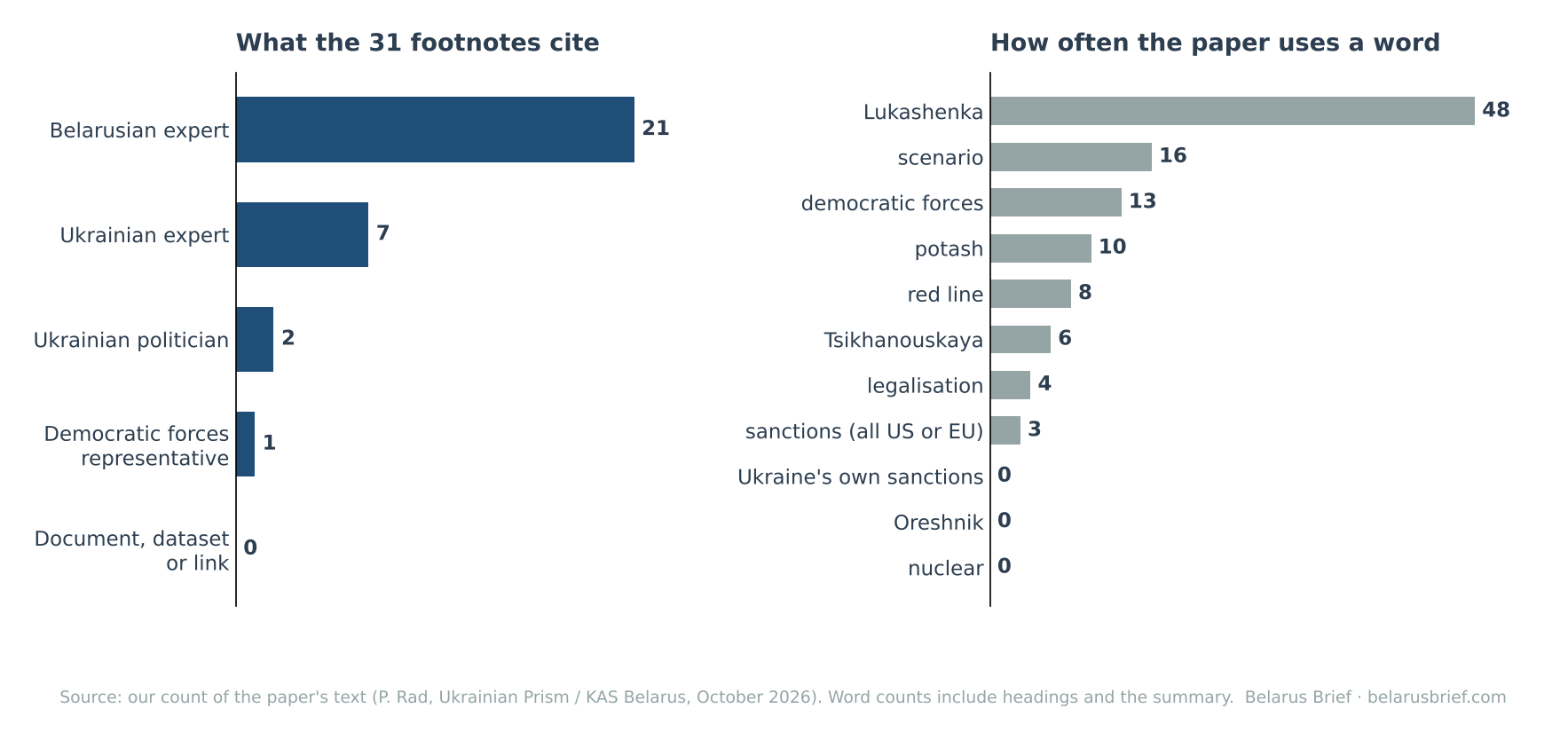
This matters for a paper about Ukrainian policy. Two thirds of its footnotes come from Belarusian experts, and no Ukrainian official is cited. One fact is also missing. Since 15 May the director of the programme where the author works, Yaroslav Chornohor, has been the foreign ministry’s ambassador-at-large for contacts with the Belarusian democratic forces. Foreign minister Andrii Sybiha confirmed the post in parliament on 29 May. The paper does not mention it. This may mean the author had good access. It may also mean the paper judges a policy that its own programme now helps to run. The reader cannot tell which.
The word count shows a second gap. The paper names Lukashenko 48 times and Sviatlana Tsikhanouskaya six times. It uses the word “sanctions” three times, each time for American or European measures. Ukraine’s own sanctions do not appear. Neither does Oreshnik, although one of the paper’s red lines is “no deepening of defence integration with Russia”.
A paper about Ukrainian policy takes two of every three footnotes from Belarusian experts.
What the dates show
The paper says Kyiv changed its tone only after progress between Washington and Minsk, and that Tsikhanouskaya’s visit was agreed quickly after the US State Department asked Poland, Lithuania and Ukraine to consider potash transit. The dates give a less tidy picture.
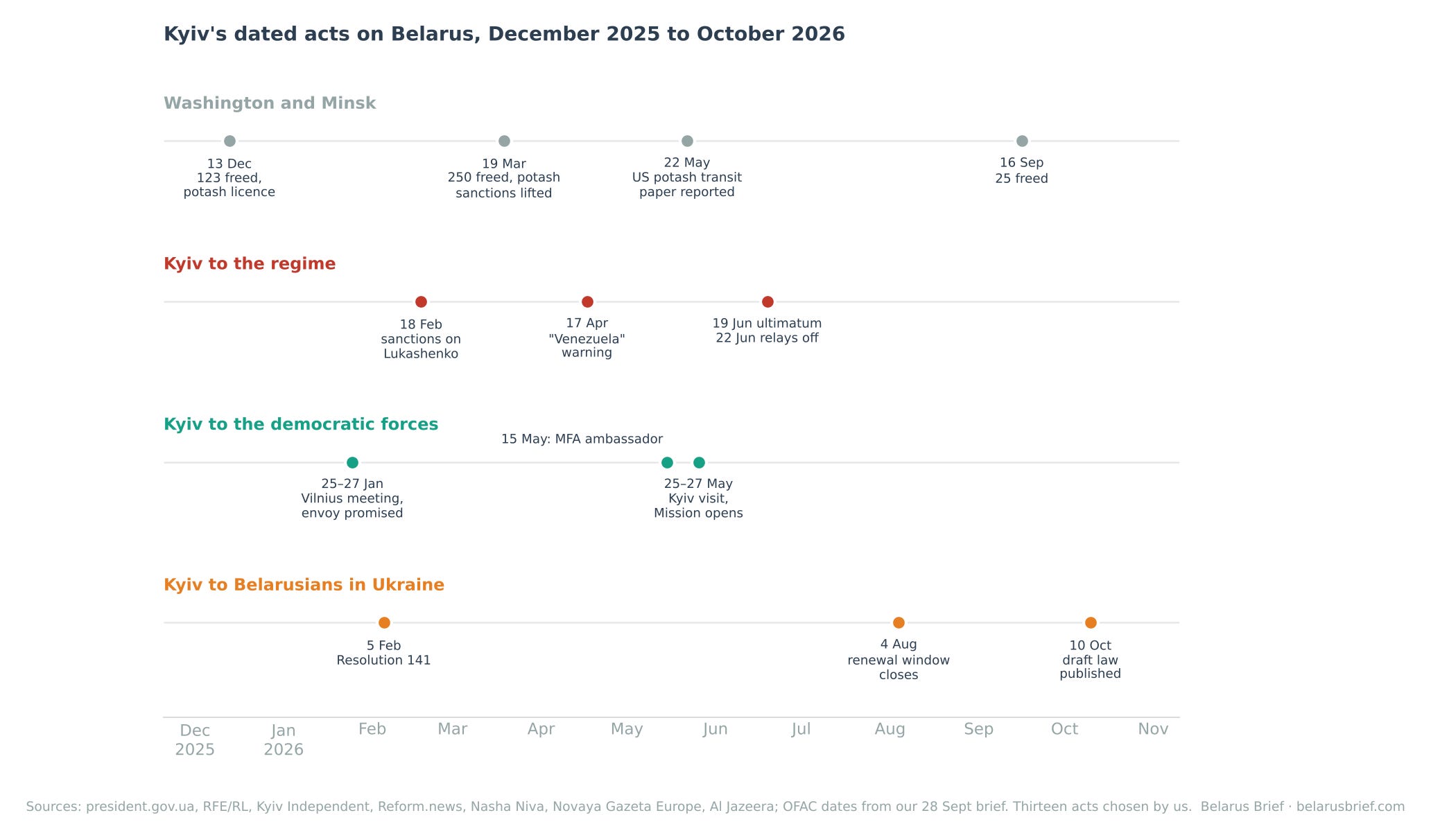
On 18 February Volodymyr Zelensky signed sanctions against Lukashenko. The date falls two months after the December round and a month before the largest one on 19 March, when 250 people were freed and Washington lifted its remaining potash sanctions. We described those rounds in “The Same Day, Told Twice”. The decree page says Russia placed drone relay stations in Belarus “in the second half of 2025”. The paper dates the relay stations to May and June 2026. June was the ultimatum, and Zelensky said on 24 June that the equipment had been silent since the 22nd. We noted the same slip in an ECFR brief in August. The sanctions are a reaction, as the paper says of Kyiv’s policy in general. They are also Kyiv’s own instrument, used against the direction Washington was taking, and the paper leaves them out.
The visit also has an earlier history. Zelensky met Tsikhanouskaya in Vilnius on 25 January. Two days later Sybiha said the president had told him to appoint a special envoy on Belarus “soon”. Her trip to Kyiv was planned for March and postponed because the envoy had not been named. The ministry’s ambassador came on 15 May, 108 days after the promise. RFE/RL reported the American potash paper on 22 May and described it as undated and unsigned. Tsikhanouskaya arrived on 25 May and opened the Mission of Democratic Forces of Belarus. So the American paper may have speeded up a visit. It did not create one. A second reading is possible: Kyiv may have known of the US request weeks before it became public. The undated document does not let us decide.
Kyiv’s hardest step of the year came a month before Washington’s largest round.
The track nobody bargains over
The paper lists the legalisation of Belarusians in Ukraine as unfinished business. In one place it reports “noticeable progress” and in its conclusions “the absence of positive changes”. It gives no number and names no legal act. Both exist.
On 5 February the Cabinet of Ministers adopted Resolution 141, which ended the automatic extension of residence permits. That was thirteen days before the sanctions on Lukashenko. Holders had to renew by 4 August, and renewal needs a valid passport. Tsikhanouskaya’s office counted 2,958 Belarusians with temporary permits and estimated that only 40 to 50 percent had valid passports. Minsk stopped issuing passports abroad in 2023, the subject of our 18 August brief [LINK: A Document That Does Not Go Home]. On 10 October, 247 days after the resolution, the State Migration Service published a draft law that would accept expired passports. It is still a draft.
Set these intervals beside the regime track. The June ultimatum produced a result in three days, by Zelensky’s account. The envoy took 108 days and is still an interim post. The passport fix has taken 247 days so far. One explanation is priority: the regime track gets attention at the top. Another is plain procedure, because a decree is faster than a law and Resolution 141 covered all foreigners. Both can be true.
One government sanctioned Lukashenko and tightened the rules for Belarusians in Ukraine within the same two weeks.
Where the model bends
The paper wants the two tracks separate. It says support for the democratic forces should continue “regardless of the state of dialogue” with the regime. Three pages earlier it says something else. Lukashenko dislikes seeing Tsikhanouskaya received in Kyiv, closing that door again “is relatively easy”, and a pause in symbolic steps toward the democratic forces “may well be a sufficient bargaining chip” for talks with Minsk. In that passage the second track is a price inside the first.
The dates fit the passage better than the principle. The Vilnius meeting came 24 days before the sanctions. The Kyiv visit ended about three weeks before the ultimatum. Two pairs are too few for a rule, and we have no information about intent.
What the sorting leaves
The economic chapter sorts sectors by how the war ends. Fertilisers and farm goods are “promising”, oil refining is “risky”, transit and labour are “mixed”. The paper’s own Figure 2 shows what this means for trade.
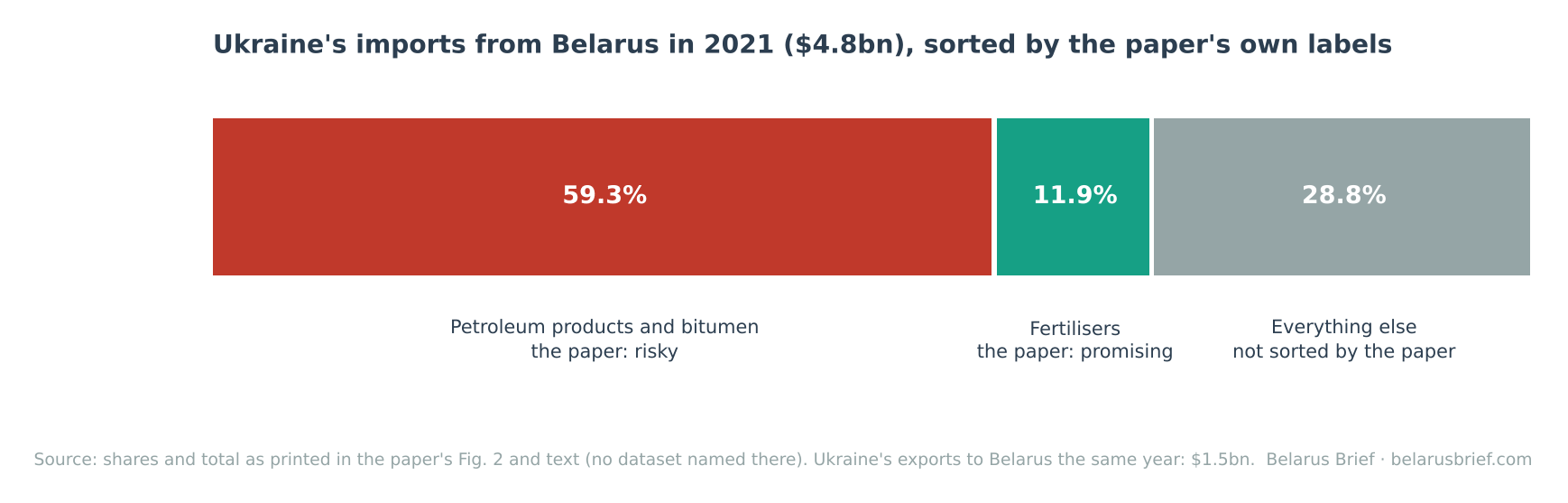
In 2021 Ukraine imported $4.8bn of goods from Belarus. Petroleum products and bitumen were 59.3 percent of that, about $2.8bn. Fertilisers were 11.9 percent. The sector the paper would reopen first is about an eighth of the old import bill. The sector it would keep closed, because Belarusian refineries run on Russian crude, is three fifths. That may be the right choice. It also means the pre-war relationship does not return under any of the three scenarios, and the paper does not say this in numbers.
One figure needs a correction. The text says the Belarusian trade deficit “more than tripled” in 2023 compared with 2022. The paper’s own Figure 1 shows $99m for 2022 and $3,252m for 2023, a rise of about 33 times from an unusual year. Against 2021 ($1,798m) the 2023 deficit is 1.8 times larger.
The trade the paper would allow is small. The trade it would refuse was most of the old relationship.
How it fits
Observation: in the paper, and in the 2026 record, Kyiv’s decisions about Belarusians follow its dealings with one man. Fit: this matches thesis T6 of our working model, that neighbours read Belarus as one man’s country, here applied to Kyiv. Alternative: a state at war puts its northern border first, and everything else waits for capacity. What would separate them: a decision for Belarusians in Ukraine, or a new opening to the democratic forces, made while Kyiv and Minsk are de-escalating.
Confidence
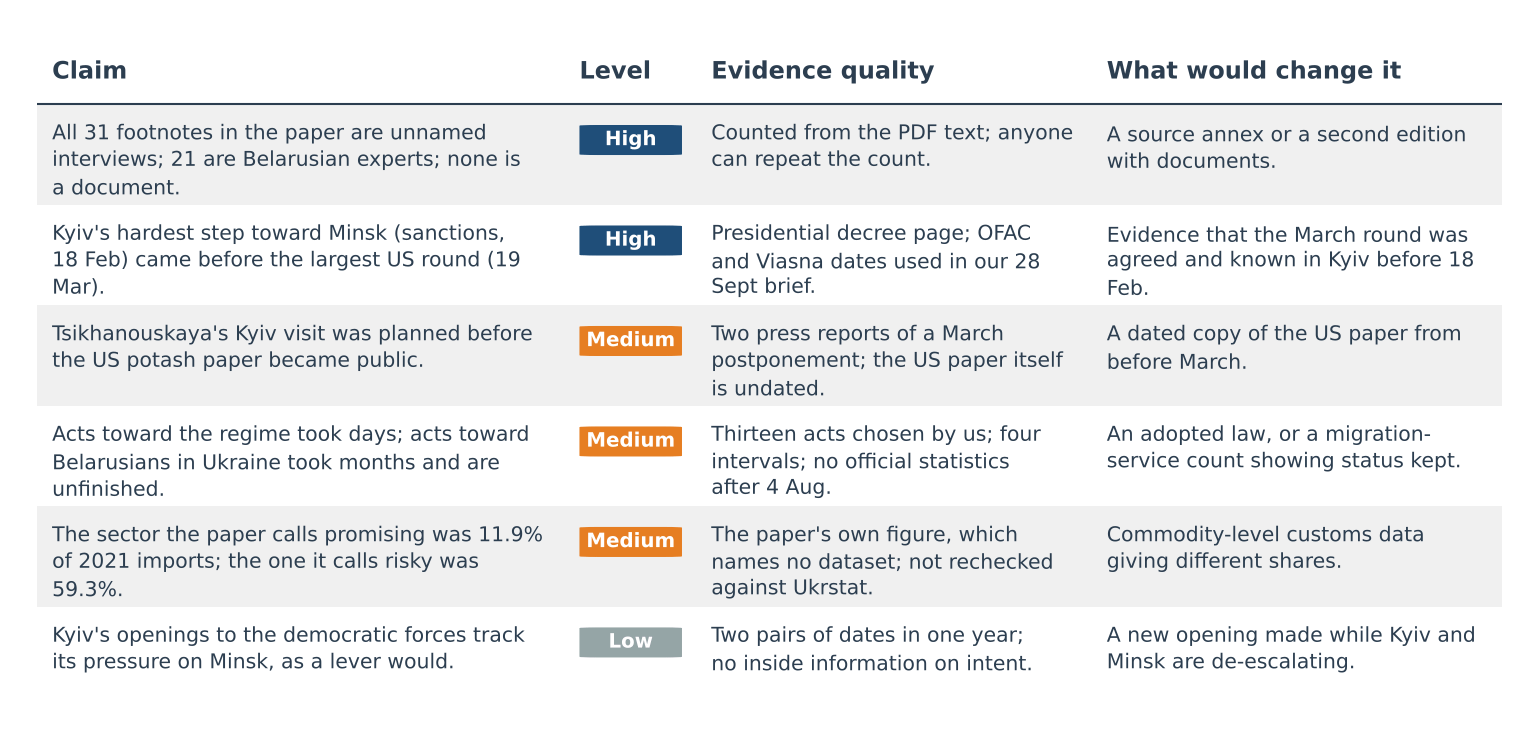
The two High rows rest on counts and official pages. The Medium rows depend on press reports and on the paper’s own unsourced figure. The Low row is an inference from sequence and should be read as a question.
What to watch
By 31 December 2026 the migration service’s draft law on expired passports will not have passed the Verkhovna Rada. Medium.
By 31 January 2027, a year after the promise, there will be no presidential decree naming a special envoy for Belarus; the ministry’s ambassador will remain the only post. Low.
By 28 February 2027 Ukraine will not have agreed to any transit of Belarusian potash. High.
By 31 March 2027 Kyiv will have issued at least one more sanctions decree naming Belarusian companies or officials. Medium.
Takeaways
The paper’s conditionality rule is sound and worth quoting. Its evidence is 31 unnamed interviews.
Kyiv’s main instrument of 2026, its sanctions on Lukashenko, is missing from the paper. They came a month before the largest US round.
The slow track is the one that concerns about 3,000 people with residence permits.
The paper asks for separate tracks and also describes how to trade one for the other.
Method and limits
We counted footnotes and words in the paper’s English PDF after fixing typographic ligatures; counts include headings and the summary. The thirteen acts were chosen by us from official pages and press reports, and each link was opened on 5 November 2026. OFAC and Viasna dates repeat our 28 September brief. This piece has no FORESIGHT corpus layer, so we make no claim about how Belarusian state media covered any of these acts. The 2021 trade shares are the paper’s own and were not rechecked. The paper gives 23 September for the Sikorski-Ryzhenkov meeting; our September brief used 22 September from TVP Info, and we did not re-verify it here. We describe behaviour and dates. We do not know what Kyiv or Minsk intend. Working-model tag: T6.