

Belarus’s border committee publishes the queue of trucks waiting to enter the EU, and its neighbours publish the migrants they stopped. In six years of our corpus, Belarusian state media carried the neighbours’ figure four times. Baltic and Polish outlets cited Minsk’s queue figure twice.
On 9 November Belarus’s State Border Committee reported more than 1,900 trucks waiting to enter the EU. The longest queue, 1,385 trucks, stood at the Polish crossing of Kukuryki (Kozlovichi), where Polish services had processed 44% of the “norm” since Friday (BelTA, 9 November 2026). On 15 November Lithuania’s border guard reported 1,962 attempts to cross illegally from Belarus stopped this year (Delfi, 15 November 2026). Both numbers describe the same border, and each puts the fault on the other side. Since 2021 Belarusian state media have published 3,457 items on the truck queue and four that give a neighbour’s count of migrants stopped. What we cannot see is what happens between the two fences, where Latvia now says the trouble starts.
Minsk counts trucks
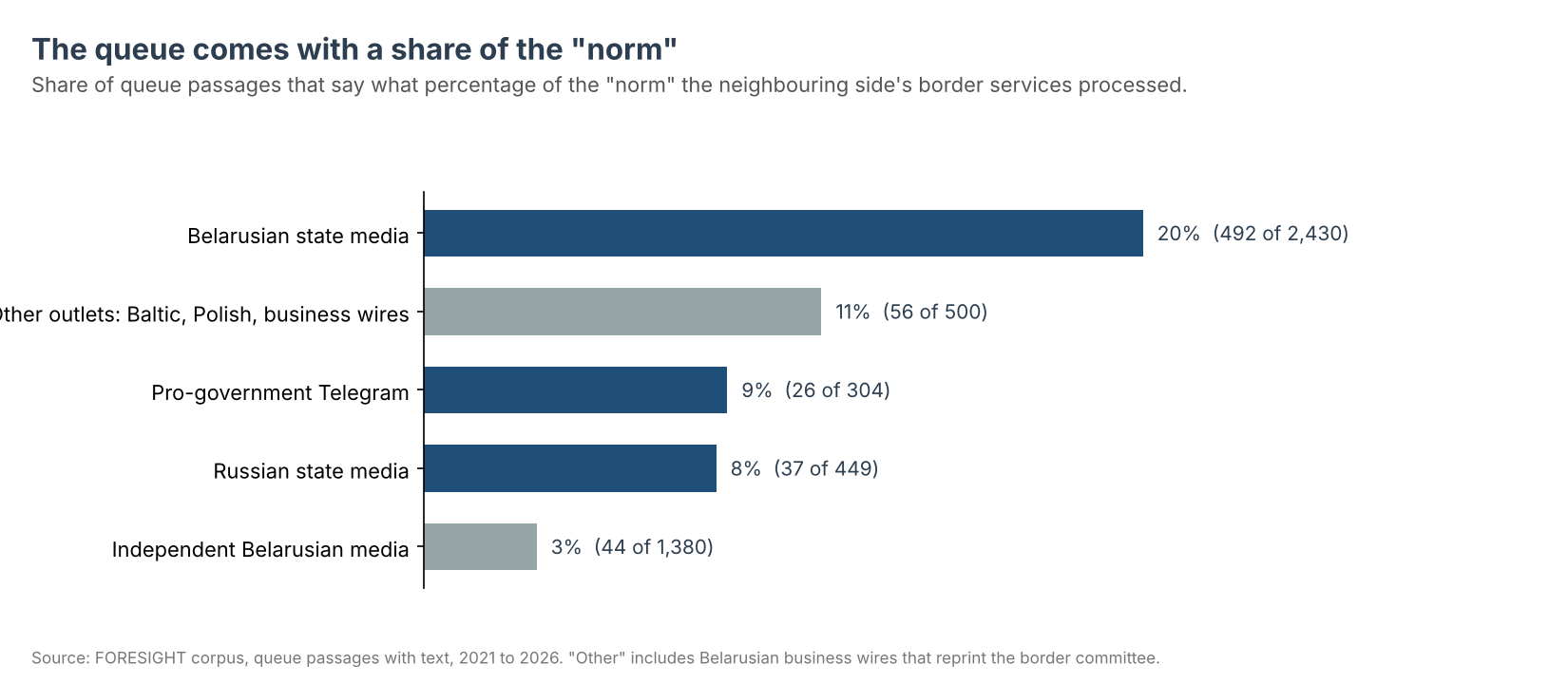
The border committee posts the queue on its Telegram channel, and state outlets reprint it. In 2025 and 2026 alone, the committee’s channel ran 228 items on the queue, SB 268 and BelTA 212. The post usually has the same shape: the number of trucks, the busiest crossing, and the share of the “norm” that the neighbouring services processed. On 30 October, for example, the committee wrote that at one crossing the neighbouring side had accepted 25% of the trucks from the norm (State Border Committee, 30 October 2026). The delay, in this format, always belongs to the other side.
One state queue passage in five gives that share of the norm: 492 of 2,430. In independent Belarusian outlets the share is 3%, or 44 of 1,380 passages. In December 2023 the committee said the queues were growing because EU countries were not meeting the norms (BelTA, 4 December 2023). A week later the queue had stayed above 3,000 trucks for more than seven days (SB, 12 December 2023).
The delay, in this format, always belongs to the other side.
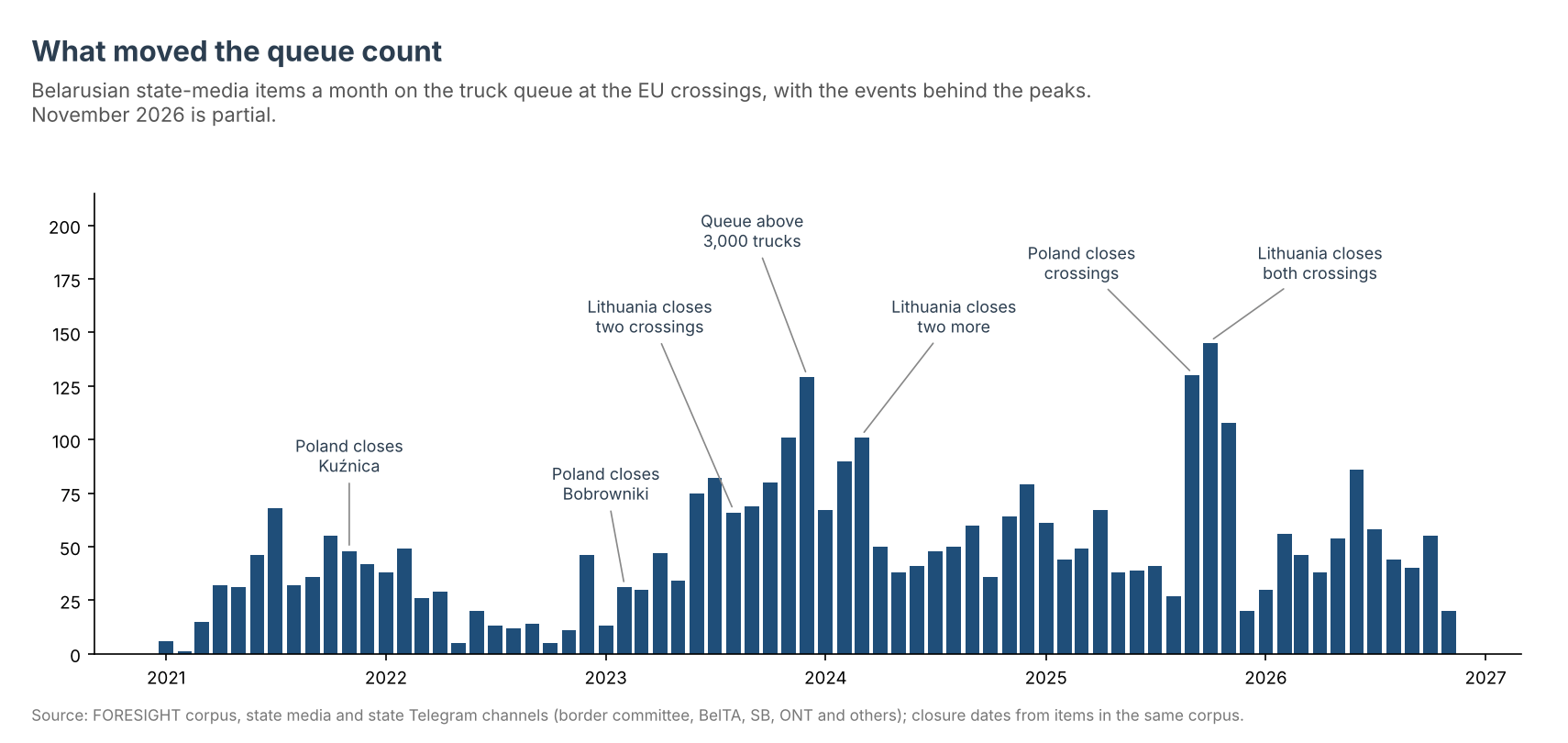
The queue count makes news when a crossing closes. State items on the queue reached 130 in September 2025, when Poland closed its crossings (BelTA, 11 September 2025). They peaked at 145 in October, when Lithuania shut both of its remaining crossings (SB, 22 October 2025).
Both numbers describe the same border, and each puts the fault on the other side.
The neighbours count people
Lithuania’s State Border Guard Service, Latvia’s State Border Guard and Poland’s Border Guard each publish a daily count of migrants stopped. Their national media carry it. On 13 November Delfi reported that Latvia had turned back 42 migrants the day before (Delfi, 13 November 2026). By 24 October, Latvian guards had stopped 696 attempts that month (Euroradio, 24 October 2026) and nearly 12,400 since January (BelNovosti, 24 October 2026).
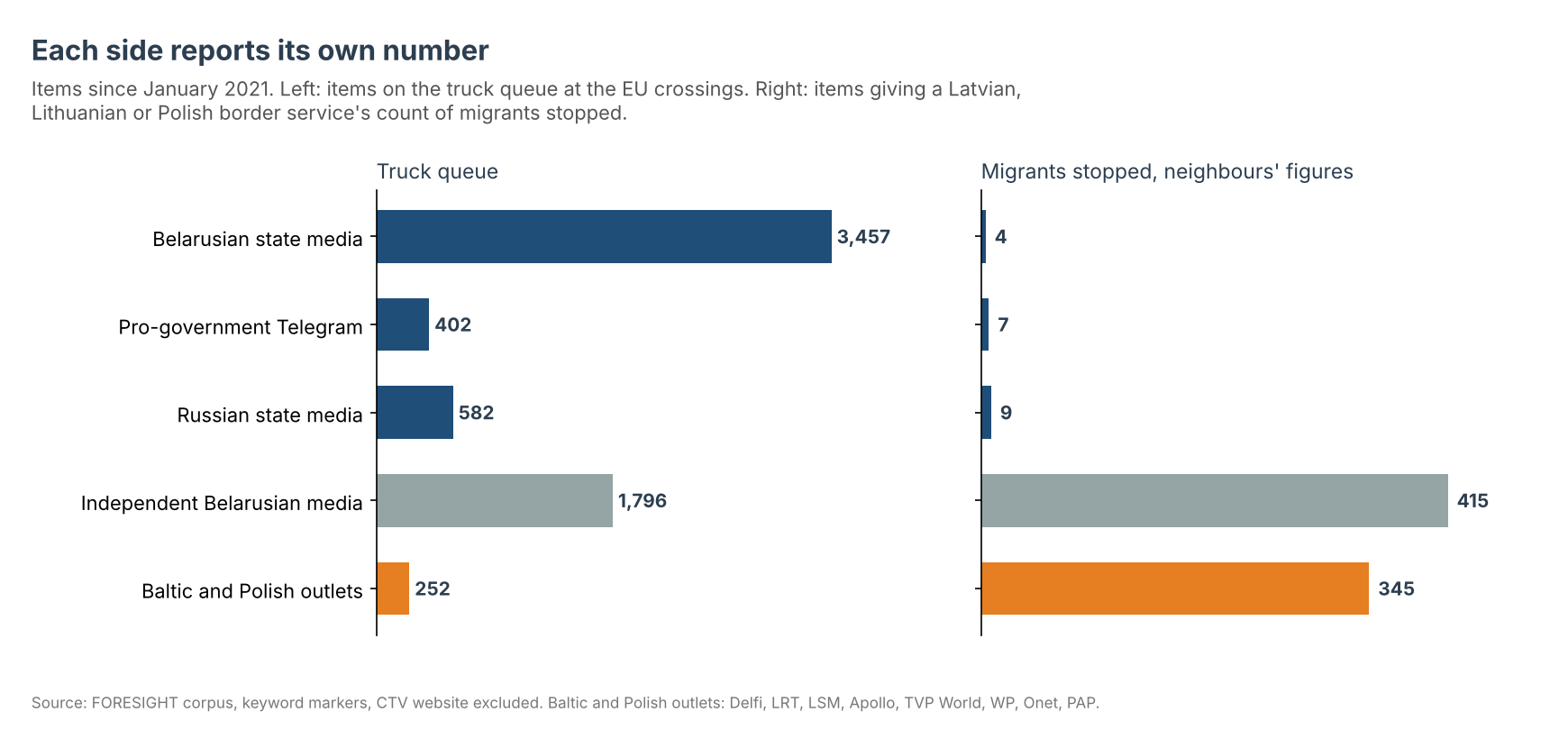
The Baltic and Polish outlets in our corpus carried such counts in 345 items. They wrote about the truck queue too, in 252 items, but from their own side of the line: drivers’ losses, empty crossings and closure decisions (LRT, 29 October 2025). Two of those 252 cite Belarus’s border committee.
Each side’s count reaches its own audience in full and the other side’s audience hardly at all.
Where the counts meet
In six years, state media carried a neighbour’s count of stopped migrants four times. Two items came on 21 November 2021, when SB repeated a Polish figure of 208 attempts stopped in one day (SB, 21 November 2021). Its Telegram channel ran the figure under the line that Poland “continues its attempts to forcibly push out refugees” (SB Telegram, 21 November 2021). The other two were state video programmes on YouTube in April 2026. One cited 24 attempts stopped at the Lithuanian border in a day and 42 people turned back by Latvia (video, 22 April 2026). Pro-government Telegram channels gave such a count seven times, and Russian state media nine.
Independent Belarusian outlets are the one place where both numbers appear. They ran 1,796 items on the queue, 291 of them citing the border committee, and 415 that give a neighbour’s count of migrants stopped. Even there the two numbers rarely share a text: 16 items carry both. Each side’s count reaches its own audience in full and the other side’s audience hardly at all.
Between the fences
Colonel Arvis Zīle heads Latvia’s Crisis Management Centre. On 11 November he told the Polish daily Rzeczpospolita that Belarus had built a second fence 400 metres to one kilometre inside its territory. Migrants are told that the EU starts beyond it, he said. Once over it, they cannot go back and are left in the zone between the fences (Zerkalo, 12 November 2026). Zīle added that the second fence can be seen on satellite images (BelNovosti, 11 November 2026). In our corpus four independent outlets reported the claim on 11 and 12 November, among them Polish Radio’s Belarusian service (Polish Radio, 11 November 2026). No state item mentioned it.
In six years, state media carried a neighbour’s count of stopped migrants four times.
Neither count can test the claim. Minsk counts vehicles at crossings, and Riga counts attempts at its own fence. The people in the zone between the two fences appear in neither number. Satellite images could test it, and we have not examined them.
Updated:
A court may test it instead. Lithuania sued Belarus at the International Court of Justice in May 2025, and Belarus has challenged the court’s jurisdiction. Poland and Russia filed declarations of intervention in June and July 2026 (ICJ). Lithuania’s evidence from 2021 includes Belarusian border guards who escorted migrants to the line and helped them past the barriers (Belsat via Centrum Europy, 18 November 2026). Zīle describes guards who now stay away from the line. If he is right, the method has changed in a way that makes such evidence harder to collect.
How sure we are
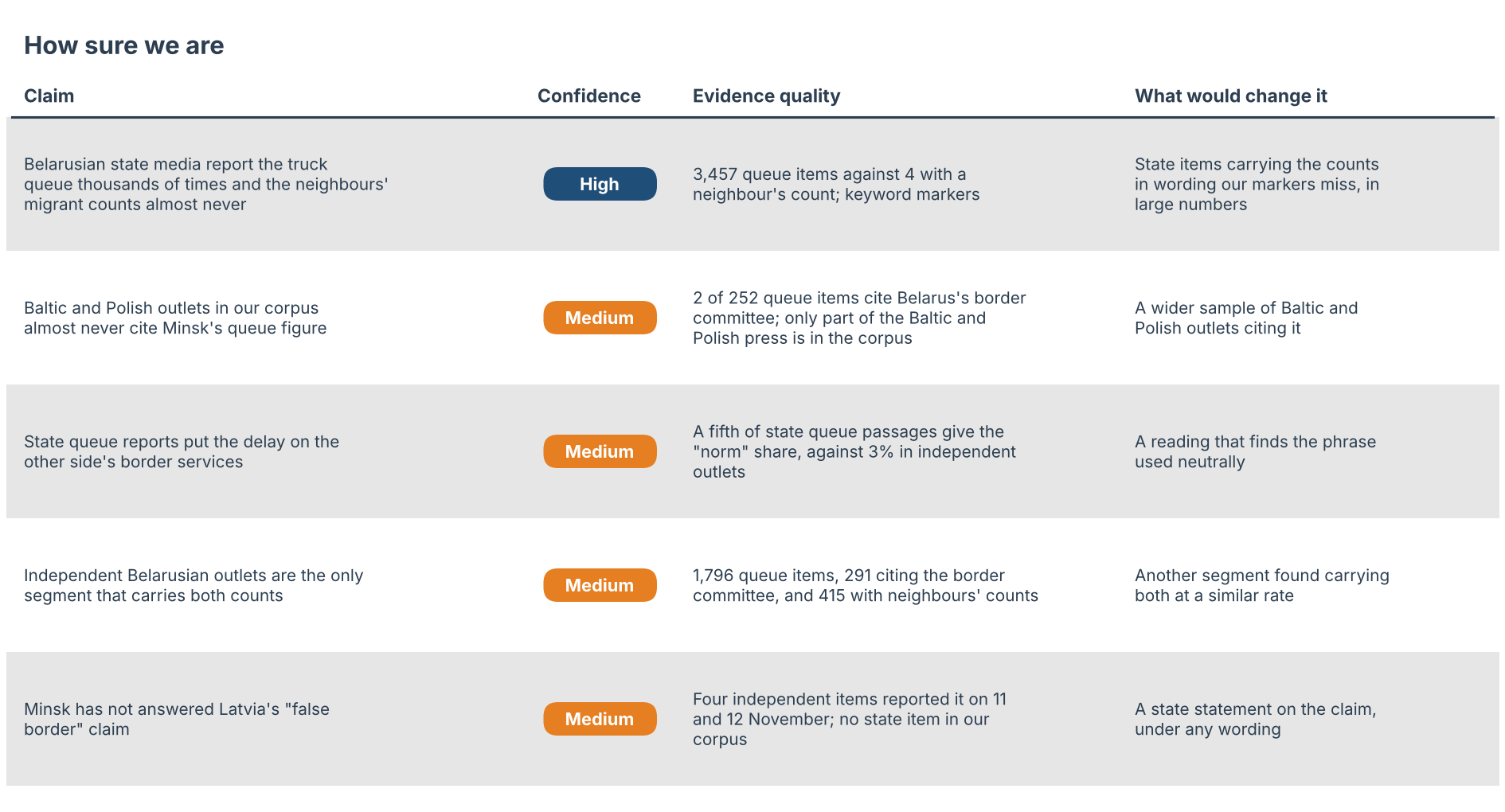
Belarusian state media report the truck queue thousands of times and the neighbours’ migrant counts almost never. High. There are 3,457 queue items against 4 with a neighbour’s count, found with keyword markers. State items carrying the counts in large numbers, in wording our markers miss, would change it.
Baltic and Polish outlets in our corpus almost never cite Minsk’s queue figure. Medium. Two of 252 queue items cite Belarus’s border committee, but only part of the Baltic and Polish press is in the corpus. A wider sample of Baltic and Polish outlets citing it would change it.
State queue reports put the delay on the other side’s border services. Medium. A fifth of state queue passages give the “norm” share, against 3% in independent outlets. A reading that finds the phrase used neutrally would change it.
Independent Belarusian outlets are the only segment that carries both counts. Medium. They ran 1,796 queue items, 291 citing the border committee, and 415 with neighbours’ counts. Another segment found carrying both at a similar rate would change it.
Minsk has not answered Latvia’s “false border” claim. Medium. Four independent items reported it on 11 and 12 November, and no state item in our corpus did. A state statement on the claim, under any wording, would change it.
How it fits
We have written about this border before, about the fence and the tunnels dug under it in “The Fence Worked. So They Dug” and “Not a One-Off”. Those pieces counted what happened at the line. This one counts what each side tells its own public about it. The two figures do not contradict each other, since they measure different things. They are rarely put side by side, and readers on each side see one half of the border. The thesis model does not cover this; we record it as an observation.
What to watch
By 31 December 2026. A Belarusian state outlet reports a Latvian, Lithuanian or Polish count of migrants stopped as plain fact. Expectation: no. Confidence: medium.
By 31 December 2026. Latvia’s count of attempts stopped in 2026 passes 13,000. Expectation: yes. Confidence: medium.
By 31 January 2027. Belarus’s State Border Committee reports a queue of more than 3,000 trucks to enter the EU on any day. Expectation: no, unless a crossing closes. Confidence: medium.
Method and limits
Counts come from the FORESIGHT corpus from January 2021, with the CTV website left out. Queue items mention a queue within 120 characters of trucks. Items with a neighbour’s count name a Latvian, Lithuanian or Polish border service, a verb such as “stopped” or “turned back”, and a number of attempts or migrants. Customs seizures were removed. “Norm” passages give the share of the norm processed. Baltic and Polish outlets are Delfi, LRT, LSM, Apollo, TVP World, WP, Onet and PAP, as far as they are in our corpus. Closure events are taken from items in the same corpus. We did not parse the number of trucks into a daily series, because one passage often gives several numbers for different crossings.
Thesis tag: none (observation).