

Minsk expects to sign for a third reactor at its nuclear plant by the end of the year. The demand that justifies it is announced by the ministry that will build it and written into a government resolution. The statistics office no longer publishes the numbers that would test it.
On 27 October the Ministry of Energy said that its general agreement with Rosatom on a third unit at the plant in Ostrovets was “in a high degree of readiness” (Reform, 27 October 2026). The case for the unit rests on one number: a “record” 43.2 billion kWh of electricity consumed in 2024. That number first appeared in 2020, as the forecast for 2023. In 2025 consumption stayed at about the same level, and a government resolution now lists some 270 measures to raise it. What we cannot see is an energy balance that would test any of this: the statistics office’s last one covers 2020, the year before the plant went into commercial operation.
A forecast, then a record
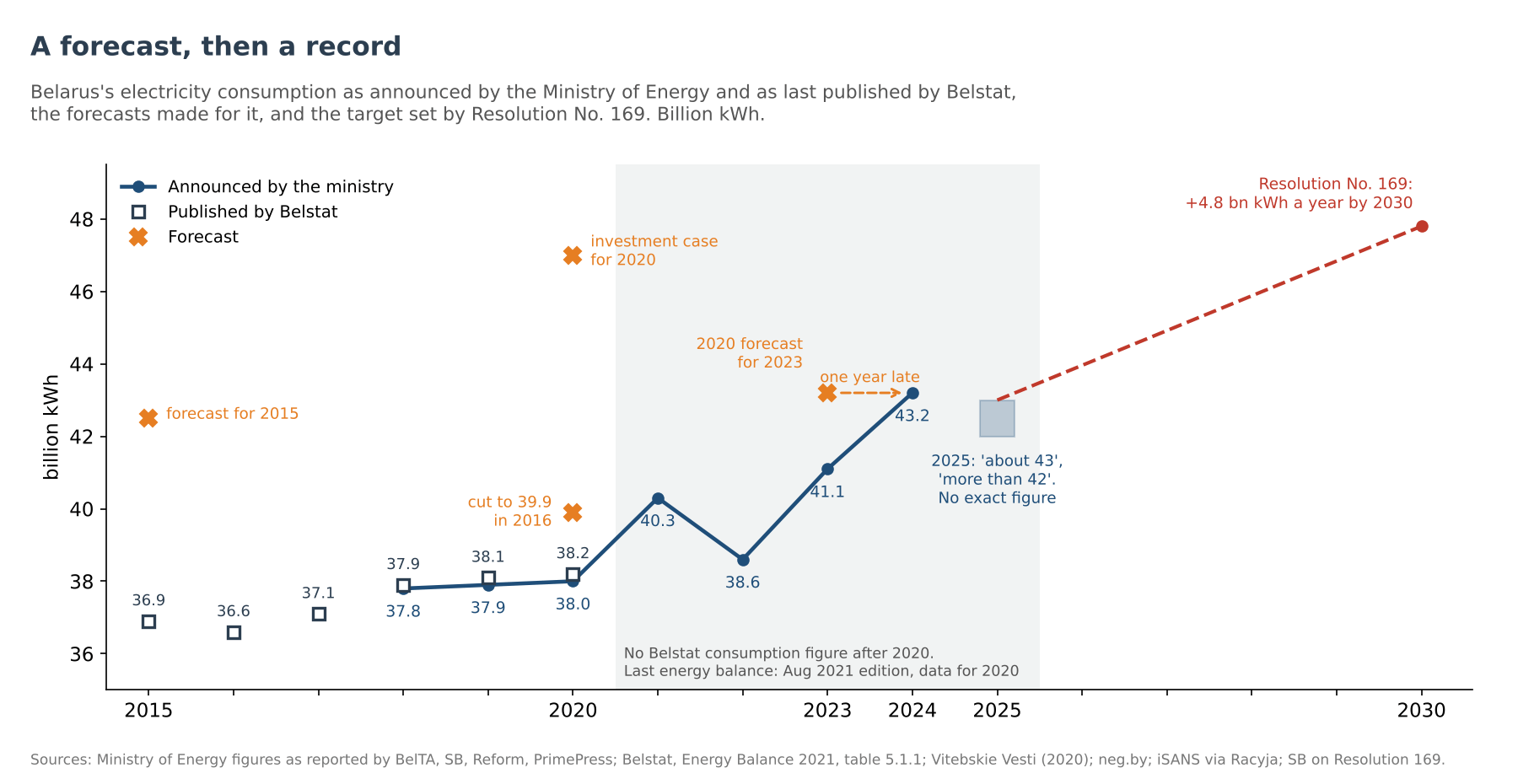
In June 2020, five months before the first unit was connected to the grid, an interview in a regional state newspaper set out the plan. The plant would reach its design output in 2023 and produce 18.5 billion kWh. That would be 42.8% of the country’s gross consumption, “which in that period is expected at 43.2 billion kWh” (Vitebskie Vesti, 17 June 2020).
Consumption in 2023 was 41.1 billion kWh, up 6.6% on the year before (Ministry of Energy, 23 February 2024). In 2024 it reached 43.2 billion, and the ministry called it a record for independent Belarus (SB, 1 February 2025). The plant produced 15.7 billion kWh that year, not the 18.5 billion in the plan (Reform, 15 January 2025). The record was a forecast that arrived a year late.
From then on, 43.2 became the main argument for more nuclear capacity. In August 2025 the energy minister, Denis Moroz, told ONT: “We see stormy growth in electricity consumption” (BelTA, 15 August 2025). In 2025 alone, 29 items in our corpus carried the figure. Independent outlets used it too, because there was no other figure to use.
Earlier forecasts missed in the same direction. The investment case for the plant expected 47 billion kWh by 2020, and by 2016 that was cut to 39.9 billion (neg.by, 20 December 2024). The forecast for 2015 was 42.5 billion, as the research group iSANS noted last December (Racyja, 6 December 2025). Belstat’s balance puts the outturn at 36.9 billion.
The year after the record
For 2025 the ministry has not given an exact figure. In February, Moroz said peak consumption last year was “at the level of 2024, that is 43 billion kWh” (state TV news, 20 February 2026). In August the ministry spoke of “about 43 billion” and said “this year it will be a bit more” (BelTA, 28 August 2026). In October a deputy minister spoke of a “historical maximum” of “more than 42 billion kWh” in 2024 and 2025 together (BelTA, 6 October 2026). For 2023 and 2024 the ministry gave figures to one decimal place. For 2025 it gave a range.
The record was a forecast that arrived a year late.
The plant’s own figure points the same way. It produced about 17 billion kWh in 2025, and the ministry put its share of consumption at 40% (BelTA, 20 February 2026). That puts total consumption near 42.5 billion, a little below 2024. Industry bought less electricity from the state utility Belenergo in 2025 than a year earlier, while other customers bought 6.3% more (Pozirk, 22 February 2026).
The decision on the third unit came on 14 November 2025, at a meeting with Lukashenko on “the results of the plant’s work, the increase in electricity consumption and proposals to build new nuclear capacity” (PrimePress, 16 July 2026). The growth it cited had already stalled that year. Moroz later put its commissioning at 2035–2038 (BelTA, 22 December 2025).
Demand by decree
The answer to flat demand is a plan for more of it. Council of Ministers Resolution No. 169 approves an “inter-sectoral complex of measures to increase electricity consumption until 2030”. It has about 270 measures. Together they should add 1,606.6 MW of consumer capacity and 4,825 million kWh of consumption a year (SB, 17 September 2026). Earlier measures, from 2018 to 2025, added 2 billion kWh, the ministry said in February (BelTA, 26 February 2026). The demand is now written into a government resolution.
Prices push the same way. For years customers have had tariffs built on the principle “the more you consume, the less you pay” (BelTA, 11 January 2024). Homes heated by electricity used 1.2 billion kWh in 2025, 1.4 times more than in 2024, and the forecast for 2026 is 1.6 billion (BelTA, 19 October 2026). Some of this demand is real and waiting. In August the minister said that more than 175,000 homes heat with electricity and that about 15,000 had been refused a connection because the local grid could not carry the load (Belmarket, 8 November 2026). That puts the limit in the wires, not in the plant.
Lukashenko has said it plainly. In September 2025 he said Belarus had “surpluses of electricity” and that a second plant would “certainly be built” (Pozirk, 2 September 2025). On 30 October this year he said that free capacity was wanted by investors for crypto mining (BelTA, 30 October 2026). Researchers quoted by Belmarket estimated a surplus of 1.7 billion kWh in 2025 with both units at full load (Belmarket, 8 January 2026).
Add the resolution’s 4.8 billion to today’s 43 billion, and consumption in 2030 would be about 48 billion kWh. That is close to the 47 billion that the plant’s investment case expected for 2020.
Forty per cent
The line that state outlets repeat most often is that the plant covers “about 40%” of the country’s needs. We counted 64 state and pro-government items with it in 2024, 64 in 2025 and 79 so far in 2026. The line has also left the state segment. An independent business outlet opened its review of the plant’s six years, published on 8 November, with “almost 40% of the country’s needs” (Belmarket, 8 November 2026).
The demand is now written into a government resolution.
By the ministry’s own year-end figures, the share was 28.5% in 2023 (BelTA, 31 March 2024) and 36.3% in 2024 (SB, 1 February 2025). The same outlets say the plant allowed Belarus to give up electricity imports completely (BelTA, 2 January 2026). Without imports, the country generates at least as much as it consumes. So in 2024 the plant’s share of generation could not be higher than its 36.3% share of consumption.
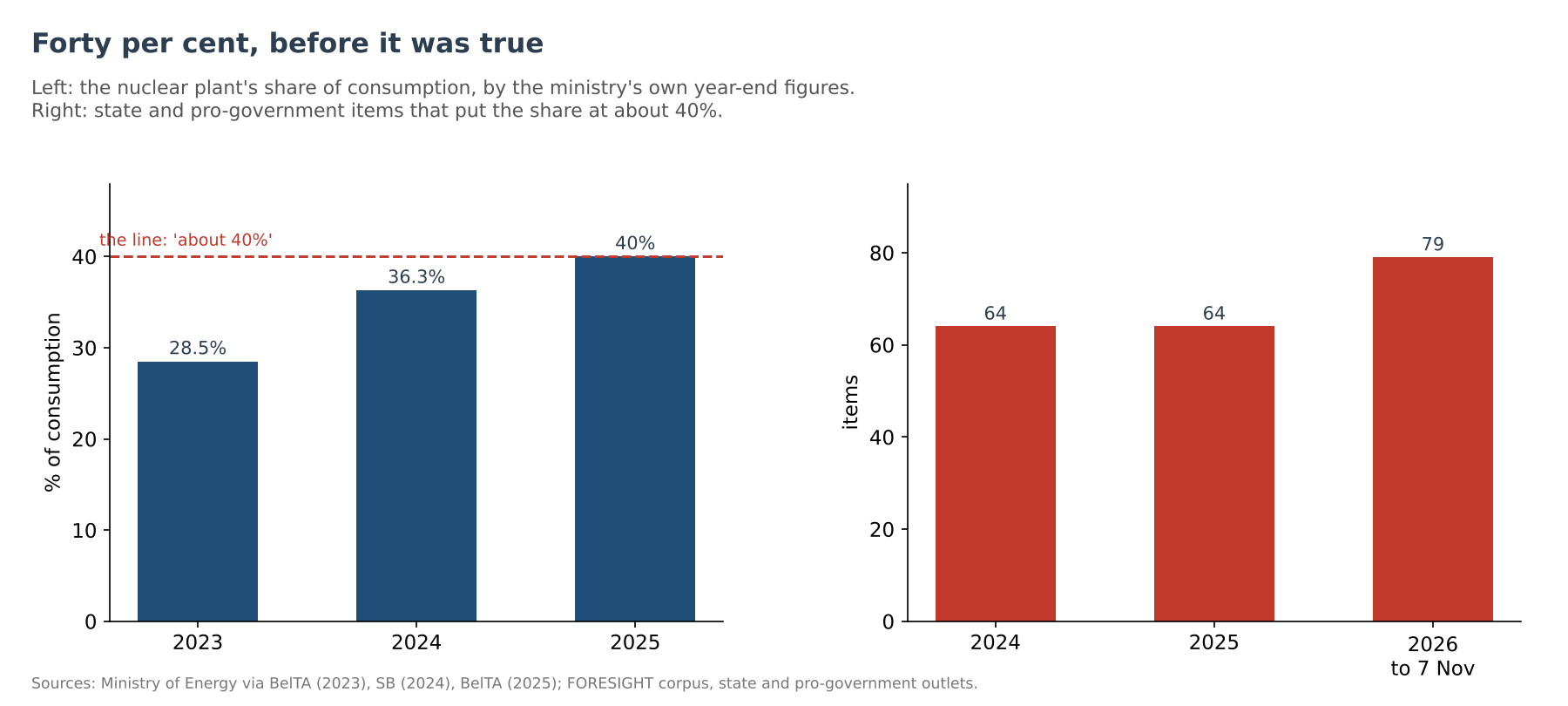
In 2025 the share did reach 40%. It got there because the plant produced more while consumption did not grow. The share reached forty per cent in the year consumption stopped growing.
What the statistics office stopped publishing
None of these figures can be checked against National Statistical Committee of the Republic of Belarus aka Belstat. Its data portal shows the date when each indicator is due next. In the energy section, fuel use by organisations was due in March 2018, the capacity of power plants in July 2019, and the output of electricity and heat in July 2020. At our audit of 8 November 2026, none of these updates had come. Three ratios did come back. The energy intensity of GDP, energy efficiency and the share of renewables in electricity output had been overdue since July 2025, and they returned between our July and November audits. Their next update, promised for 31 August 2026, is late again. Ratios without levels can show how energy use per unit of GDP changed. They cannot show how much electricity the country made or used.
The share reached forty per cent in the year consumption stopped growing.
Across the whole portal, 53 indicators came back in the same months, from children’s health to water use and unemployment, with the three ratios among them. Electricity output and plant capacity were not among them.
The printed record lasted a little longer, and it ends where the plant begins. The yearbook “Energy Balance of the Republic of Belarus” last appeared in August 2021, with data for 2020 (National Statistical Committee of the Republic of Belarus, Energy Balance 2021). The pocket handbook “Belarus in Figures” had an energy section in its 2021 and 2022 editions and dropped it in 2023, the year the second unit started commercial operation. The handbook’s last figure was electricity output of 40.6 billion kWh in 2021. iSANS dated the end the same way: from 2021, it wrote, National Statistical Committee of the Republic of Belarus stopped publishing the data (iSANS, December 2023). Our FactCheck.LT study How Belarus stopped showing what can be verified (13 August) traced the handbook’s sequence but put the last balance at 2017, three years too early.
The last balance also shows where the 2020 forecast started from. Consumption grew from 36.6 billion kWh in 2016 to 38.1 billion in 2019, about 4% in three years, and reached 38.2 billion in 2020 (National Statistical Committee of the Republic of Belarus, Energy Balance 2021, p. 60). The forecast of June 2020 expected 43.2 billion for 2023, 13% above 2019. After 2020 there is no National Statistical Committee of the Republic of Belarus consumption figure at all.
For 2022 to 2025, every kilowatt-hour figure is the ministry’s own. National Statistical Committee of the Republic of Belarus still prints an output index for the whole utilities sector, which counts electricity together with gas, steam and hot water. It rose 5.5% in 2024 and 1.7% in 2025 (National Statistical Committee of the Republic of Belarus, Belarus in Figures 2026, p. 42), but it cannot separate electricity from heat. The same ministry announces consumption, plans its growth and will build the new unit. In our media corpus we found no item in either segment that mentions the end of the official energy series.
How sure we are
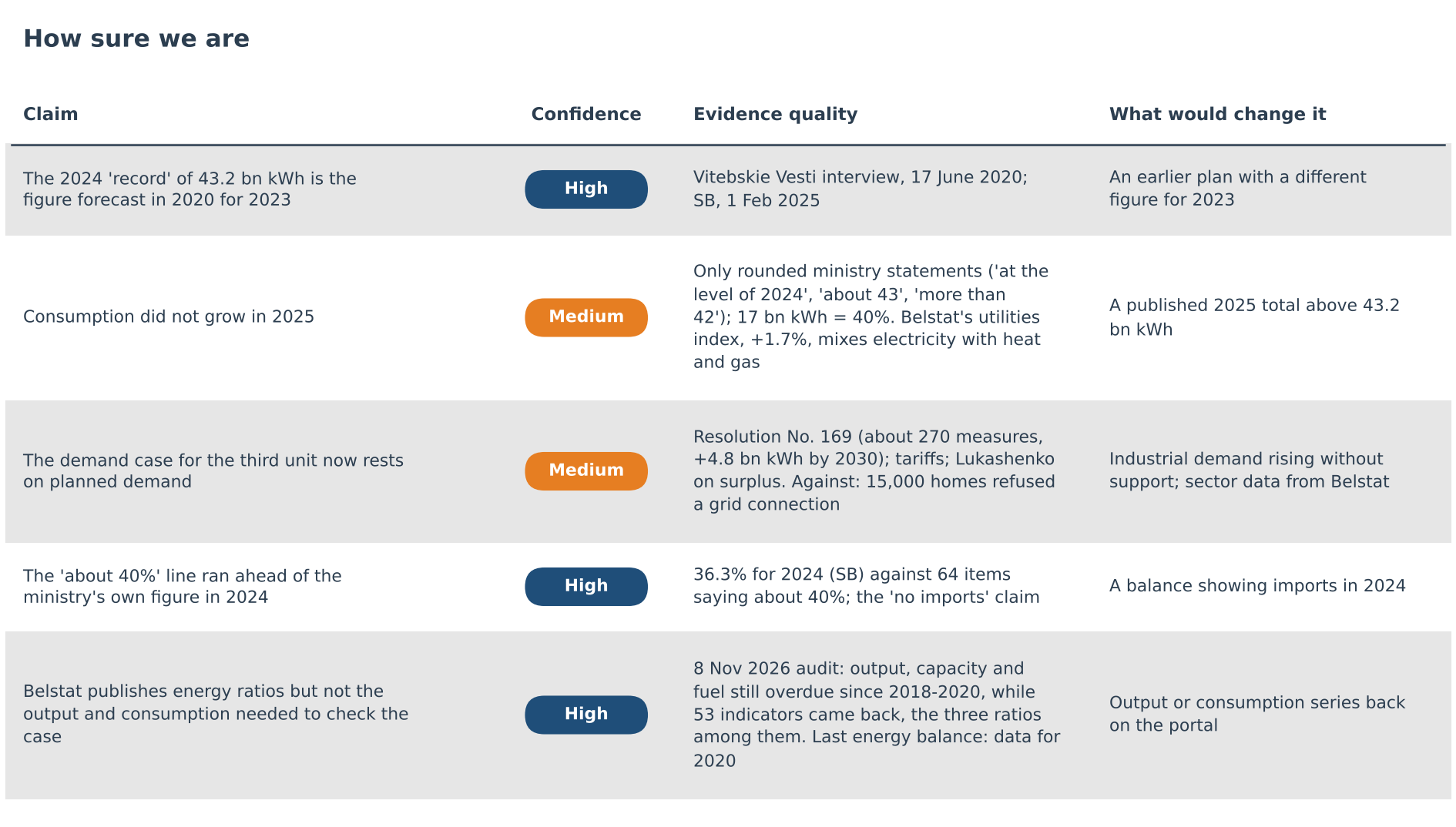
The 2024 “record” of 43.2 billion kWh is the figure forecast in 2020 for 2023. High. The Vitebskie Vesti interview of 17 June 2020 and the SB report of 1 February 2025. An earlier plan with a different figure for 2023 would change it.
Consumption did not grow in 2025. Medium. Only rounded ministry statements (“at the level of 2024”, “about 43”, “more than 42”) and the plant’s 17 billion kWh at 40%. Belstat’s output index for the utilities sector rose 1.7%, but it mixes electricity with heat and gas. A published 2025 total above 43.2 billion kWh would change it.
The demand case for the third unit now rests on planned demand. Medium. Resolution No. 169 with about 270 measures and 4.8 billion kWh more by 2030, the tariffs, and Lukashenko on surplus and mining. Against it, about 15,000 homes were refused a grid connection, which shows some demand that is real. Industrial demand rising without support, or sector data from National Statistical Committee of the Republic of Belarus, would change it.
The “about 40%” line ran ahead of the ministry’s own figure in 2024. High. 36.3% for 2024 in SB against 64 items saying about 40%, plus the claim that imports have stopped. A balance showing imports in 2024 would change it.
National Statistical Committee of the Republic of Belarus publishes energy ratios but not the output and consumption needed to check the case. High. At our audit of 8 November 2026, electricity and heat output, plant capacity and fuel use were still overdue since 2018–2020, while 53 indicators, the three ratios among them, had come back. The last energy balance covers 2020, and the handbook dropped its energy section in 2023. Output or consumption series back on the portal would change it.
How it fits
This fits T5, the image ahead of the fact. A missed forecast is presented as a record, a share is rounded up before it is reached, and the series that would test both is no longer published. The plant’s own reliability is a separate question. Its outages were the subject of The Fourth of December (6 August), and Belstat’s habit of quiet revisions was the subject of Three Billion, Later (16 August).
For 2022 to 2025, every kilowatt-hour figure is the ministry’s own.
A simpler reading deserves a hearing. Reactors take ten years to build, planners have to think about 2040, and one flat year says little about the next decade. Pushing demand onto the grid is also a reasonable way to use a plant that is already paid for and to burn less imported gas. That reading explains the decree. It does not explain why a forecast that was a year late is called a record, why the 2025 total exists only as a range, or why the official energy balance stops the year before the plant began commercial operation.
What to watch
By 31 December 2026. The general agreement with Rosatom on the third unit is signed. Expectation: signed. Confidence: medium.
By 31 March 2027. The ministry gives a figure for 2026 consumption. Expectation: a figure between 43.0 and 44.5 billion kWh, announced as growth. Confidence: medium.
By 31 July 2027. National Statistical Committee of the Republic of Belarus puts any electricity output, consumption or capacity series back on its portal. Expectation: no. Confidence: high.
Method and limits
The media counts come from the FORESIGHT corpus from 1 January 2019 to 7 November 2026, with digest titles removed, the CTV website left out and each URL counted once. Items about the third unit had to name the Belarusian plant within 150 characters, which removes Lukoml, Rooppur, Akkuyu and Russian stations. The consumption series is built from figures that the ministry announced and media reported. We read each value in its sentence and kept only Belarusian annual totals. For 2021 some later outlets give 40.5 billion kWh; we use the minister’s own 40.3 billion, which matches the 4% fall to 38.6 billion he announced for 2022. Belstat’s consumption figures for 2015 to 2020 come from table 5.1.1 of the Energy Balance 2021, p. 60, and the utilities index from Belarus in Figures 2026, p. 42, both from our archive of National Statistical Committee of the Republic of Belarus publications. The 2021 handbook printed a preliminary 37.6 billion kWh for 2020; the balance revised it to 38.2 billion. Where National Statistical Committee of the Republic of Belarus and the ministry both give a figure, the ministry’s is lower by up to 0.2 billion kWh. The count of 29 items in 2025 takes items where 43.2 appears next to the word for consumption. The “about 40%” count takes state and pro-government items where 40% stands next to the plant and to electricity output, consumption or needs, and leaves out sentences about other countries. It reads only the passage around the first number in each item, so it is a lower bound. The 2025 consumption estimate is our arithmetic from the ministry’s 17 billion kWh and 40%. The 2030 figure adds the resolution’s 4.8 billion kWh to a base of 43 billion; the resolution does not state its base. The search for items about the end of official energy statistics used a narrow set of phrases and may have missed some. The Belstat dates come from our audits of the data portal on 20 July and 8 November 2026. The portal shows when an indicator is due, not which year of data it holds, so we do not know which year the returned ratios cover.
Thesis tag: T5.